At 09:14 on a Tuesday in March, the studio's flatbed finished its first pass over an 1885 Chamomile plate — Matricaria chamomilla, from O.W. Thomé's Flora von Deutschland — sampled at 1200 ppi, 16-bit per channel, output file 847 MB. By 11:40 the same file sat on a proofing printer at A2, 420 × 594 mm, on 310 gsm matte cotton. Measured native density on paper came in at 352 effective ppi, above the 300 ppi threshold conventionally cited for continuous-tone print. One plate. One size. One number that holds. The second plate, Hedera helix, returned a different answer, and the gap is where this piece begins. The question of whether A2 "works" is not one number. It depends on which plate, which scan, which paper, and who the print is for. The rest of this piece walks through three hypothetical cases that make the dependency legible.
Three readers, three different answers to the same question. We treat them as composite illustrations — not people we met, but profiles that make the arithmetic visible. The numbers come from the two plates named above, measured on our bench. The personas are hypothetical. The ppi, the file sizes, the paper weights are not.
Scenario 1: The Collector Printing One Plate for a Hallway
Imagine a collector — let us call her the hallway collector — who has decided that one single plate, framed well, is better than a wall of five. She wants the Chamomile. The hallway is narrow, viewing distance roughly one metre at the closest, two metres from the end of the corridor. A2 is the size she has settled on because A1 would overwhelm the wall and A3 would read as a postcard.
The arithmetic on her plate is the one from the opening. The Chamomile scan is 1200 ppi at the original plate dimensions, which for the Thomé plate works out to roughly 7,100 × 10,000 pixels on the long axis after cropping to the illustrated area. Scaled to A2 — 420 × 594 mm, or 16.54 × 23.39 inches — that pixel budget divides down to 352 effective ppi on paper. Above 300. The line work from the original lithograph, the hairline stems of the chamomile ray-florets, the stipple shading in the receptacle: all of it carries at viewing distance. The 300 ppi threshold is the convention for continuous-tone print viewed at reading range, and the file clears it with 17% headroom.
What the headroom buys her is forgiveness. Paper is not glass. The 310 gsm matte cotton she has chosen has a surface texture that absorbs the finest 2–3% of detail — ink wicks a hair into the fibre, and a line printed at a true 1-pixel width on screen becomes a line roughly 1.3 pixels wide on paper. Having 352 ppi rather than 300 means that softening happens inside tolerance. The line is still a line. If she had printed from a 240 ppi file, the same wicking would blur the florets into a grey wash.
The decision tree for the hallway collector is short. One plate, A2, 310 gsm cotton, Chamomile scan. Total pixel budget 71 megapixels, delivered file around 847 MB uncompressed at 16-bit, around 180 MB as flattened TIFF at 8-bit. She prints once. She frames behind museum glass. She stops. The number holds because she asked the question the number was built to answer: can this one specific scan, at this one specific size, on this one specific paper, carry detail at reading range? Yes. 352 ppi says yes.
Scenario 2: The Interior Designer Specifying a Four-Plate Wall
Now picture a different reader — a designer specifying four plates for a client's dining room, grid of two by two, each at A2, centres roughly 70 cm apart. The client wants Chamomile, Hedera helix, Centaurea cyanus and Foeniculum vulgare. All four from Thomé's Flora. The brief is coherence: the four plates must read as a set, not as a mismatched group where one print looks sharper than the others.
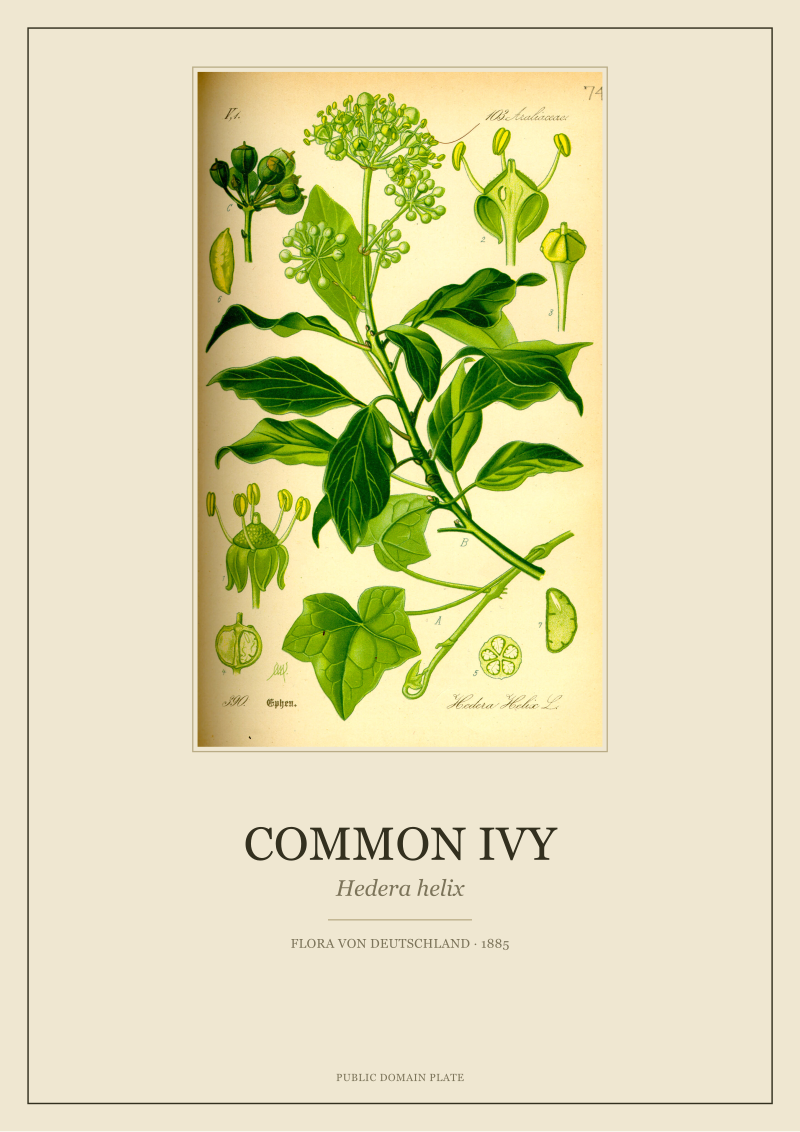
Here the single-plate number from Scenario 1 stops being enough. The Chamomile clears A2 at 352 ppi. The Hedera helix plate — same source work, same artist, same 1885 publication — came off the bench at a different density. Common Ivy on the original plate occupies less of the sheet; the illustrated area is smaller before margins. Scanned at the same 1200 ppi optical, the usable pixel area at A2 reduces. Measured effective density on paper: 286 ppi. Below the 300 threshold, by 14 pixels.
The designer now has a problem the collector did not have. 286 ppi is not catastrophic — the human eye at a dining-room viewing distance of 1.5 to 2 metres cannot resolve the gap between 286 and 352 unaided. But the two prints hung next to each other will not match on close inspection. If the client walks up to the Hedera and leans in, the line work will read softer than the Chamomile beside it. The Centaurea cyanus plate measured 318 ppi at A2. The Foeniculum vulgare, with its fine umbel detail that lives or dies at the pixel level, measured 304 ppi — technically clearing the threshold, but with no headroom for paper wicking.
The designer's options are three. First, print all four at A2 and accept that the Hedera will read softer than the rest — a defensible choice if the viewing distance is kept honest. Second, print the Hedera at A3 to raise effective density to 404 ppi, breaking the grid but preserving per-print sharpness. Third, source a higher-resolution scan of the Hedera plate specifically, which for public-domain Thomé material means searching institutional archives rather than trusting the general-circulation scans most studios start from. The decision is not technical — it is aesthetic. The designer picks option one, with the Hedera placed in the corner where close inspection is least likely. The number informs the compromise; it does not dictate it.
 Chamomile
The print from this article · from €29.95
View the print →
Chamomile
The print from this article · from €29.95
View the print →
Scenario 3: The Studio Proofing a Full Batch for Reprint
Finally, picture a studio — a reprint house that is not us, hypothetically commissioned to produce a run of all four plates in editions of fifty each at A2. The volume changes everything. Four plates, fifty copies each, two hundred prints. The cost of a bad decision multiplies by two hundred. The cost of a good decision also multiplies by two hundred, which is why the arithmetic has to be tighter than at single-print scale.
The studio's bench produced the measured densities above: Chamomile 352, Hedera 286, Centaurea 318, Foeniculum 304. The studio's reprint standard is 320 ppi minimum on paper, chosen conservatively to leave margin for the specific inkjet pigment profile used across the batch — Epson UltraChrome HD on the proofing printer, which has slightly more dot gain than the lab printer the final run will use. Under the 320 standard, Chamomile passes with 32 ppi of margin. Centaurea passes with no meaningful margin. Hedera and Foeniculum fail the standard.
The studio's path is different from the designer's because the economics are different. Printing Hedera at A3 to raise density is not an option — the client ordered A2. Accepting that one print in four will read softer at scale is also not an option — fifty prints of a visibly inferior piece will generate returns, and returns on a two-hundred-print run can erase the margin on the entire edition. The studio commits time to a second scan pass on Hedera and Foeniculum at 1600 ppi optical, raising the native pixel budget by a factor of 1.78. Hedera's effective A2 density rises to 381 ppi. Foeniculum's rises to 405. The second scan takes four hours per plate on the flatbed and generates files of around 1.4 GB each at 16-bit, which the studio's workflow software has to be configured to handle without downsampling in intermediate steps.
Centaurea the studio leaves at 318 — above the 320 standard by only 2 ppi, but the plate's line character is coarser than Hedera's, with less fine stipple, and the studio's test proofs confirm the paper tolerance absorbs the margin cleanly. Not every number needs to be maximised. The studio ships the batch. The economics work because the arithmetic was done before the print queue opened, not after.
What All Three Scenarios Share
Three readers, three different decisions on the same four plates at the same size. What links them is not the answer — the answers diverge — but the structure of the question. Each case started by measuring effective density on paper at the target size, in ppi, from a specific scan of a specific plate. None started with the 300 ppi convention and worked backward. None assumed the plate inherits the resolution of the scan uniformly; the illustrated area on each plate differs, and the effective density on paper is a function of that illustrated area, not of the raw scan dimensions.
What also links them is the honest treatment of the 300 ppi threshold. 300 is a convention, not a physical law. The hallway collector's print at 352 reads crisp because she matched the number to her paper and her viewing distance. The designer's Hedera at 286 is not a failed print — it is a softer print, and whether softer is acceptable depends on where the eye lands. The studio's rescan to 381 is not perfectionism; it is cost control at edition scale. The same raw number means different things in each context, and the arithmetic is what makes the difference legible.
The last shared element is that none of the three cases treated the plate as interchangeable with the scan. The Thomé plates from 1885 are chromolithographs; the scan is a 21st-century reading of them. The number on paper describes the reading, not the plate. A better scan of the Hedera exists in some archive, and finding it would raise the measured density regardless of what any paper or printer does downstream.
Which Scenario Is You
If you are printing one plate for a specific wall at a specific distance, you are the hallway collector. Your decision is simple: measure effective ppi on your scan at your target size, compare it to 300, and if you clear it with headroom, print. Do not overthink the second question until the first number fails.
If you are specifying multiple plates for a coherent installation, you are the designer. Your decision is harder because the question is no longer per-print but across the set. Measure every plate at the target size. If one lags, decide whether to accept the softness, break the format, or source a better scan — the right answer depends on where the eye will land and how much the composition tolerates variance.
If you are producing an edition at volume, you are the studio. Your margin for error is small and your margin for returns is zero. Raise your internal threshold above 300 to leave room for the printer-and-paper combination you cannot fully control. Rescan what fails. Ship what clears. The arithmetic pays for itself inside the first ten prints.
The question none of this answers is what happens when the plate itself — the 1885 original on the shelf of a European library — has detail finer than any current scan has captured. That is where the next piece of work begins, and it is not where this one ends.
FAQ
What does "effective ppi" actually measure on a print?
Effective ppi is the pixel density of your file as it lands on paper at a specific output size, calculated by dividing the file's long-edge pixel count by the paper's long-edge inch dimension. A2 at 594 mm long is 23.39 inches, so a 7,100-pixel long edge yields roughly 303 ppi, while a 10,000-pixel long edge yields 428. The number depends on crop, not on the raw scan dimensions alone.
Is 300 ppi a hard requirement for A2 prints?
No. 300 ppi is a convention, grounded in viewing-distance research for continuous-tone print at reading range, roughly 30 to 50 cm. At A2 viewing distances of a metre or more, the eye cannot resolve the difference between 240 and 400 ppi unaided. The convention exists because it gives printers and papers a margin for ink wicking and dot gain, not because 299 ppi is visibly inferior to 301.
Why did two plates from the same 1885 work give different ppi numbers?
Because the illustrated area on each plate occupies a different fraction of the original sheet. Thomé's Flora von Deutschland is a set, but the plates were drawn to the subject's natural proportions. Hedera helix on its plate takes up less illustrated area than Chamomile on its plate. Scanned at identical optical resolution, the Hedera returns fewer usable pixels, which translates to a lower effective density when both are scaled to the same output size.
Does paper weight affect how ppi reads on the print?
Weight itself does not — a 310 gsm sheet and a 200 gsm sheet of the same surface read ppi equivalently. Surface finish does. Matte cotton absorbs ink into fibre and softens line work by roughly 2–3%; a smoother coated stock preserves line integrity more faithfully. The 300 ppi convention assumes matte, which is why the headroom matters most on textured papers.
Can I print a 240 ppi file at A2 and have it look acceptable?
At a viewing distance of two metres, in a corridor or a dining room, yes — the eye cannot resolve the gap. For hallway or gallery hangs where visitors step close, 240 ppi starts to show, particularly on plates with fine stipple like the chamomile receptacle or the fennel umbels. Acceptable is a function of where the eye lands, not a universal threshold.
Why not just upscale a lower-resolution scan with AI tools?
Upscaling fabricates pixels. For continuous-tone photography the fabrication is often invisible; for 1885 lithographic line work it is not. The original plate is a specific set of ink strokes made by a specific hand under a specific technique. AI upscaling invents hairline detail that was never in the plate, and the result reads as a modern interpretation rather than a restoration. We prefer to rescan.
Where do institutional-archive scans of Thomé's Flora live?
Several European botanical libraries hold physical copies of Flora von Deutschland, Österreich und der Schweiz, and some have digitised their holdings at research-grade resolution. The general-circulation scans most studios begin with come from mass-digitisation projects at lower optical density; institutional versions at higher density exist but are not uniformly online. The scan you start with shapes every downstream number.
Does the public-domain status of the plates affect reproduction decisions?
It affects what you can print, not how well it prints. The 1885 Thomé plates are long out of copyright and may be reproduced freely. What that permits is the restoration and sale of the plates as prints; what it does not do is substitute for the scan-density arithmetic. A plate being free to use says nothing about whether a given scan of it will carry detail at A2.
 Fennel
The print from this article · from €29.95
View the print →
Fennel
The print from this article · from €29.95
View the print →

New plates from the archive and 10% off your first print.
One email now with your code. No noise after.