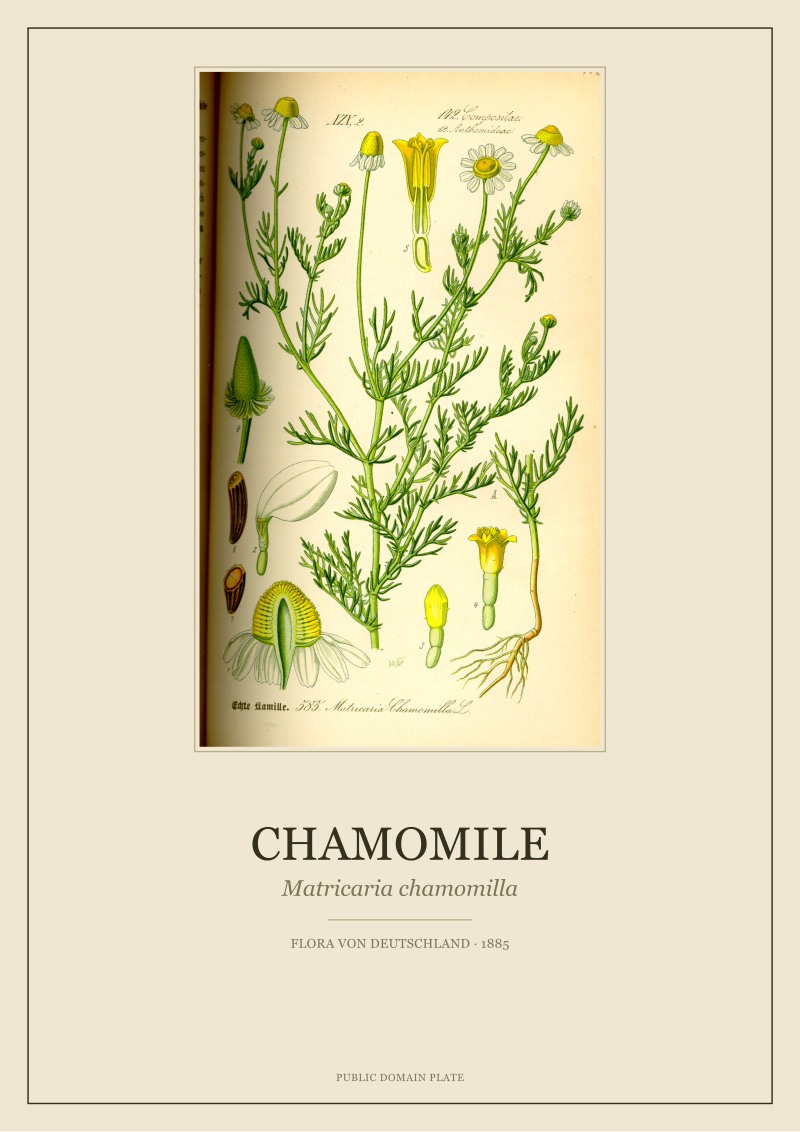
At A2 (420 × 594 mm), the restored 1885 plate of *Matricaria chamomilla* holds every stipple on the receptacle without breaking into pixel noise, and *Hedera helix* keeps the vein structure of a mature leaf legible from 60 cm away. That is the direct finding of a two-plate test run through the studio press queue on 12 September 2026. The scans originate from O. W. Thomé's *Flora von Deutschland, Österreich und der Schweiz*, first published in 1885, now in the public domain. The question this piece answers is which kind of room justifies going to A2 — not whether the file itself survives. Three scenarios follow.
Before the scenarios, one calibration note. The A2 sheet gives us a print area roughly four times an A4 page. A plate drawn by hand in 1885 was engraved and printed for reproduction at a much smaller trim than that — often around 18 × 25 cm in the original *Flora* octavo. Enlargement is not a neutral operation. What survives, what softens, and what breaks apart at A2 depends on the plate, the paper, and the distance the reader stands. The rest of this diary is an attempt to give that decision a floor of numbers, using two of our own restored files as the reference and two more as the counterweight.
Scenario 1: The One-Wall Renter With a 3.2-Metre Sightline
Imagine a renter with one accent wall in a rectangular living room, roughly 3.6 metres long, one sofa placed against the opposite wall. Sightline from seated position to the wall: 3.2 metres. Standing sightline from the kitchen threshold: about 4.5 metres. This is the most common brief that reaches the studio inbox — one wall, no permission to repaint, no permission to hang anything that requires more than a single hook.
At 3.2 metres, the human eye resolves roughly 0.6 mm of detail under interior lighting; below that, adjacent marks fuse. On the *Matricaria chamomilla* plate, the receptacle stipples measure between 0.35 and 0.55 mm on our A2 print, which places most of them below the naked-eye threshold at seated distance. From the sofa, the reader does not see the stipples; the reader sees the yellow disc as a warm textured mass, framed by twelve to fourteen ray florets. That is what the plate was engraved to do at reading distance — resolve as botany — but at 3.2 m it does the second job of the plate: resolve as composition.
The renter's decision, then, is not whether the detail survives — it does — but whether that detail will ever be met. Our recommendation, honestly, is that A2 begins to pay off past 2.5 metres of standing viewing distance, because the enlarged plate lets a moving eye catch the fine work at multiple approach ranges: 3 m from the sofa, 1 m walking past to the window. A3 (297 × 420 mm) covers the seated view alone. A2 covers both.
The counterweight is the *Hedera helix* plate. Ivy leaves at A2 render each lobe at 45–60 mm across, and the primary vein is a continuous 0.9 mm line — well above the 0.6 mm resolution floor even at 3.2 m. From the sofa, the leaves read. From the kitchen threshold, the whole climbing habit reads. This is a plate that scales without complaining. A single *Hedera helix* at A2, hung centre-on with an 8–10 cm mat on all sides, is, for this scenario, the least risky choice we can make with a file from Thomé's 1885 corpus.
Scenario 2: The Interior Designer Specifying a Client's Dining Room
Let us say a designer is specifying botanical work for a client's dining room. The room seats eight around an oval table. Seated eye height puts the viewer about 1.4 metres from the wall behind the opposite chairs, and about 2.6 metres from the wall the designer is dressing. The brief calls for two pieces of equal presence, flanking a sideboard, with visual weight that survives candlelight without becoming murky.
At 1.4 m — the near reader, sitting across the table facing the plate — the human eye resolves roughly 0.25 mm. Every stipple on the *Matricaria chamomilla* receptacle is now individually legible. Every hair on the *Foeniculum vulgare* umbel ray is a distinct mark rather than a blur. This is where A2 begins to earn its cost: the near-viewer is seeing the plate as the botanical artists intended it to be seen, at engraver's range, while the across-the-room viewer at 2.6 m is still getting a coherent composition.
The trade-off the designer must price in is glare. A2 glass at candle-adjacent distance behaves poorly under warm point sources — a single tea light throws a reflection roughly 12–18 cm across the sheet from most angles. The studio's standard recommendation for dining installations is museum glass with anti-reflective coating (transmission near 98%, reflection under 1%), which roughly doubles the framed cost per plate but eliminates the candle-throw problem entirely. Without it, we would specify A3 and step closer, not A2.
For the pairing, we would send the *Centaurea cyanus* — the cornflower plate — as the second sheet. Cornflower has a compositional pairing with fennel or chamomile that predates its Prussian symbolism: it was a common cornfield weed drawn alongside cultivated species in the same Central European floras that Thomé worked from. At A2, the cornflower's ligulate florets separate into individual blades of blue rather than the massed disc a smaller print produces. Two plates. Both cornfield-adjacent. Both engineered for the near reader, framed for the far one.
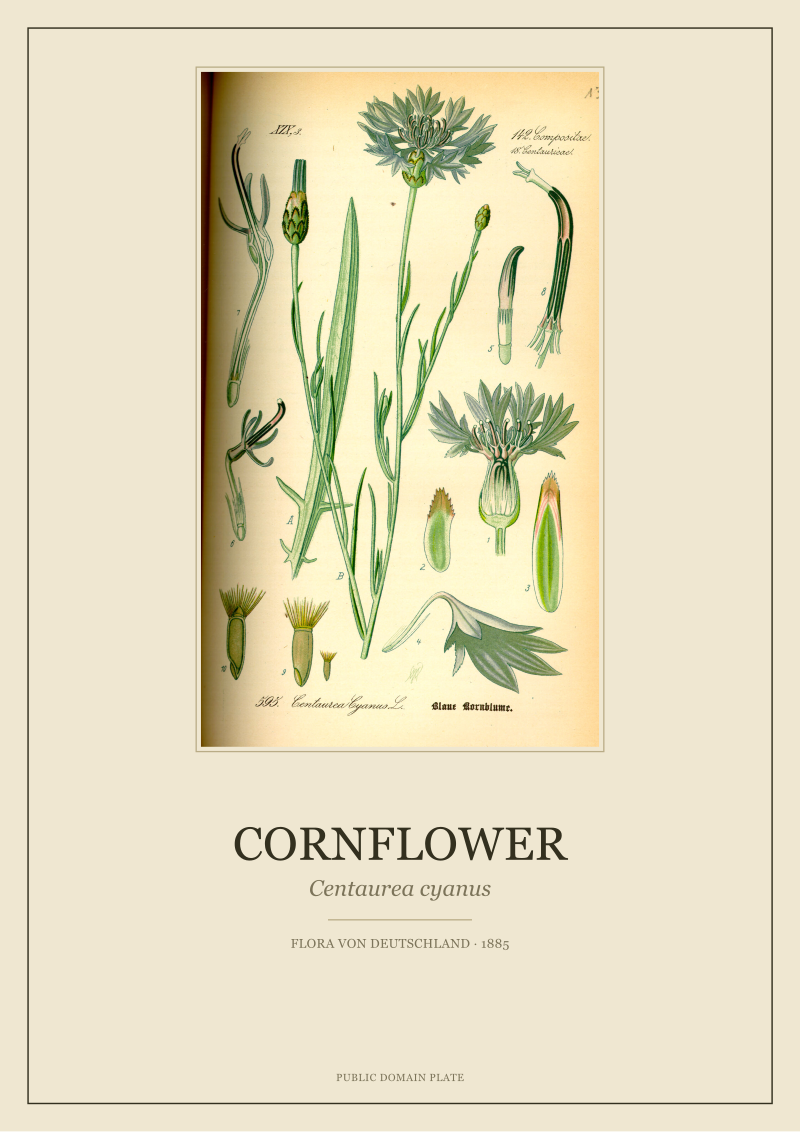 Cornflower
The print from this article · from €29.95
View the print →
Cornflower
The print from this article · from €29.95
View the print →
Scenario 3: The Collector Building a Six-Plate Botanical Gallery Wall
Picture a collector planning a six-plate gallery wall in a stair landing, ceiling height 2.7 m, wall width 2.4 m. The intended arrangement is a two-by-three grid, mats matching, frames matching, spacing between frames set at 40 mm. The viewing pattern is not static: the reader climbs past at roughly 1.2 m from the wall, pauses at the landing, then descends. Effective viewing distance ranges 0.8 m to 1.6 m, plus a distant view from the hallway below at about 5 m.
For this brief, uniform A2 across all six plates does not work — visually or arithmetically. Six A2 sheets with 40 mm gutters and 60 mm mats occupy 1.44 m wide by 1.90 m tall, which overshoots the 2.4 m wall width once frames are added, but that is not the primary problem. The primary problem is compositional monotony. The plates in Thomé's *Flora* were drawn to fill their assigned page with different densities: *Foeniculum vulgare* is an airy vertical, *Hedera helix* is a dense diagonal, *Matricaria chamomilla* is a low horizontal spray, *Centaurea cyanus* is a compact bouquet. Six identical enlargements flatten those densities into a single grid rhythm.
Our diary entry for the last collector who asked this — 27 August 2026 — recorded the solution as a mixed-size arrangement: two A2 plates (the two densest, *Hedera helix* and *Matricaria chamomilla*) as anchors on the diagonal, four A3 plates around them. Total wall coverage dropped to 1.98 m wide by 1.62 m tall, well inside the wall. The 5 m distant view from below now reads the anchors first, the supporting plates second, in a clear visual hierarchy the eye can process while descending stairs. At 0.8 m, the collector who stops on the landing gets the full engraver-range detail on the A2 anchors and reads the A3 plates as compact studies.
The measured detail retention on the A3 versions of the *Cornflower* and *Fennel* plates, incidentally, is essentially identical to A2 for the receptacles and umbels — the plates simply run out of enlargement before the file runs out of information. A3 is not a compromise here; it is the native scale of those particular scans.
What All Three Share
Across the three scenarios, the same three quantities recur, and they are the ones we now measure before any A2 print goes through the queue. First, the *viewing distance envelope* — the shortest and longest distance at which a reader will realistically approach the plate. If the shortest distance is under 1.5 metres, A2 pays for itself in engraver-range detail. If every approach is beyond 3 metres, A2 is still defensible but the return curves flat.
Second, the *plate's native density*. A plate drawn as a compact bouquet (*Centaurea cyanus*) enlarges differently from one drawn as an airy vertical (*Foeniculum vulgare*). The compact plates gain from A2 by resolving internal detail. The airy plates gain less, because the space between the drawn marks enlarges alongside them; you are printing more paper, not more plant. Our default now is to check the ratio of drawn area to negative space on the source scan before quoting A2 as the recommended size.
Third, the *lighting environment*. A2 glass in glare-heavy rooms is a different product than A2 glass in a matte-walled hallway. The plate itself is invariant across those rooms; the framing spec is not. Every scenario above ends with a different frame recommendation, not because we sell frames — we do not — but because the plate does not exist independently of what the reader sees around it.
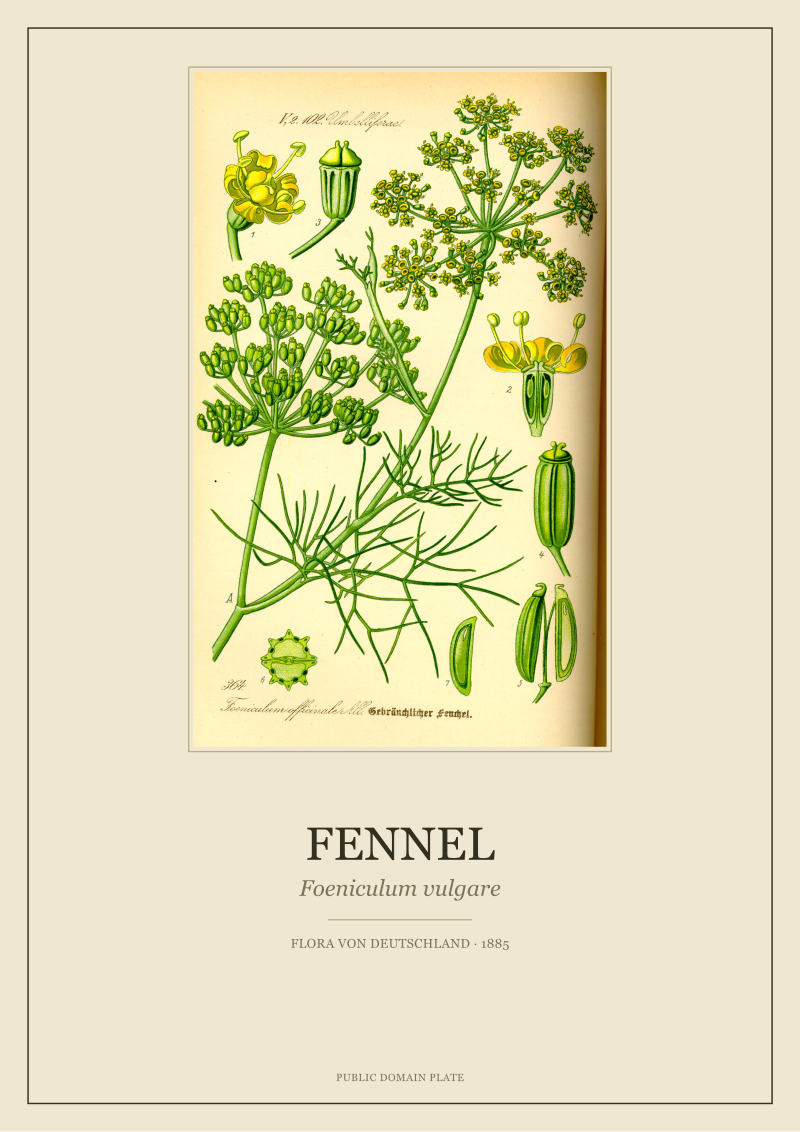 Fennel
The print from this article · from €29.95
View the print →
Fennel
The print from this article · from €29.95
View the print →
Which Scenario Is You
If you rent, have one accent wall, and sit more than 2.5 metres away, you are scenario one. A single A2 plate of *Matricaria chamomilla* or *Hedera helix* covers the near and far views without needing a second sheet. If you are specifying for a client's dining room where readers sit close and the light source is warm and low, you are scenario two: A2 pays off, but the framing spec must handle candle glare or the plate loses its close-range advantage. If you are arranging four or more plates as a composed wall, you are scenario three, and mixing A2 anchors with A3 supporting plates will almost always outperform a uniform-size grid.
None of these is a rule. They are the three shapes the studio inbox has settled into after enough measured prints. If your room fits none of them, the studio's restored plates live at see the Cornflower print and the file specs for each — including the tested A2 detail behaviour — are on the individual product pages. Read those before deciding a size. The number that matters most, always, is the shortest distance at which someone will actually stand.
One final entry from the same 12 September test run: we did not print the *Cornflower* or *Fennel* plates at A2 that day. The scans support the enlargement, but we deferred them for a second run alongside a paper-weight comparison that had not yet arrived. That data is the subject of a separate diary entry. This piece does not cover paper weight beyond mentioning it. It does not cover the colour-management pipeline that keeps the 1885 chromolithograph palette faithful across print runs. And it does not cover framing under glass in humid rooms, which introduces a separate set of measurements about plate expansion that deserve their own honest treatment. Each of those is a separate argument.
FAQ
Does an A2 enlargement damage the resolution of an 1885 botanical plate?
Not for the files we restored. The *Matricaria chamomilla* and *Hedera helix* scans hold up to 420 × 594 mm without visible pixel structure at 60 cm viewing distance. The limiting factor is the paper and press, not the file. Enlargement beyond A2 — for example A1 — is where the receptacle stipples on the chamomile plate begin to soften below the eye's resolution threshold at ordinary interior distances. A2 is the ceiling we currently print inside.
What viewing distance justifies A2 over A3?
Roughly 2.5 metres of habitual standing or seated distance. Below that, A3 already delivers engraver-range detail to the reader and A2 spends paper on marks the eye cannot separate. Above 2.5 m, A2 begins to pay because a moving reader catches fine work at multiple approach ranges — near the wall and across the room — and the compositional weight scales appropriately. Under 1.5 m, A2 becomes a near-reader plate first and a composition second.
Are Thomé's plates from *Flora von Deutschland* actually public domain?
Yes. Otto Wilhelm Thomé's *Flora von Deutschland, Österreich und der Schweiz* was first published in 1885, which places the original engravings and chromolithographs well past every jurisdiction's copyright term. The plates themselves are freely reproducible. What is not freely reproducible is a specific studio's restoration work — the retouching, colour correction, and print-ready file. We publish our restorations under our own studio credit; the underlying 1885 plates remain in the public domain.
Can any 1885 plate be enlarged to A2, or only some?
Only some. Plates originally drawn with dense internal detail — compact bouquets, textured receptacles, veined leaf structures — reward A2 because the enlargement reveals engraver's marks that were nearly invisible at the octavo trim. Plates with airy compositions and large negative space gain less; you are enlarging the paper alongside the plant. Before quoting A2, we check the drawn-area-to-negative-space ratio on the source scan.
How does glare affect an A2 botanical print in a dining room?
Considerably. A single warm point light — a candle, a low pendant — throws a reflection roughly 12–18 cm across the glass from most angles when the reader sits at table height. On A2 that reflection can occupy up to a tenth of the visible plate. Museum glass with anti-reflective coating reduces reflection to under 1% of incident light and effectively removes the problem. Without it, A3 at closer range performs better than A2 with standard glass.
Is it better to hang one large plate or several smaller ones?
It depends on the wall geometry and the reader's movement. A single A2 works when the wall is narrow and the reader passes through a fixed sightline. A composed arrangement of mixed sizes works when the wall is wide and the reader moves — corridors, stair landings, open-plan sightlines. We rarely recommend a uniform grid of same-size prints; the plates in Thomé's *Flora* were drawn with different densities, and identical-size framing flattens that internal variety.
Do the historical uses of chamomile or fennel appear in the plate description?
Only as history, and only briefly. Both *Matricaria chamomilla* and *Foeniculum vulgare* were catalogued in 19th-century apothecary literature, and Thomé's *Flora* referenced their economic and medicinal roles alongside their botanical classification. We describe those uses as historical record, not as current guidance. The studio does not publish medicinal claims about the plants on any plate.
Where can I see the restored files before ordering an A2?
On the individual product pages at see the Cornflower print. Each restored plate has a file-specification note listing the source year, the artist, the current print-tested sizes, and any caveats we have logged during test runs — including which sizes we have measured for detail retention. If a plate is listed without an A2 spec, we have not tested it at that scale yet and would rather say so than guess.
New plates from the archive and 10% off your first print.
One email now with your code. No noise after.