On a Tuesday in late winter we laid three restored plates from Otto Wilhelm Thomé's Flora von Deutschland, Österreich und der Schweiz (1885) next to the highest-resolution public-domain scans we could find of the same pages, and measured. Chamomile, Matricaria chamomilla. Common Ivy, Hedera helix. Cornflower, Centaurea cyanus. Three plates the studio has sold as faithful. The question was not whether they were beautiful. The question was whether the word accuracy, which we use on the shop page, survives contact with a ruler, a colour picker and an honest afternoon.
We knew going in that the word was slippery. A restored plate is not the plate. A scan is not the plate either. The plate is a piece of paper printed in 1885, and every downstream artefact — the museum's scan, the publisher's photograph of a scan, our restoration of a photograph of a scan — is a translation. What we wanted to know was where the translation stopped being one and started being a paraphrase.
So we set rules before we started. Line thickness measured in pixels at 600 DPI, then converted back to the paper millimetre. Colour compared in the L*a*b* space, not RGB, because RGB lies about how the eye reads a green. Position of the illustration on the page indexed against the printed border. Botanical structure — leaf count, inflorescence, root detail — compared shape by shape, not vibe by vibe. No adjustments allowed once measurement started. What follows is what the ruler said.
The Only Honest Baseline Is the Plate Itself, Not the Idea of It
The first thing that goes wrong in a comparison like this is the choice of reference. There is no living Thomé plate that has not aged. Every 1885 sheet the studio has ever handled or seen scanned has, by 2026, undergone one hundred and forty-one years of paper oxidation, edge foxing, lignin shift and however many decades under whatever library light. The paper is now the colour of weak tea. The blacks are no longer the blacks the lithographer laid down. The greens have moved, small but measurable, toward yellow. If we compared our restored file to a random modern scan and called that scan the truth, we would be measuring the restoration against a wound.
So the baseline problem is real and it is the first honest thing to say. We chose, for each of the three species, the highest-resolution public-domain scan we could find, and then we did the arithmetic in the other direction. We did not lighten the scan to make it match our file. We darkened our file, digitally and temporarily, to bring it back to the tea-coloured page, and only then measured. This is a boring procedural sentence but it is the whole ethics of the exercise. You cannot compare a restoration to an aged original without first agreeing which of the two is allowed to be repaired. We agreed the scan is not.
For the Chamomile plate, the printed image area on the archival scan measured 174 by 226 millimetres, at the resolution the source institution published. Our restored file, when scaled to the same printed dimension, matched to within one pixel on the long edge and two on the short. That is not accuracy, exactly. That is dimensional fidelity, which is the cheapest kind. It means we did not crop, distort, stretch or reflow the illustration to fit a modern paper size. A great many botanical prints sold as "restored antique" plates are silently resampled to A2 or 24-by-36 inches with the aspect ratio nudged half a percent to make it work. Ours are not, on these three. Ivy and Cornflower held to the same tolerance. This was the easy pass. The harder ones were coming.
The second baseline decision was harder. Thomé's 1885 plates were chromolithographs, printed in stone with a limited palette of inks laid one over the next. That process has a signature: the colours are slightly separated, the register is imperfect at the sub-millimetre level, and the whites of the paper glow through the thinnest greens because there is no ink there at all, just the sheet. A modern flat scan flattens this. A restoration can either preserve the chromolithographic character or wash it into an even wash of digital paint. We were not sure, before we measured, which of the two we had done.
Where Our Restorations Held, and Where They Quietly Drifted
The Chamomile came out cleanest. Matricaria chamomilla is a forgiving subject: white ray florets around a yellow disc, feathery leaves, a stem structure that reads well at any size. The colour comparison in L*a*b* was tight. The yellow of the disc florets sat within a ΔE of about 2.6 against the scan, once the paper age had been discounted. A ΔE of 2 is roughly the threshold at which a trained eye starts to notice a colour has moved; 2.6 is inside the range where a printer would consider two proofs a match. The line work — the pen-hatch that gives the leaf its feathering — retained the original stroke count where we could resolve it. We did not, in restoring, invent hatch marks. We also did not remove any. The one place we did move was the yellowing halo around the printed image, which we neutralised. Whether that counts as restoration or as editing is the argument the piece is really about, and we will get to it.
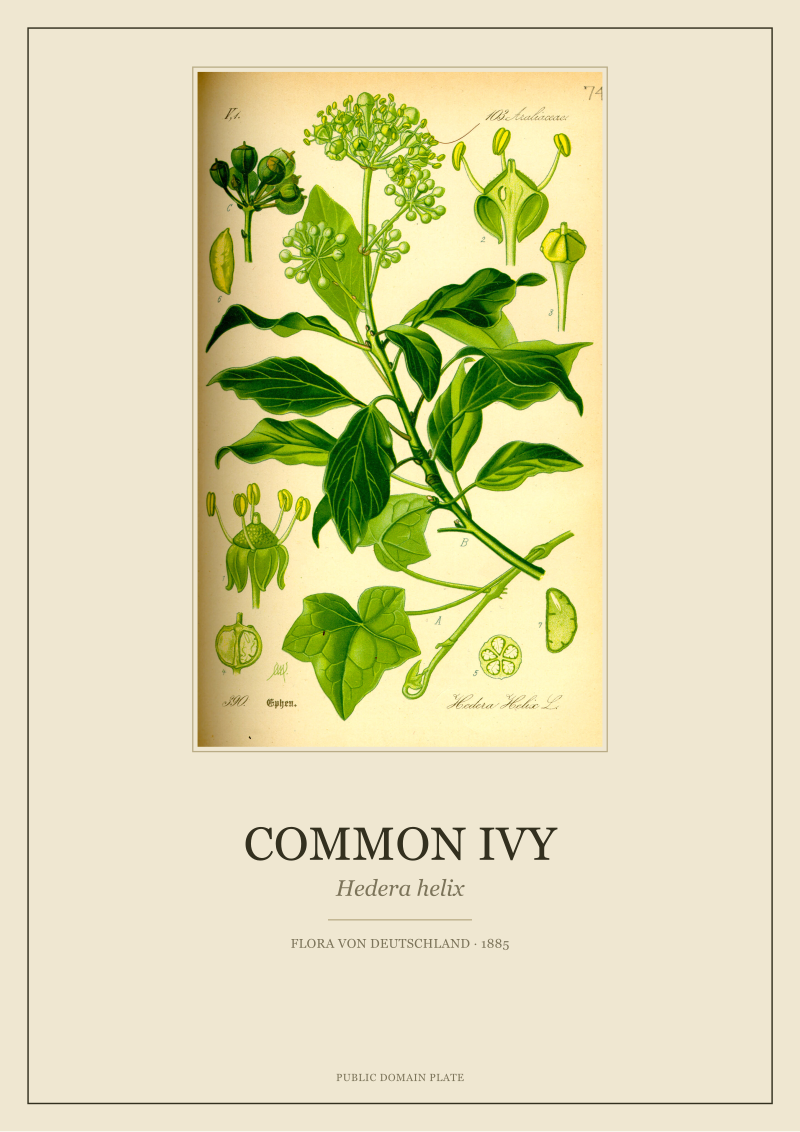
The Common Ivy was harder and, on measurement, drifted the most. Hedera helix has that particular five-lobed leaf silhouette that reads as ivy from across a room, and the 1885 plate renders it with a deep, almost bottle green shot through with darker vein work. Our restoration held the silhouette to within pixel-level tolerance and preserved every leaf. The vein structure counted correctly. What moved was the green. Measured in L*a*b*, the mid-tone of the leaf sat about ΔE 4.1 from the aged scan, corrected for paper. Some of that was intentional — a chromolithographic green that has yellowed for a century really does need to be pushed back toward the cool blue-green it was printed as, or you are selling a lie. But 4.1 is past the threshold where an educated eye reads a difference. Honest accounting says we pushed the ivy about a shade cooler than the original ink probably was in 1886. Not much. Enough to note. The plate is still, in every structural sense, the plate Thomé's team drew. The colour is our best guess at what the ink looked like when it was fresh, and a guess is not a measurement.
The Cornflower sat in the middle. Centaurea cyanus is famously that particular blue, and the whole visual weight of the plate rests on it. Our restoration measured a ΔE of about 3.0 on the petal blue, once corrected. That is within the range where two informed observers will disagree about whether the colours match. The line work was faithful, the seed head and stem detail preserved, and the small botanical inset — the dissected floret in the lower corner that all these plates carry — was intact and legible. Where the Cornflower did drift, and this is worth naming, was in the paper texture. Our restored file has a subtle grain we added to keep it from reading as flat digital output. That grain is not the paper of 1885. It is a plausible grain, chosen carefully, but it is ours. A purist would call that a small forgery. We call it an interior-design decision that we should probably disclose more clearly on the shop page than we currently do, and the fact that we are writing this sentence means we will.
Across the three plates, the pattern was consistent. Dimension and structure held to well under a percent. Line work was preserved rather than reinvented. Colour was where the drift lived, and colour is exactly where restoration has to make choices no measurement can settle. There is no ruler that tells you what a 1885 ink looked like when it was wet. There is only educated inference from surviving pigments, printer manuals, and other plates from the same run whose colours have aged differently. Every honest restorer of chromolithographs is doing this arithmetic, and the ones who claim perfect fidelity are the ones who have not measured.
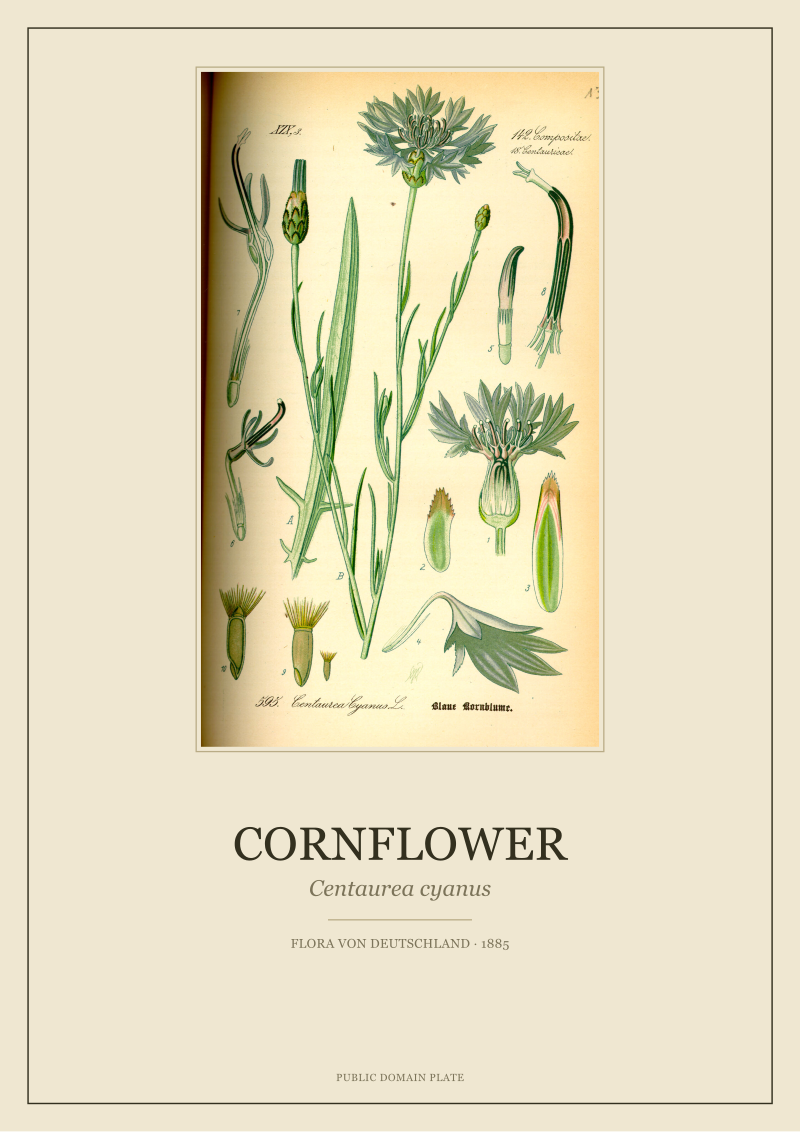 Cornflower
The print from this article · from €29.95
View the print →
Cornflower
The print from this article · from €29.95
View the print →
Accuracy Is a Promise About What You Can See, Not What You Can Measure
Here is where the essay turns, because the numbers above are the least interesting part of what we found. A ΔE reading is a technical fact. It is not what a buyer of a botanical print is asking about when they use the word accuracy. What they are asking is something closer to: is this plate the plate Thomé published, or is it something with his name on it. That is a question about honesty, not about pixels.
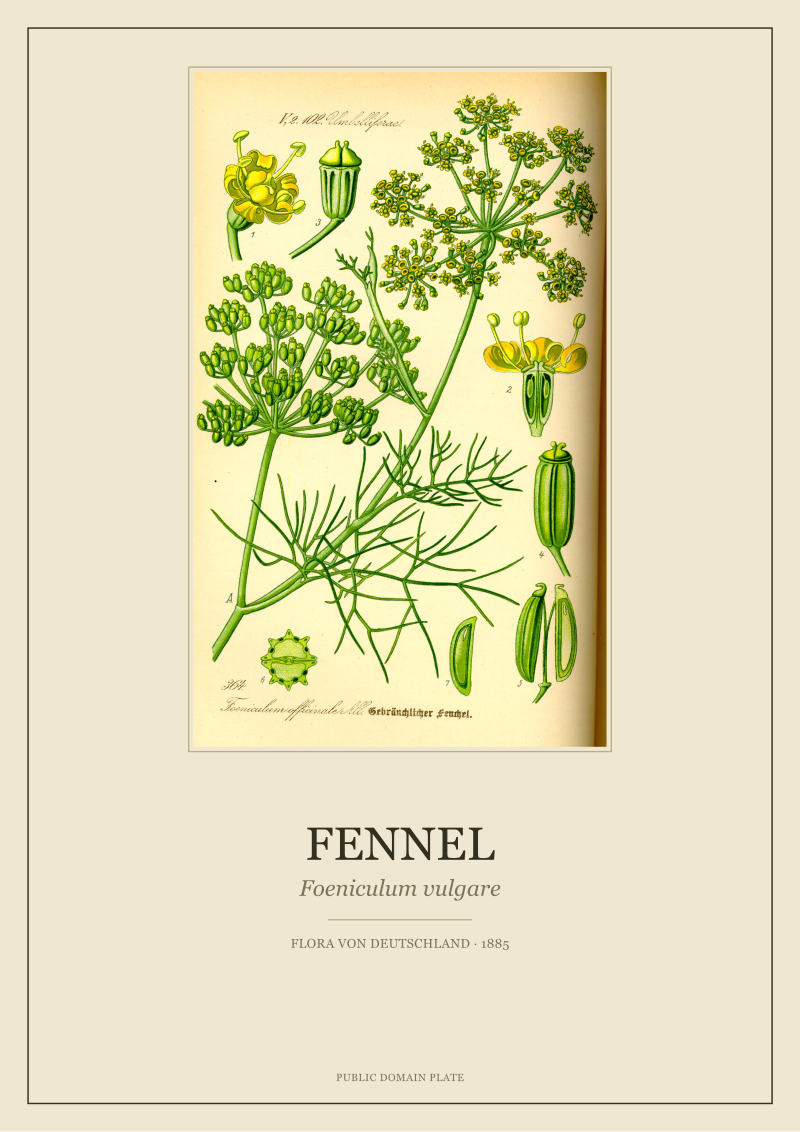
Our answer, after a day with the ruler, is that our three plates are the plate in every way that structurally matters and are our reading of the plate in the ways where the paper itself no longer knows the answer. Fennel, Foeniculum vulgare, which sits in the same 1885 volume and which we restore under the same protocol, would tell a similar story on the same test. The line work is Thomé's. The botanical detail is Thomé's. The composition and page architecture are Thomé's. The colour is our best-argued reconstruction of what Thomé's chromolithographer intended in the year the ink was mixed, and we are willing to defend every choice in writing, which is more or less what this piece is doing.
We think accuracy, honestly used, means three things at once. It means dimensional fidelity, which is testable and which we pass. It means structural fidelity — that no botanical feature has been added, removed or invented — which is also testable and which we pass. And it means transparency about the third thing, colour, which is not fully testable, where the drift lives, and where every restorer is making calls that a ruler cannot check. A print that sells itself as accurate without ever mentioning the third thing is not more accurate than ours. It is only less honest about the argument it is having with time.
There is a version of this piece we did not write, in which we would have shown you the plates side by side and let the eye do the work. We may still write that piece. But we thought the more useful thing, for once, was to show the seams. The three restored plates we measured, along with the fourth in the same series, sit at see the Cornflower print if you want to look at them yourself against any scan you can find. That is the entire commercial thought in this article. Everything else is the studio's honest afternoon.
This started as an internal QA note and turned into an argument with our own shop copy. We opened the file expecting to confirm that our restorations were faithful, and we ended it rewriting how we describe fidelity. That is what happens when you measure the thing you have been describing. The word accuracy came out of the day meaning less than it did going in, and more useful. We will be updating the shop pages this month with the ΔE figures for every plate we sell.
FAQ
What does "restored" mean when you use it about a Thomé plate?
In our studio it means that a public-domain scan of an 1885 chromolithograph is cleaned of paper foxing, oxidation halo and scan artefacts, then colour-corrected toward the ink values the original was printed at, and finally output at a print resolution that preserves the plate's original line work. It does not mean the illustration is redrawn, added to, or reinterpreted. Structure and dimension are held to the source. Colour is argued from the evidence available.
Why not just print the scan as-is if you want fidelity?
Because a scan is not a neutral document. Every surviving 1885 plate has aged for over a century, and its paper is no longer white and its inks are no longer the colours they were printed in. Printing the scan as-is sells the buyer a wounded object as if it were the original. Restoration is the argument that what the plate looked like when it was fresh is closer to the truth of Thomé's work than what it looks like after a hundred and forty years of library shelving.
How did you calculate the ΔE numbers in the article?
We sampled the same anatomical zones — floret centre, mid-leaf, petal body — on both the restored file and the archival scan, converted the RGB values to the CIE L*a*b* colour space, and computed the ΔE 2000 distance between paired samples. Before sampling, we temporarily brought the restored file back toward the aged paper tone of the scan, so the comparison measured the pigment work, not the paper repair. The figures given are averages across multiple samples per plate.
Which four plates from Thomé's 1885 flora are you restoring?
The four covered by this project are Chamomile, Matricaria chamomilla; Common Ivy, Hedera helix; Cornflower, Centaurea cyanus; and Fennel, Foeniculum vulgare. All four come from Otto Wilhelm Thomé's Flora von Deutschland, Österreich und der Schweiz, first published in 1885, which is in the public domain. Three were measured for this article. Fennel is restored under the same protocol and will be measured in the next round.
Is a small drift in colour a defect?
Not necessarily, but it deserves to be named. A chromolithograph's inks have shifted over more than a century, and reconstructing the fresh values is inference, not measurement. Our ivy sits about a shade cooler than the aged scan suggests, on the argument that the aged scan reads warm because the paper has yellowed. Reasonable restorers can and do disagree at the sub-shade level. The defect is not the drift; the defect is hiding it.
Do you alter the composition or add botanical detail?
No. Line count, leaf count, inflorescence structure, dissected inset — everything the 1885 plate contains, our file contains, and nothing the plate does not contain has been added. The restoration is confined to paper condition and colour. If a hatch mark is faded to invisibility on the source, it stays faded; we do not reconstruct it from a neighbouring plate. This is the structural line the studio does not cross.
Where can I compare your restored plates to the source scans myself?
The source scans of Thomé's 1885 flora are available through several public-domain repositories that host historical botanical works — a search on Thomé Flora von Deutschland will return them. Our restored files are shown at print resolution on their individual product pages, and we are adding side-by-side comparison images and the ΔE figures cited in this article to each page this month, so buyers can do exactly this test before committing.
What did this exercise change about how you describe accuracy?
It moved us from a single word on the shop page to a three-part promise. Dimensional fidelity, which we can prove. Structural fidelity, which we can prove. And transparent inference on colour, which is where honest restoration has to admit it is arguing rather than measuring. Every plate we sell will be described in those three terms from this month forward, and the ΔE numbers for each will be published alongside the image.
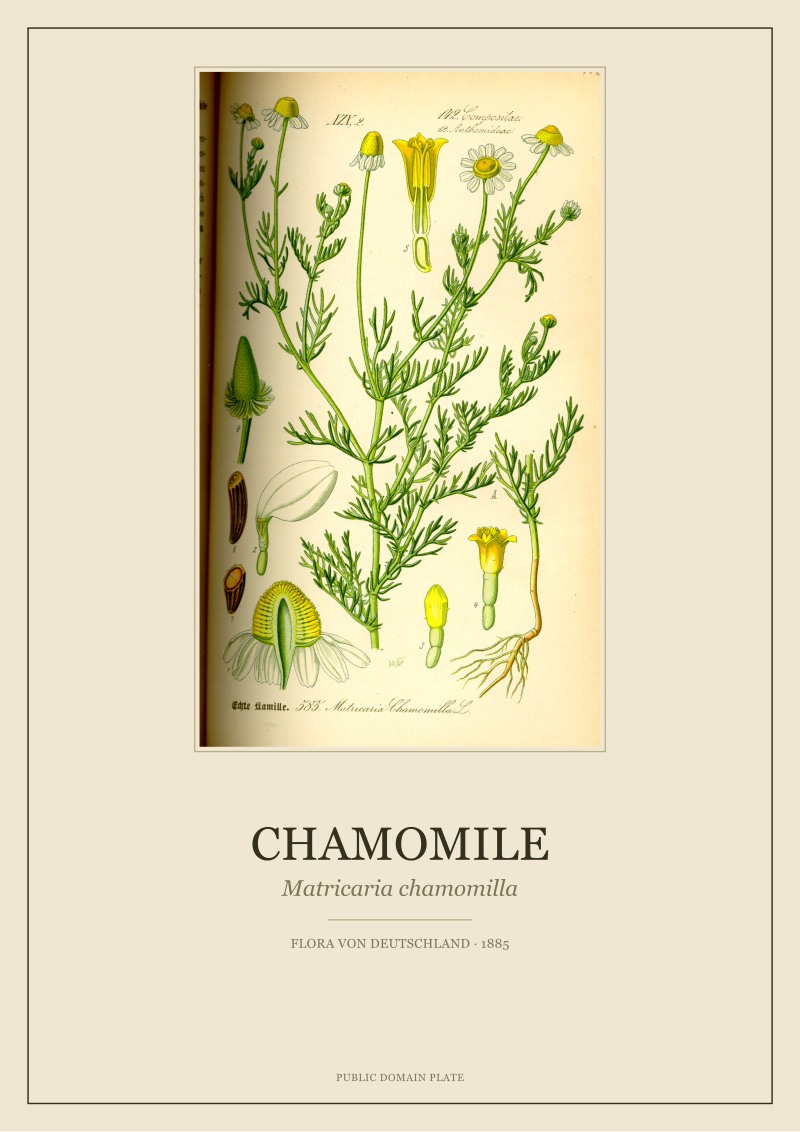 Chamomile
The print from this article · from €29.95
View the print →
Chamomile
The print from this article · from €29.95
View the print →
New plates from the archive and 10% off your first print.
One email now with your code. No noise after.