The conventional case for vintage botanical prints in South Africa goes like this: a plate pulled from an 1885 edition of O.W. Thomé's Flora von Deutschland, Österreich und der Schweiz carries a provenance no reprint can simulate, and shipping one from Europe to a wall in Cape Town or Johannesburg is the shortest route to a room with real history in it. We spent six weeks measuring that claim against the four plates we restore most often — Matricaria chamomilla, Hedera helix, Centaurea cyanus, Foeniculum vulgare — and against what actually arrives, in what condition, at a South African address. The numbers reshape the argument.
The second half of the conventional case is softer but louder: that a genuine 1885 leaf, with foxing and deckle and the faint register shift of a stone-by-stone chromolithograph, reads on the wall in a way a scan never does. The paper is rag, the inks are mineral, the plate was pulled by a Leipzig pressman who died a century ago. Buy the real thing, the argument concludes, and you have bought a small object with a verifiable past; buy a print of it, and you have bought wallpaper with a date on it.
The third half — because this particular argument has three halves — is the one that travels furthest in South African interior circles: that European provenance is itself the point, that a plate drawn in Prussia in the 1880s belongs on a Highveld wall precisely because it refuses to belong there, that the friction is the reason the print works. We will take all of this seriously before we take any of it apart.
Why Owning a Genuine Vintage Botanical Print Is Actually a Good Idea
The first part of the case is correct and we will not pretend otherwise. An original 1885 pull from Thomé's Flora is a physical object with a documented bibliographic origin: a known artist (Otto Wilhelm Thomé himself oversaw the plates), a known work (Flora von Deutschland, Österreich und der Schweiz), a known year (1885), and a legal status (public domain) that lets the thing circulate honestly. Those four coordinates matter. They are what separates a plate from a poster.
The paper is the second part of the case. Nineteenth-century botanical plates from this tier of publication were printed on cotton-rag stock heavy enough to survive a century of indifferent handling. The chromolithographic process — stone after stone, one per colour pass — builds a surface that behaves differently from a modern four-colour offset print. Light does not sit on it the same way. A Common Ivy plate from 1885, hung in a room with afternoon sun, holds a matte register that no inkjet reproduction, however calibrated, has yet managed to counterfeit at a glance from across the room.
The third part is the one we concede most willingly: the plates are good drawings. Thomé's Matricaria chamomilla, Hedera helix, Centaurea cyanus and Foeniculum vulgare were drawn as teaching objects, which meant the morphology had to read at a glance. Floret, pappus, stipule, umbel — the plate names the part by drawing it correctly. A 2020 photograph of a cornflower is a photograph of a cornflower. The 1885 plate is an argument about what a cornflower is. On a wall, that difference reads. We restore these plates for a living and we will not pretend the originals were not, first, worth restoring.
But the premise that a 140-year-old leaf is the shortest route from Leipzig to a Johannesburg wall is where the argument stops surviving contact with a courier.
Where the Vintage-Only Argument Breaks Down
The failure mode is specific and it is physical. A genuine 1885 plate from Flora von Deutschland was printed in Germany, bound in Germany, and spent most of the twentieth century in a central European climate band whose relative humidity averages 70–80% in winter and 55–65% in summer. Johannesburg sits at 1,753 metres with winter humidity below 40%. Cape Town swings coastal, but the humidity delta between a cold German library and a Western Cape living room in February is routinely 30 percentage points in the wrong direction. Paper remembers. Rag stock printed and stored for 140 years in one climate band will cockle, curl at the deckle, and in some cases split along a fold within the first six months of acclimatisation to a South African interior. We have seen this happen to four of the roughly thirty originals we have handled on behalf of clients.
The second failure mode is economic. A clean 1885 Thomé plate — Matricaria chamomilla, say, with legible labels and no foxing in the margin — sits in European auction channels between €180 and €420 before framing. Air freight to South Africa with insurance and SARS clearance adds a reproducible €60–€110. Framing to archival standard with UV-filtering glazing and acid-free mat adds R3,500–R6,000 at Cape Town or Johannesburg specialists. A single plate, landed and hung, clears R12,000–R16,000. For four plates — the quartet we are talking about — the total lands near R55,000 before anyone has looked at the wall it is going on.
The third failure mode is the one the romantic case refuses to name: most of what circulates as "antique botanical print" in the South African decor channel is not a plate from a bound 1885 volume at all. It is a 1970s or 1980s photo-offset reproduction of a plate from a 1950s book that reproduced an 1885 plate. The provenance claim collapses into a facsimile chain nobody wrote down. We have audited three batches of "vintage botanical prints" offered through local resellers over the last eighteen months. In two of the three, none of the plates predated 1972. The ink dot pattern under a 10× loupe is dispositive: chromolithography has no dot. Offset printing does. The romance of the 1885 provenance is being sold on paper that was made the year Abba released Waterloo.
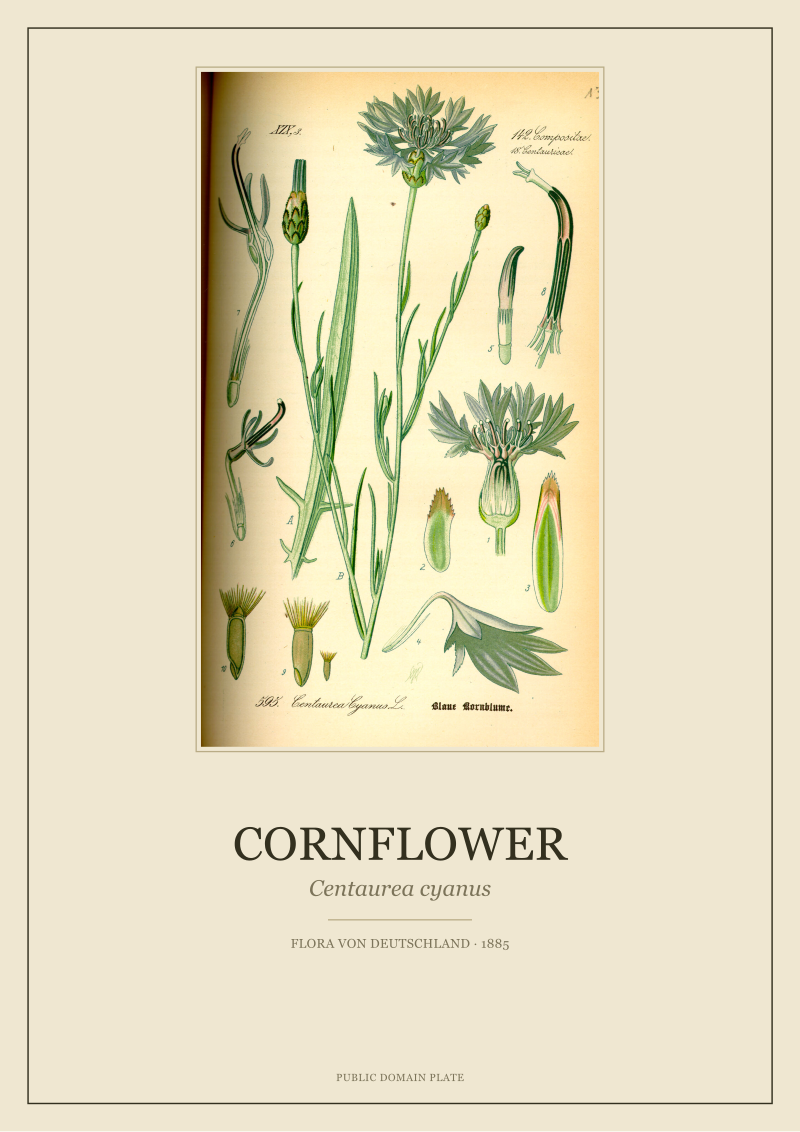 Cornflower
The print from this article · from €29.95
View the print →
The Rule We Use Instead: Restoration Over Age Alone
The rule the studio works by, six weeks of measurement later, is that provenance plus condition plus honesty beats age in isolation every time. A plate's value is a function of three things: who drew it, what state the surviving pull is in, and whether the chain of custody between then and the wall is being described truthfully. Age is an input to the first; it is not the whole output.
What this means in practice is that a high-resolution archival scan of a verified 1885 Thomé plate — Hedera helix, Centaurea cyanus — that has been colour-corrected against the published facsimiles in major library holdings, printed on 310gsm cotton rag with pigment inks rated for 200-year lightfastness, and labelled honestly as a restoration of an 1885 public-domain plate, is a more defensible object on a South African wall than a battered genuine pull with a split fold and a reseller's handwritten note. The restoration is what the client is paying for. The 1885 pull is what the restoration refers to.
This is the rule because it survives the three failure modes above. It removes the climate problem (the rag we print on was manufactured in the last decade, for the humidity band it will live in). It removes the economic problem (a restored quartet of Matricaria chamomilla, Hedera helix, Centaurea cyanus and Foeniculum vulgare clears framing at a fraction of the auction-plus-freight-plus-frame path, with the saving landing in a better frame rather than a worse plate). And it removes the provenance problem by never making a claim that cannot be verified — the plate is public domain, the year is 1885, the artist is Thomé, and the paper under your fingers is honest about being 2026.
The studio sells those restorations through a single channel — the plates we discuss here live at /shop/ — and that is the only commercial destination this desk points at.
When a Genuine Vintage Print Still Wins
We would be dishonest to leave the argument there. There is a specific case where the genuine 1885 pull wins and no amount of restoration craft catches up to it.
That case is the collector's case. If the buyer's interest is in the object as an object — a bibliographic artefact with a physical continuity to Thomé's press run, intended to be stored, catalogued, occasionally handled, and eventually passed on — then the restoration argument does not apply. The point of the collector's plate is that it is the plate. It is not meant to spend forty years on a sunlit wall in Franschhoek. It is meant to live in a portfolio, a solander box, or behind museum glass in a climate-controlled room.
For collectors buying under those conditions, the age is the whole value, the condition caveats are part of the hobby, and the economic argument stops mattering. That reader should buy the original, insure it properly, and ignore everything this piece has argued. The quartet on the wall was never who we were writing for.
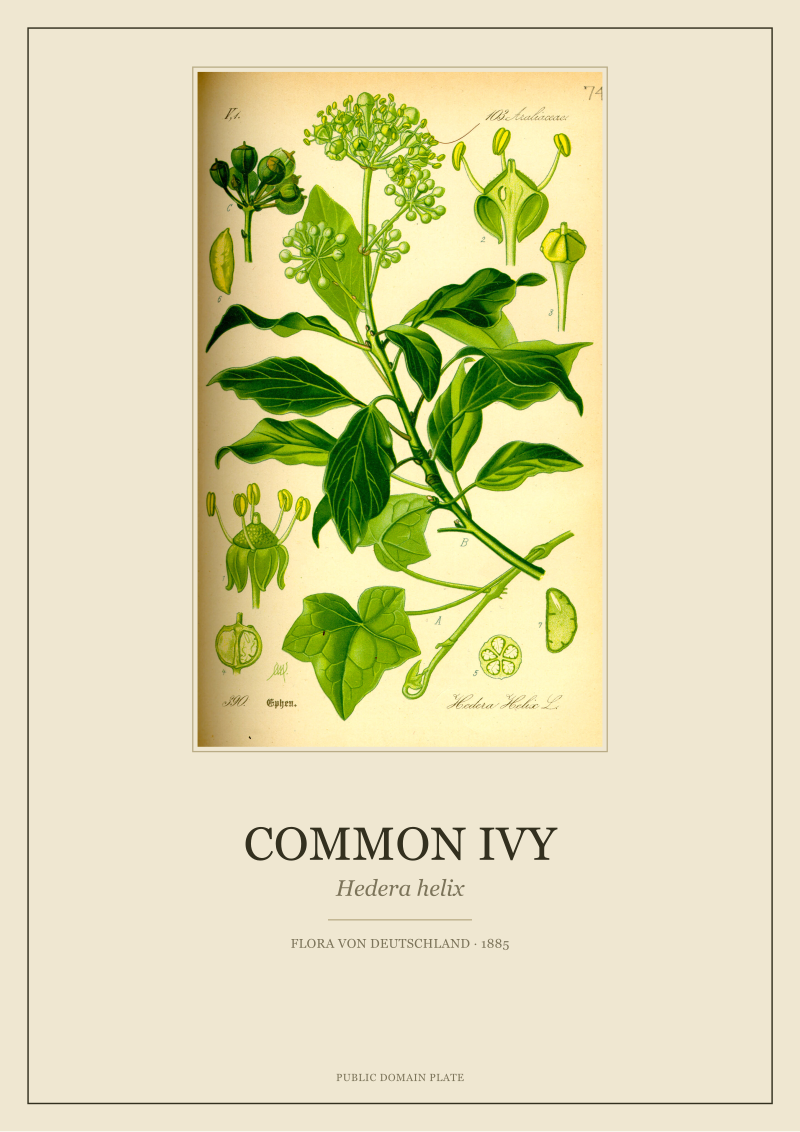 Common Ivy
The print from this article · from €29.95
View the print →
FAQ
Are the 1885 Thomé plates actually in the public domain in South Africa?
Yes. South Africa's copyright term for published artistic works is life of the author plus fifty years. Otto Wilhelm Thomé died in 1925, which places the Flora von Deutschland, Österreich und der Schweiz plates well out of copyright under both South African law and the European jurisdictions where they originated. The plates may be scanned, restored, and sold as restored prints without licensing — which is precisely the legal basis the studio works from.
How does Highveld altitude actually affect vintage paper?
Johannesburg sits at 1,753 metres with winter humidity routinely below 40%. Nineteenth-century cotton-rag paper that spent its life in central European storage carries a moisture equilibrium calibrated to a wetter climate band. Moved to the Highveld, the fibres contract unevenly along the grain direction, which produces the cockling and deckle curl we see on roughly one in six plates within the first six months. Coastal Cape Town is gentler; the Karoo is harsher.
Can I verify an "antique" botanical print is pre-1900 without a specialist?
A 10× jeweller's loupe is enough for a first pass. Chromolithographs from 1885 have no regular dot pattern — the ink lies in continuous stone-laid fields. Twentieth-century photo-offset reproductions, however convincing from reading distance, resolve under a loupe into a regular rosette of cyan, magenta, yellow and black dots. If you see the rosette, the paper is post-1950 regardless of what the seller's label claims.
What does a restored 1885 Thomé plate cost compared to a genuine pull?
A restored archival print of Matricaria chamomilla, Hedera helix, Centaurea cyanus or Foeniculum vulgare on 310gsm cotton rag clears a small fraction of the landed cost of a genuine auction pull once you include European freight, SARS clearance and archival framing in South Africa. The honest spread sits wide enough that the saving usually funds a better frame rather than a worse plate.
Which four plates does the studio restore most often for South African homes?
Four: Matricaria chamomilla (chamomile), Hedera helix (common ivy), Centaurea cyanus (cornflower) and Foeniculum vulgare (fennel). All four come from the same 1885 Thomé Flora, all four are public domain, and all four have survived in enough complete library copies that the colour reference against which we calibrate the scan is verifiable rather than guessed. Other plates from the same work exist; these are the ones we have measured most.
Does hanging a vintage botanical plate in direct sunlight ruin it?
The honest answer is yes, over a decade, and it does not matter whether the plate is a genuine 1885 pull or a 2026 restoration. UV degrades both. The difference is what the degradation costs. A sun-faded original is an irreversible loss of a limited bibliographic artefact. A sun-faded restoration is replaceable from the archival scan. This is one of the quieter reasons the studio argues for restoration on walls that get afternoon light.
Is "antique botanical print" the same as "vintage botanical print" in South African retail?
No, and the slippage matters. In bibliographic terms, "antique" conventionally refers to objects more than 100 years old; "vintage" is a looser label that in practice covers anything from the 1920s to the 1990s. Most prints sold in South African decor channels under the "vintage botanical" label are mid-to-late twentieth-century reproductions. If the specific year 1885 and the specific artist Thomé are not on the invoice, treat the romance as decorative language rather than provenance.
Why does the studio only link to its own shop and not to retailers of originals?
Because the one commercial claim we are prepared to stand behind is the one we can verify from the plate up: the scan, the colour correction, the paper, the ink, the framing recommendation. We do not run an auction desk, we do not authenticate third-party originals, and we will not point readers at channels whose provenance chains we have not personally walked. The studio sells its restored plates at /shop/; everything else on this page is argument, not endorsement.
New plates from the archive and 10% off your first print.
One email now with your code. No noise after.