A kitchen herb wall built from restored botanical plates works with as few as two prints and rarely needs more than seven. From O.W. Thomé's Flora von Deutschland, Österreich und der Schweiz (1885) we hold four plates that could plausibly hang near a stove: Matricaria chamomilla, Foeniculum vulgare, Hedera helix, and Centaurea cyanus. Two of the four are kitchen herbs in the strict sense. One is a wall-climber that has kept company with old kitchens for centuries. One is a cornfield weed that ended up in country bread. Whether that is enough for a wall depends on the wall. We will walk through three hypothetical kitchens to show what enough looks like.
The question we get asked in the studio is almost always the same: how many prints. It is the wrong question asked first. The right first question is how much wall, how tall the ceiling, and how close the viewer stands when the kettle boils. Answer those and the count answers itself. To make that concrete without pretending we have interviewed anyone, we have built three composite kitchens from the sort of rooms we have restored plates for. Picture each one. The math is the same math we would do if you sent us photos.
Scenario 1: The One-Wall Renter With a Two-Metre Run of Plaster
Imagine a rented flat with a single stretch of usable kitchen wall — 200 centimetres between a doorframe and the corner of a cabinet, and 130 centimetres of clear vertical between the worktop and the underside of a shelf. That is the entire canvas. There is a kettle underneath, a wooden knife block, a tea tin. The tenant cannot paint, cannot drill above a certain height, and will move again in eighteen months. This is the most common brief we see, and the answer is almost never seven prints.
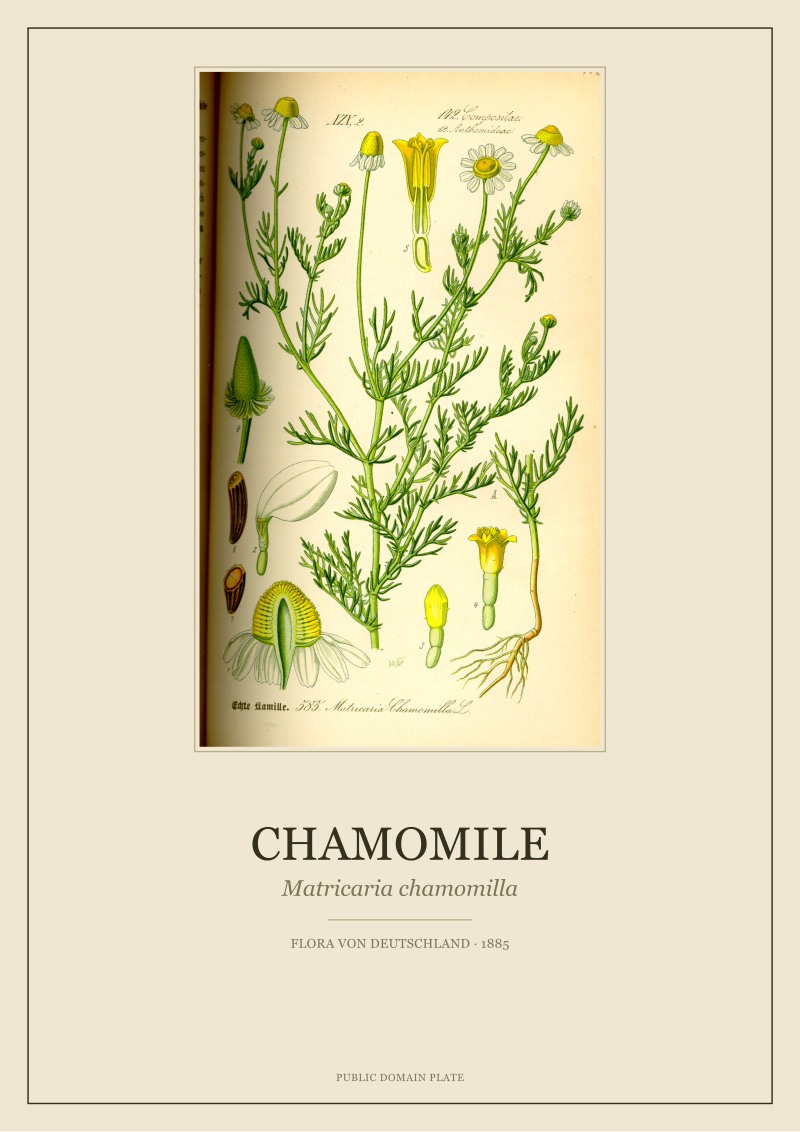
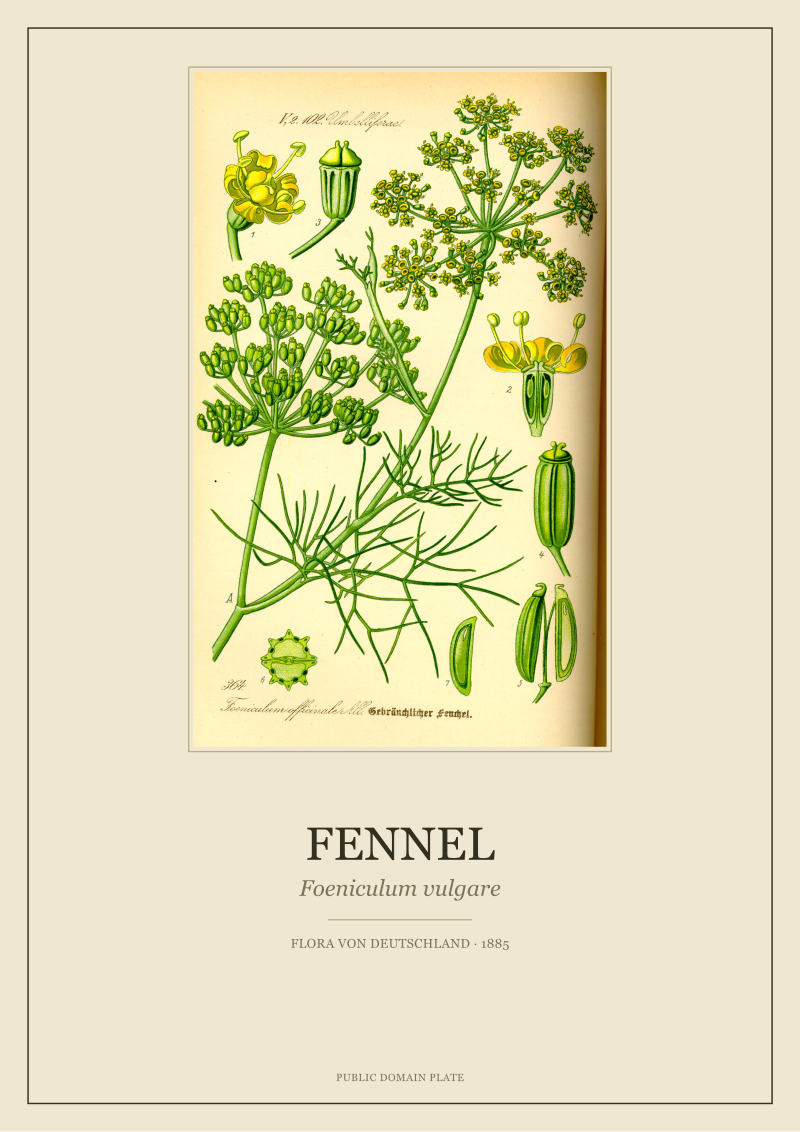
Let us say the tenant chooses two of our four Thomé plates: Matricaria chamomilla and Foeniculum vulgare. Chamomile and fennel. Both are unambiguously kitchen herbs — dried flowers in one jar, seeds in another — and both share the same 1885 hand, the same Flora, the same restoration pass. That coherence matters more on a small wall than variety does. Two plates from the same book read as a considered pair; two plates from different sources read as a start-again.
The math for this run: an A3 print at 297 by 420 millimetres, framed in a 30-millimetre moulding, occupies roughly 357 by 480 millimetres of wall. Two frames hung side by side with a 60-millimetre gap between them cover 774 millimetres horizontally. Centred on a 2000-millimetre run, that leaves 613 millimetres of plaster on each side — generous, quiet, correct. Vertically, hang so the midpoint of each frame sits at 1550 millimetres from the finished floor, which places the botanical illustration itself at standing eye level for most adults and keeps the bottom of the frame a full 260 millimetres above a standard 900-millimetre worktop. Steam from the kettle rises and disperses before it reaches the glass; grease from the hob, if the hob is close, does not.
Cost, honestly: two restored A3 prints in a mid-range oak or ash frame will land somewhere between 180 and 280 euros total depending on framer. That is what two paintings from a chain homeware shop cost, and those are printed on paper the framer sighs at. The Thomé plates are on cotton-rag stock, restored from public-domain scans without the yellowing the source files carry, and the tenant takes them to the next flat.
The honest limit of this scenario: two prints will not carry a long wall. If the run were three metres instead of two, two prints would look marooned. The scenario works because the wall is short.
Scenario 2: The Slow-Build Homeowner Framing Over Three Years
Picture a family kitchen in a renovated ground-floor flat. The owners have moved in, painted a chalky off-white, and know they want botanical prints somewhere — not because a magazine told them to, but because they inherited a copy of Thomé from a grandmother and remember the plates. They have four metres of continuous wall running from a dresser to a pantry door, and a ten-year plan for the flat. This is a slow-build project.
The temptation, when the wall is that long and the intention is that clear, is to buy everything at once and hang a symmetric grid. We would talk them out of it. A four-metre wall filled in one weekend reads like a hotel corridor. A four-metre wall filled over three years, print by print, reads like a family.
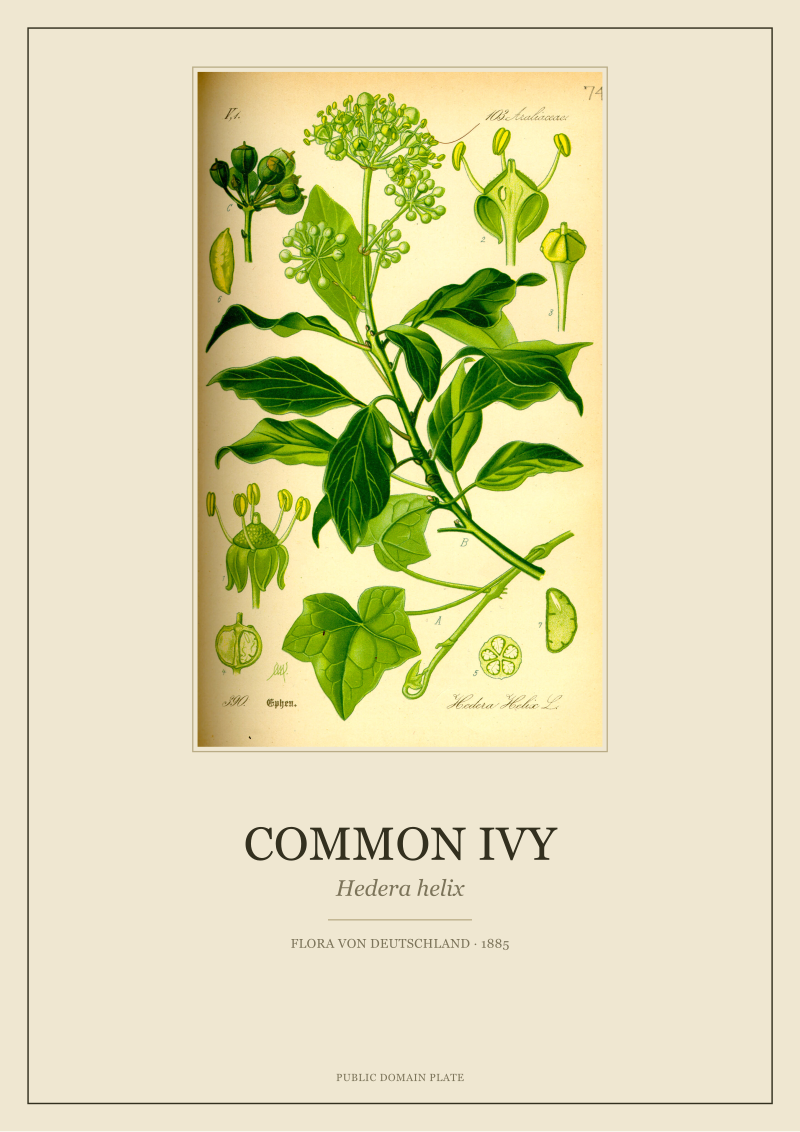
Suppose the homeowners begin with the two culinary plates — chamomile and fennel again — hung in year one as a pair on the left side of the wall, occupying about 900 millimetres. Year two they add Hedera helix, common ivy, hung on the right side of the wall with 800 millimetres of empty plaster between the pair and the single. Ivy is not a kitchen herb; it is a wall-climber. Its historical association with the kitchen is architectural rather than culinary, and hanging it separately preserves that distinction. The single ivy plate anchors the right end without pretending to belong to the same shelf as the chamomile.
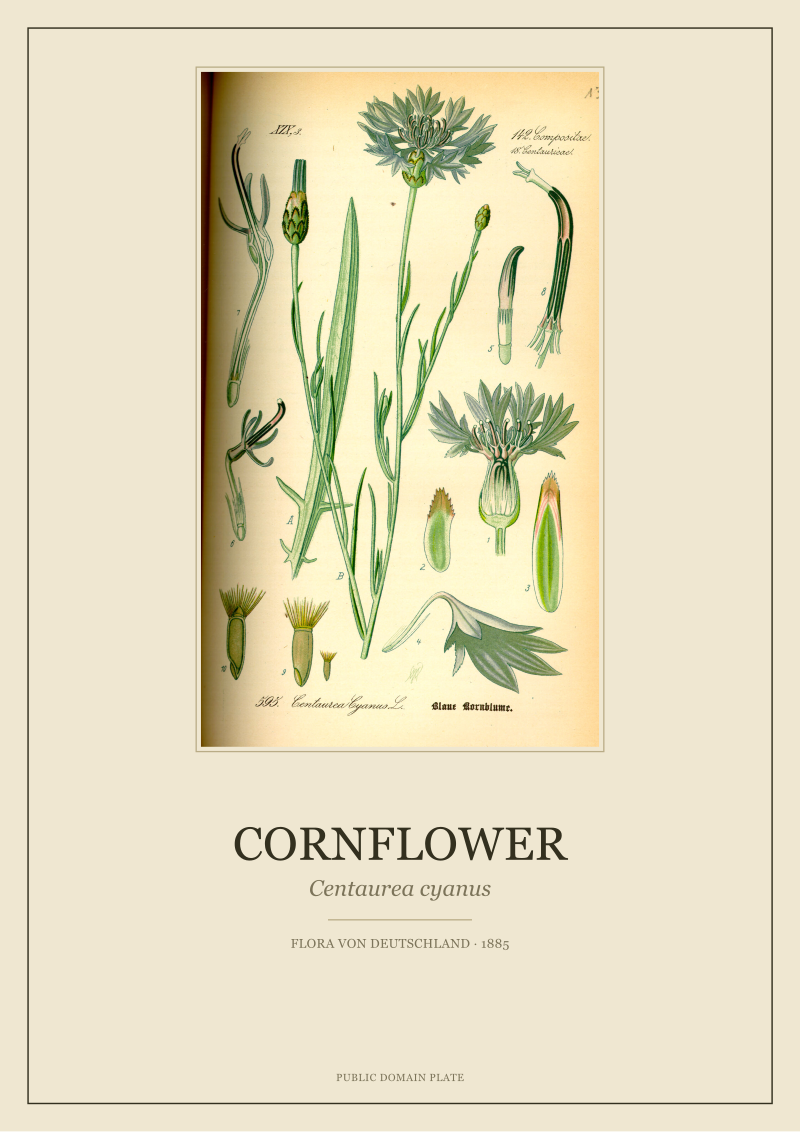
Year three they add Centaurea cyanus, cornflower, in the gap. Cornflower is not a herb either. It is a cornfield weed that used to turn up in rye bread whether the miller wanted it or not, which is a kitchen story told from the outside. Placed between the culinary pair and the ivy, it becomes a hinge — a plant that lived on the edge of what was eaten.
That leaves us at four plates on a four-metre wall. The count is deliberately low. Frames at A2 (420 by 594 millimetres) in a slim 25-millimetre moulding occupy roughly 470 by 644 millimetres each. Four A2 frames along a four-metre run, with variable gaps of 200 to 400 millimetres, leaves the wall breathing. If the family wants more, we would suggest a smaller Thomé plate at A4 hung asymmetrically below the ivy — a fifth print that acknowledges the plan is not a grid.
The honest limit of this scenario: three years is not a marketing timeline. It is what actually happens when people buy the way most people buy. If the homeowners wanted the wall finished by Christmas, we would give them a different sequence.
 Chamomile
The print from this article · from €29.95
View the print →
Chamomile
The print from this article · from €29.95
View the print →
Scenario 3: The Small-Kitchen Cook Working Above the Hob
Now imagine a galley kitchen where the only wall that will take art is the strip above the hob, between the extractor hood and a set of upper cabinets. The clearance is 45 centimetres vertical by 90 centimetres horizontal. There is a splashback of tempered glass, an induction cooktop below, and steam every night at seven. Anyone who has cooked in this kitchen has thought about hanging something there and then remembered the physics.
Let us be direct. We would not hang a paper print in this position, restored or otherwise. Chromolithographic reproductions on cotton-rag stock are stable in ordinary domestic humidity, but the space directly above an active hob cycles between 40 and 90 percent relative humidity within minutes, coats the nearest surfaces in aerosolised oil over the course of a year, and heats framed glass unevenly enough to stress the seal. What survives in that microclimate is tile, stone, and glass. Not paper.
The scenario is worth including because most kitchen-herb-wall guides ignore it and pretend a print will be fine above the stove. It will not. The honest recommendation for this cook is to move the print out of the danger zone. Suppose they have a second wall — perhaps a stretch of tongue-and-groove above a small breakfast table, three metres away from the hob. On that wall, at 1600 millimetres from the floor, a single A3 Matricaria chamomilla behaves. Steam does not reach it. Splatter cannot. The plant on the plate is the herb they make tea from every night with the kettle that lives above the hob. The two objects are in the same room and doing different jobs.
If the second wall does not exist — if the hob strip really is the only available surface — then the answer is not a print but the plate reproduced on ceramic, and that is a different studio and a different craft, and we do not sell it. This is where honesty about scope is more useful than a sale. One plate on the safe wall, or none. That is the choice.
The math for this scenario is small because the scenario is small: a single A3 frame at 357 by 480 millimetres, centred on its own field, at eye level for the seated diner rather than the standing cook. Cost between 90 and 140 euros framed. The rest of the budget stays in the pocket.
What All Three Kitchens Share
Three composite kitchens, three different counts — two, four, one — and yet the underlying decisions rhyme. Each began with the wall, not the wish list. Each measured before shopping. Each rejected the assumption that a "herb wall" needs to include only culinary herbs; ivy and cornflower earned their place by being honest about what they are and what they did in the vernacular kitchens the Thomé plates were drawn for. And each accepted that the wall's real limit is physical, not aesthetic.
There is a second pattern. All three scenarios treat the plates as objects with provenance. The 1885 date is not a decorative flourish. It is the reason the illustrations look the way they do — chromolithographic printing at the peak of its craft, drawings made from herbarium specimens by an illustrator who was writing a schoolbook flora and did not know he was making wall art. That history travels with the print. Reprints of Thomé have circulated for a hundred and forty years because the plates were built to be reproduced, and every kitchen that hangs one is participating in that long re-run.
The third shared thing is restraint. Two prints in the first scenario, four in the second built over three years, one in the third. None of these kitchens looks like a botanical shop. All of them look like rooms with a few good things on the walls. That is the difference between decoration and inheritance, and it is not decided by the number of prints, it is decided by the count.
 Cornflower
The print from this article · from €29.95
View the print →
Cornflower
The print from this article · from €29.95
View the print →
Which Scenario Is You
Read the three back and ask three questions about your own wall. First, how much continuous plaster do you actually have — measured, not eyeballed? Under two metres puts you in Scenario 1. Between three and five metres, with time on your side, puts you in Scenario 2. If the honest answer is that your only wall is above the hob, you are in Scenario 3 and the useful thing we can tell you is to look for a different wall in the same room.
Second, how fast do you want the wall finished? A single weekend suits two prints. A grid of six or seven wants a year of looking. If you cannot decide, start with one culinary plate at eye level and live with it for a season. The next print will announce itself.
Third, do you cook? A cook needs the prints out of the steam and grease line. A kitchen that mostly hosts coffee and toast can hang closer to the action. The plates last a very long time if the room lets them; they age fast if it does not. Choose accordingly, and choose fewer than you first thought.
FAQ
How far from the hob should a botanical print hang to stay safe?
As a working minimum, we suggest 90 centimetres of horizontal distance from the edge of an active hob and 120 centimetres from a range extractor's face. Direct-above positions, even with an extractor running, cycle humidity and aerosolise cooking oil fast enough to stress framed paper over five to ten years. Cotton-rag stock is stable in normal kitchen humidity; it is not stable in steam plumes. If in doubt, move the frame to the next wall over.
Can chamomile and fennel plates from 1885 hang together as a coherent pair?
Yes, and better than most pairings. Both come from Thomé's Flora von Deutschland, Österreich und der Schweiz, which means the same illustrator, the same year, the same chromolithographic method, and the same paper conventions. Coherence on a two-print wall depends on shared provenance more than on colour or subject. Two plates from one book read as a considered pair; two plates from two different sources read as a false start, no matter how similar the plants are.
Is common ivy actually a kitchen herb, or is it a stretch to include Hedera helix?
Common ivy is not a culinary herb and we do not present it as one. Its place in a kitchen wall is architectural and historical — Hedera helix has climbed European kitchen walls for centuries, appears in rustic still lifes with bread and cheese, and shares the vernacular kitchen's iconography without ever being an ingredient. We include the plate when the wall has room for a hinge between what was cooked and what grew around the room. On a strict two-print herb wall, it is the wrong pick.
Why include cornflower in a herb wall when it is a weed?
Because the vernacular kitchen the Thomé plates were drawn for did not separate weeds from ingredients as cleanly as a modern spice rack does. Centaurea cyanus grew in rye and wheat fields across nineteenth-century Central Europe and turned up in country bread whether farmers wanted it or not. Hanging the plate acknowledges the kitchen as a room where food was made from a landscape, not from a supermarket. It is contextual rather than culinary, and it works on longer walls where a single hinge print earns its place.
What sizes and gaps do you recommend for a two-print pair on a two-metre wall?
Two A3 frames — each roughly 357 by 480 millimetres external including a 30-millimetre moulding — with a 60-millimetre gap between them, centred on the run. That puts about 613 millimetres of empty plaster on each side. Hang so the midpoint of the frame sits at 1550 millimetres from the floor. This keeps the illustration at standing eye level, the bottom of the frame safely above a standard worktop, and the whole composition quiet enough to read as considered rather than sparse.
How much does a small kitchen herb wall from restored Thomé plates actually cost?
For a two-print A3 pair in mid-range oak or ash mouldings, expect roughly 180 to 280 euros framed, depending on framer and glazing choice. A single A3 print, framed, lands between 90 and 140 euros. A slow-build four-print wall at A2 rises to the 600 to 900 euro range over the years it takes to complete it. These are ranges, not quotes; framing is where the price moves most, and glazing choice — standard glass, low-reflective, or museum — is the biggest lever inside that.
Are the plates original 1885 prints or modern reproductions?
Modern restorations from the public-domain scans of the 1885 Flora, printed on cotton-rag paper by our studio. Originals of Thomé's plates do exist on the antiquarian market, but they are 140-year-old sheets with foxing, tape shadows, and colour shifts, and they belong in archival portfolios rather than on kitchen walls. Our restoration removes the yellowing without repainting the linework, keeps the illustrator's signature, and prints at a stable modern resolution. What you hang is the drawing as it was intended to read, on paper that will last.
If I only have one wall in the whole kitchen, is one print enough?
Yes. A single well-placed plate at eye level, on a wall that can actually hold it — dry, away from grease, not shadowed by a cabinet — reads as a chosen object rather than an empty space with a picture nailed to it. Two prints look better than one on some walls; one print looks better than two on others. If the wall is under 1.2 metres of usable width, one is almost always the right count. Restraint scales.
New plates from the archive and 10% off your first print.
One email now with your code. No noise after.