A botanical print is not decor. Hear us out. The 1885 chromolithograph of Hedera helix that O.W. Thomé published in Flora von Deutschland, Österreich und der Schweiz was, first, a schoolbook page — a taxonomic instrument dressed as art. That is why it survives on walls in 2026: it was built to be looked at slowly. This guide is a flowchart in prose. Three questions route the reader through the studio's 1885-source catalogue, from common ivy outward, and land on a specific plate to give this year. No stars, no winners, no ranking — three forks and a table.
Question 1: Is the Enthusiast a Botanist or a Reader of Rooms?
This is the first fork because it decides what the print is doing on the wall. A botanist — professional, hobbyist, or the friend who owns three field guides and knows the difference between an axil and a bract — reads a Thomé plate the way a musician reads a score. The dissected corolla in the corner, the tiny cutaway of a stamen, the ovary sliced open like a fruit under a microscope: those are not decorative flourishes. They are the reason the plate was drawn. A reader of rooms sees a very different object. They see composition, weight, palette, the way ink sits on paper 141 years after it was printed. Both readings are correct. They ask for different plates.
If Yes — they are a botanist
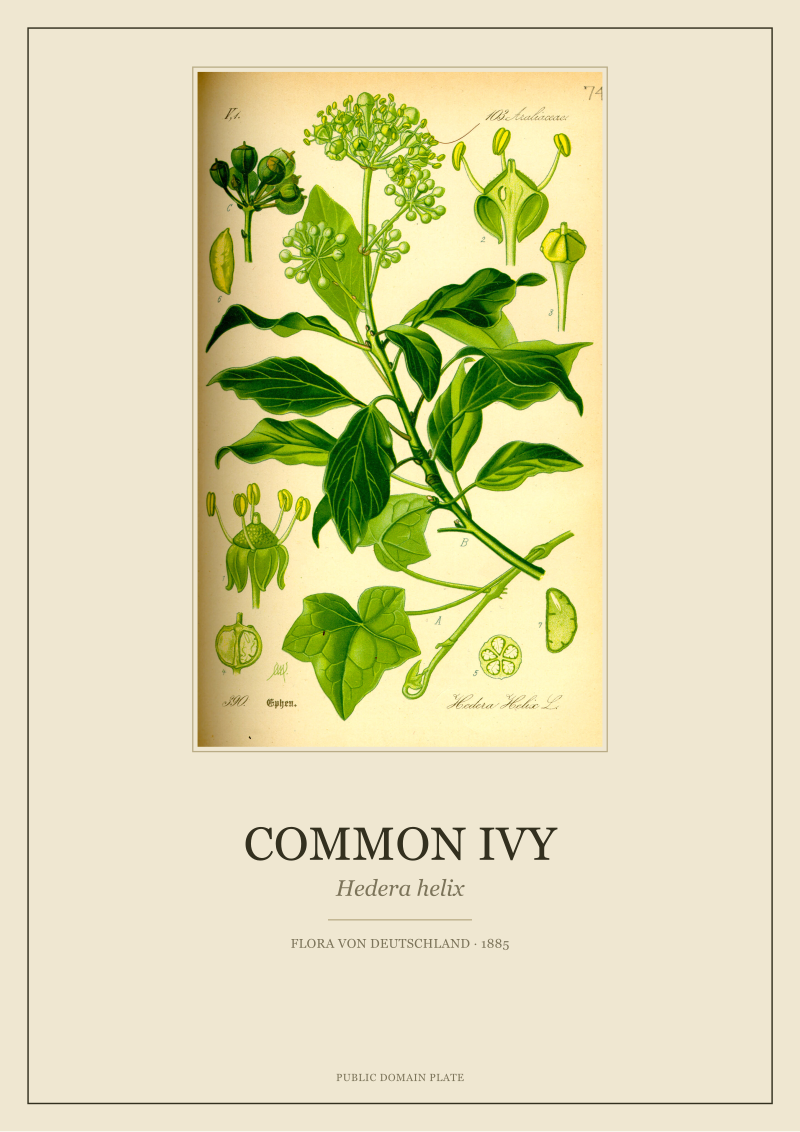
Give them a plate where the anatomical work is the point. The 1885 Hedera helix is a strong opening gift here for a specific reason: ivy is a plant most people think they know, and Thomé's dissection quietly proves they do not. The plate isolates the juvenile lobed leaf beside the adult entire leaf — the same specimen, two life stages, side by side. It shows the flower, which almost no one ever notices ivy having (small, greenish-yellow, umbels in autumn). It shows the fruit, black and berry-like, in a cutaway. A botanist unwraps that print and reads it for ten minutes before hanging it. That is the correct response.
Beyond ivy, lean toward Thomé plates where the dissection is generous: umbellifers, orchids, anything with a complicated flower. Skip the plates that are mostly habit sketches with a leaf detail and nothing else — they will bore a botanist by week two.
If No — they are a reader of rooms
Give them a plate that composes. Thomé's 1885 volumes were laid out by a lithographer who understood negative space; some plates are dense little laboratories, others are near-empty portraits with a single stem climbing off-centre through white. The reader of rooms wants the second kind. The common ivy plate, again, works here — but for the opposite reason. Its climbing habit runs diagonally across the page. The negative space is the composition. A framed Hedera helix hung in a hallway reads as line drawing before it reads as botany, which is exactly what a room-reader wants.
For this branch, avoid plates crowded with dissections in every corner. The visual noise that thrills a botanist tires a room-reader within a season.
Question 2: Does the Room Already Have Green in It?
The second fork is about the room where the print will live. This is not interior decoration advice — it is a colour question, and colour decides which 1885 plate stops working after three months and which one settles in. A chromolithograph from Thomé's Flora carries a very particular green: mineral, slightly cool, printed in three or four ink passes with the paper showing through. It is not the green of a houseplant. It is not the green of a Farrow & Ball wall. It is 1885 green, and it either sings against the room or fights it.
If Yes — the room already has plants, painted greens, or botanical fabric
Route away from green-dominant plates. If the recipient's living room already contains a fiddle-leaf fig, a mint-coloured armchair, and a William Morris cushion, a Hedera helix print risks becoming the fourth green thing in the frame. It stops being read as a specific plant and starts being read as "more greenery." Instead, choose plates where a non-green element carries the composition: the pale straw yellows of a grain plate, the bruised purple of a foxglove, the near-white of an umbellifer's inflorescence, the copper-red of an autumn Rubus. Thomé's palette across the 1885 volumes includes far more than green; the ivy plate is simply the most-cited entry point.
That said, common ivy still earns a place in a green-dense room if it hangs in a corridor or entryway rather than the main living surface. Corridors reward repetition. Living rooms punish it.
If No — the room is neutral: wood, plaster, linen, stone
Now green is doing structural work. In a room without other botanical elements, a single Hedera helix print becomes the one green note in the space, and it lands with real weight. This is the classic Thomé placement: a plaster-coloured wall, an oak table, an unfussy frame in black-stained ash or raw oak, one botanical plate. The 1885 chromolithography process — printed from multiple stones, each carrying one ink colour — produces a green that reads warm against cool neutrals and cool against warm ones, which is why the plates hold up across such varied interiors. For a first gift into a green-free room, the common ivy plate is a defensible default. It is legible even to people who cannot identify it, and its climbing line gives the composition somewhere to go.
 Common Ivy
The print from this article · from €29.95
View the print →
Common Ivy
The print from this article · from €29.95
View the print →
Question 3: One Plate, or the Beginning of a Wall?
The third fork is the one gift-givers get wrong most often. A single restored botanical plate and the first plate of a future gallery wall are not the same object, and they are not chosen the same way. If the recipient has never owned a botanical print, do not gift them a set of six matching frames on the assumption that a wall is what they want. If they already have two Thomé plates leaning against a bookshelf waiting to be hung, do not gift them a single unrelated species that will orphan the composition they are half-building.
If Yes — one plate, a standalone gift
Choose a plate that can carry a wall alone. This is a harder brief than it sounds. A standalone botanical needs enough internal complexity to reward long looking but enough compositional restraint to not shout. Common ivy, again, is unusually well-suited: the dissections give the botanist something, the climbing habit gives the room-reader something, and the muted palette lets the frame carry the presentation. Frame recommendation for a standalone: raw oak or black-stained ash, museum-grade non-reflective glass, generous mat (at least 6 cm on the widest side). The mat is not aesthetic padding. It is the visual pause that tells the eye this plate is meant to be read as a single object, not as part of a grid.
If the recipient's aesthetic is more maximalist, the standalone plate can go into a heavier frame — walnut, gilded, even antique — but the mat stays generous.
If No — the first plate of a wall, or an addition to an existing one
Now the plate is a member of a set, and the criteria shift entirely. What matters is not the individual plate's strength but its relationship to its neighbours: palette consistency (all Thomé, all 1885, so the paper tone and ink registration match); scale consistency (frame the whole set to identical outer dimensions, regardless of the original plate's proportion — the mat absorbs the difference); species relationship (either a taxonomic group, an ecological group, or a colour group). For a wall being built around common ivy, natural companions are other climbers (hop, bindweed, honeysuckle from the same 1885 corpus), other evergreens, or other plants that were pressed into service as decorative motifs in Victorian interiors alongside ivy.
The mistake to avoid: mixing a Thomé 1885 plate with a plate from another flora, another decade, another lithographic process. The paper will look different. The greens will not agree. The wall will read as a thrift store rather than a set.
If You Answered Everything: The Recommendation Table
Eight combinations, one recommendation each. Each cell is one concrete sentence. The plate reference names either the specific 1885 Thomé Hedera helix or a category of plate the studio's 1885-source catalogue can supply.
| Q1: Botanist or Room-Reader? | Q2: Room Already Green? | Q3: Standalone or Wall? | Recommendation |
|---|---|---|---|
| Botanist | Yes | Standalone | Skip ivy; give a dissection-heavy plate in a non-green palette, single frame, generous mat. |
| Botanist | Yes | Wall | Start a taxonomic wall around a non-green group — grains, umbellifers, or autumn fruits from the 1885 corpus. |
| Botanist | No | Standalone | Give the 1885 Hedera helix — dissections reward the botanist, green anchors the neutral room. |
| Botanist | No | Wall | Open a climbers-and-evergreens wall with the 1885 ivy plate; add a second climber within six months. |
| Room-Reader | Yes | Standalone | Choose a compositionally quiet non-green plate — foxglove, poppy, or a pale umbellifer — hung away from the plant zone. |
| Room-Reader | Yes | Wall | Build a wall in the corridor, not the living room; use a warm-toned Thomé set to break the room's green dominance. |
| Room-Reader | No | Standalone | The 1885 ivy plate in raw oak, museum glass, generous mat — the safest strong-first gift in the catalogue. |
| Room-Reader | No | Wall | Start with the 1885 ivy as anchor; plan three more plates of matching outer frame size within the year. |
The table is not a scorecard. It is a routing instrument. If the recipient sits between two branches — many enthusiasts do — pick the branch that reflects how they will actually use the print, not the branch that flatters them. A botanist who never hangs anything on their walls is a room-reader in practice. Route accordingly.
For every recommendation above, the studio's 1885-source catalogue — restored by hand and code from public-domain scans, printed on archival stock — is at see the Common Ivy print. That is the only commercial destination this guide will point at.
 Fig
The print from this article · from €29.95
View the print →
Fig
The print from this article · from €29.95
View the print →
FAQ
Why does Thomé's 1885 Flora von Deutschland keep showing up in gift guides for 2026?
Because the plates were built to be looked at closely and slowly, and that quality does not age. Thomé's chromolithographs were printed as instruments of instruction — every anatomical detail is there for a botanical reason, not a decorative one — and the compositional restraint that came from that discipline is exactly what contemporary interiors reward. The 1885 date also matters legally: the plates are firmly public domain, which is why restored versions can circulate without the licensing frictions that limit newer botanical art.
Is common ivy a safe gift for someone with a small apartment?
Yes, and arguably safer than a larger species portrait. The 1885 Hedera helix plate reads at close range — the dissections reward proximity — so it works in the compressed viewing distances of an apartment where the recipient will pass it at arm's length daily. Large habit portraits of trees or shrubs often need three to four metres of viewing distance to compose properly, which apartments simply do not provide. Ivy earns its wall.
What frame does the studio recommend for a first botanical print?
Raw oak or black-stained ash, museum-grade non-reflective glass, and a mat of at least six centimetres on the widest side. The mat is the single decision most gift-givers underweight. A restored 1885 plate hung flush to the frame reads as a poster; the same plate with a generous mat reads as an object meant to be studied. The frame material is a matter of the recipient's room, but the mat depth is closer to a rule.
Can I mix a Thomé 1885 ivy plate with a modern botanical print on the same wall?
We would advise against it. The paper tone, the ink registration, and the compositional grammar of a 19th-century chromolithograph do not sit comfortably beside a contemporary print, even a well-designed one. The mismatch reads as accidental rather than curatorial. If a mixed wall is unavoidable, at least keep the frames and mats identical, and separate the pieces with enough negative space that neither is asked to relate directly to the other.
Is the ivy in Thomé's plate the same species people grow indoors as houseplants?
It is the same species — Hedera helix — but the plate depicts it in its wild-grown European form, showing both juvenile lobed foliage and adult entire foliage, plus the small autumn flowers and black fruits that indoor cultivation almost never allows the plant to produce. That is part of what makes the plate quietly striking as a gift for someone who owns ivy as a houseplant: it is a portrait of what their own plant would look like if it were allowed to climb a stone wall for a decade.
Is a botanical print ever the wrong gift?
Yes. If the recipient's walls are already dense with pattern, image, or colour, another framed object is friction rather than pleasure. If they move house frequently and travel light, framed prints on glass are among the least portable gifts one can give. And if they are a working botanist who spends their day surrounded by specimens, adding a plate to the home may be more workplace than sanctuary. The gift depends on the wall it will hang on more than the person receiving it.
How is a restored plate different from a scan someone could download for free?
The scan is the raw material. Restoration is what happens between the scan and the printable file — removing the foxing, correcting for uneven yellowing, rebalancing colour channels that have drifted asymmetrically over 140 years, sharpening the lithographic line without introducing artefacts. Done honestly, restoration preserves what the 1885 plate looked like when it left the press and removes what time did to it afterwards. Done dishonestly, it invents detail that was never there. The distinction matters.
What single plate would you gift someone who has never owned a botanical print before?
The 1885 Hedera helix, framed in raw oak with a generous mat, hung at eye level in a room with neutral walls. It is legible to non-botanists, rewarding for botanists, compositionally quiet enough to live with, and specific enough to be remembered. If it turns out to be the only botanical print the recipient ever owns, it will have earned its wall alone. If it turns out to be the first of many, it is a defensible anchor for everything that comes after.
New plates from the archive and 10% off your first print.
One email now with your code. No noise after.