Four plates sit open on the studio bench this morning: Chamomile (Matricaria chamomilla), Common Ivy (Hedera helix), Cornflower (Centaurea cyanus), Fennel (Foeniculum vulgare). All four were drawn for the same book — O.W. Thomé's Flora von Deutschland, Österreich und der Schweiz, 1885 — and all four are in the public domain. That is the receipt. Before any Australian buyer types "vintage botanical prints" into a search bar, those three facts (artist, work, year) are the only ones that reliably travel with a plate across 141 years and roughly 16,000 kilometres. Everything else, including the word "vintage" itself, is where the trouble begins.
The Receipt: Four Plates, One Book, 1885
Look at the four names on the bench and the pattern is almost boring in its uniformity. One artist: Otto Wilhelm Thomé, a German schoolmaster-turned-illustrator whose signature was precision, not flourish. One work: a didactic flora designed for the classrooms of the German-speaking world, which is why the drawings privilege dissection — a leaf margin, a floret in cross-section, a seed shown twice at different scales — over decorative balance. One year: 1885, which places these specific lithographs comfortably past any copyright horizon in every jurisdiction we have ever shipped to, Australia included.
That triad — artist, work, year — is the only part of the provenance we underwrite with the full weight of the studio. If a seller cannot tell you which three names those are, the "vintage" claim is a vibe, not a document.
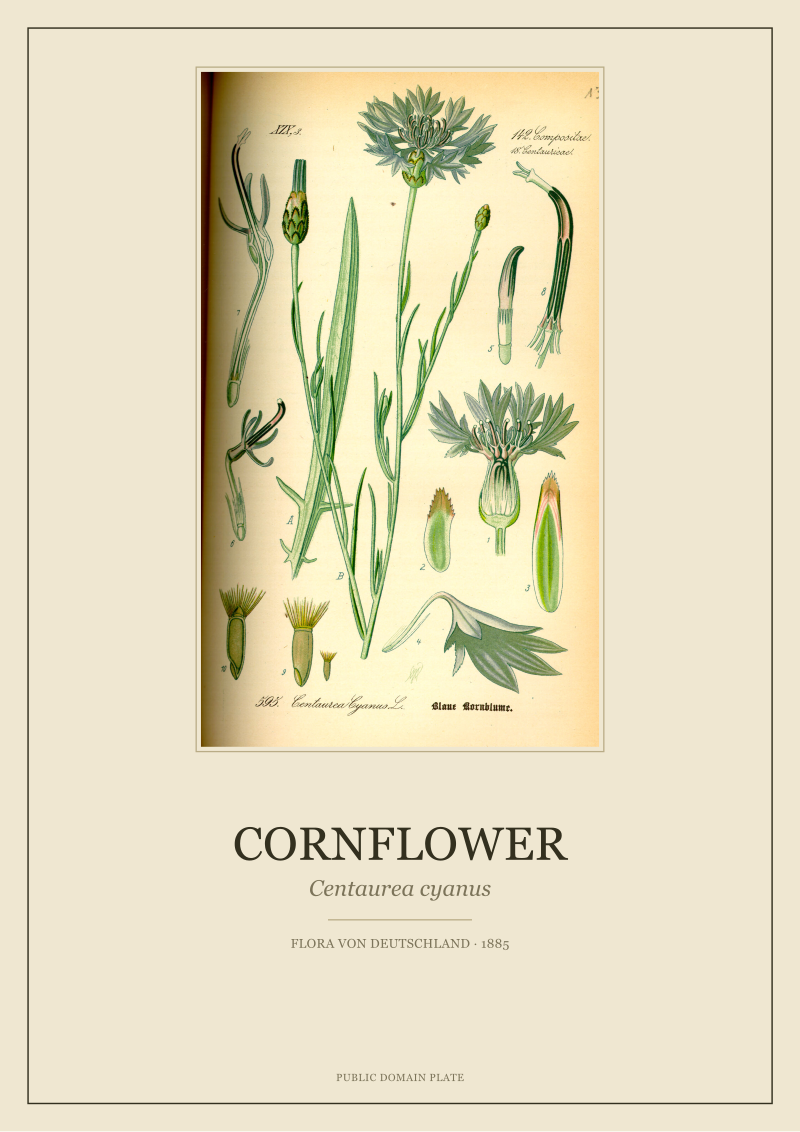
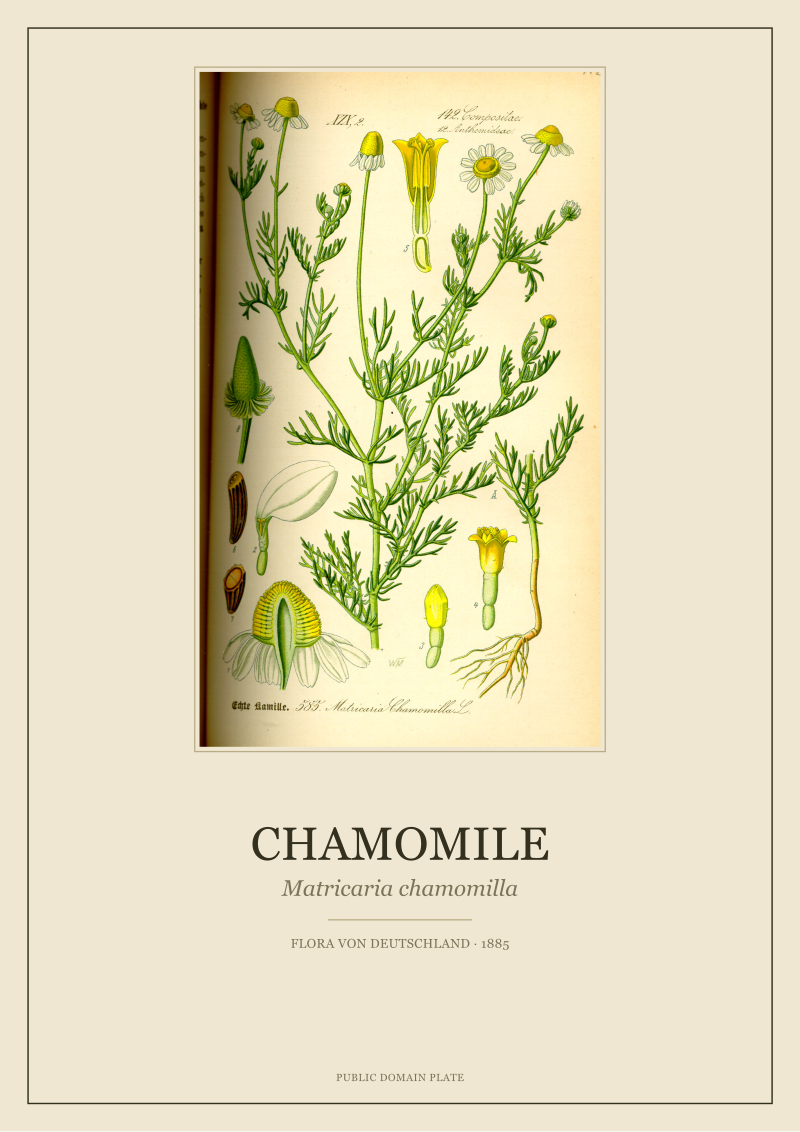
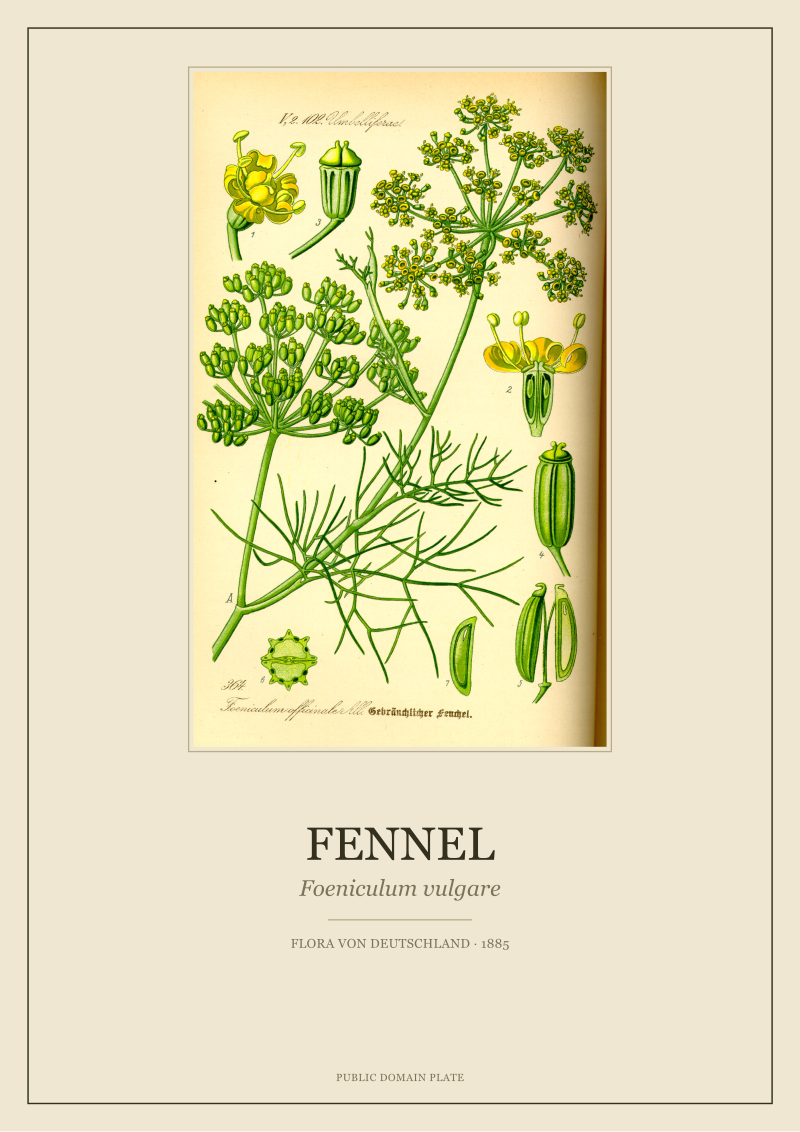
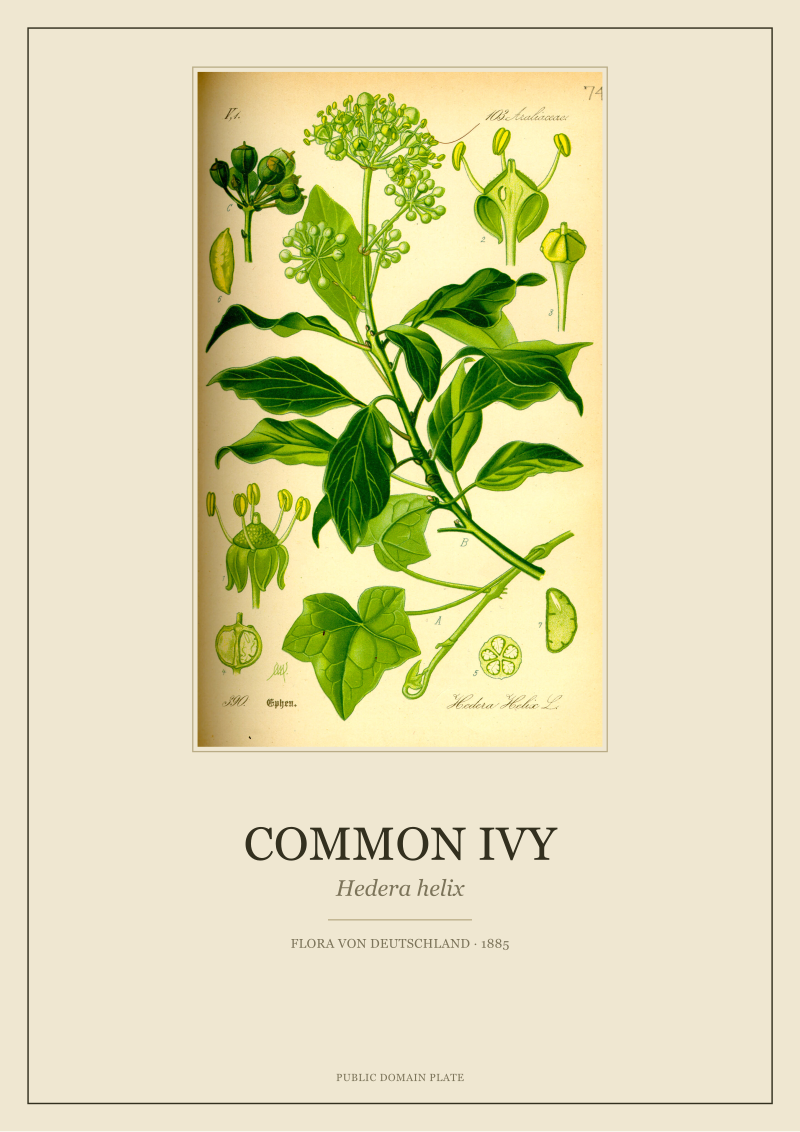
Four plants and four stories, incidentally, with nothing in common beyond the hand that drew them. Chamomile is the daisy-family workhorse whose name has been pulled across apothecary labels for centuries, which we mention here only as context for the illustration — the fine ray florets, the hollow conical receptacle Thomé insists on showing in section. Ivy is the opposite temperament: woody, climbing, promiscuous across walls, and in the Thomé plate drawn with its juvenile and adult leaf forms side-by-side, because Hedera helix changes its leaf shape when it is ready to flower and the schoolbook needed to teach that. Cornflower is the one that looks, at first glance, modern — the saturated blue is almost a graphic design cliché now — but the drawing is austere, agricultural, a plant that in 1885 was still a common weed of European grain fields. Fennel is pure structural geometry: the umbel radiating from the stem like a diagram of a diagram.
Four plates. One book. 1885. Everything on the bench is downstream of that line.
What the Numbers Actually Say About "Vintage"
Here is where language starts to drift. "Vintage" is not a legal term in print, framing, or furniture. Different trade bodies use different cut-offs — twenty years, fifty years, a hundred years — and antique markets in Melbourne and Sydney use the word interchangeably with "antique", "antique-style", "reproduction", and (occasionally) "aesthetic". Our standard, when we write about the plates we restore, is literal and dated: the source lithograph is 1885. We say so on every page.
That matters because the Australian market is unusually exposed to the slippage. A buyer in London or Berlin can plausibly find a loose 1885 Thomé page in a Saturday market stall; those originals circulated through German-language schools for decades and the physical paper, where it survived, migrated to flea markets and antiquarian sellers. In Australia, that migration essentially did not happen — the originals are rare, the shipping is punitive on a paper object that is already acidic and brittle, and the climate (we will come back to this) is a problem. So the vast majority of what sells as a "vintage botanical print" to an Australian address is one of three things, and only one of them is the thing the receipt describes.
The three categories, in descending order of what we would call honesty: a modern archival print made from a high-resolution scan of the original 1885 lithograph (what we do); a decorative reproduction printed on commodity stock from a lower-resolution scan with the colour sometimes "enhanced" past the plate's actual palette; and an "inspired by" piece, a new illustration drawn in the general key of 19th-century botanical work and sold under the same shelf label.
The first is 1885 in substance. The second is 1885 in source but not in craft. The third is 1885 in neither. All three cheerfully share the word "vintage" in Australian online marketplaces, which is why the receipt — artist, work, year — is the only thing that disambiguates them.
 Cornflower
The print from this article · from €29.95
View the print →
What Nobody Mentions About Buying Them in Australia
A few operational facts rarely show up in the listing copy, and they are the ones that determine whether a plate on your wall still looks like a plate in five years.
Climate first. Australian households run across a wider humidity band than most European ones — Brisbane and Darwin sit routinely above 70% relative humidity, and large parts of Victoria and NSW swing hard between dry winters and humid summers. Original 1885 lithographs are printed on acidic paper that was never engineered for that kind of oscillation. We have examined original Thomé pages, shipped to coastal Queensland and framed without buffering, that have foxed (those small rust-coloured spots) within eighteen months. A modern archival print on cotton rag, by contrast, is designed to be chemically stable under the same conditions, which is one of the quiet reasons our studio does not sell cut-up originals: the honest, long-lived object for an Australian wall is almost never the loose 1885 page.
Distance second. The posted-item shipping lane from Europe to Australia is, in paper-art terms, physically hostile — unventilated containers, temperature swings, the occasional tube that arrives having spent a week at 50 °C in a transit warehouse. A print in a rigid, archival mailer with corner protection is a different object by the time it arrives than one rolled into a cheap cardboard tube.
Framing third, and the least discussed. Many high-street framers in Australia will, by default, mount a print with pressure-sensitive tape against standard mountboard behind standard glass. Each of those three defaults is wrong for a long-lived botanical print. Acid-free hinges, cotton or alpha-cellulose mats, and glazing with UV filtration (museum glass, or acrylic equivalents) are the three line items that separate a print that reads clearly in 2040 from one that has yellowed, bowed, and faded. The cost difference per frame is non-trivial. The quality difference is not subtle.
None of this is secret. It is simply absent from the listing.
The Real Cost of a Plate Done Properly
Put a plausible dollar figure on it, start to finish, and the shape of the market becomes legible.
The commodity end: a mass-market "vintage botanical" print sold through a general homewares retailer in Australia will typically run between forty and ninety Australian dollars for a framed A3-ish object. The source is almost always a low- or mid-resolution scan — frequently from an aggregator database, sometimes with colour pushed to look more saturated than Thomé's original lithograph ever was — printed on commodity stock, in a factory frame with standard glass and standard mountboard. There is nothing inherently dishonest about this product. There is also almost no overlap, materially, with the 1885 plate the label gestures at.
The archival end: a studio-restored plate (a careful scan, cleaned of foxing and dust artefacts without flattening the paper's actual texture, printed on cotton rag with pigment inks rated for 100+ years of lightfast life, framed by a conservator or framed by the buyer with the three line items above) tends to sit between roughly 180 and 450 Australian dollars for a comparable size, depending on paper choice and framing specification. The print itself is the smaller of the two line items; the framing, done properly, is usually the larger one.
Where does the gap go? Roughly: the scan source and its licensing (public domain in substance, but a decent scan still has to come from somewhere, and the best source files have real labour in them), the restoration time (anywhere from two to twenty hours per plate depending on condition), the substrate (archival rag is five to eight times the cost of commodity poster stock), the ink (pigment vs. dye), and the framing stack described above.
If you want the comparison in one line: at the commodity end you are buying the look of 1885. At the archival end you are buying an object that will physically honour 1885 for the next hundred years. Which one you want depends entirely on the question the print is answering on your wall. The studio sells only the second kind, and we price it accordingly in our shop.
 Chamomile
The print from this article · from €29.95
View the print →
If You Only Remember One Thing
The three facts that travel with a botanical plate — artist, work, year — are the only ones that disambiguate "vintage" from vibe. For the four plates on our bench this morning, that triad is Thomé, Flora von Deutschland, 1885. Any seller who can state those three can be interrogated against them. Any seller who cannot is selling you a word.
The next question — the one this piece is a handoff to, not an answer for — is which 1885 plate actually belongs on your particular wall. That is a question about room, light, paper, and the plant you can still name in your head a year from now. It is not a question the receipt can settle, and it is where our next piece picks up.
FAQ
Are these 1885 Thomé plates actually in the public domain in Australia?
Yes. Australian copyright for a lithograph of this age has long since expired, and the public-domain status of the Thomé plates travels with the work regardless of the buyer's jurisdiction. What we sell is a restored archival print made from a high-resolution scan of the public-domain source — the underlying image is free to reproduce, which is why no licensing fee is attached to the plate itself. The craft and the materials, not the image rights, are what you are paying for.
Does "vintage" mean the print I receive is from 1885?
Almost never. The 1885 refers to the original Thomé lithograph, which is the source. The physical object you hang is a modern archival reproduction printed, in our case, on cotton rag with pigment inks rated for a 100+ year lightfast life. Loose original 1885 pages do exist, but they are rare, acidic, and poorly suited to the Australian climate. The archival print is the honest long-lived object; the word "vintage" refers to the plate's historical origin, not the paper's age.
Why not just buy an original 1885 page from a European seller?
Three reasons stack up. First, condition: survivor pages are often already foxed, trimmed, or glued, and shipping accelerates the damage. Second, climate: Australian humidity ranges are hostile to acidic paper, especially above the 30th parallel. Third, framing: an original page needs museum-grade framing or it degrades visibly within a few years. The total cost of acquiring, shipping, and conservation-framing an original frequently exceeds a studio-restored archival print, with a shorter effective lifespan on the wall.
How much should I budget for a well-framed botanical print in Australia?
Figure between 180 and 450 Australian dollars for a studio-restored archival print at a mid-size format, with the frame doing most of the heavy lifting on the upper end of that range. The three framing line items that matter are acid-free hinging (not tape), a cotton or alpha-cellulose mat, and UV-filtering glazing. The print itself is usually the smaller cost; the framing done to archival standard is usually the larger one, and the gap between a correct frame and a default-store frame is the single biggest factor in how the print ages.
Can I frame these myself and still have an archival result?
Yes, with discipline. The three non-negotiables are the same whether a conservator does the work or you do: hinge the print with acid-free paper hinges rather than any pressure-sensitive tape, use a cotton or alpha-cellulose mat with a bevelled window rather than standard mountboard, and specify UV-filtering glazing (museum glass or an equivalent acrylic). Those three items are available through specialist framing suppliers in every capital city. The rest — the frame moulding, the proportions — is aesthetic and reversible.
Why does the studio only sell these four plants?
It is not a doctrine, it is a working rhythm — four plates were on the bench the morning we wrote this, and the restoration pipeline runs plate by plate from the same Thomé source. The broader catalogue grows as each plate finishes its restoration cycle. We would rather release ten plates we have personally cleaned, graded, and proofed than list two hundred we have only aggregated from a database. The receipt — artist, work, year — stays stable across every plate we add.
Will the colours match the original Thomé lithograph exactly?
Closely, not identically, and we are explicit about this. A 1885 chromolithograph was printed from a limited stone-and-ink palette, and the colours in surviving copies vary from one another based on print run and 141 years of light exposure. Our restoration targets the plate's own documented palette rather than a punched-up version — the Cornflower blue, for example, is held back from the saturated cliché it has become in modern reproductions. The intent is the drawing's actual tonality, not a flattering lie about it.
New plates from the archive and 10% off your first print.
One email now with your code. No noise after.