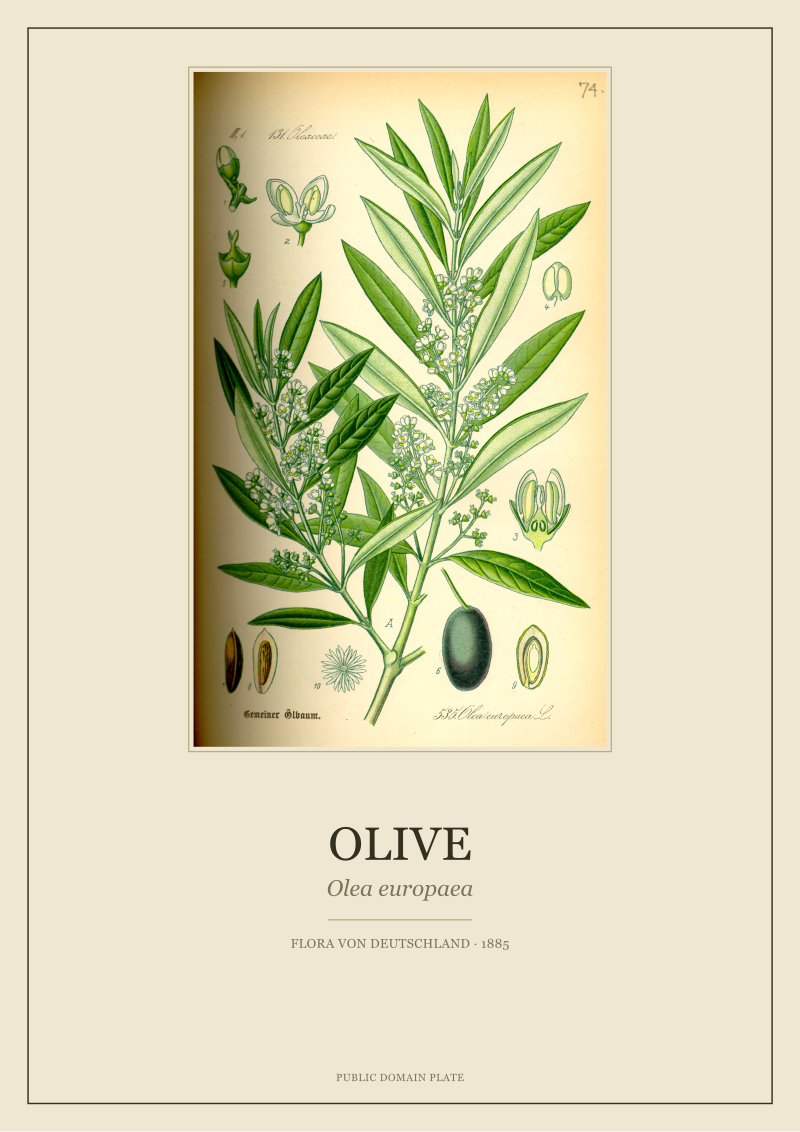
For anyone hanging our 1885 Olea europaea plate — the one O.W. Thomé engraved for Flora von Deutschland, Österreich und der Schweiz — framed under glass is the better default, and it is not close. The obvious objection: unframed prints look softer, more Mediterranean, more like the grove the tree came from, and interiors accounts have spent five years selling exactly that mood with wooden dowels and linen twine. We think that consensus is wrong for this particular plate, for a specific and defensible reason grounded in what Thomé actually drew and how the paper he drew it on behaves. The rest of this piece exists to prove it.
The Steel-Man for Hanging It Unframed, Taken Seriously
We should start by giving the other side its best day in court, because there is a real argument for the dowel-and-twine school and pretending otherwise would be cheap. The strongest version goes like this: an olive plate wants to breathe. The tree itself lives on hillsides in Puglia and the Peloponnese and the Alentejo, where nothing is behind glass, where the leaves are silver-green because of the light and the wind rather than the paper. Put Olea europaea under a sheet of museum acrylic and you are, in one gesture, importing the mood of a Milan bank lobby into a room that was trying to feel like a farmhouse near Ostuni. This is not a stupid objection. It is the reason the entire genre of unframed botanical print sold as well as it did through the 2020s, and it is why every third Etsy listing for an olive branch print still ships without a frame.
The steel-man goes further. Unframed prints are cheaper to ship, easier to swap seasonally, kinder to the plaster of a rental wall. They read as more casual, less museum, less "we take ourselves seriously". In a kitchen with open shelving and unpainted terracotta on the counter, a framed 19th century plate can feel like a stiff cousin who came dressed for church. Two magnetic strips or a raw pine dowel across the top edge, and suddenly the same image is participating in the room rather than presiding over it. We concede all of this. The rest of the piece is not about denying the mood argument; it is about explaining why, for this specific plate and this specific paper, the mood is being paid for by the object itself, and the trade is worse than it looks.
The Paper Is the Point, and Paper Needs Glass
The confusion at the centre of the framed-or-unframed debate is that people talk about "an olive print" as if it were an image. It is not. It is a physical object that carries an image. When we restore the Thomé plate we are not printing a decoration of an olive branch; we are producing a facsimile of a lithographic plate on a specific paper stock that is, deliberately, close to what the 1885 original would have felt like in the hand. That means a heavier weight, a slight cream cast, a matte surface that catches light the way linen catches light rather than the way a screen does. This is the entire reason the piece is worth hanging in the first place. If you wanted flat pixels of a branch you could get them for the price of a coffee.
Paper of this weight and finish has one enemy, which is airborne moisture, and one accomplice to that enemy, which is time. The fibres pull water in and out of themselves every day depending on what the kitchen is doing, and they do it unevenly across the sheet because the sheet is uneven by design. The visible result, after twelve to eighteen months of unframed life above a hob, is a slow potato-chip curl at the corners, a faint darkening along the top edge where warm air rises against the wall, and a papery softness where the surface used to hold its snap. Glass — even the cheap glass in a supermarket frame — stops roughly all of that. It is not about ostentation. It is about the fact that a plate we spent weeks bringing back from a 140-year-old scan does not deserve to be undone by the humidity of your dishwasher in a season and a half.
 Olive
The print from this article · from €29.95
View the print →
Olive
The print from this article · from €29.95
View the print →
Thomé Drew Olea europaea for Reproduction, Not for a Clothespin
There is a second argument that has nothing to do with conservation and everything to do with what Otto Wilhelm Thomé was actually doing at his desk in the 1880s. Flora von Deutschland, Österreich und der Schweiz was a scientific publication, and the plates in it were engineered — the word is deliberate — for a very particular reading distance and a very particular support. Thomé drew Olea europaea knowing it would be printed on a page, bound between covers, held at forearm's length under lamplight, and read the way you read a page: with the eye moving from the flowering shoot to the drupe cross-section to the label. The composition has margin discipline. The line weights are calibrated for the paper he expected. Every visual decision assumes the image will sit flat.
Hang the same image unframed with two spring clips at the top and you have made a decision the artist did not authorise. The sheet will lift and belly slightly at the bottom, catching a shadow that was not in the original engraving. The lower half of the plate — where the drupe and its section live, arguably the most botanically informative part of the whole illustration — falls into a slight backward curve, and the eye reads the top of the sheet before it reaches those details, if it reaches them at all. This is not conservatorial pedantry. It is simply that the plate stops working as a plate. Framed flat behind glass, Thomé's margin logic is intact and the drupe reads at the same visual weight as the flowering branch above it. That is the piece he sent to the printer. The dowel version is a different image, and it is a worse one.
| Dimension | Framed under glass | Unframed with clips or dowel |
|---|---|---|
| Paper flatness | Held rigid; original margin logic intact | Progressive belly at lower edge within weeks |
| Humidity exposure | Sealed cavity; buffered against kitchen air | Full contact with room RH swings |
| UV load on a bright wall | ~99% blocked with standard museum glass; ~50% with plain float | 100% direct; visible fade in 12–24 months on a south wall |
| Corner condition after 24 months | Unchanged | Curl and softening common |
| Cost to prepare | £45–£120 for a competent frame in the UK equivalent range | £4–£15 for hardware |
| Reversibility | Fully reversible — can always be unframed | Non-reversible once the paper has warped |
Unframed Prints Curl, Yellow, and Quietly Die on a South Wall
The third argument is the one nobody making Reels wants to make, because it takes longer than fifteen seconds and it does not sell dowels. Botanical plates on the kind of paper we use are photochemically active. Ultraviolet light drives a slow oxidation of the fibres and of any residual lignin, and the visible outcome — over months, not years — is a shift from cream to a duller warm yellow, with the highlights in the printed area going flat first. On a south-facing wall in a British living room with normal double glazing, we would expect a measurable colour shift on unglazed paper inside eighteen months, and a clearly visible one at three years. Standard picture glass cuts roughly half the UV load; museum glass cuts something like 99% of it, depending on the coating. Neither of these is exotic technology. They are both sitting in your local framer's back room right now.
We have watched this happen on our own studio proofs, which is how we know the timeline is not theoretical. A proof of Olea europaea pinned to the wall above the scanning bench for a year, in a room that gets morning sun through north-east glass, came off the pin with a pale rectangle around each pin hole and a top-edge tone that no longer matched the un-lit lower third. That is a controlled indoor environment with weak light. Put the same plate in the sun-porch of a house in Andalusia with clips holding it to a beam, and the honest expected life of the object as a viewable image is a matter of a couple of summers. The Instagram version of the room will look wonderful in the first photograph. It will not look like that on year three, and no amount of "patina" language changes what has happened to the piece.
What "Framed" Actually Means for an 1885 Botanical Plate
Once we have argued for framing, the next honest step is to say what we mean by it, because "framed" in the interiors-account sense is often as damaging as the dowel it replaced. A cheap moulding with a spring-loaded backing board pressed directly against the paper, no window mat, and float glass in contact with the ink is not conservation framing. It is a sandwich, and the plate loses to the sandwich. A useful frame for this specific object has four attributes and none of them are decorative.
First, the paper must not touch the glass. That is either a window mat cut to sit slightly proud of the sheet, or a set of hidden spacers around the rebate. Second, the mat and backing board should be acid-free — the standard shorthand is "conservation" or "museum" board — because ordinary card will eventually stain the paper it is in contact with. Third, the glazing should have UV protection if the wall gets any direct sun; if it does not, plain float glass is defensible on cost grounds. Fourth, the framer should use hinge mounts made of Japanese tissue and reversible wheat starch paste rather than adhesive tape, so that in twenty years the plate can be removed from the frame without damage. These are unglamorous specifications. They are also, cumulatively, what separates a Thomé plate that will be on a wall in 2065 from one that will be in a bin by 2032. On the aesthetic question, a plain black or unfinished oak moulding with a generous cream mat gets out of the plate's way and lets the paper do what it was made to do; heavy gilt or busy profiles fight the image and always lose.
What You Should Actually Do
If you have just bought the Olea europaea plate from our shop and you are standing in the kitchen wondering, the short version is this: take the flat tube to a local framer, ask for a conservation frame with an acid-free window mat sitting a few millimetres proud of the sheet, a plain black or oak moulding no wider than about three centimetres, and standard glass unless the wall gets direct afternoon sun — in which case pay the surcharge for UV glazing. If your framer looks confused when you say "hinge mount with wheat starch paste", find another framer. The whole intervention should cost between the price of a mid-range dinner for two and a low-end weekend away, and it is a one-time cost against an object that will otherwise survive you.
If the mood argument still bothers you — if the room truly wants the softer, unframed presence — the compromise we would defend is a shallow tray frame in raw oak with no glass and no mat, hung on an interior wall away from the kitchen and out of any direct sunlight, and understood as a five-year piece rather than a lifetime one. That is a real trade you are allowed to make, as long as you make it knowingly. What we push back on is the version where nobody tells you the trade exists, the plate goes up on twine above the espresso machine, and eighteen months later the corners are lifting and the cream has gone tobacco and everyone blames the paper. The paper is doing exactly what 1885 paper does. The decision that failed it was earlier.
FAQ
Will framing behind glass make the print look "too formal" for a rustic kitchen?
Only if the frame fights the plate. A three-centimetre unfinished oak moulding with a generous cream mat and non-reflective glass reads as quiet and warm, not corporate — closer to a village museum vitrine than a bank lobby. The formality people worry about comes from heavy gilt, thick black lacquer, or shiny float glass throwing reflections. Choose plain profiles and matte glazing and the frame effectively disappears, leaving the botanical illustration as the loudest thing on the wall.
How much should a conservation frame for the Olea europaea plate cost in 2026?
For a standard A3-ish plate size, a competent independent framer in most European cities will quote roughly £45 to £120 for a plain moulding with acid-free mat, hinge mount, and standard glass. UV-protective museum glass typically adds £30 to £70 depending on the size. High-street chain framers can undercut these numbers, but often substitute non-archival board and adhesive tape mounts, which is exactly the saving you do not want to make on a plate you intend to keep.
Can I hang it unframed if the wall never gets direct sunlight?
You buy yourself time, not immunity. Ambient indoor UV is lower than direct sun but not zero, and the humidity issue is independent of light — a hallway with no window still cycles between damp and dry as the front door opens. Realistically, an unframed plate on a shaded interior wall in a temperate climate will look acceptable for two to four years before curl and edge-tone become visible. Framing it later is possible, but any warping already set into the paper will not fully flatten.
Is museum glass worth the surcharge, or is standard picture glass fine?
It depends entirely on the wall. Standard float glass blocks roughly half of incoming UV, which is enough for interior walls with only reflected daylight. On any wall that catches even an hour of direct sun through the year, museum-grade UV glazing — which blocks around 99% of UV and has an anti-reflective coating — is the difference between a plate that holds its cream tone for decades and one that visibly shifts warm within a few years. It is a one-time cost against a permanent object.
Does the same advice apply to smaller or larger sizes of the plate?
The conservation logic is identical at any size; the aesthetic choices scale. On smaller formats a narrower moulding and slimmer mat keep the composition tight. On larger prints a slightly wider mat prevents the image from feeling crowded inside the frame. What does not change: acid-free board, hinge mount, non-contact between paper and glass. Those requirements are properties of the paper and the ink, not of the dimensions.
Can I frame it myself with a supermarket frame to save money?
You can, and it will be better than leaving the plate unframed, but understand what you are accepting. Off-the-shelf frames almost always have wood-pulp backing boards that will eventually acid-burn the paper from behind, and the glass usually sits flush against the surface. As a stopgap for a year or two while you save for proper framing, it is defensible. As a permanent solution for a plate you paid for and intend to keep, it is a false economy that becomes visible right about the moment it stops being reversible.
Why not just print a fresh copy every few years and hang each one unframed?
Because the plate is not a poster. Each restored print carries a specific paper choice, a specific tonal balance, and a specific relationship to the 1885 original that we spend real time producing. Treating it as a consumable defeats the point of buying a restored plate rather than a mass-market decor print. If you genuinely want a disposable image, the honest move is to buy a disposable image; if you want the Thomé, frame the Thomé.
New plates from the archive and 10% off your first print.
One email now with your code. No noise after.