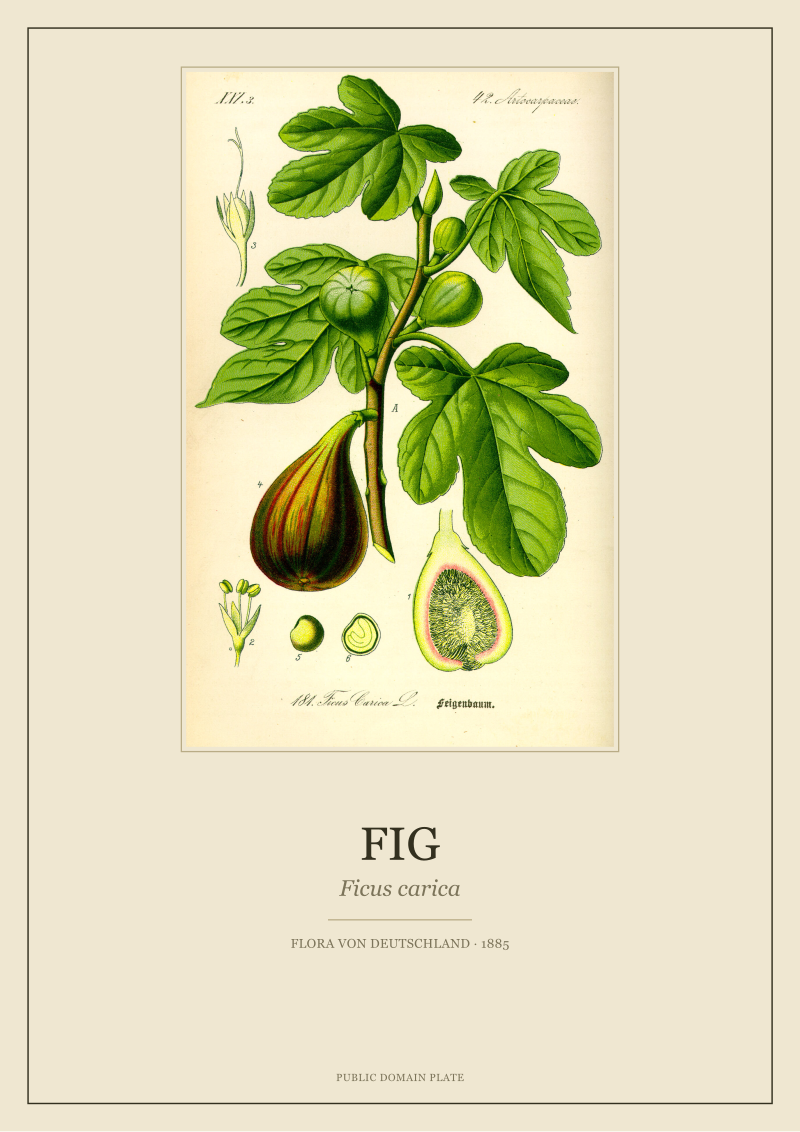
Most people look at a nineteenth century fig plate and see decoration. They are wrong, and calmly so. Hear me out. Every fig plate the studio restores — and Otto Wilhelm Thomé's 1885 Ficus carica from Flora von Deutschland, Österreich und der Schweiz is the one that keeps landing on the desk — is built as a forensic document first and a beautiful object second. There is a pattern we keep seeing: the details readers assume are ornamental are almost always taxonomic. The leaf lobing, the syconium sliced open in cross-section, the small Latin line beneath the composition — none of it is filler. It is the drawing telling the truth about the plant.
The Pattern: Details Assumed Ornamental Are Almost Always Taxonomic
The pattern shows up before we even open the scan. Readers write in about their favourite plate, and roughly nine notes out of ten describe it the same way: they mention the composition, the colour, sometimes the "vibe" of the paper. Almost nobody mentions the anatomy. The fig plate is the clearest example of the disconnect, because Thomé's Ficus carica looks, at a glance, like a decorative arrangement of a leafy branch. It is not. It is a keying document dressed up well enough to hang on a schoolroom wall.
The reason for the misreading is historical. A nineteenth century flora had two audiences at once. The first was the professional botanist, who needed enough evidence in the picture to identify a specimen without touching one. The second was the schoolteacher, the pharmacist, the amateur — the reader for whom the image had to be legible, orderly and, yes, pleasant to look at. Thomé's whole enterprise, the Flora von Deutschland, Österreich und der Schweiz published in 1885, was built to serve both audiences on the same page. That is why the plates feel so composed: the composition is doing the heavy lifting of making a taxonomic key look like an illustration.
Once you learn to read the plates as documents, the "ornament" argument collapses. Nothing sits on the sheet for aesthetic reasons alone. A leaf angled toward the viewer is angled because that angle shows the lobe pattern most clearly. A stem cut on a diagonal is cut that way so the joint at the node stays visible. A fruit rendered next to a fruit-in-section is not there for symmetry; it is there because the whole species argument requires both views. The pattern we keep seeing is that the more "decorative" a Thomé plate feels, the more disciplined its scientific labour usually is. The Ficus carica sheet is a textbook case.
The Lobed Leaf: Silhouette as Species Signature
The single most identifiable element on the Ficus carica plate is the leaf, and it is doing all the work the artist could ask of it. A fig leaf is famously lobed — usually three or five palmate lobes with rounded sinuses between them — and Thomé draws it in full silhouette, held slightly open toward the viewer, with the venation traced from the petiole outward. The silhouette is the species signature. If you learned botany from these plates, you learned to identify a fig from thirty feet away by the leaf shape alone, and Thomé's rendering is set up to teach exactly that.
Look at where the leaf sits on the sheet. It is not tucked into a corner or used as background: it is placed near the compositional centre, angled so that the plane of the blade is as close to parallel with the page as a naturalistic drawing can get. This is a choice. A leaf shown edge-on would give you almost no diagnostic information; a leaf laid perfectly flat would look pressed and dead. The artist splits the difference. What you get is a leaf that reads as alive but reveals its outline honestly — the lobes counted, the sinuses shaped, the tip and the base both legible.
The venation is the other quiet argument in the leaf. Fig leaves have a palmate primary vein pattern radiating from the petiole, with secondary veins branching out toward the lobe tips. Thomé draws this network cleanly enough that you can trace it, but not so clinically that it competes with the outline. He is using two different rendering densities at once: an emphatic contour for the silhouette, and a lighter interior for the veins. That is why the leaf reads as botanical rather than decorative. A decorator would have flattened the vein structure to a background texture. A botanist keeps the veins prominent enough to key from.
None of this is unique to the fig, but the fig makes it obvious. The leaf is so recognisable — so photographically famous, thanks to two thousand years of Mediterranean art — that we forget it is a diagnostic feature first. Thomé remembered.
 Fig
The print from this article · from €29.95
View the print →
Fig
The print from this article · from €29.95
View the print →
The Cross-Section: Why 1885 Cut the Fig Open on the Page
Here is the detail that most reproduction posters quietly remove because it "looks odd" on a wall: the sliced syconium. On the original Ficus carica plate, the fig fruit does not appear only in its familiar teardrop form. It appears also cut cleanly in half, with the interior exposed — the hollow chamber, the packed layer of tiny florets lining the inside wall, the narrow opening at the tip called the ostiole. That cut is not a whim. It is arguably the most important botanical statement on the whole sheet.
The fig is a flower turned inward, and until you draw the cross-section you are not really drawing a fig at all.
A fig is not, technically, a fruit in the everyday sense. It is a syconium: an inverted inflorescence, a stem tip that has curled in on itself so that hundreds of minuscule flowers bloom on the inside of a closed vessel. Whatever you eat when you eat a fig, you are eating the ripened wall of that vessel plus its interior of tiny fertilised florets. You cannot show that with an exterior view. You cannot even hint at it. The whole reason nineteenth century floras drew the fig in section was to make the reader see, at a glance, what a fig actually is — a flower structure disguised as fruit. Thomé's plate makes that argument in a single stroke.
The compositional courage of the cut is easy to miss now. In 1885, showing the interior of a familiar edible on a botanical plate was not a design flourish; it was a pedagogical necessity. Every reader of the Flora had been eating figs their whole life without knowing they had been eating an inside-out bouquet. The cross-section on the plate corrects that in silence. And it also solves a problem for the artist: the exterior of a ripe fig is, honestly, a dark and uninformative shape. The interior — with its radiating floret texture, its faint gradient from wall to hollow, its visible ostiole — is where all the visual interest lives. Botany and composition, for once, are pulling in the same direction.
When we restore this plate, the cross-section is the element we protect most carefully. Old scans blur it. Cheap reproductions crop it out. Both moves gut the drawing. Without the sliced syconium, the Ficus carica sheet becomes a pretty branch. With it, the sheet becomes an argument about what a fig fundamentally is.
The Latin Label: The Real Caption Sitting Under the Art
There is one more detail almost every reader overlooks, and it sits at the bottom of the sheet in the smallest type on the page: the Latin label. On the Ficus carica plate it reads, in the terse scientific convention of the period, the genus and species followed by an authority abbreviation — the binomial that tells you exactly which taxonomic entity this drawing claims to represent. It looks like a caption. It is not a caption. It is the anchor that makes the entire drawing verifiable.
Botanical Latin, as it appears on these plates, is not decorative typography. Every element is load-bearing. The genus name (Ficus) locates the plant within a family — Moraceae, the mulberry family — and immediately narrows the range of species the drawing could depict. The species epithet (carica) narrows it further, to the specific Mediterranean fig with this leaf shape, this fruit form, this native range. The authority that follows tells you which botanist formally described the species, and by extension which published description the drawing is expected to match. In 1885, a reader could take that label, walk to a herbarium, and compare the drawing against a preserved specimen and a written diagnosis. The label is what makes the drawing scientific rather than merely accurate.
That is why, when we restore a Thomé plate, we treat the Latin line with the same care as any painted element. Chromolithographic type in the 1880s was printed in a distinct ink layer, often faded now, sometimes ghosted almost to invisibility on the original sheet. It is tempting to reset the text in a modern typeface for "readability". We do not. The type is part of the historical object; more than that, it is the drawing's certificate of identity. Remove it, or replace it with a modern face, and you have quietly demoted the plate from a document to a decoration. The whole point of Thomé's Flora was that it never was one.
Read from the label up, the plate suddenly reorganises itself. First the taxonomic claim: this is Ficus carica. Then the evidence, in visual form: this is what the leaf looks like, this is what the fruit looks like from the outside, this is what the fruit looks like from the inside. Nothing on the sheet is arbitrary. Nothing is there for balance alone. Every detail is testifying.
So What Do You Actually Do
If you have a fig plate on your wall, or you are thinking about hanging one, the practical advice is short and slightly unromantic. Read the plate before you frame it. Spend ten minutes with the leaf shape, count the lobes, follow the veins from petiole to tip. Look for the cross-section — if the version you have does not include it, you are looking at a stripped reproduction and you should probably find another. Find the Latin line. Say the binomial out loud. You will look at the plate differently within a week, and you will look at every other botanical print differently within a month.
If you are buying a print, the same reading applies as a quality test. A trustworthy restoration of a nineteenth century fig plate will keep all three of the elements this piece has been about: the honest lobed leaf silhouette with its venation intact, the sliced syconium in cross-section, and the original Latin label typeset as it was on the source sheet. If any of those are missing, cropped, softened or replaced, the object in front of you has been redesigned rather than restored. The difference matters, and the price should reflect it. Our own restorations of Thomé's Ficus carica live at /shop/ for readers who want to compare against the checklist above.
The last piece of advice is the one we give ourselves, in the studio, every time a new plate comes in. Trust the artist. Otto Wilhelm Thomé, working in 1885 with a team of lithographers and a chromolithographic press, was not decorating a page. He was building a scientific argument you could hang on a wall. When you restore his work, and when you live with it afterwards, the least you can do is read what he actually drew.
This piece did not cover the ecological story of the fig wasp, which is the reason the syconium evolved in the first place and which deserves its own essay. It did not cover the printing history of chromolithography, the technology behind the colour on these sheets, which we treat separately when we talk about how the plates were made. And it did not cover the long iconography of the fig in art history from Roman frescoes onward, which is a cultural argument rather than a botanical one. Each of those is a different room in the same house, and each is worth walking through on its own.
FAQ
Why does the fig on the plate appear twice, once whole and once cut in half?
Because a fig is not really a fruit in the everyday sense — it is a syconium, an inflorescence turned inside out, with hundreds of tiny flowers lining an internal cavity. A whole fig shows you only the outside of that cavity. The cross-section reveals what the plant actually is. Nineteenth century floras like Thomé's 1885 sheet cut the fig open on the page so the reader would understand the structure, not just recognise the silhouette.
What is the small Latin line at the bottom of a Thomé fig plate?
It is the binomial identification: the genus Ficus, the species epithet carica, and typically an authority abbreviation for the botanist who formally described the species. It functions as the drawing's certificate of identity, letting a nineteenth century reader cross-check the illustration against a preserved herbarium specimen or a written diagnosis. It looks like typography. It is really the anchor that makes the plate scientifically verifiable rather than merely pretty.
Why are the fig leaves drawn with such prominent lobes and veins?
Because leaf shape is one of the fastest ways to identify a fig at a glance. Ficus carica leaves are palmately lobed, usually with three or five rounded lobes and clearly radiating primary veins. Thomé emphasises both features so that a reader learning botany from the plate could recognise the species in the field. The prominence is diagnostic, not decorative — a flattened or stylised leaf would strip the drawing of its keying value.
Who was Otto Wilhelm Thomé and what is Flora von Deutschland?
Otto Wilhelm Thomé was a nineteenth century German botanist and educator whose Flora von Deutschland, Österreich und der Schweiz was published in 1885. The work is a systematic flora of the German-speaking lands, illustrated with hundreds of chromolithographic plates intended to teach species identification to students, teachers and amateur naturalists alongside professional botanists. The plates now sit in the public domain and have become one of the most quoted sources of nineteenth century botanical art.
Is a modern reproduction of the fig plate the same as a proper restoration?
No. A reproduction typically re-prints a low-resolution scan, sometimes cropping the cross-section or resetting the Latin type in a modern font for "readability". A restoration works from the highest available scan of the original 1885 sheet and preserves every diagnostic element — the leaf silhouette, the syconium in section, the original typography. The difference is not sentimental. A stripped reproduction quietly demotes a scientific document into a decoration.
Are the details on the plate accurate by modern botanical standards?
Broadly yes, for the features the plate depicts. The leaf morphology, the syconium structure and the taxonomic naming Thomé uses remain consistent with how Ficus carica is understood today. Nomenclatural revisions since 1885 have refined some authority citations across the wider genus Ficus, but the species identity on this particular plate has been stable. As a nineteenth century document, it holds up better than most illustrations of comparable age.
Why do restorers avoid retouching the Latin type into a modern typeface?
Because the type is part of the historical object, and because it is the drawing's identity claim. Replacing it with a modern face would erase the visible evidence that this is an 1885 chromolithograph and would treat the label as caption rather than as scientific anchor. Restoration in the studio sense means stabilising what fades — not editing what the original author put on the page. The Latin line stays as printed.
New plates from the archive and 10% off your first print.
One email now with your code. No noise after.