Most gift guides for botanical prints are ranked lists that assume the giver already knows the recipient's taste better than the recipient does. This one does not. We are the studio behind the restorations, and we watch people buy the wrong plate for the right person more often than the reverse. So this guide is a flowchart in prose: three questions, routed carefully, ending in a small table. We start with fennel — *Foeniculum vulgare*, drawn by O.W. Thomé for his *Flora von Deutschland, Österreich und der Schweiz* in 1885 — because it is the plate people ask about first, and often the one they should not buy.
Question 1: Does the Recipient Already Love a Specific Plant?
This is the first fork because it decides whether you are giving a gift or projecting one. A botanical print is not a bouquet. It does not wilt. It stays on a wall for years, in the recipient's eyeline every morning. If the plant is already meaningful to them, you are confirming a small private fact. If it is not, you are asserting one. The two are different transactions, and the second one fails more often.
Fennel is the canonical trap here. It shows up in gift-guide roundups because *Foeniculum vulgare* looks handsome in Thomé's 1885 plate — the umbels open in a light structure, the seeds sit at the tip of the frame, the linework is exact. But the plant carries a specific cultural signal. Someone who loves fennel usually loves fennel: they cook with it, they know pastis, they grew it once in a raised bed. Someone who is neutral on fennel sees a fennel plate on the wall as an anise-adjacent question mark that never quite resolves.
If Yes
Buy the plate of the plant they already love, not the one you assume they should love. Verify the species down to the epithet if you can. A recipient who says "I love lavender" may mean *Lavandula angustifolia* (English lavender, narrow leaves, cool violet spike) or *Lavandula stoechas* (French lavender, tufted bracts, warmer colour). The Thomé plates distinguish between species; a reproduction from an unclear source may not. Match the specific plant. If it is fennel, then the fennel plate is exactly right — this is the only clean route to giving fennel as a gift.
If No
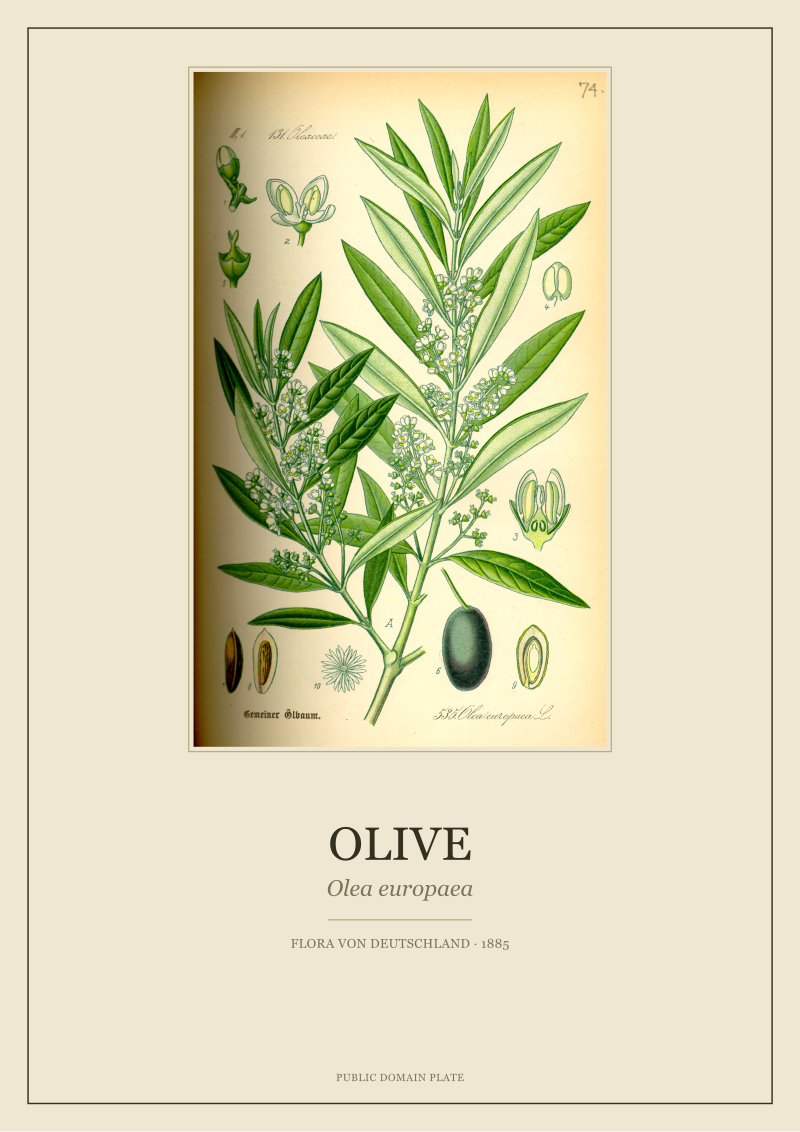
Do not compensate with something rare or "interesting". Rare plants are the second-most-common mistake in this category. A monkshood or belladonna plate is striking and quite loud on a wall, and it usually gets removed within a year. Route instead toward what we call a low-signal botanical: a common European tree, a familiar herb (rosemary, thyme), a domestic fruit (apple, plum). These plates communicate craft and paper rather than the giver's opinion of the recipient's inner life. Fennel does not qualify as low-signal. Fennel is a signal.
Question 2: Where Will the Print Actually Hang?
This is the second fork because framing and paper are decided by the wall, and the wall is decided by the room. A print that works in a north-facing hallway will look muddy in a bright kitchen. A print that reads across a dining room will disappear over a small desk. The question sounds practical because it is. Skip it and you will buy something that stays in the tube.
The Thomé plates were originally printed as book pages, roughly 22 × 30 cm, on machine-made paper of the 1880s. Modern archival prints from restored scans commonly run at A4 (21 × 29.7 cm), A3 (29.7 × 42 cm), or A2 (42 × 59.4 cm). The size choice is not aesthetic — it is functional. A2 dominates a room. A4 disappears in one. A3 is the safe default for a print that must hang alongside furniture and not compete with it.
If Yes
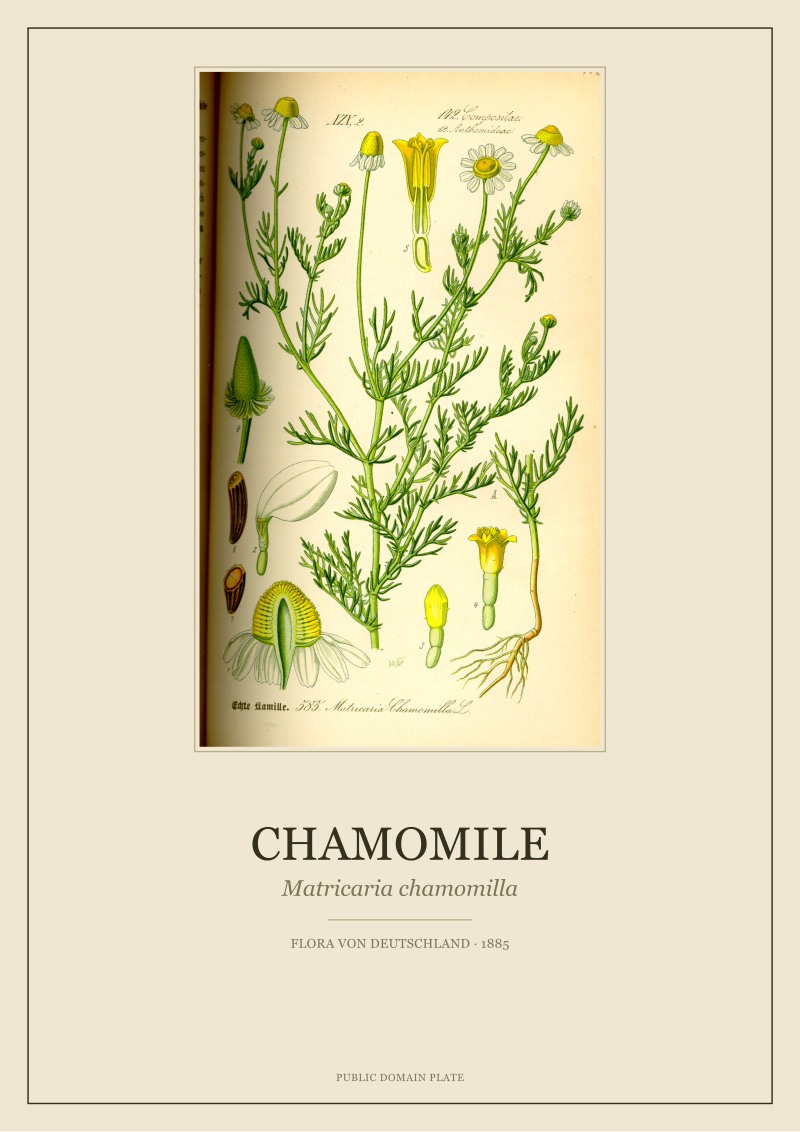
If you know the exact wall — you have seen it, you have measured it, you know what is currently there — buy for the room. Kitchens tolerate warmer plates: fennel, dill, chamomile, olive. Hallways handle darker foliage and denser compositions. Studies and reading corners can carry a single specimen plate with a wide mount, because the eye rests on them. A bathroom is not a place for archival ink on cotton rag; humidity fades the pigment faster than a sunlit wall would. If the wall is a bathroom wall, route back to Question 1 and give a different gift.
If No
If you do not know the wall, buy small and buy neutral. A4 with a generous mount, in a plain wood or matte black frame, will find a place in most rooms without demanding one. Avoid gold frames, and avoid anything wider than the print's mount — a heavy frame reads as decoration, and a paper botanical wants to read as document. Do not buy an unframed print for someone who has never framed anything. Framing is a two-week errand most people never run; the gift then hangs unframed for a year and becomes a mild reproach.
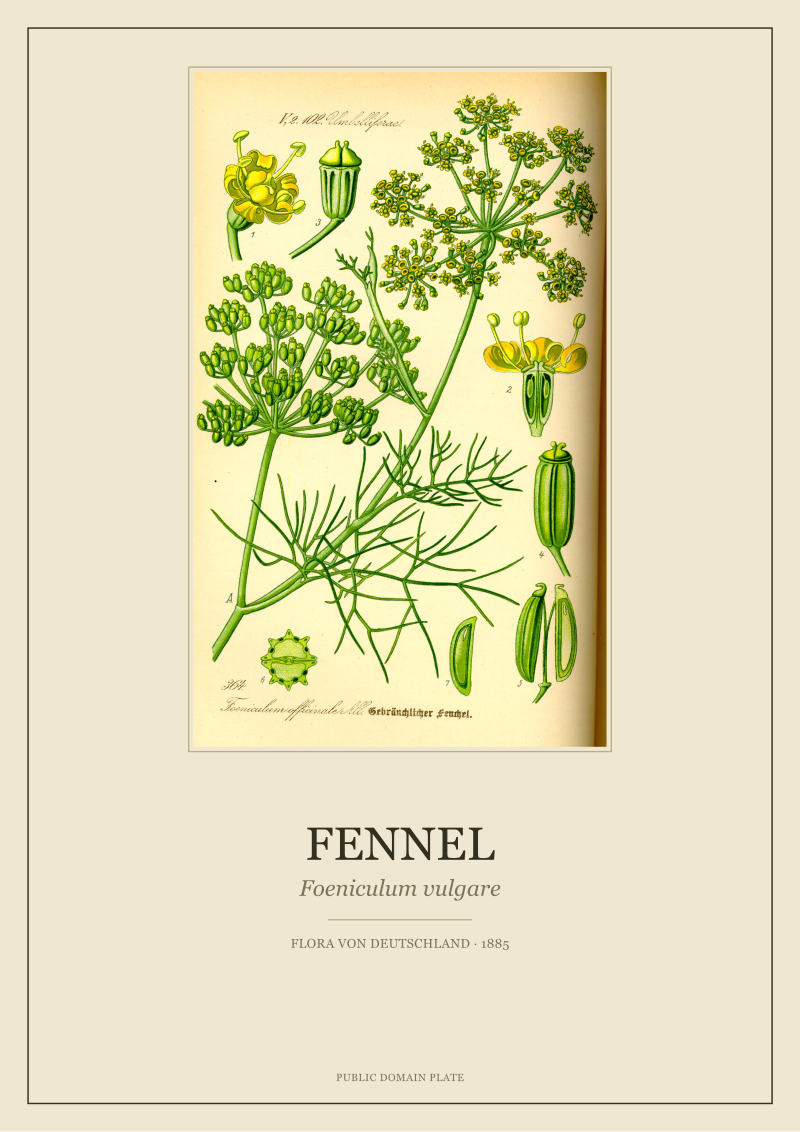 Fennel
The print from this article · from €29.95
View the print →
Fennel
The print from this article · from €29.95
View the print →
Question 3: How Much Wall Are You Really Willing to Commit?
This is the third fork because botanical prints behave differently in isolation and in series. A single plate is a statement — the plant, the artist, the paper. Two plates read as a pair, which is a decision. Three or more plates become a wall, which reads as a collection. Each mode has different rules, different failure states, and different price ranges. The mistake is buying one plate now with a plan to "add more later". The later usually does not happen, and the single plate reads as unfinished.
The commit question is therefore binary in practice: are you giving one framed plate, or are you seeding a small wall? There is no middle path that works. Two plates, hung apart, usually look like two plates hung apart.
If Yes
If you are seeding a wall, buy a set of three from the same source and, ideally, the same source flora — the coherence of Thomé's *Flora von Deutschland* across all three plates is a reason people buy from series. Match the paper, the print size, and the frame. Vary the plant but not the treatment. A common working set is one flowering plant, one culinary herb, one tree branch — three registers of botany, one visual grammar. If fennel is one of the three, place it in the middle position and flank it with something denser on each side; alone, fennel reads light, and a light print at the edge of a triptych looks like it is drifting.
If No
If you are committing to one plate, buy the best single plate you can. This is where restoration quality matters more than any other decision in this guide. A poorly cleaned scan will show as a grey cast, uneven margins, or ghosting around the linework. A properly restored plate holds the original ink density without smoothing the paper texture into plastic. Ask the seller what source scan they used, whether the plate is a restoration or a pastiche, and what paper weight and finish they print on. If they cannot answer the third question, they are reselling a stock file. Our own restorations of Thomé's 1885 plates are catalogued on our /shop/ page with those specifications visible on each listing.
If You Answered Everything: The Route Table
Every combination of the three answers routes to a different recommendation. Read your three answers across the row.
| Q1 (loves a plant) | Q2 (knows the wall) | Q3 (seeding a wall) | Recommendation |
|---|---|---|---|
| Yes | Yes | Yes | Triptych of that plant's family — three related species, matched paper, A3 each, hung horizontally on the known wall. |
| Yes | Yes | No | Single A3 plate of that specific species, restored source, wide mount, wood frame sized to the wall. |
| Yes | No | Yes | Triptych of the loved plant at A4, matched frames, packaged as a set the recipient can hang together anywhere. |
| Yes | No | No | Single A4 of the loved species, framed, in a neutral wood — the safest possible gift in this category. |
| No | Yes | Yes | Three low-signal plates chosen for the room — culinary herb, common tree, fruit branch — matched at A3. |
| No | Yes | No | One A3 plate of a low-signal species tuned to the room; skip fennel unless the room is a kitchen. |
| No | No | Yes | Do not seed a wall for someone whose taste and wall you both do not know. Route back to Q1 and give something else. |
| No | No | No | Single A4 low-signal print, framed, plain frame. If unsure between candidates, choose the older species. |
The fennel row is deliberately narrow. It appears cleanly only when Q1 is Yes and the recipient has an existing relationship to the plant. In every other row where fennel would be a candidate, a quieter species performs better as a gift. This is not a comment on fennel or on Thomé's plate, which is one of the finer umbelliferous drawings in the *Flora*. It is a comment on the semantics of giving.
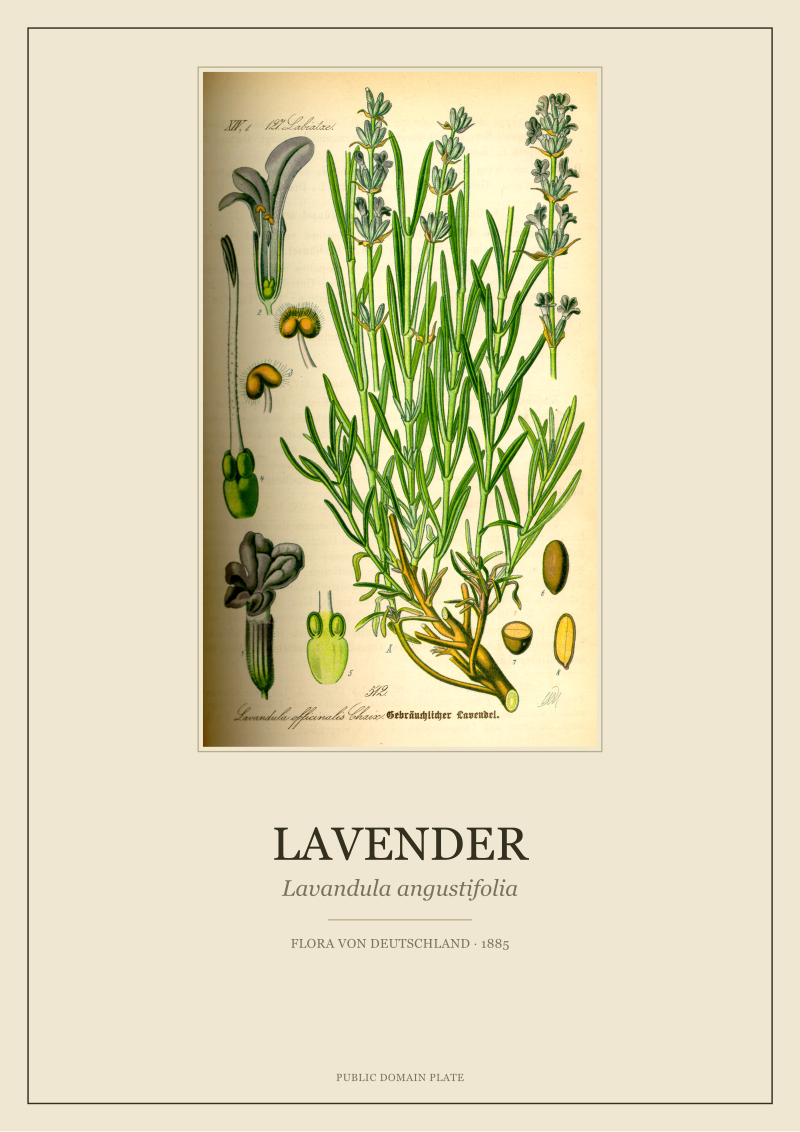 Lavender
The print from this article · from €29.95
View the print →
Lavender
The print from this article · from €29.95
View the print →
What This Guide Does Not Cover
This guide does not cover custom commissions of plates outside the *Flora von Deutschland*. Different source floras — Redouté's roses, Curtis's botanical magazine, Turpin's plates — have different restoration considerations and different collector audiences, and we treat those as separate categories with their own routing logic.
It does not cover the medicinal or apothecary history of fennel or of any other plant in the *Flora*, because this desk does not publish health-adjacent claims. There is a real history there — kitchens, monasteries, teaching hospitals of the 19th century — but it is a history essay, not a gift guide, and it belongs elsewhere on the site.
It does not address international shipping timelines for the December 2026 gifting window, currency conversion, framing services in specific cities, or how to hang three prints level without a laser level. Each of those is a small logistics problem with a clean answer, and none of them are honest content for a 2,000-word editorial. The gift decision is upstream of all of them, and it is where most gifts in this category go wrong.
FAQ
Is a fennel botanical print ever the right gift?
Yes, in one narrow case: the recipient already has a demonstrated relationship to fennel — cooking, gardening, or a documented affection for anise-adjacent plants. In that case, Thomé's 1885 plate of *Foeniculum vulgare* is a precise gift because the plate itself is precise: the umbels, seed heads and stem structure are drawn without stylisation. Outside that case, fennel reads as a projected taste rather than a shared one, and the print tends to migrate off the wall inside a year.
What print size works for most walls in 2026?
A3 (29.7 × 42 cm) is the safe default when you know the room but not the specific wall. It reads across a dining room, holds its own next to furniture, and does not shrink into a hallway. A4 works when the wall is small or the room is uncertain — a study, a bedroom, a rental. A2 is a commitment size and should only be bought for someone who has explicitly asked for a large single plate.
Are 19th-century public domain plates legal to reproduce and gift?
The original plates from O.W. Thomé's *Flora von Deutschland, Österreich und der Schweiz*, published in 1885, are in the public domain. Reproductions of the images are legal to sell and gift. What varies by seller is the quality of the source scan and the restoration work. A gift-worthy print uses a properly cleaned, colour-corrected scan on archival paper — a stock-file reproduction on thin poster stock is legal but disappointing.
How can I tell if a botanical print is well restored?
Look for three things: sharp linework at the leaf veins and umbel joints (a poor scan blurs these); consistent paper tone without a grey cast in the margins (bad cleaning leaves haze); and a paper weight that feels closer to cotton rag than to office stock. A seller who cannot state the source scan, the paper GSM, and whether the plate is restored or reconstructed is selling a stock file rebranded.
Should I buy the print framed or unframed as a gift?
Buy it framed. An unframed print is a two-step gift, and step two — taking it to a framer, choosing a mount, waiting a week — is the step most recipients skip. The print then lives in a tube on a shelf. If you cannot frame it before gifting, at minimum include a paid framing voucher redeemable at a specific local framer, not an open-ended promise.
Is fennel a good kitchen wall choice specifically?
In a kitchen wall context, fennel works better than on most other walls because the room permits culinary botany. Alongside dill, chamomile, or a herbs-and-umbels grouping, fennel reads as a kitchen plate rather than a personal declaration. Kitchens also tolerate warmer, brighter plates because ambient light and steam soften the visual register. It remains a Q1-Yes gift; the room permission does not override the recipient permission.
How many botanical prints make a wall without looking cluttered?
Three is the working minimum for a wall grouping and five is the working maximum before the grid starts to compete with the room. Odd numbers hang better than even numbers. Vary the plant across the group but match the paper, print size and frame — the coherence of treatment is what makes a botanical wall read as a collection rather than an accumulation.
What is the difference between a restoration and a reproduction?
A reproduction reprints the original file as-is: whatever damage, foxing, discolouration or scan noise was in the source ends up on the wall. A restoration takes a source scan and rebuilds it — removing foxing without smoothing the paper, correcting colour drift, sharpening line integrity where possible, without inventing detail that was not on the original plate. Restorations are more expensive to produce and, for gift-quality prints, materially better.
New plates from the archive and 10% off your first print.
One email now with your code. No noise after.