Most 2026 gift guides for botanical print enthusiasts sort by price bracket, then padding. That is the wrong axis. Hear us out. A botanical print is a decision about a specific illustrator, a specific year, and a specific wall — not a decision about a dollar figure. This guide is a flowchart in prose. We will ask three questions. The anchor plate throughout is Juniperus communis, drawn by O.W. Thomé for Flora von Deutschland, Österreich und der Schweiz in 1885, now public domain and one of the most gift-versatile plates our studio restores. Answer the questions. The table at the end returns your recommendation.
Question 1: Does the Recipient Already Read Latin Labels?
This is the first fork, and it decides more than any question about frame color or matting width. A botanical plate carries two texts: the picture and the caption. The caption is the diagnostic ledger — binomial, authority, family, sometimes locality and habit. If the recipient reads it, the plate is a document. If they do not, the plate is an image that happens to have Latin on it. Both are valid gifts. They are not the same gift.
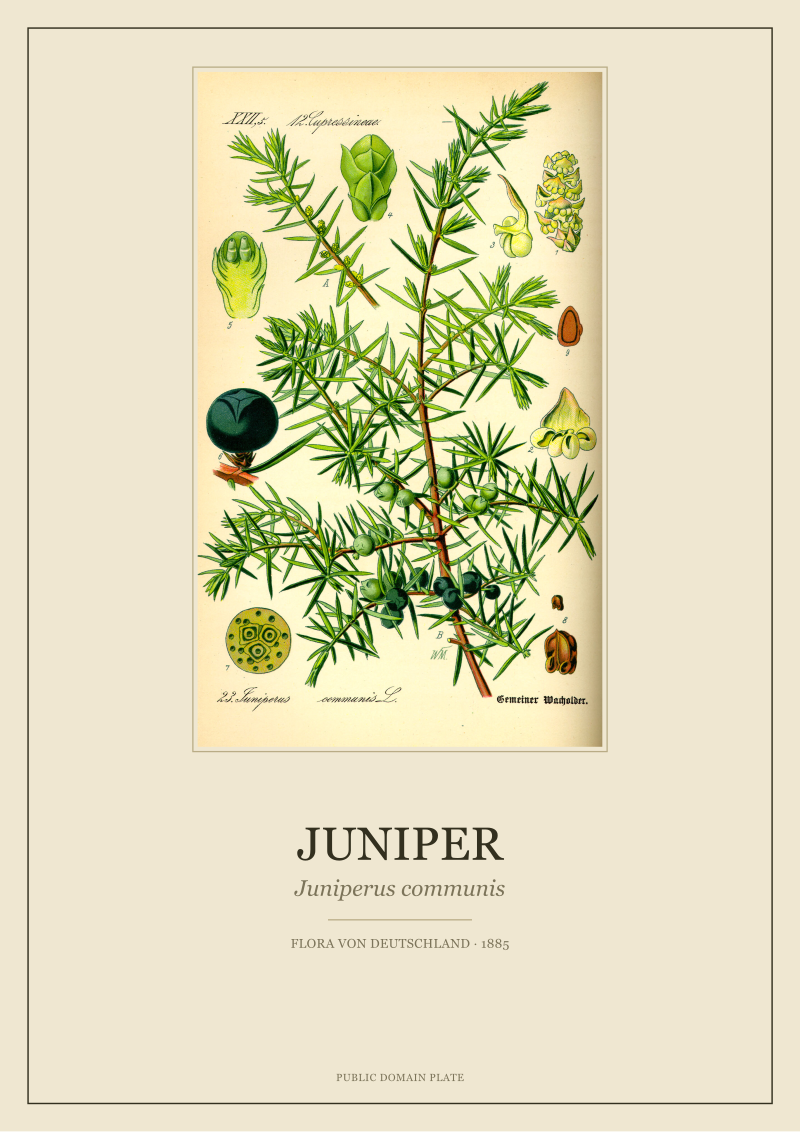
The Thomé Juniperus communis plate is a useful stress test for this fork. The plate labels the whole habit, then breaks out cone scales, seed, and needle cross-section with numbered call-outs. To a botanist, this is a working key. To a non-botanist, the call-outs are decorative — small precise objects arranged around a central figure. The plate reads well both ways, which is why we recommend it as a first plate for either kind of recipient. Not every plate has that dual life.
If Yes
The recipient will inspect the caption before the composition. Prioritize provenance and legibility. That means: the illustrator's name printed clearly (Thomé, in this case), the source work identified (Flora von Deutschland, Österreich und der Schweiz), the year (1885), and public-domain status stated on the back of the print or in the studio's accompanying card. It also means the Latin label on the plate itself must survive restoration — no softening of the diacritics on Österreich, no dropped umlaut, no anglicized "Juniper Communis" with capital C. If the caption is wrong, the botanist notices in the first thirty seconds. Match the plate to a taxon they have field experience with; a plate becomes personal the moment the recipient has knelt next to the plant.
If No
The recipient will inspect the picture first. Prioritize composition and color depth over documentation. Thomé's Juniperus works here because the habit sketch — an upright branch with staggered whorls of three needles — carries the visual weight without requiring the viewer to parse the anatomical inserts. The Latin becomes ornament, and that is fine. Provide a small studio card that translates the caption in plain English for the moment the recipient becomes curious. Curiosity arrives roughly six to twelve months after installation, in our experience with follow-up emails. Do not pre-load the plate with jargon; let the picture do the initial work.
Question 2: Is the Wall Bare, or Already Crowded With Art?
The second fork is spatial, not aesthetic. It routes the format decision — single sheet, framed pair, small grid — and the size decision. Framers and interior editors talk about "visual budget" per wall: the total amount of pattern, contrast, and edge a wall can carry before it becomes noise. A bare wall has surplus budget. A crowded wall is over budget already, and any addition must either replace something or shrink to fit the gaps.
We ask this question early because the answer changes the sizing math. A bare wall wants a plate large enough to hold the wall's proportions — commonly A2 or A1 for a wall taller than 2.2 m, and the mat width should scale with the sheet. A crowded wall usually wants A4 or A5, unmatted or with a narrow mat, slotted into the existing grammar. Guessing wrong is the single most common regret we hear from gift-givers, and it is fixable only by reprinting at a different size.
If Yes (Bare Wall)
Recommend a single sheet at A2 or larger. Thomé's Juniperus at A2 reads at conversational distance across a living room; at A1 it holds a stairwell. The plate benefits from scale because Thomé drew fine parallel hatching on the cone scales that only resolves properly above 40 cm on the long edge. Below that, the hatching flattens into gray. If the recipient's wall is bare and tall, this is the plate we would choose for them without asking. Suggest a wide, plain mat — 6 to 8 cm — in an unbleached off-white that does not fight the paper tone of the reproduction. Frame in oak, walnut, or matte black; avoid gilt, which was a nineteenth-century framing convention that fights the schoolbook restraint of the source plate.
If No (Crowded Wall)
Recommend A4 or A5, and think in pairs or triples rather than solo. Juniperus works well paired with another Thomé conifer plate for taxonomic rhyme, or with a broadleaf plate for visual contrast between needle and leaf. On a crowded wall, the eye reads the plate as a member of a set, not as a standalone document. The mat can shrink to 3 to 4 cm, or vanish entirely with a float mount that lets the deckle edge of the reproduction show. If the crowded wall already contains photography, the botanical plate holds its own — the drawn line reads as a different register from the photographic image, and the two do not compete. If the crowded wall is entirely paintings, a plate can either extend the botanical thread or feel foreign; ask before deciding.
 Juniper
The print from this article · from €29.95
View the print →
Juniper
The print from this article · from €29.95
View the print →
Question 3: Do They Want One Plate, or the Beginning of a Wall?
The third fork is temporal. It asks whether the gift is complete on delivery or whether it is a first move in a longer collecting arc. This matters because a standalone gift and a foundation gift look identical in the box and diverge sharply in what should accompany them.
Botanical print enthusiasts, in our correspondence, split roughly evenly on this question. Some want the definitive plate — one taxon they love, one restoration they trust, framed, hung, done. Others want a seed for a botanical wall that will grow across seasons and birthdays. Juniperus communis functions well in either role, which is again why it is our default recommendation when we do not know the recipient. It is a common European species with cultural weight from Scotland to the Balkans, so it does not demand a themed collection around it. It also plays nicely inside a themed collection — evergreens, medicinal-history plates framed as history, aromatic plants — if the recipient decides to build one.
If Yes (One Plate, Done)
Present the plate as a completed object. Frame it before giving. Include the studio card with plate metadata — illustrator, work, year, license status, restoration notes — so the recipient has the receipts without having to ask. Do not include a coupon or a "next in the series" leaflet. The gift is the plate. If you are unsure of size, err toward A3, which is our best-selling single-plate format for gifts across three years of order data and fits standard off-the-shelf frames in most European and North American markets. A3 also reads at close and mid distance without demanding a specific room.
If No (Beginning of a Wall)
Present the plate as a first move. Give it unframed, in a flat portfolio with a second plate that pairs taxonomically or visually. Include a written note that names the intended arc — "Northern European conifers", "medicinal-history quartet, framed as history", "Thomé plates from the 1885 first edition" — so the recipient has a thesis to build against. Recommend A4 sizing for the arc, because grids of A4 assemble into three-, four-, six-, and nine-plate walls without recomposing. The Juniperus plate is a strong opener because its color palette — muted greens, silvered blue on the cones, warm paper ground — sets a neutral tone that later plates can either match or deliberately break. Do not gift a full wall at once. Half the pleasure is the accumulation.
If You Answered Everything: The Recommendation Table
The three questions produce eight combinations. Read your answers from left to right and take the recommendation on that row.
| Q1 (Reads Latin) | Q2 (Bare Wall) | Q3 (One Plate) | Recommendation |
|---|---|---|---|
| Yes | Yes | Yes | Juniperus A2, wide mat, oak frame, provenance card visible. |
| Yes | Yes | No | Unframed A4 Juniperus plus one paired Thomé conifer plate in a portfolio. |
| Yes | No | Yes | Framed A4 Juniperus with narrow mat, sized to slot into the existing grid. |
| Yes | No | No | Unframed A4 Juniperus plus two paired plates to extend the current wall's thread. |
| No | Yes | Yes | Juniperus A2, wide mat, matte black frame, plain-English translation card. |
| No | Yes | No | Framed A3 Juniperus now, portfolio of two more A3 plates for later hanging. |
| No | No | Yes | Framed A5 Juniperus, float mount, no coupons or leaflets in the package. |
| No | No | No | Unframed A4 Juniperus with one broadleaf pair for visual contrast on the wall. |
The table is a starting position, not a verdict. If the recipient is a working botanist with a bare wall and wants one plate, an A2 Juniperus in oak is the answer nine times out of ten — but the tenth time the recipient studies conifers professionally and would rather have Pinus sylvestris. Ask, if you can. If you cannot, Thomé's Juniperus is the gift that offends the fewest botanical priors, which is a real property in a real category. Our studio restores this plate from the 1885 source and holds it in the archive at /shop/ if you need a version that has already had the acid staining pulled without softening Thomé's line.
FAQ
Why Juniperus communis specifically as the default gift plate?
Three reasons. It is a widely distributed Northern Hemisphere species, so the recipient has likely encountered it in the field regardless of country. Thomé's 1885 rendering shows both habit and anatomical inserts on one sheet, which gives the plate two reading modes for two kinds of viewer. And the palette — muted greens with a silvered blue on the cones — sits neutrally next to most existing wall art without demanding a themed collection. It is the plate that fits the most rooms without becoming generic.
What is the difference between a plate and a print in this guide?
"Plate" refers to the original lithographic image published in a botanical work — in this case, the Juniperus communis illustration by O.W. Thomé in the 1885 Flora von Deutschland, Österreich und der Schweiz. "Print" refers to what you hang: a modern reproduction made from a high-resolution scan of the original plate, then restored — dust removed, foxing pulled back, paper tone rebalanced. The plate is the historical object. The print is the wall-ready descendant.
Is Thomé's Flora truly public domain in 2026?
Yes. The work was published in 1885 and O.W. Thomé died in 1910, which places the illustrations well past the seventy-years-after-death copyright expiry that governs most European and North American jurisdictions. There is no rights holder to license from. What is not automatically public domain is a specific modern scan or a specific modern restoration; those may carry the restorer's authorship. The underlying plate is free. The version you gift depends on who restored it.
How do I match a botanical plate to a recipient I do not know well?
Follow the three questions in reverse importance. The wall condition (Question 2) is the safest guess — you can often see it from a photograph or a video call. The completed-versus-arc question (Question 3) can be assumed as "completed" for a gift to a casual recipient. Question 1 — do they read Latin — is the one to hedge on: include a translation card either way. Juniperus communis is the fallback because it is the plate most likely to land regardless of how you guessed.
Should the gift be framed or unframed?
Framed if it is a completed gift, unframed if it is the beginning of a collecting arc. Framed gifts feel finished on delivery, which matters for occasion-driven giving — birthday, housewarming, holiday. Unframed gifts, delivered in a flat portfolio, invite the recipient into the framing decision themselves, which is the correct posture for anyone who is going to build a botanical wall over months or years. A framed gift to a future collector can feel presumptuous about their taste in wood.
Do you recommend gift-guide bundles across multiple plates?
Only when the recipient has already told you they are building a wall. Bundles gifted to non-collectors tend to sit in the portfolio unframed for years. A single well-chosen plate lands. Two plates with a stated thesis land. Three or more plates delivered at once tend to overwhelm the recipient's framing budget and stall. If you must bundle, keep it to two, and name the arc explicitly in the accompanying note so the recipient understands the intent.
What frame and mat should accompany a Thomé plate?
For matting: unbleached off-white or warm cream, not bright white, which will fight the paper ground of the reproduction. Width scales with sheet size — 3 to 4 cm for A5 and A4, 5 to 6 cm for A3, 6 to 8 cm for A2 and larger. For framing: oak, walnut, or matte black work with the schoolbook austerity of Thomé's line. Avoid gilt frames, which impose a nineteenth-century parlor convention the plate itself does not carry. Avoid ornate mouldings; Thomé's drawing is quiet, and the frame should match that register.
Where does the /shop/ recommendation fit into this guide?
Our studio restores the Juniperus communis plate discussed throughout, along with the Thomé conifer and broadleaf pairings the table suggests. If the recommendation row you landed on names a specific plate and format, the archive at /shop/ is where our own restorations live. That is the only commercial destination this guide points to. The rest of the decision — frame, mat, wall, timing — you can execute with any restorer whose provenance and license disclosure meet the standards in Question 1.
This guide did not cover three things and it should say so. It did not cover gifting botanical prints across international customs — shipping, VAT, and framing tolerances differ enough between jurisdictions that a single recommendation would mislead. It did not address the question of when a botanical plate is the wrong gift entirely, which is a separate essay about reading the recipient rather than reading the plate. And it did not discuss non-Thomé botanical illustrators — Redouté, Curtis, Sowerby — each of whom carries different visual conventions and would reroute the questions above. Each of those is its own decision tree.
New plates from the archive and 10% off your first print.
One email now with your code. No noise after.