Most guides to choosing a botanical print treat it as a matter of taste — pick the plant you like. Hear me out. When the two plates on the table are both from O.W. Thomé's Flora von Deutschland, Österreich und der Schweiz, printed in 1885 and now in the public domain, the decision is not primarily about the plant. It is about what each drawing does to a wall. Melissa officinalis, the lemon balm, and Centaurea cyanus, the cornflower, come from the same book, the same hand, the same year — and photograph a room in almost opposite ways.
We have restored both in the studio. We have hung both, at various sizes, in various rooms, and watched what light does to them at seven in the morning and at four in the afternoon. What follows is a plate-by-plate reading of the two, arranged as a comparison desk would arrange it — dimension by dimension, with the numbers where numbers exist and judgment where judgment is required. It is not a ranking. It is a piece of editorial thinking meant to make one plate feel obviously right in your room, and the other feel obviously right somewhere else.
| Dimension | Melissa officinalis (Lemon Balm) | Centaurea cyanus (Cornflower) |
|---|---|---|
| Common name | Lemon Balm | Cornflower |
| Latin binomial | Melissa officinalis | Centaurea cyanus |
| Plate artist | O.W. Thomé | O.W. Thomé |
| Source work | Flora von Deutschland, Österreich und der Schweiz | Flora von Deutschland, Österreich und der Schweiz |
| Plate year | 1885 | 1885 |
| License status | Public domain | Public domain |
| Dominant hue | Green, leaf-forward, quiet | Blue, flower-forward, saturated |
| Compositional habit | Bushy, multi-stemmed, herbaceous mass | Slender single stem, one flowering head, open air |
| Cultural register | Herb garden, kitchen, apothecary shelf (as history) | Cornfield, national symbol, wildflower romanticism |
| Wall behavior | Recedes, harmonizes, holds a corner | Advances, draws the eye, sets a colour note |
Six columns would be dishonest here — we are comparing two plates, not five. Four columns is the correct instrument. Read the table left-to-right and you have the identity brief; read it top-to-bottom and you have the argument of this article.
Botanical Identity on the Plate: Melissa officinalis Beside Centaurea cyanus
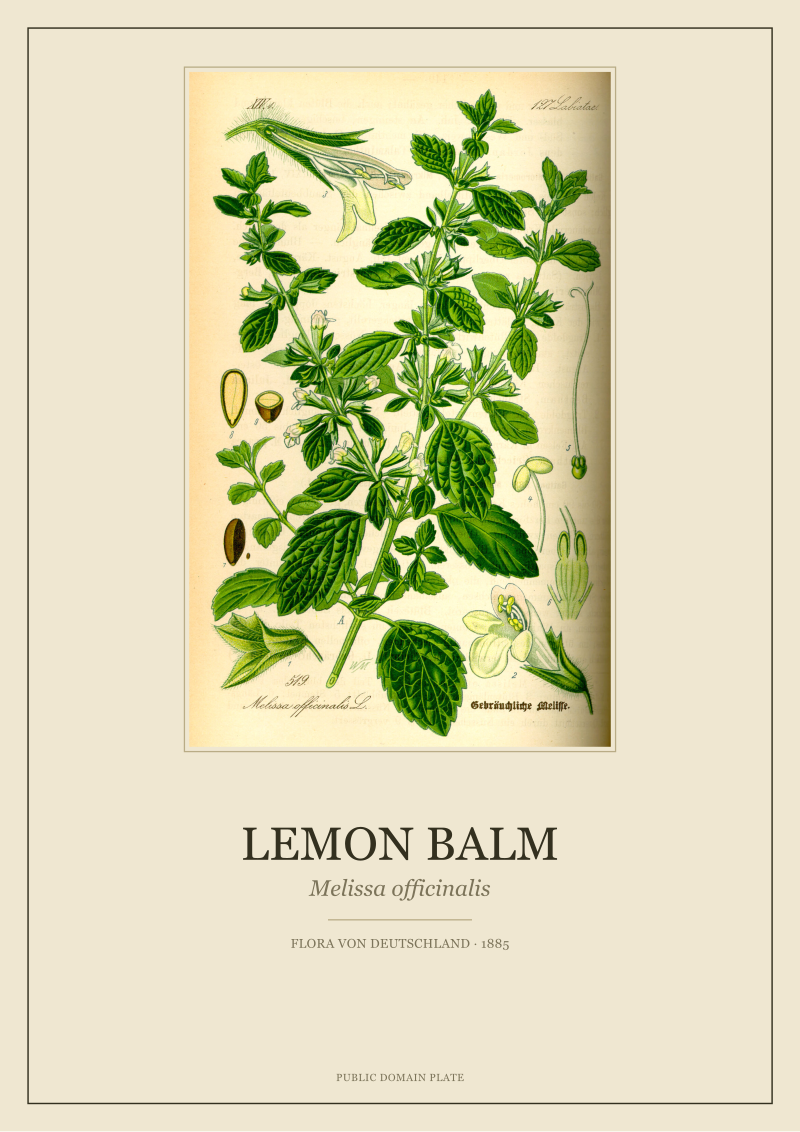
The two species are, botanically, unrelated. Melissa officinalis is a mint-family perennial — square stems, opposite leaves, the leaf surface faintly quilted between the veins. Thomé's plate shows the plant as a gardener would meet it: a small bush, several stems rising together, foliage dominant, the tiny white-to-pale flowers tucked into the leaf axils as an afterthought. The lemon balm is drawn as a leaf plant, not a flower plant. That is a decision, and it matters. If you approach the plate expecting a bloom to lead your eye, the plate refuses. It gives you green.
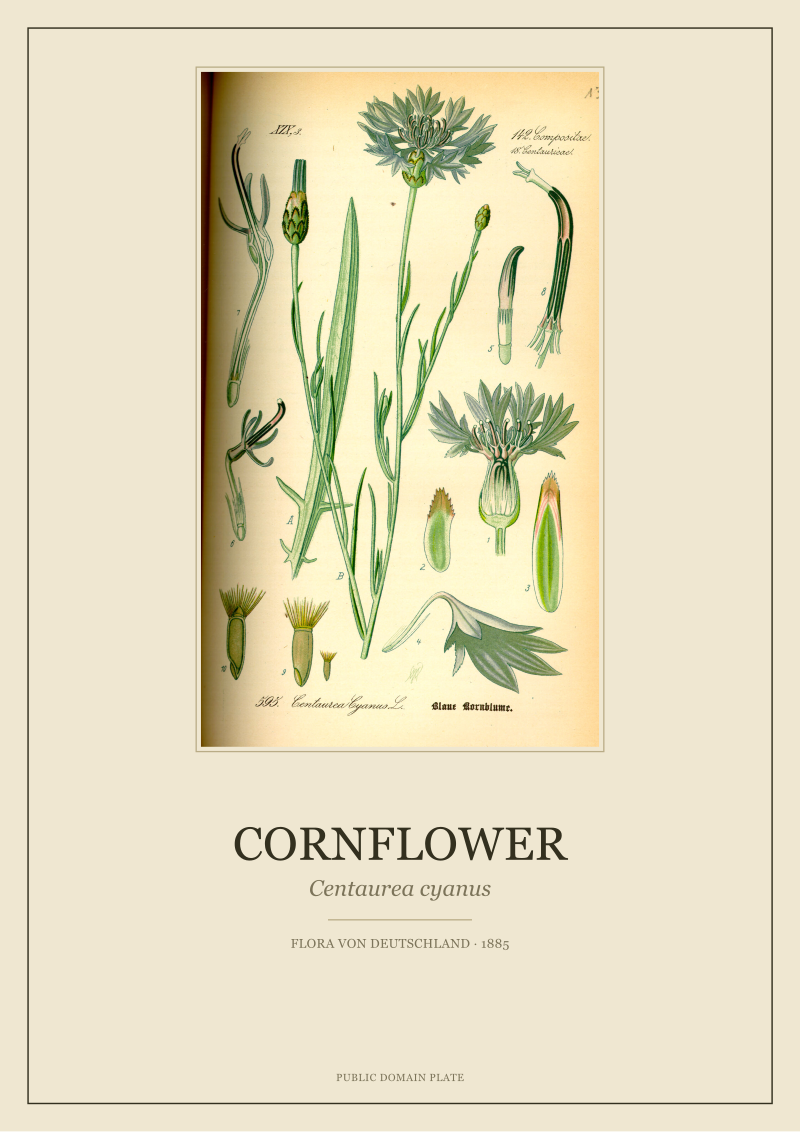
Centaurea cyanus is an annual of the daisy family, a cornfield companion of wheat and rye for so many centuries that European botany treats it as an archetype rather than a species. Thomé draws it single-stem, tall and thin, the flowering head opening at the top as a fringed blue star. Leaves are minor; the composition is architectural. One line, one flower, one colour.
Placed side by side on a studio table, the two plates read as opposites of the same tradition. The lemon balm is horizontal in feeling — it wants to spread. The cornflower is vertical — it wants to rise. The lemon balm rewards close viewing (the leaf texture, the tiny florets); the cornflower rewards viewing across a room (the blue is a signal, not a detail). The Latin names on both plates are set in the same convention — genus capitalized, species lowercase, italic when set in modern type. Read the label up, as the studio saying goes: officinalis is the medieval apothecary tag, cyanus is the Greek word for a deep blue. The plates carry that etymology into the room whether you know it or not.
The Source: What Thomé's 1885 Flora Actually Was
Both plates come from the same book. Otto Wilhelm Thomé's Flora von Deutschland, Österreich und der Schweiz, first published in 1885, was a scientific flora for the German-speaking region — a systematic illustrated inventory of the plants growing wild or cultivated across Germany, Austria and Switzerland. It was made to be used: keyed, indexed, referred to by teachers and by field botanists. The plates were not intended as decoration. That they became decoration, more than a century later, is part of what makes them interesting on a wall.
Thomé's flora came out of a particular moment in botanical publishing. Chromolithography had matured; a colour plate could now carry a botanist's exactness and a printer's saturation at the same time. The convention Thomé used was the whole-plant portrait — root or lower stem included when it fit, life-size or clearly scaled, with a botanical inset for the flower or seed structure that a viewer needed to see close up. Every plate is doing two jobs at once: it is describing a species so a stranger could identify it, and it is composing a page so the book stays legible.
Because both plates come from the same 1885 edition of the same work, they share a printing register and a compositional grammar. If you hang them together, they read as siblings — which is a strong argument for pairing rather than choosing. But the question this piece is answering is which one, alone, on one wall. That returns us to what the plate does, not what the book is.
The license status is identical for both: public domain, meaning the image itself is free of copyright. What you buy from a serious studio is not the image but the restoration of it — the removal of foxing, the correction of the scanner's colour drift, the printing on paper that matches the plate's original weight. The provenance line matters, and we come back to it in section five.
 Cornflower
The print from this article · from €29.95
View the print →
Cornflower
The print from this article · from €29.95
View the print →
Line, Habit and Color: How the Two Plates Draw Differently
Line first. Thomé's cornflower plate is, at its core, a study in three or four essential strokes. A stem, a leaf, a bud, a flower. The rendering is generous where it needs to be — the ray florets around the central disc are drawn with a lithographer's patience — but the negative space around the plant is real space. Air. The plate breathes. Framed generously, mounted with a wide window, the cornflower is a print that lives in the margin as much as in the ink.
The lemon balm is the opposite argument. Thomé's plate for Melissa officinalis fills the page. Stems cross other stems; leaves overlap leaves; the composition is dense in a way that mirrors the plant's growth habit. You do not see through the plate to a white ground; you see through the plate to more plant. This means the lemon balm can carry a smaller frame and a tighter mount without feeling cramped, because the plate is already tight by design.
Colour behaves in matching opposite directions. The cornflower's blue is the whole event — the pigment saturates a small central area and the eye reads the page as "blue plate", even though most of the sheet is white or muted green. It is a plate that colour-matches a room from across the room. The lemon balm carries no such signal. Its palette is entirely green — several greens, all quiet, gradations between the young top leaves and the older lower ones, with the pale flowers barely tinting the composition. It is a plate that colour-matches a room only when you stand in front of it.
Habit — the way a plant grows — is what these two drawings actually preserve. Botanical illustration at Thomé's standard was never about a beautiful specimen; it was about the recognisable one. The lemon balm plate shows you a plant you would meet in a herb garden, and the cornflower plate shows you a plant you would meet at the edge of a wheat field. Two entirely different European landscapes, drawn in the same year, by the same hand.
Room Register: Where Each Plate Sits Best Inside a Room
We hesitate to talk about interiors because most interior advice becomes styling, and styling ages badly. What we can talk about is register — the tone a plate strikes when it is on a wall, before anyone reads the label.
The cornflower reads as ceremonial. The single stem, the vertical composition, the intense blue: it functions the way a small painting functions. It wants to be the thing you look at in a room, not the thing you look past. In a narrow hallway, in a small dining room, above a writing desk, the cornflower is a punctuation mark. Hang it too close to another strong plate and the two argue; hang it alone, framed generously, and it holds a wall by itself. It is a plate that does not want company on either side.
The lemon balm reads as domestic. The bushy habit, the leaf-heavy composition, the quiet green: it functions the way a well-set kitchen shelf functions. It rewards being lived with rather than looked at. It absorbs the light of the room instead of throwing it back. In a kitchen, in a study, in a bedroom, in a stairwell — anywhere the walls carry other objects — the lemon balm sits comfortably beside frames, spines, ceramics. It is a plate that welcomes company.
A useful test: photograph the wall you have in mind at ten in the morning and again at five in the afternoon. If both photographs show a wall that is already busy — a shelf, a lamp, a doorframe, a mirror — the lemon balm will settle into it. If both photographs show a wall that is empty and waiting for one thing, the cornflower will meet it.
Neither plate is right for every wall. The mistake is assuming the more colourful one is universally the better print. It is not. It is the more demanding one.
 Lemon Balm
The print from this article · from €29.95
View the print →
Lemon Balm
The print from this article · from €29.95
View the print →
Provenance and Restoration: What "Public Domain, 1885" Means on the Wall
Both plates are in the public domain. That fact is the beginning of the sourcing conversation, not the end of it. A scan of Thomé's 1885 flora on a state library server is a document; a plate on your wall is an object. The distance between those two is what a restoration studio does.
A raw archive scan of an 1885 chromolithograph will typically carry a century and a half of paper history: foxing spots where humidity met iron in the paper, a warm yellow cast from lignin oxidation, a slight blue shift in the cyan channel from earlier scanning technology. None of that is the plate as it was printed. Some of it is the plate as it has aged, which is honest; some of it is the file as it was captured, which is not. Restoration is the studio deciding, plate by plate, what to keep and what to correct — a form of editorial judgment much closer to conservation than to retouching. The cornflower's blue in particular is a colour that scanners frequently misread; the lemon balm's greens are a range that low-bit-depth files flatten into two or three tones instead of seven.
This is why we say the license is public domain but the object is not commodity. The plate on your wall is the product of a decision chain: which archive scan to source, how to correct the paper cast without erasing the paper's age, what weight of paper to print on, how large to print so the linework holds. Two studios can start from the same public-domain file and produce two very different objects. If you would like to see how we do it, our restored versions of both plates live on our /shop/ page, one per listing, with the provenance line printed on the back.
Which Dimension Actually Matters Most
If the dimensions in the table above were all equally weighted, this article would have no argument. They are not. The dimension that matters most, in our view, is room register — how a plate behaves inside a specific room — because it is the only dimension the wall will judge for you every day. Latin name, plate year, license status, artist: these are grounding facts. They do not change if you move house. Room register does.
A useful way to hold the decision is this. Ask what you want the wall to do. If the wall should quiet down — recede, hold a corner, live comfortably beside books and lamps and kitchen life — the lemon balm is the answer, and the answer is not close. If the wall should speak — draw the eye across a room, mark a small architectural moment, carry a colour note into a palette — the cornflower is the answer, and again, not close. Both plates come from the same 1885 hand; both are honest documents of European botany; both survive the trip from a scientific flora to a private wall with dignity intact. Choosing between them is a decision about the wall, not a decision about the plant.
FAQ
Are Melissa officinalis and Centaurea cyanus related botanically?
No. Melissa officinalis belongs to the mint family (Lamiaceae) — square stems, opposite leaves, aromatic foliage. Centaurea cyanus belongs to the daisy family (Asteraceae) — composite flower heads with ray and disc florets. On Thomé's plates the difference is legible without the labels: the lemon balm is drawn as a leafy bush, the cornflower as a single-stem architectural plant with one composite head. Same book, same year, same illustrator, entirely different botanical lineage.
Both plates are from 1885 — does the age change how they look on a wall?
It changes what a good print looks like, not what a bad one does. An archive scan straight off a library server usually carries paper foxing, a yellow lignin cast, and colour drift in cyans and greens — none of which reflect how the 1885 plate looked when it left the press. A properly restored plate corrects the file's failures while keeping the paper's honest age. What you see on the wall should read as a 140-year-old drawing, not as a 140-year-old file.
Can I hang both plates together instead of choosing?
Yes, and if you have the wall for it, we recommend it. Because both come from the same 1885 edition of Thomé's Flora, they share printing register and compositional grammar — they read as siblings on a wall. Hung as a pair, they cover both registers: the cornflower speaks, the lemon balm answers. The question this article addresses is the harder one — one plate, one wall — because that is the harder decision.
Is Thomé's Flora von Deutschland actually public domain?
Yes. Otto Wilhelm Thomé's Flora von Deutschland, Österreich und der Schweiz was first published in 1885, and the plates are long past any copyright term worldwide. What a serious studio sells is not the image but the restoration of it — the file work, the colour recovery, the paper and printing decisions — and the object that arrives on your wall. The image is free; the object is not.
Which of the two is more forgiving in a small room?
The lemon balm. Its dense, leaf-forward composition means it does not need generous framing to read correctly, and its quiet green palette does not fight with wall colours, textiles, or nearby objects. The cornflower is technically small in physical footprint but visually large — the saturated blue signals across the room, and it wants space around it to breathe. In a small room, that space is the constraint that matters.
Does either plate carry historical associations that might date it?
Both do, in opposite directions. Lemon balm carries an apothecary-and-kitchen history stretching back to medieval Europe; we mention that as history, not as claim. Cornflower carries agricultural and national-symbol associations across several European countries, tied to its long companionship with cereal fields. Neither association intrudes on the plate as an object — Thomé drew the plants, not the folklore — but if you know the history, both plates read with a second layer beneath the botanical one.
Which plate photographs better for social media?
The cornflower, easily. The blue is a single strong colour note that reads instantly at thumbnail size, and the vertical composition frames cleanly in a phone crop. The lemon balm, being green-on-white and detail-rich, needs a real photograph — good light, close enough to see the leaf texture — to earn its impact. If the print's second life is going to be as an image passed around, the cornflower does more work at smaller sizes.
If I can only afford one plate this year, how should I decide?
Decide from the wall backward, not from the plant forward. Stand in front of the wall you have in mind and ask whether it needs a quiet plate or a speaking one — that is the whole question. If the room is already visually busy, the lemon balm will settle it. If the room has one empty wall waiting for a single considered object, the cornflower will meet it. Both are honest 1885 plates; the choice is about the room they enter, not about which flower you prefer.
New plates from the archive and 10% off your first print.
One email now with your code. No noise after.