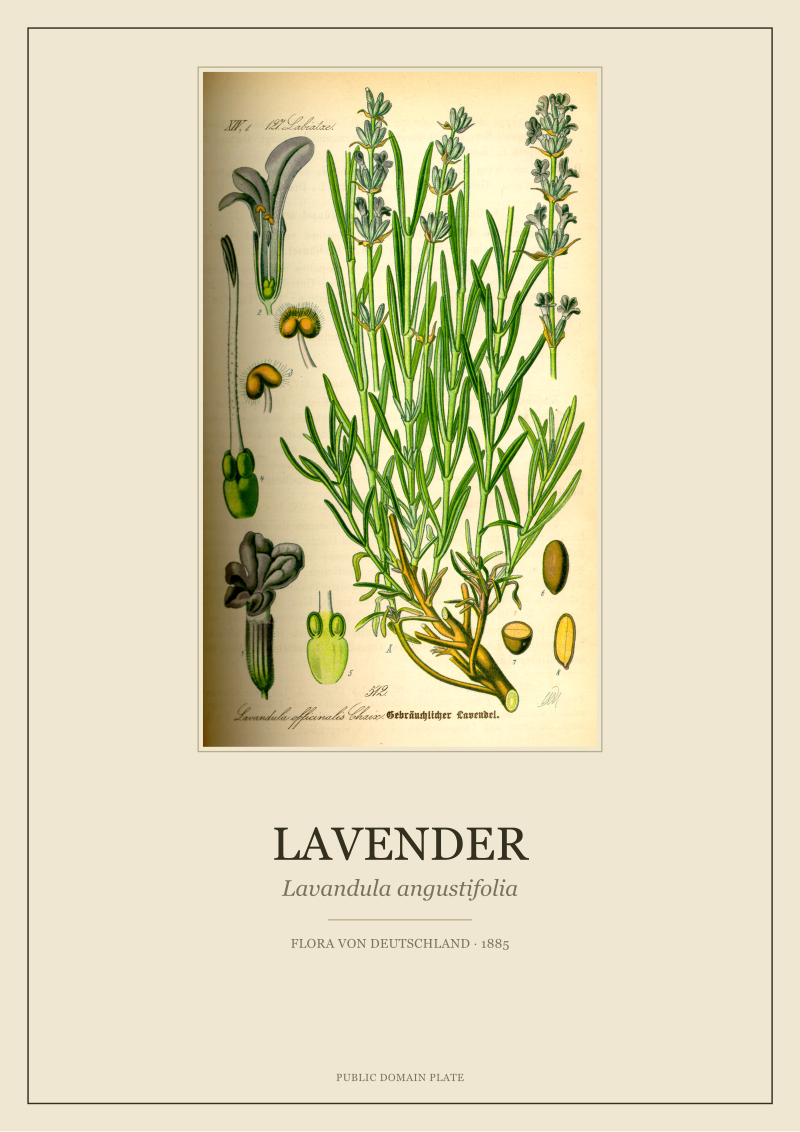
The lavender plate we work from is O.W. Thomé's Lavandula angustifolia, drawn for Flora von Deutschland, Österreich und der Schweiz in 1885 — a narrow botanical portrait, tall spike, tight florets, the kind of image that behaves very differently at A4 than at 70 by 100 centimetres. The question we get weekly, in some form, is always the same: what size should I order. This piece is a flowchart in prose. We are going to ask you three questions about your wall, your standing distance and your neighbours, and route you to a dimension that will not embarrass the plate or the room.
Question 1: How Wide Is the Wall the Plate Will Live On?
Measure the wall in centimetres, edge to edge, before you look at anything else. Not the sofa in front of it, not the console under it — the wall itself, from corner to window frame or corner to corner. Everything downstream depends on this number, because a botanical print does one of two things on a wall: it either occupies a legible share of the visual field, or it floats as an apologetic postage stamp. There is no third option, and the plate cannot save you from a bad ratio.
The rule we use in the studio is the two-thirds rule for a single hanging piece and the one-half rule when the print sits above furniture. A plate that occupies less than one-third of the horizontal wall width will read as an afterthought no matter how beautifully it has been restored. A plate that occupies more than three-quarters starts to feel wallpaper-like and loses the object-quality that makes a framed botanical worth framing. The lavender plate is a portrait-orientation image with a lot of vertical air around the spike, so the horizontal share matters more than it would for a landscape composition.
If the Wall Is Under 180 cm Wide
Small entryways, narrow hallways, the sliver of wall between a doorframe and a corner. Here you are working with what publishers used to call quarto or octavo scale — think A4 (21 × 29.7 cm) or A3 (29.7 × 42 cm), framed with a generous 5–7 cm mat that pushes the framed footprint up to roughly 32 × 40 cm or 40 × 52 cm. The plate reads at intimate range, the way it was designed to be read in the original schoolbook. Do not oversize a narrow wall to compensate for a lack of other art; the crowd it creates will fight the plate rather than support it.
If the Wall Is 180–320 cm Wide
The most common domestic case: a dining room feature wall, a bedroom above a headboard, a living room stretch between two windows. This is the range where the classic 50 × 70 cm size earns its reputation. Framed with a 6–8 cm mat, the outer dimension lands near 62 × 82 cm, which occupies roughly one-third of a 240 cm wall and one-quarter of a 320 cm wall — the sweet spot for a single centred print. If you are hanging above a sofa, keep the frame width between 55 and 75 per cent of the sofa width and you will not have to think about it again.
If the Wall Is Over 320 cm Wide
Loft walls, open-plan lounges, converted stairwells. A single 50 × 70 cm print will vanish here, no matter how many centimetres of matting you add. You are choosing between two honest paths: go up to 70 × 100 cm framed (which becomes roughly 85 × 115 cm outer) and treat the plate as an anchor, or accept that the wall wants a set and jump ahead to Question 3. What you cannot do — what people try and then quietly regret — is centre a small plate on a large wall and hope that "negative space" will do the work of composition. It will not.
Question 2: How Close Will Anyone Actually Stand to It?
Botanical plates were engraved for the reader's eye at reading distance. The lavender plate in particular carries labelled floret details, calyx cross-sections and stamen studies at a scale that assumes you are within arm's length. Hang the same plate above a fireplace where the nearest human is four metres away, and those details become texture rather than information. The plate still looks pleasant. But you have paid for reading and gotten wallpaper.
The number to hold in your head is 2.5 metres. Under that distance, you can read the plate. Over it, you are looking at the shape. Both are legitimate uses, but they call for different sizes, and this is the fork most people skip.
If the Nearest Standing Position Is Under 2 Metres
You are close enough to read. Choose the smaller end of the size available: A4, A3, or 50 × 70 cm framed with a wide mat that invites the eye in. The value of a botanical plate at close range is the botanical Latin under the illustration, the numbered dissection panel, the delicacy of the line where Thomé's engraver has separated calyx from corolla. Oversize the print here and you will be standing so close that the eye cannot resolve the composition — you will see paper, ink and mat rather than a plant.
If the Nearest Standing Position Is 2 to 4 Metres
Most dining rooms and living rooms fall here. You want the plate large enough that the silhouette of the lavender spike registers cleanly across the room, but not so large that it dominates when you finally sit down within reading range. The 50 × 70 cm and 60 × 80 cm framed sizes were, in effect, designed for this middle distance by the museum print trade of the last century. If in doubt, go up one size, not down. Under-scaling is the more common error by a wide margin.
If the Nearest Standing Position Is Over 4 Metres
Stairwell landings, double-height entrances, offices with the desk on the opposite wall. At this distance, the plate is functioning as a graphic element rather than a botanical document. Go to 70 × 100 cm framed at minimum. Consider that the labelled details will become invisible, and that this is fine — the composition of a mature Thomé plate holds up as pure silhouette because he composed his plates to work at multiple reading scales. That is one of the reasons the 1885 work has aged well, and one of the reasons we still restore it.
 Lavender
The print from this article · from €29.95
View the print →
Lavender
The print from this article · from €29.95
View the print →
Question 3: Is the Lavender Plate Hanging Alone, or With Neighbours?
A plate alone and a plate in a set behave like different objects. The alone plate is a portrait — it wants centring, breathing room, a considered relationship to the furniture below and the ceiling above. A plate in a set is a member of a chorus, and its individual size matters less than the geometry of the group. If you are unsure which you want, decide now, because the size answer changes.
The single most common mistake we see in customer photos is a set of three prints hung at wildly different scales on a wall too small to hold them. The second most common is a single small print marooned in the middle of a set-sized wall. Both errors trace back to skipping this question.
If the Plate Is Hanging Alone
Reread Questions 1 and 2, take the size they pointed to, and stop there. Do not add a second print because the wall "still has room". A well-scaled single plate does not need company, and adding company almost always downgrades both. The lavender plate has enough vertical drama in the spike to hold a wall by itself when correctly sized — that is what portrait-orientation botanicals were made to do.
If the Plate Is Hanging With Neighbours
Now the arithmetic changes. In a set of two or three, use the smaller framed sizes — A3 (framed ~40 × 52 cm) or 40 × 50 cm — and treat the total footprint of the group, including the gaps between frames, as the size the wall reads. Aim for 4–6 cm of gap between identical frames. The lavender plate pairs naturally with other narrow-portrait plates from the same 1885 work; it fights landscape-format plates unless you separate them across a wide wall rather than clustering them. In a set of four or more, keep them all identical in outer dimension and mat width, or the group will read as chaos rather than composition.
If You Answered Everything: The Size Map
The table below collapses every combination of the three questions into one framed-size recommendation. Wall width is W, viewing distance is D, neighbours is N. Each recommendation cell gives the framed outer size we would ship for that combination if you asked us in a studio email.
| Q1: Wall Width | Q2: Viewing Distance | Q3: Alone or Set | Recommended Framed Size |
|---|---|---|---|
| Under 180 cm | Under 2 m | Alone | A4 or A3 framed (32 × 40 to 40 × 52 cm outer) |
| Under 180 cm | Under 2 m | Set | A4 framed, group of 2 verticals (32 × 40 cm each) |
| Under 180 cm | 2–4 m | Alone | A3 framed with wide 7 cm mat (40 × 52 cm outer) |
| 180–320 cm | Under 2 m | Alone | 50 × 70 cm framed (62 × 82 cm outer) |
| 180–320 cm | 2–4 m | Alone | 50 × 70 cm framed, centred with 60 cm from furniture top |
| 180–320 cm | 2–4 m | Set | 40 × 50 cm framed, group of three, 5 cm gaps |
| Over 320 cm | 2–4 m | Alone | 70 × 100 cm framed (85 × 115 cm outer) |
| Over 320 cm | Over 4 m | Set | 50 × 70 cm framed, group of three or five, 6 cm gaps |
One caveat the table cannot carry: the lavender plate is one of the narrower compositions in Thomé's 1885 work, and it tolerates being hung as a taller-than-average portrait better than most botanicals in the series. If you are between two sizes on the vertical axis, go taller. If you are between two sizes on the horizontal axis, go with the mat rather than the print — a wider mat on a smaller print is almost always more elegant than a smaller mat on a larger print, and it is the trick that separates a museum hang from a poster hang. The plate itself, in its restored form and at the sizes above, lives in our shop if you would like to see the framed options against the numbers you just measured.
FAQ
What is the most common size mistake people make with a lavender print?
Under-sizing. Around three-quarters of the customer photos we see feature a plate that is one size too small for the wall it hangs on. The corrective instinct is usually to add more small prints around it, which makes the composition worse rather than better. The cleaner fix is almost always to swap the single small plate for one size up, framed with the same mat proportion, and remove the surrounding clutter entirely.
Does the mat width really matter, or is that a framing detail?
It matters more than most people realise. A 3 cm mat around a 50 × 70 cm plate reads as poster framing; a 7 cm mat around the same plate reads as museum framing, and the plate itself gains presence rather than losing it. For Thomé's 1885 botanicals, we default to mat widths between 6 and 8 cm because they were originally designed to sit inside book bindings with generous surrounding paper. The mat replaces the binding.
Can I hang the lavender plate horizontally to fit a wider wall?
No. The 1885 plate is composed vertically around the tall lavender spike, with the labelled dissection panels arranged in the lower quadrant. Rotating it ninety degrees breaks both the botanical reading order and the composition Thomé engraved. If your wall is wider than it is tall, either choose a different plate from the series that was originally drawn in landscape orientation, or pair the lavender vertically with a second narrow portrait to build horizontal width through the group.
How high above furniture should the framed plate hang?
The centre of the framed image should sit at approximately 145–155 cm from the floor when the plate hangs alone on an empty wall, and roughly 20–30 cm above the top of a sofa, console or headboard when the plate hangs above furniture. The lower figure surprises people: hanging too high is the second commonest error after under-sizing. If the bottom of the frame is more than 30 cm above the furniture, the plate visually detaches and stops relating to the room below.
Is A2 or A1 a reasonable size for a domestic wall?
A2 (framed roughly 50 × 65 cm outer) sits inside the same range as the 50 × 70 cm option and behaves similarly. A1 (framed roughly 65 × 90 cm outer) is a genuine large-wall size and should be treated with the same restraint as our 70 × 100 cm recommendation — only for walls over 320 cm wide, or as an anchor in a room where the plate is meant to be the dominant object. Below that threshold, A1 tips into overwhelm.
Do lavender prints go with other 1885 Thomé plates in a gallery wall?
Yes, and this is one of the cleanest gallery-wall strategies available, because every plate in Flora von Deutschland was drawn by the same hand for the same publication in the same year. The line weight, engraver style, Latin-label typography and paper tone match by construction. Mixing Thomé plates with botanicals from other publishers is possible but requires much closer attention to line weight and colour saturation, or the group reads as an assortment rather than a series.
At what size does the botanical Latin on the plate become unreadable?
On our restored files, the species name and the numbered dissection labels remain readable at A3 framed from a viewing distance of about 1.5 metres. At A4, you need to be within a metre. At 50 × 70 cm, the labels read comfortably from two metres. Above 70 × 100 cm the labels become clearly legible from across the room, which is one of the reasons we recommend the larger sizes for spaces where the plate is being read as document rather than decoration.
Should I ever frame the lavender plate without a mat?
Rarely, and only in one specific case: when the plate is one of a tightly hung set of four or more identical frames, where the mat's job of isolating the image is being done instead by the surrounding frames themselves. For any single-plate hang, or any set of three or fewer, the mat is doing structural composition work and removing it makes the plate look cheaper than it is. Skip the mat only when you have a very deliberate reason to.
New plates from the archive and 10% off your first print.
One email now with your code. No noise after.