A framer once handed us a Thomé chamomile — Matricaria chamomilla, from Flora von Deutschland, Österreich und der Schweiz, 1885 — sitting inside a moss-green double mat with a 4mm bevel, and asked whether we would have cut it the same way. We would not have. The mat was strangling the flower. That conversation, repeated across cornflower, ivy and fennel plates over a decade of restorations, is why this piece is written as a flowchart rather than an essay. We will ask you three questions, in order. Answer each honestly and the mat depth, the glazing and the mount style follow almost automatically. No taste required, only reading.
Question 1: Is Your Print an Original Plate, a Reprint, or a Restored File?
This is the question every framer should ask and almost none do. The answer decides whether you are protecting a paper artefact or presenting an image, and the two jobs require different frames. An 1885 lithographic leaf from Thomé's Flora is a physical thing that has already survived 140 years of foxing, humidity swings and attic storage; a modern reprint on cotton rag is a stable object with no restoration debt; a restored digital file printed today (our studio's category) is a third animal — the image is old, the substrate is new, and the frame should acknowledge both. Get this wrong and you either over-engineer a poster or under-protect a museum piece.
If It Is an Original 1885 Impression
Treat it as conservation, not decoration. The mat must be 100% cotton rag, museum grade, buffered to a pH of 8.5, cut with an over-mat that never touches the ink surface — a spacer bar hidden behind the window keeps the paper breathing. Never dry-mount. Never tape-hinge the whole edge; use two Japanese paper T-hinges at the top only, with wheat starch paste, so the sheet can expand and contract seasonally. Glazing here is not a preference, it is a duty: museum glass with a 99% UV filter or acrylic equivalent. Reversibility is the whole point — a future conservator should be able to remove your frame and find the paper exactly as you received it, minus 140 years and plus nothing.
If It Is a Later Reprint or Reproduction
You have latitude the original does not permit. A conservation-grade cotton mat is still the right choice — pulp mats yellow within five years and bleed acids into the print — but the hinging discipline relaxes. You can dry-mount a reprint on foamboard if the print has no collectible value and you want a flat, poster-like presence. Glazing can be standard anti-reflective float glass; the UV protection matters less because the print itself has no historical value to lose. In this branch, framing is a design decision, not a preservation one, and the mat can be more assertive — a wider window, a deeper bevel — without offending the object.
If It Is a Restored Digital File (Printed Recently)
This is where our studio's plates live, and we have opinions. The paper is new — usually a 310gsm hot-press cotton with a matte finish — so it will not warp inside the frame the way a brittle 1885 sheet might. But the *image* deserves conservation-grade treatment because the visual information is old and irreplaceable. Our rule: museum mat, museum glass, corner-mount pockets instead of hinges. The mount is fully reversible, the print is protected from UV that would fade the modern inks within a decade, and if the buyer decides to reframe in 2040 the print comes out unbruised. Think of it as "conservation-appropriate for a new object carrying old information."
Question 2: Where Will the Frame Actually Hang?
The room is not a footnote to the frame — it is half the specification. A cornflower plate (*Centaurea cyanus*, Thomé, 1885) hung above a radiator in a west-facing kitchen has different needs from the same plate above a north-facing bedroom console. Framers who skip this question ship one specification for every wall and then wonder why the client's print foxes in two summers. The two variables that actually matter are light exposure (direct sun, indirect daylight, artificial only) and humidity load (kitchens, bathrooms, unheated rural rooms versus climate-controlled living spaces). Get both right and the frame lasts a lifetime; get them wrong and the mat wicks moisture into the paper edges within a year.
If the Wall Gets Direct Sunlight or Sits Above a Heat Source
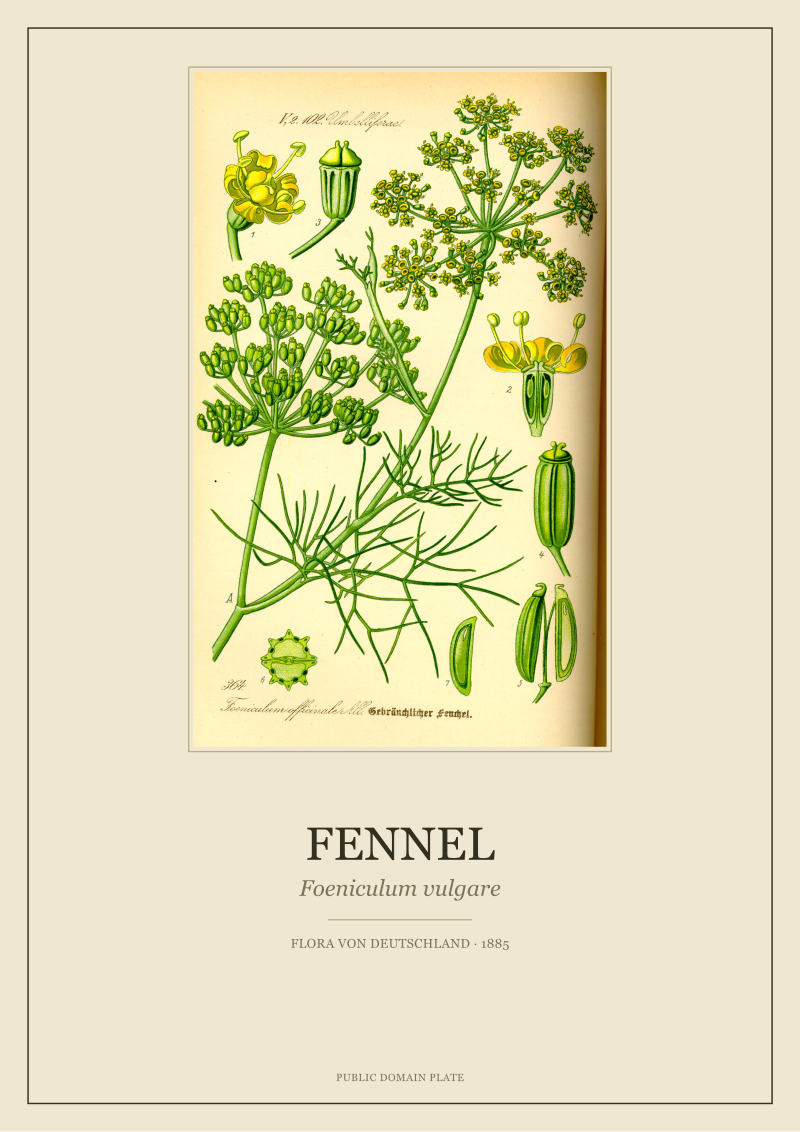
Escalate the glazing and widen the mat. Museum acrylic with 99% UV filter is non-negotiable here; standard glass blocks perhaps 45% of UV and lets the rest bleach the print. The mat should be widened by at least 15% beyond the "aesthetic" recommendation — a fennel plate (*Foeniculum vulgare*, Thomé, 1885) that would normally take an 8cm mat wants closer to 10cm, because the wider air gap between glass and paper reduces the greenhouse effect that builds up behind glazing in sunlight. Consider a spacer strip in the rebate to lift the glass 3–5mm off the mat surface, allowing air movement. If the room genuinely bakes, our recommendation is honest: hang something else on that wall.
If the Wall Is Interior, Shaded, or Climate-Controlled
You can relax the specification without cutting conservation corners. Museum glass remains our default (the cost delta over standard glass is negligible on a piece you plan to keep for decades), but standard anti-reflective glazing is defensible here. The mat can breathe more visually — a single 6–8cm cotton mat rather than a double — because the ambient conditions are stable and the paper is not fighting environmental stress. This is the branch where mat colour matters most, because the eye actually sees the mat rather than reading through it: warm off-white (Ivory, Antique) for the Thomé palette, never bright white, which flattens the aged paper tone into looking cheap.
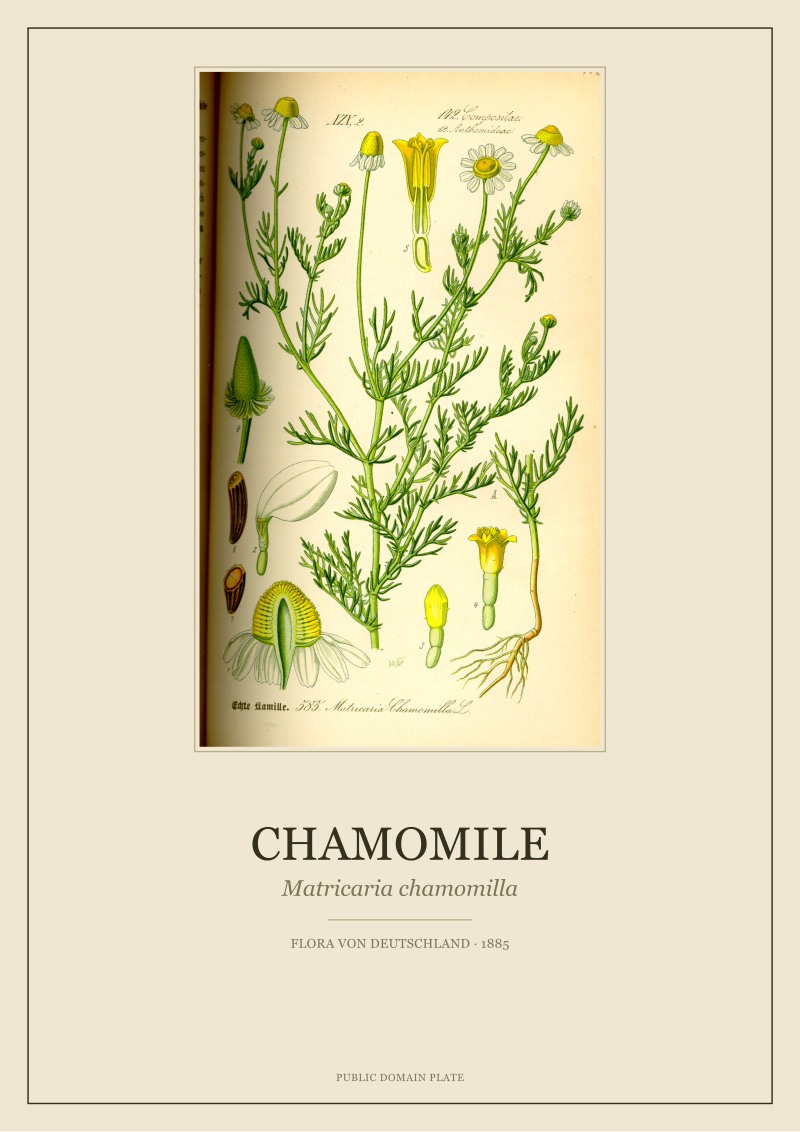 Chamomile
The print from this article · from €29.95
View the print →
Chamomile
The print from this article · from €29.95
View the print →
Question 3: Window Mat or Float Mount?
The final fork. A window mat covers the paper edges with a cut aperture; a float mount lifts the entire sheet, deckle edges included, on a raised platform behind the glass. Most framers default to the window because it is faster to cut and easier to sell. But the choice is not aesthetic — it is dictated by the print itself. If the sheet has intact original deckle edges, or if the ivy plate (*Hedera helix*, Thomé, 1885) you own extends its illustration into the margin in a way a window would crop, float mount wins by default. If the sheet has been trimmed at some point in its history (many 20th-century collectors cropped plates to fit standard frames), the window mat is more honest, because it hides an amputation the float would advertise.
If You Have Full Deckle Edges or Illustration Extending Into the Margin
Float mount. Use corner mounts or archival photo pockets on a rag backing board, lifted 4–6mm off the mount board with a hidden spacer so the deckle casts a soft shadow. The visual effect is that the paper appears to hover — you see the object, not the aperture around it. This is the correct choice for any 1885 plate that has survived intact, because the deckle is part of the historical record. Never trim to fit a window. Never fold under. If the frame is 2cm too small, order the correct frame.
If the Sheet Has Been Trimmed or Has Damaged Edges
Window mat, cut with generous overlap. A window that covers the outer 8–10mm of the sheet edge hides trim marks, foxing at the margins, and any historical repair a former owner attempted. Cut the aperture to reveal the full illustration plus 3–5mm of clean paper as a breathing zone — never crop the plate itself, and never let the window bevel touch the printed area. A 45° bevel in matching cotton core (not a coloured core, which reads as decorator-fussy against the aged paper) keeps the eye focused on the illustration rather than the cut.
If You Answered Everything
Here is the eight-row map. Read across your three answers; the recommendation is the frame you should build.
| Q1 (Print type) | Q2 (Light/humidity) | Q3 (Mount style) | Recommendation |
|---|---|---|---|
| Original 1885 | Direct sun / heat | Deckles intact | Museum acrylic, 10cm cotton mat, float mount with corner pockets, spacer bar 5mm |
| Original 1885 | Direct sun / heat | Trimmed sheet | Museum acrylic, 10cm cotton mat, window with 8mm overlap, hidden spacer |
| Original 1885 | Shaded / stable | Deckles intact | Museum glass, 8cm cotton mat, float mount with T-hinges at top, no dry-mount |
| Original 1885 | Shaded / stable | Trimmed sheet | Museum glass, 6–8cm single cotton mat, window with clean overlap, T-hinges |
| Restored file | Direct sun / heat | Deckles intact | Museum acrylic, 10cm cotton mat, float mount on 310gsm rag, spacer 5mm |
| Restored file | Shaded / stable | Deckles intact | Museum glass, 8cm cotton mat, float mount with corner pockets, warm off-white |
| Reprint / repro | Direct sun / heat | Any edges | Standard AR acrylic, 8cm rag mat, window mat, dry-mount acceptable if flat |
| Reprint / repro | Shaded / stable | Any edges | Standard AR glass, 6cm rag mat, window mat, design latitude yours to spend |
The pattern beneath the table: the older and rarer the object, the less the mat should assert itself, and the more the glazing should protect. A Thomé chamomile from a restored 2025 file wants the same visual restraint as the 1885 original — because the illustration is the same age — but the paper it now sits on tolerates modern handling. That paradox is where most framing goes wrong. It over-decorates the object because it does not know how to distinguish the image from the substrate. Once you separate those two, the frame chooses itself.
A closing note on what this guide did not cover. We have not addressed frame moulding — width, profile, timber versus painted, gilded versus matte — because that decision is architectural and belongs to the wall, not the print. We have not covered hanging systems for heavy multi-plate arrangements, which need a separate conversation about picture rails, D-rings and load ratings. And we have not touched insurance and provenance documentation, which any original 1885 impression above a certain valuation should have but which sits outside the framer's chair. Each of those is a separate piece and we owe them to you eventually.
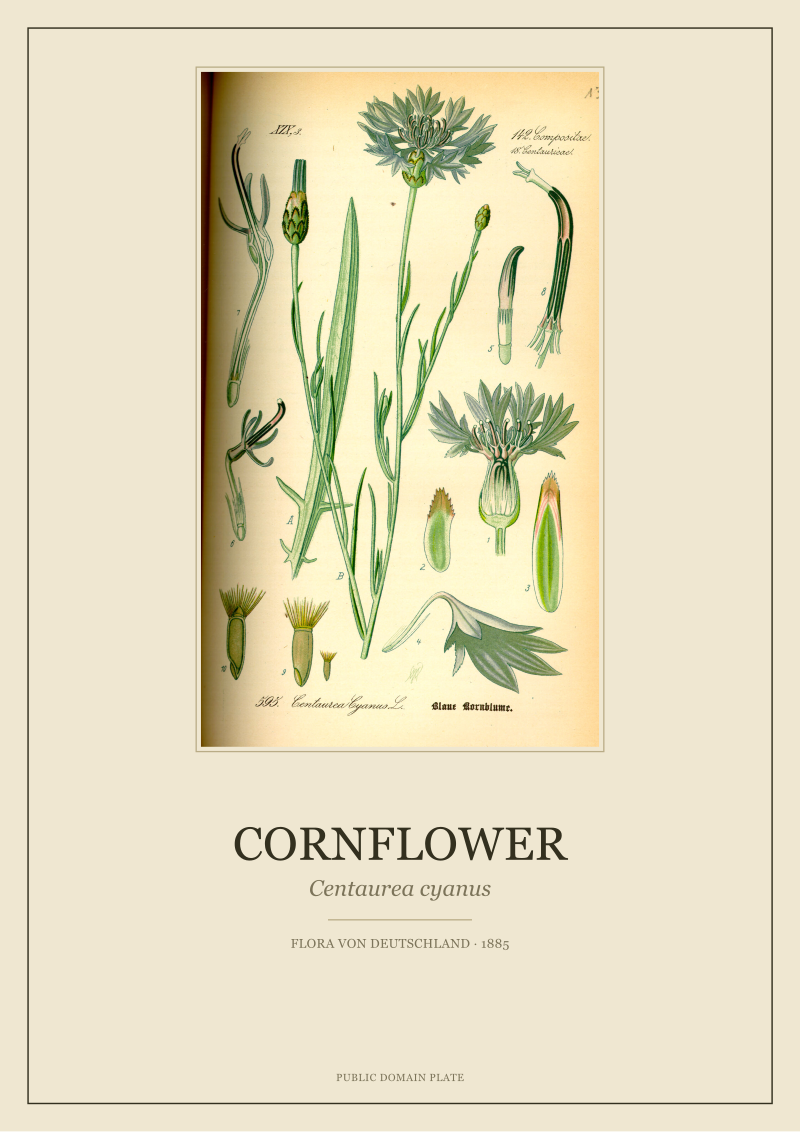 Cornflower
The print from this article · from €29.95
View the print →
Cornflower
The print from this article · from €29.95
View the print →
FAQ
Does a passe-partout actually protect the print, or is it just decoration?
Both, but the protection function is the older reason it exists. A window mat physically separates the paper from the glazing, which prevents condensation transferring moisture directly onto the ink surface, and it creates an air gap that buffers small temperature swings. On an 1885 lithograph the mat also absorbs airborne acidity before it reaches the sheet — provided the mat itself is 100% cotton rag. A wood-pulp mat protects nothing; it accelerates yellowing by bleeding lignin acids into the print edges within a few years.
What mat colour works for 19th-century botanical plates like Thomé's Flora?
Warm off-whites — Ivory, Antique White, Bone — read correctly against the aged paper tone of an 1885 plate. Bright optical white flattens the print into looking like a modern reproduction, because the pure white acts as visual bleach next to the softened cream of the original sheet. Coloured mats (moss green, sage, dusty rose) tend to compete with the illustration's own palette and date the frame to the decade it was cut. Neutral warm tones age better and let the plant carry the composition.
How wide should the mat be for a standard-sized botanical print?
For a plate around 25×35cm, our default is a 7–8cm mat on all four sides in stable indoor conditions, widening to 9–10cm if the wall receives direct sunlight or sits above a heat source. Wider mats are not just aesthetic — they increase the air buffer inside the frame, which reduces micro-condensation on the glass. Narrower mats (under 5cm) crowd the illustration visually and reduce the protective air volume. Equal borders read as classical; a slightly deeper bottom border reads as gallery-formal and works for larger plates.
Should I use glass or acrylic on an original 1885 botanical plate?
For a genuine original, use museum-grade glazing with a 99% UV filter — the choice between glass and acrylic is secondary to the UV rating. Acrylic is lighter (matters for large frames), shatter-resistant (matters if you have children or move often), and easier to ship. Glass is more scratch-resistant, does not attract static that pulls loose pigment particles, and does not yellow over decades. Standard float glass without UV coating blocks less than half the damaging wavelengths and will noticeably fade the plate within 15–20 years of daylight exposure.
Can I frame a botanical print above a radiator or in a bathroom?
Above a radiator, only with heightened glazing, a wider mat, and the understanding that the print is on hardship duty. In a bathroom, we advise against framing any paper artefact from the 19th century. Humidity cycles of 30% to 90% within a single day, which is normal for a working bathroom, will cause the mat and paper to expand and contract at different rates, eventually cockling the sheet and lifting hinges. For those rooms, use a modern reprint or a restored file on stable cotton paper, and reserve original plates for climate-stable interior walls.
Is float mounting appropriate for all botanical prints, or only some?
Only prints with intact original edges — genuine deckles, printed edges, or illustrations that extend past the plate line into the margin. Float mount treats the sheet as a complete object and celebrates its perimeter. If the sheet has been trimmed at any point in its history (very common for 20th-century collector plates rebound into standard frames), the float mount will advertise the trim as a visual defect. In that case a window mat, cut to overlap the outer 8–10mm of the sheet, is more honest and more flattering.
Do restored digital files of botanical plates need the same conservation-grade framing as originals?
The paper does not need it — modern 310gsm cotton rag is far more stable than 140-year-old lithograph sheet — but the image deserves it, because the visual information is old and modern inks will fade under UV within a decade if unprotected. Our studio's practice is museum mat, museum glazing, and reversible corner-mount pockets on any restored file we sell. The frame should outlast the room it hangs in, and reversibility means the print survives future reframing without damage from adhesives or dry-mount.
New plates from the archive and 10% off your first print.
One email now with your code. No noise after.