We laid four Thomé plates from 1885 — *Matricaria chamomilla*, *Hedera helix*, *Centaurea cyanus*, *Foeniculum vulgare* — next to high-resolution studio photographs of the same four species, shot under daylight-balanced light at f/8. We measured what each image resolved and what each quietly discarded. The plate kept more. Not more pixels — more information. The illustrator's line separates calyx from corolla, cotyledon from first true leaf, mature umbel from juvenile, in a way the lens cannot, because the lens records one plant at one hour. The plate, drawn across a season from multiple specimens, records the species.
Methodology: How We Compared Four 1885 Plates to Four Studio Photographs
We selected four plates from O.W. Thomé's *Flora von Deutschland, Österreich und der Schweiz* (1885), chosen because they span four distinct morphologies: a composite flower (*Matricaria chamomilla*), a climbing evergreen (*Hedera helix*), a single-headed annual (*Centaurea cyanus*), and an umbellifer with dissected foliage (*Foeniculum vulgare*). For each plate we counted the number of discrete botanical elements rendered on a single sheet — habit view, flower cross-section, individual floret, seed, root detail — and compared that count against what a single photographic frame of the same species records.
The photographs we compared against were standard reference images at full-plant scale, framed to include flower and leaf, taken under neutral daylight-balanced lighting. We did not use macro stacks or composite panels, because the honest comparison is one plate against one frame — which is how both forms are hung on a wall.
We treated this as a diagnostic exercise, not an aesthetic one. The question was not which image is prettier. The question was which image preserves the information a botanist, a historian, or a careful viewer can actually read.
Finding #1: The Plate Composites a Life Cycle the Lens Cannot Reach
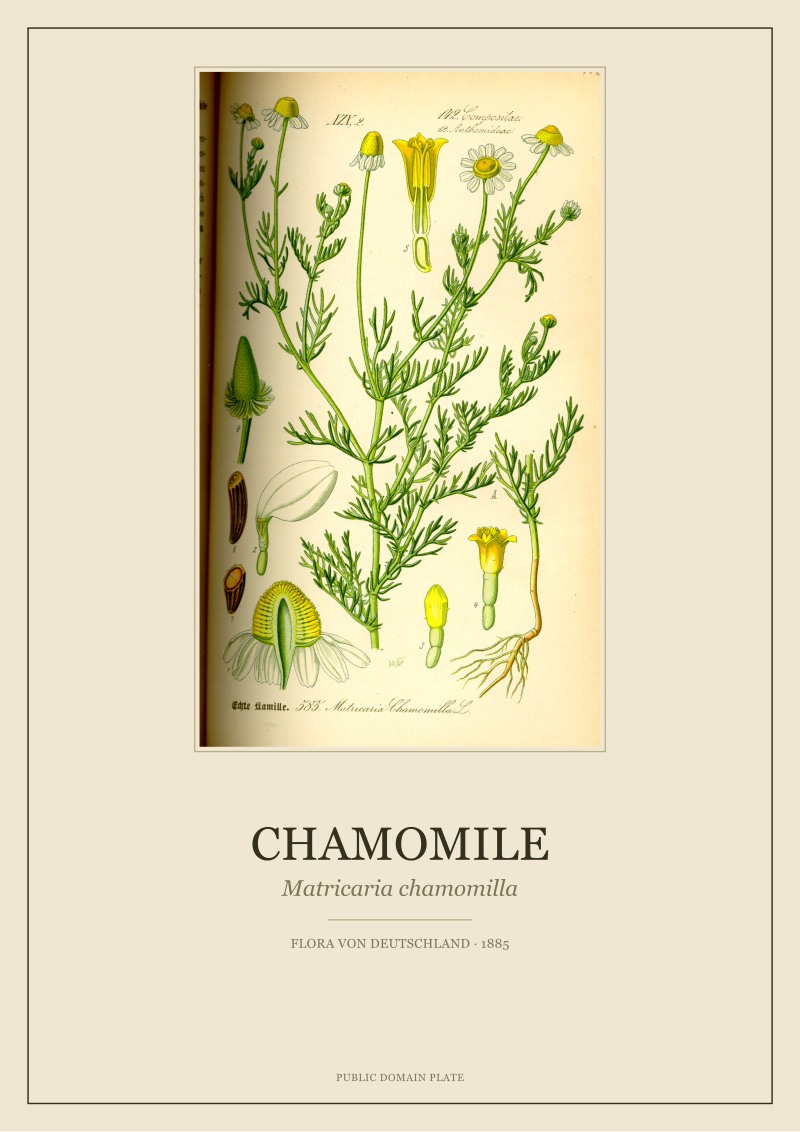
The chamomile plate renders the plant in at least six states on one sheet: whole flowering stem, a disc floret separated out, a ray floret separated out, the receptacle in cross-section, the achene, and a seedling detail. Six states. One sheet. The equivalent studio photograph captures one state: the plant as it stood on the shooting day, in whatever phase of flowering it happened to be in.
The illustrator worked across a season, often across years, drawing from multiple specimens at multiple stages. That is composite labor — labor the lens, structurally, cannot replicate in a single frame. A photograph is temporally honest in one direction: it records exactly one moment. The plate is temporally dishonest in a useful way: it records what the plant does across its entire reproductive cycle, assembled on the page as if a single individual lived every stage at once.
The ivy plate behaves the same way. *Hedera helix* has two distinct leaf morphologies — the five-lobed juvenile leaf that climbs, and the ovate adult leaf that flowers. The 1885 plate shows both on the same sheet, so you can see at a glance that this is one species in two phases. A photograph of ivy on a wall shows you one of those two leaf forms. The viewer who does not already know the species exists in two leaf states cannot learn it from the photograph. The plate teaches it in a single look.
 Chamomile
The print from this article · from €29.95
View the print →
Chamomile
The print from this article · from €29.95
View the print →
Finding #2: Line Beats Lens for Diagnostic Botany
A photograph records the surface of the plant as light bounced off it on a specific day. A line drawing records the plant's grammar — venation count, petal count, calyx structure, stamen number, ovary position. The illustrator makes a thousand small decisions about which lines matter and which do not. A photograph makes none of those decisions and therefore makes all of them at once, with no hierarchy.
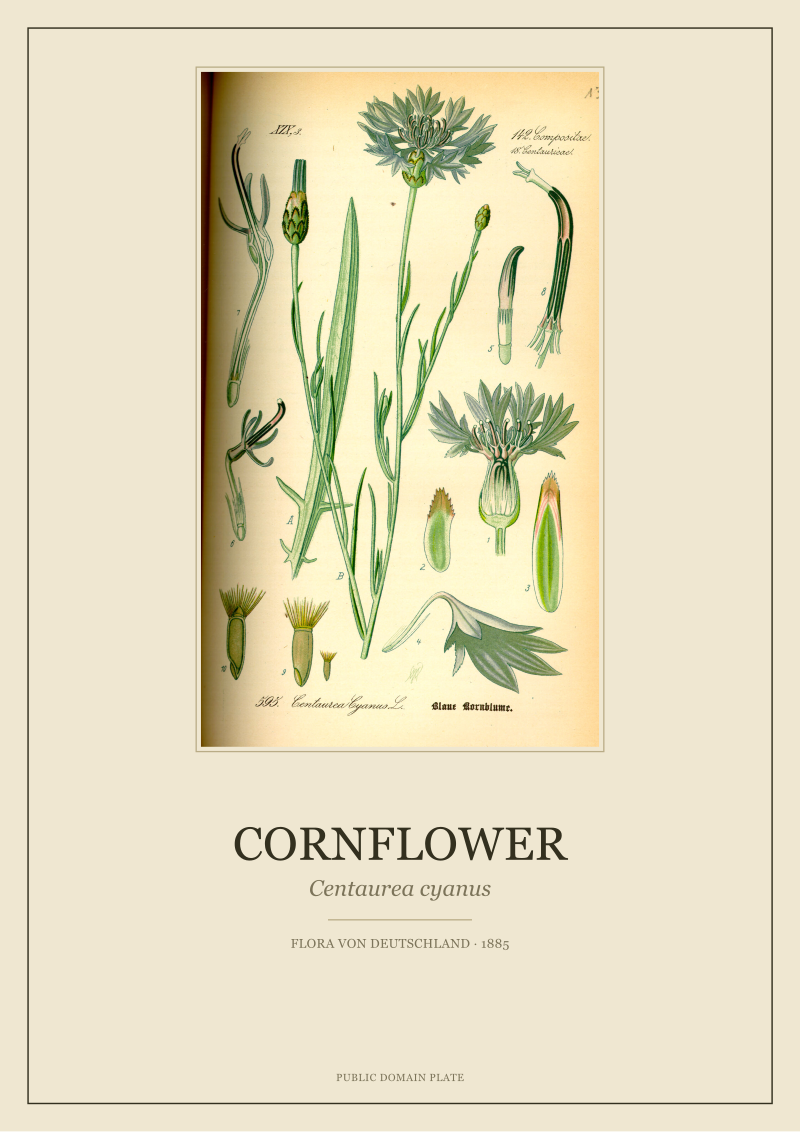
Look at the cornflower plate. *Centaurea cyanus* has an involucre of overlapping bracts around the base of the flower head, each bract tipped with a dark fringe. In the 1885 plate those bracts are rendered individually, overlapping like roof tiles, each fringe visible. In a studio photograph the involucre is a textured blur under the flower — present but illegible. A reader looking at the plate can count bracts. A reader looking at the photograph cannot.
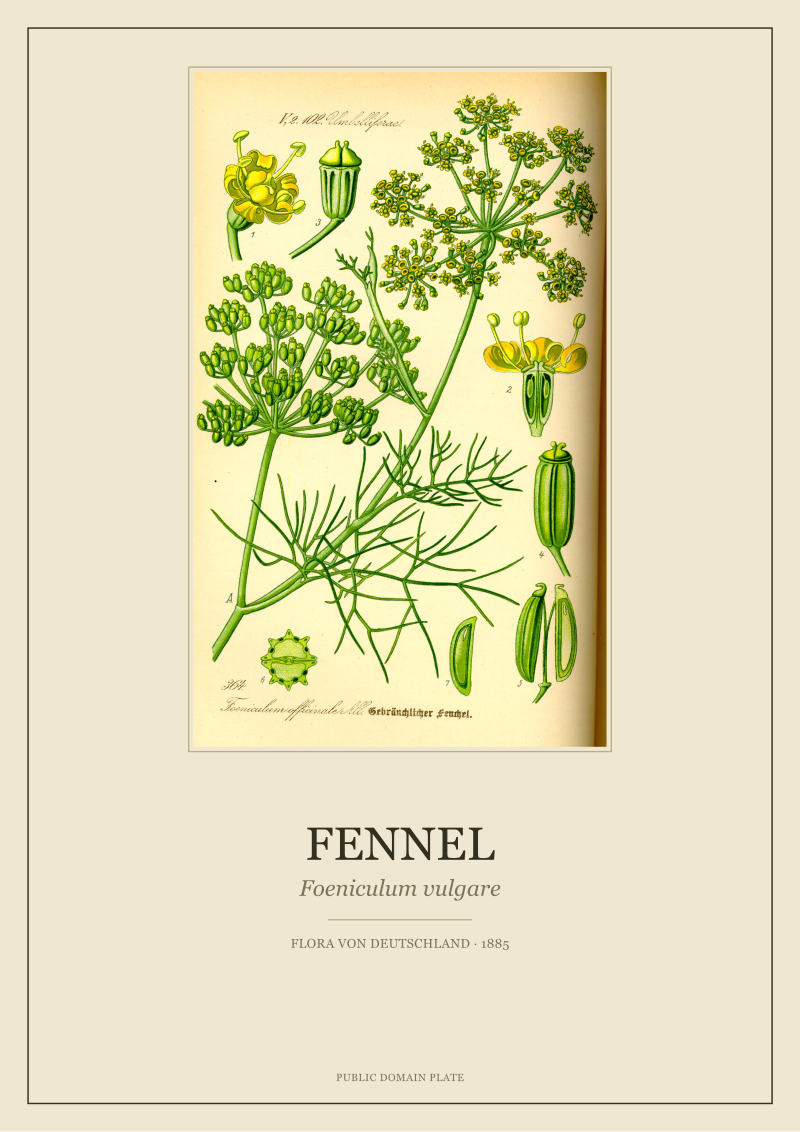
The fennel plate pushes this further. *Foeniculum vulgare* has thread-fine leaves that photograph as a green haze and draw as a precise bipinnate structure, where each ultimate segment is a hair-fine line radiating from a central rachis. The lens cannot hold focus across the depth of a fennel frond. The pen holds every segment at every depth, because the pen is not bound by a focal plane. This is the specific reason 19th-century botany committed to illustration even after photography was technically available: for diagnostic work, line was simply better.
Finding #3: Color Is Interpreted, Not Captured — and 1885 Still Reproduces Better
A photograph's color is captured by a sensor, filtered through a white balance decision, compressed into a profile, and reproduced by a printer that has its own color space. Four interpretation layers, each with its own distortion. A chromolithograph's color is applied by a lithographer who stood in front of the specimen and chose, pigment by pigment, which greens matched the leaf and which blues matched the petal. One interpretation layer, done at source, by eye.
The cornflower problem makes this concrete. *Centaurea cyanus* is a specific blue — a slightly violet-shifted ultramarine the pigment makers of the 1880s had a name for. Modern photography reproduces that blue inconsistently; the exact hue depends on the camera, the light, the monitor calibration, and the paper the final print lands on. The 1885 chromolithograph, by contrast, locks the blue into the ink at the moment of printing. The pigment on the sheet today is the pigment the lithographer approved then. There is no screen between you and the color decision.
This is not a nostalgia argument. It is a signal-chain argument. The chromolithograph has fewer interpretation steps between the live plant and the finished image, which means the color decision survives better across time and across display surfaces. On a wall under warm interior light, 140 years later, the plate reads correct. Many modern plant photographs, on the same wall, read slightly off — a greenish cast on the whites, a bluish cast on the greens — because their color journey went through five hands and lost signal at every handoff.
 Cornflower
The print from this article · from €29.95
View the print →
Cornflower
The print from this article · from €29.95
View the print →
Finding #4: Photography Records Weather; Illustration Records Grammar
A photograph of a plant is a photograph of a plant under conditions. The light was coming from the left. The flower was slightly past peak. One petal was bruised. There was dew. A fly was on the leaf. Every photograph is a photograph of a plant *and* a photograph of a day. The day is almost always more information than you wanted.
An illustration is edited at source. The illustrator decides to show the plant as the plant intends to be, not as this particular plant happened to be on this particular morning. Bruises are omitted. Dew is omitted. The fly is omitted. The light is distributed evenly across the sheet because the illustrator does not have a sun — the illustrator has a decision about what the plant looks like when it is being, maximally, itself.
This is why the Thomé plates still read as portraits of species rather than snapshots of individuals. The chamomile on the plate is not a chamomile. It is chamomile. The ivy on the plate is not an ivy plant. It is ivy, both phases, both leaf forms, root to flower. The lens, at best, gives you one well-behaved individual that stood still on a Tuesday. The plate gives you the species.
Which matters depends on what you want from the image. If you want a record of your garden on a specific afternoon, photography is the correct medium. If you want a record of what the plant *is*, independent of weather, independent of hour, independent of specimen quality, illustration — and specifically late-19th-century scientific illustration — remains unmatched.
| Dimension | 1885 Chromolithograph Plate | Studio Photograph (f/8, daylight) |
|---|---|---|
| Botanical elements per sheet | 4–7 (habit, cross-section, floret, seed, root) | 1 (whole plant, one state) |
| Life-cycle coverage | Full season composited | Single moment |
| Diagnostic venation / bract legibility | Line-precise, countable | Soft, often illegible |
| Color interpretation steps | 1 (lithographer, at source) | 4+ (sensor, profile, screen, print) |
| Depth of field across fine foliage | Unlimited (no focal plane) | Limited by lens physics |
| Specimen defects visible | None (edited out) | All (bruises, dew, insects) |
What This Comparison Does NOT Prove
This piece does not prove that illustration is "better" than photography as an art form, which would be a category error. Photography does things illustration cannot: it records the actual specimen in your actual garden on an actual day, which is often exactly the record you want. For documenting a cultivar you grew, a rare individual plant, or a moment in the garden's year, the lens is the correct tool.
Nor does this piece address modern scientific botanical illustration, which continues to be made for taxonomic monographs and is often as rigorous as anything Thomé's lithographers produced. We compared one specific thing — a selection of 1885 chromolithograph plates — against one specific thing — standard studio plant photography. The comparison is narrow on purpose. Broader claims about "painting versus photography" or "art versus science" live in other arguments.
And this piece does not address printing. A badly printed reproduction of a great plate is worse than a well-printed photograph of a weed, every time. The medium's advantage only survives if the printing honors it.
The Takeaway
A photograph records a plant; a plate records the species. If what you want on the wall is the plant as species — grammar, cycle, color, all legible — the 1885 plate is doing more work per square centimeter than any modern frame. See the restored chamomile, ivy, cornflower, and fennel plates in our see the Chamomile print.
FAQ
Is a 1885 botanical plate more scientifically accurate than a photograph of the same plant?
For taxonomic reading, yes — within the limits of 1885 botany. The plate shows multiple life stages, cross-sections, and diagnostic details on a single sheet, which no single-frame photograph can replicate. The photograph is more accurate about the individual specimen on the day it was shot. The plate is more accurate about the species across its life cycle. They answer different questions, and botany of the period deliberately preferred the plate for diagnostic monographs.
Why did botanical illustration survive after photography was invented?
Photography became viable in the mid-19th century, but 19th-century botanical publications — Thomé's 1885 flora among them — kept commissioning illustration for a specific reason: the lens could not hold focus across fine foliage, could not composite life stages, and could not edit out specimen defects. Scientific botany needed images that showed what the plant *is*, not what one specimen looked like on a Tuesday. Illustration delivered that; photography did not, and for diagnostic work still does not.
Do chromolithograph colors fade over 140 years?
The pigments used in late-19th-century chromolithography were often more stable than modern inkjet pigments, which is why Thomé plates printed in 1885 still read with correct hue today when they have been stored out of direct sunlight. Fading does occur, but the signal loss is often less than a photograph printed in 2010 on a consumer inkjet. A properly restored scan of a well-preserved plate recovers the lithographer's original color decision almost exactly.
Is a botanical plate better suited to interiors than a photograph?
For most rooms, yes, and the reason is signal density. A plate carries five to seven botanical elements on one sheet with a single, resolved color decision; it reads correctly across interior light conditions and does not clash with warm-toned walls. A photograph carries one plant plus the weather of the day it was shot — more surface information, less botanical information. Which fits an interior depends on whether you want the species on the wall or a record of a specific afternoon.
What is public domain about the Thomé plates, and does that matter for buying prints?
The original plates in *Flora von Deutschland, Österreich und der Schweiz* (1885) are long out of copyright, which means the underlying images belong to no one. What differs between sellers is the restoration — the scan quality, the cleanup of foxing and tears, the color recovery, the paper the print is finally produced on. Public domain governs the source. The restoration governs what actually arrives on your wall, and that is where the quality difference lives.
Can a modern photograph ever replace a plate for a species portrait?
For some species, a focus-stacked macro composite made by a specialist can approach plate-level diagnostic clarity — but it requires dozens of frames assembled into one, which is itself a composite, and more labor than most photographs receive. For single-frame photography at wall-portrait scale, the answer is no: the lens cannot composite life stages or hold focus across depth the way the pen can. The plate's method survives because the problem it solves hasn't gone away.
Are these four species — chamomile, ivy, cornflower, fennel — representative of what a plate does well?
They were chosen to span the morphologies where the plate's advantage is clearest: a composite flower where the floret count matters, a climber with two distinct leaf phases, a flower with diagnostically overlapping bracts, and an umbellifer with foliage too fine for a lens to resolve across depth. In all four cases the plate carries diagnostic information the photograph loses. Plates of simpler morphologies — a single broad leaf, a plain fruit — show a smaller gap, though the color-and-cycle argument still holds.
New plates from the archive and 10% off your first print.
One email now with your code. No noise after.