Four plates. One question. We pulled *Matricaria chamomilla*, *Hedera helix*, *Centaurea cyanus* and *Foeniculum vulgare* from O.W. Thomé's *Flora von Deutschland, Österreich und der Schweiz* (1885) off the restoration desk this month and asked a specific thing of them: how much of the Kew Gardens tradition of botanical illustration — a tradition codified in London decades before Thomé sat down in Cologne — is legible in the line, the layout, the label? The plates are German. The grammar underneath them is, in large part, English. That is the argument, and it is what the next 2,400 words are going to prove or fail to prove.
Methodology: What We Audited, and What Kew Has to Do With a German Flora
The audit is narrow on purpose. Four plates, one work, one year. Each of the four — chamomile, common ivy, cornflower, fennel — was pulled from a single edition of *Flora von Deutschland, Österreich und der Schweiz*, printed in 1885 and drawn under the supervision of Otto Wilhelm Thomé. We scanned each plate at studio resolution, indexed every drawn element on the sheet (habit view, dissected part, seed detail, cross-section), and cross-referenced the compositional grammar against the conventions Kew Gardens had, by the 1880s, spent nearly a century codifying through its own *Curtis's Botanical Magazine*, its *Icones Plantarum*, and its house rules for staff and contract artists.
Kew is not on the label. That is the honest bit. Thomé did not train at Kew, and the *Flora* was not a Kew publication. What Kew did was set the international grammar for what a scientific plant portrait was allowed to look like — the diagnostic dissection alongside the habit, the outlined line before the wash, the isolated specimen on a plain ground. By 1885, that grammar was the default posture of any serious continental flora, Thomé's included. We are auditing how much of it he obeyed, and where he departed.
The limitation to state upfront: we did not compare Thomé plates against physical Kew publications side by side. That would be a separate audit and a longer one.
Finding #1: The Diagnostic Habit — Why Kew Drawings Show the Dissection
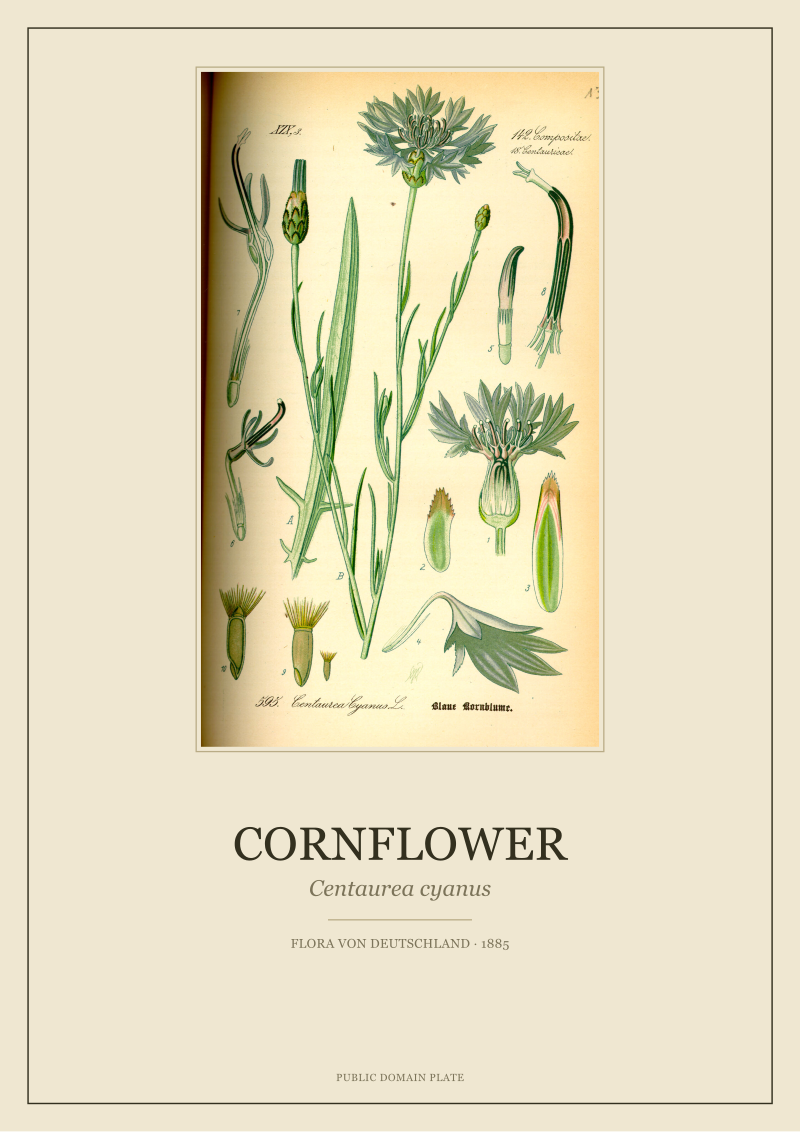
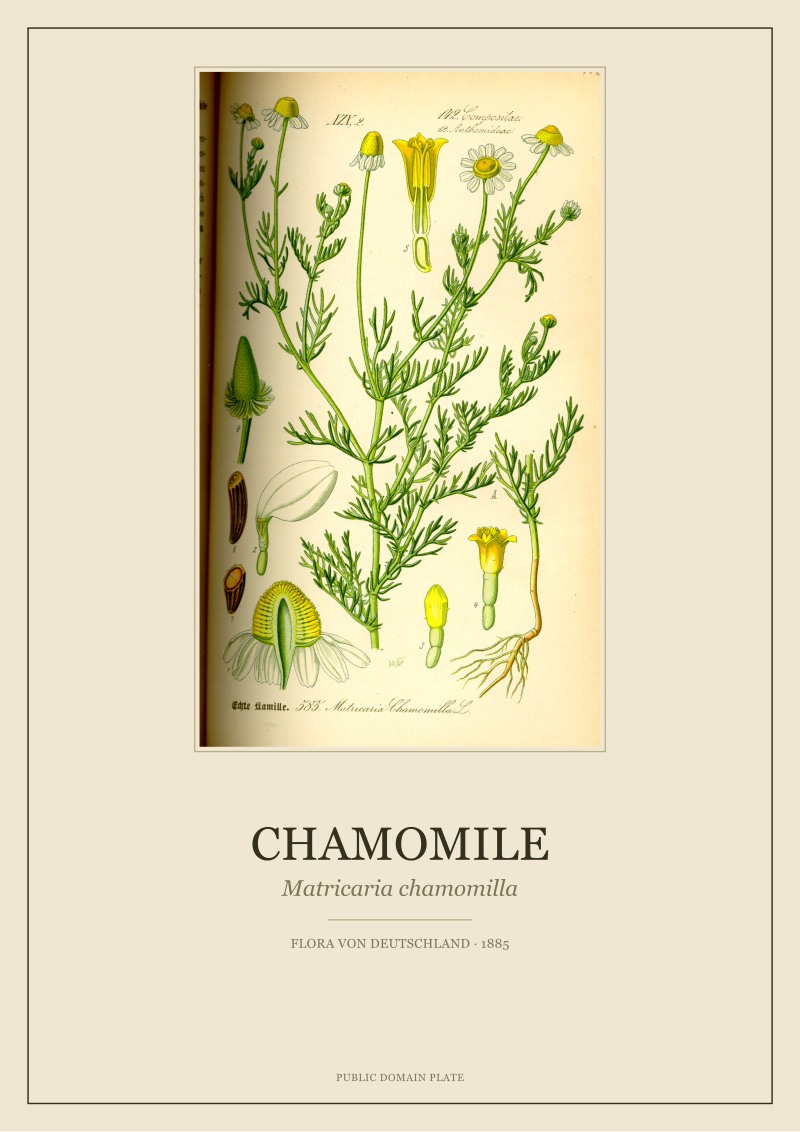
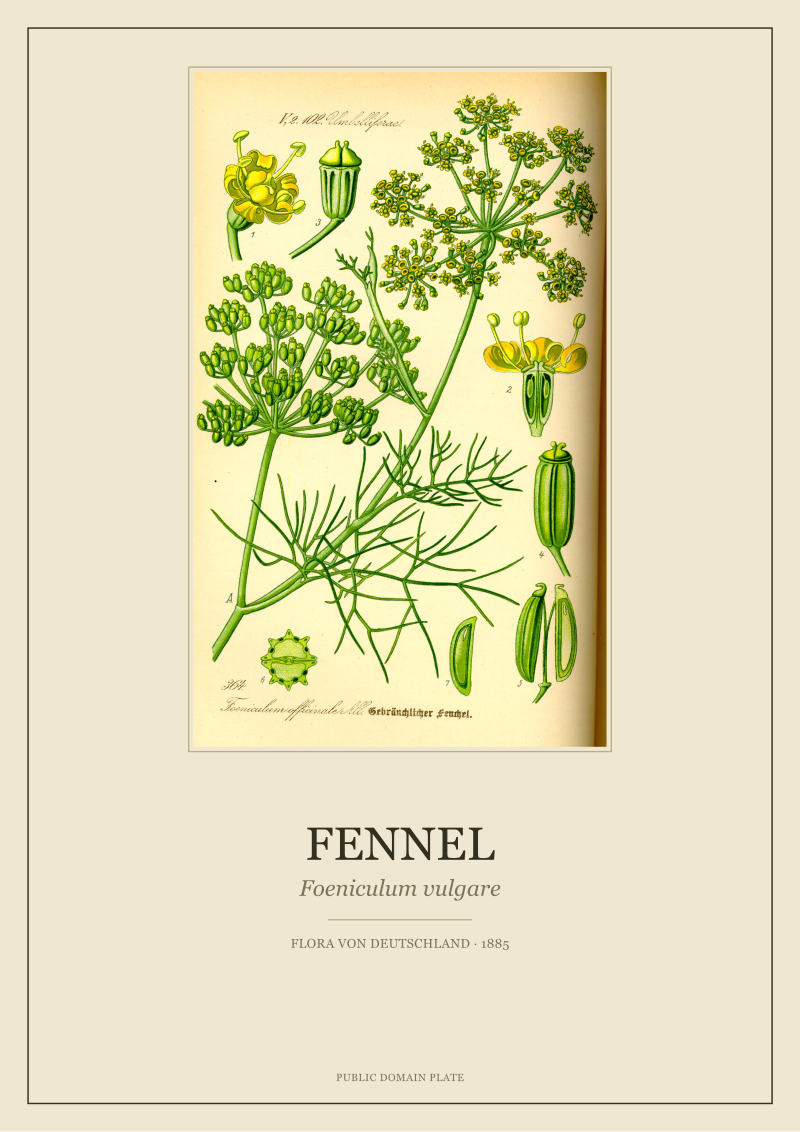
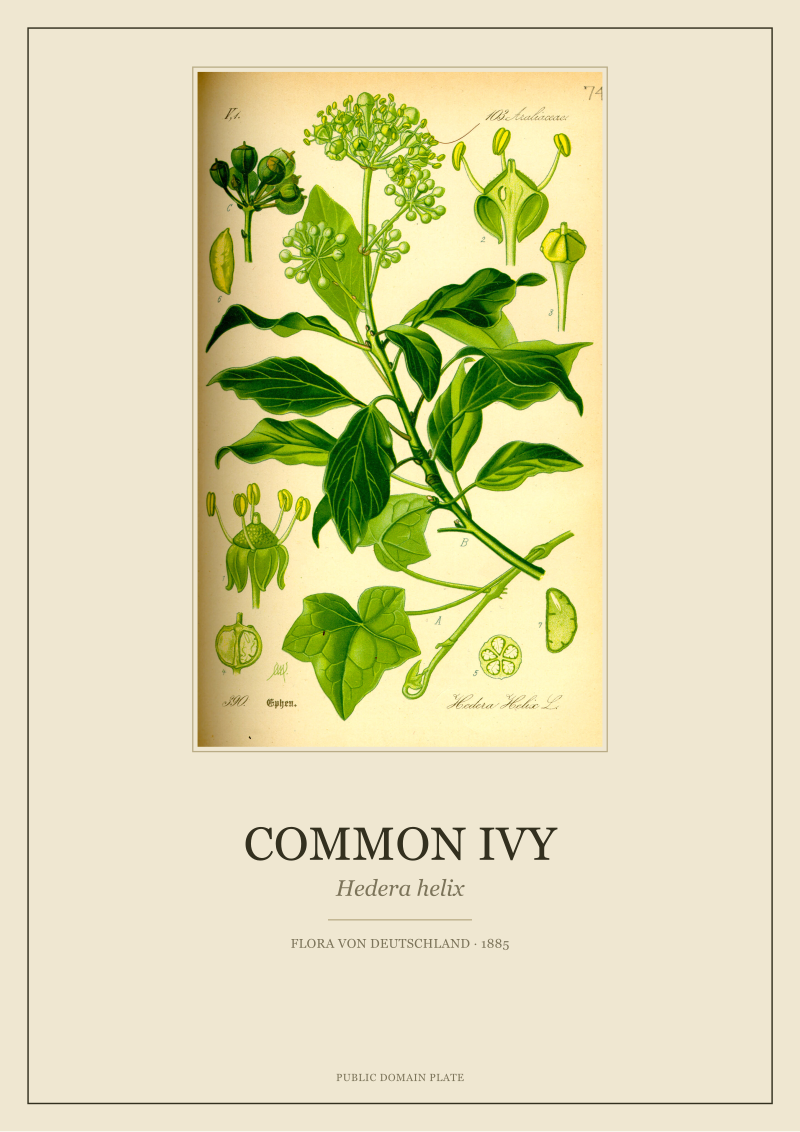
Every plate in our four shows the same organisational move. The full plant sits in the centre or upper portion of the sheet. Around it — smaller, numbered, sometimes cut away from a supporting sprig — sit the diagnostic parts: a flower head opened up, a fruit in cross-section, a single seed enlarged past its true scale, a leaf with venation exaggerated. On the *Matricaria chamomilla* plate the ray florets and disc florets are separated out; on *Foeniculum vulgare* the umbel is broken down into an individual flower and then into a single mericarp. On *Hedera helix* the flowering umbel appears next to the mature berry. On *Centaurea cyanus* the involucral bracts are pulled apart from the head.
This is not decorative variety. It is the diagnostic habit, and Kew is where it was hardened into obligation. *Curtis's Botanical Magazine*, running continuously since 1787 and taken over by Kew in the mid-nineteenth century, had by the 1880s trained its readership — and its artists — to expect that a plant portrait was not a portrait of a plant. It was a portrait of a plant *plus* the specific evidence a botanist would need to identify that plant in the field or the herbarium. A rose without the dissected flower and the achene was a nice picture; a rose *with* them was a scientific document.
Thomé's four plates all obey the rule. The dissections are numbered, they correspond to a caption, and they are drawn with the same care as the main habit view. Verdict: fully compliant with the Kew convention. On this count the tradition is not only legible in the German plate — it is structural to it.
 Cornflower
The print from this article · from €29.95
View the print →
Cornflower
The print from this article · from €29.95
View the print →
Finding #2: The Line Before the Wash — Kew's Pencil Discipline in a Chromolithograph
Kew's studio artists — Walter Hood Fitch is the name that carries most of this weight through the mid-nineteenth century — trained under a rule that reads simply and is hard to execute: the line comes first, and if the line is right, the colour is a decision, not a rescue. Fitch drew directly onto the lithographic stone from his own pencil work, and the plates that came out of Kew in the 1850s and 60s carry an evident hierarchy — an outline that could stand on its own without the wash, and a wash that never tries to invent structure the outline did not already give it.
Thomé's plates are chromolithographs, printed with multiple colour stones and a level of tonal sophistication Fitch was not usually chasing. The technology moved on. The discipline did not. On all four plates in our sample, the outline holds. Strip the colour off the ivy and the leaves still describe themselves through the vein-work and the terminal lobing. Do the same to the fennel and the umbel geometry survives as line alone. The cornflower's ray florets read as strokes before they read as blue.
That is Kew grammar in a German shop. The chromolithography is continental — probably Cologne, plausibly a Leipzig subcontract, we would need the printer's mark to say for sure — but the pencil discipline under it belongs to the tradition Fitch put on paper thirty years earlier. Verdict on this convention: inherited, cleanly, and legible on the page.
Finding #3: The Species-Portrait Convention, Applied to Chamomile and Cornflower
Kew's other structural gift to the tradition was the species portrait as a form. One plate, one species. No landscape context, no companion planting, no bees, no gardeners' hands, no glasshouse behind the specimen. The plant is lifted out of its habitat and set against nothing. Sometimes the nothing is a pale wash; more often, in the *Botanical Magazine* tradition, it is the paper itself.
The chamomile and cornflower plates in our audit are almost aggressive in their obedience to this. *Matricaria chamomilla* — a plant that in life colonises disturbed ground, roadsides, field edges, the least picturesque places in Europe — is drawn against nothing. No soil line, no companion weeds, no context that would place it in the wheat field where any German child of 1885 would have first seen it. *Centaurea cyanus* is given the same treatment: a plant historically inseparable from grain agriculture, painted as if it had never touched a cornstalk. This is not carelessness. It is doctrine. The Kew convention held that context contaminates identification. A cornflower drawn among wheat teaches you cornflowers-in-wheat; a cornflower drawn against paper teaches you the cornflower.
The ivy and fennel plates obey the same rule but with less at stake — neither carries the same weight of vernacular association that chamomile and cornflower do. What the chamomile and cornflower plates prove is that Thomé, in 1885, was willing to strip out the cultural background of a plant to preserve the diagnostic foreground. That is a Kew inheritance, and it is the reason these plates still look modern.
 Chamomile
The print from this article · from €29.95
View the print →
Chamomile
The print from this article · from €29.95
View the print →
Finding #4: What Kew Standardized That Thomé Inherited — And What He Quietly Dropped
Not everything crossed the Channel. Two Kew conventions show up weakened or altered in the four plates on our desk.
The first is the caption. Kew's tradition — especially the *Botanical Magazine* — placed considerable weight on the accompanying text: a description in Latin and English, the collector's name, the date and place of first flowering under glass at Kew, the source herbarium sheet. The plate was one half of a two-part scientific record. Thomé's *Flora* is captioned, but sparely: Latin binomial, German common name, family, numbered key to the dissections. The narrative apparatus is gone. What remains is the labelling grammar, not the storytelling.
The second is the individual signature. Fitch, Matilda Smith, Lilian Snelling — Kew artists were named on their plates and named consistently across their working lives, a practice that turned botanical illustration into an authored discipline. Thomé's *Flora* runs under Thomé's name as editor and directing artist, but the plates in our four-plate sample do not surface the hand of an individual draughtsman with the same clarity. The work is corporate in a way *Curtis's* never was.
Both departures are legible as the choice of a schoolbook publisher, not a research institution. Thomé's *Flora* was aimed at teachers, students, and the educated general reader — not the Kew subscriber list. The grammar of the plate stayed; the surrounding scholarly apparatus was cut for the audience. On this count, verdict: partial inheritance, with the losses accounted for.
The Comparison Table: Four Plates, Four Kew Conventions, Four Verdicts
| Plate (Thomé, 1885) | Diagnostic dissection present | Line-first discipline | Isolated specimen | Kew convention preserved |
|---|---|---|---|---|
| *Matricaria chamomilla* | Yes — ray and disc florets separated | Yes — outline holds without wash | Yes — no field context | Fully |
| *Hedera helix* | Yes — flowering umbel and berry both drawn | Yes — leaf venation carries as line | Yes — no wall or tree support shown | Fully |
| *Centaurea cyanus* | Yes — involucral bracts pulled apart | Yes — florets read as strokes | Yes — no wheat, no field | Fully |
| *Foeniculum vulgare* | Yes — umbel broken to single flower and mericarp | Yes — umbel geometry legible in line | Yes — no kitchen or garden context | Fully |
The table is uniform on purpose. The uniformity is the finding. Across four species with radically different growth habits — an annual weed, a woody climber, an arable-field wildflower, a tall perennial umbellifer — the same four Kew-derived conventions are obeyed in the same way. This is what tradition looks like in a plate: the invisible consistency underneath the visible variety.
What This Does NOT Prove
It does not prove Thomé worked from Kew publications. He may have. He probably owned some. But the audit above does not establish a documentary link — no marginalia, no letters, no shared engraver. What we have established is grammar-level inheritance, which is what conventions do when they succeed: they stop being borrowings and start being defaults.
It also does not prove Kew *invented* every convention on the list. The diagnostic dissection has roots in seventeenth-century herbals; the isolated specimen predates Kew's rise. Kew's contribution was codification and dissemination at scale through the nineteenth century, particularly via the *Botanical Magazine* and the artists who trained through it. A more careful audit would compare a Thomé plate against a directly contemporaneous German flora that predates the Kew consolidation — Reichenbach's *Icones*, for instance — and ask which conventions travel from where. That is the next audit, not this one.
The Takeaway
The German plate on our wall is speaking English underneath the Latin. What Kew standardised in the century before Thomé is what makes his 1885 chamomile still legible as a scientific object in 2026.
FAQ
Did Otto Wilhelm Thomé study at Kew Gardens?
Nothing in the *Flora von Deutschland, Österreich und der Schweiz* itself establishes a Kew training or connection for Thomé, and this audit did not extend to biographical archives. Our argument is not that Thomé was Kew-trained. It is that by 1885 the conventions Kew had spent the nineteenth century codifying — the diagnostic dissection, the outlined line, the isolated specimen — had become the international default for scientific plant portraiture. Thomé inherited that grammar the way any serious continental illustrator of his generation did.
Why is the cornflower drawn without any wheat around it?
Because Kew's species-portrait convention held that habitat context contaminates identification. A *Centaurea cyanus* drawn among ripening cornstalks teaches you what cornflowers-in-wheat look like; a *Centaurea cyanus* drawn against paper teaches you the cornflower itself, in a form that reads the same whether the reader is in a Bavarian schoolroom or a Cape Town herbarium. Thomé's plate follows that discipline strictly, which is why the plant looks isolated in a way its actual nineteenth-century life never was.
Are chromolithographs like Thomé's the same technique Kew used?
Not quite. Kew's most influential mid-nineteenth-century plates, particularly under Walter Hood Fitch, were hand-coloured lithographs — the outline printed from the stone, the colour applied by studio colourists working from a master copy. Chromolithography, which prints each colour from a separate stone, was the industrial evolution of that technique and dominated the 1880s continental market Thomé worked in. The output looks similar because the pencil discipline underneath is the same; the colour production process differs.
What is a "diagnostic dissection" on a botanical plate?
A diagnostic dissection is a smaller, usually numbered drawing that appears alongside the main habit view of the plant and shows a part — a flower opened up, a fruit cut across, a single seed enlarged — that a botanist would need in order to identify or classify the specimen. On the chamomile plate the ray and disc florets are separated; on the fennel plate a single flower and a mericarp are broken out of the umbel. The convention is what turns a picture of a plant into a scientific record.
Why does the audit only look at four plates?
Because the audit is a proof of grammar, not a survey of the *Flora*. Four species with genuinely different growth habits — a weed, a climber, an arable wildflower, an umbellifer — give us enough variety to test whether the same conventions repeat under different visual conditions. They do. A broader sweep across more of Thomé's plates might sharpen the picture of where the conventions weaken or shift, but the four-plate scope was chosen to make the pattern legible without diluting it into an inventory.
Can I see the restored plates from this audit?
The four plates discussed here — *Matricaria chamomilla*, *Hedera helix*, *Centaurea cyanus* and *Foeniculum vulgare* from Thomé's 1885 *Flora* — are in the studio's public-domain restoration set and available as archival prints through our shop. Each is scanned from the original edition and cleaned by hand and code, with the diagnostic dissections preserved rather than cropped out for decorative effect. The Kew grammar audited above is the reason we leave them in.
New plates from the archive and 10% off your first print.
One email now with your code. No noise after.