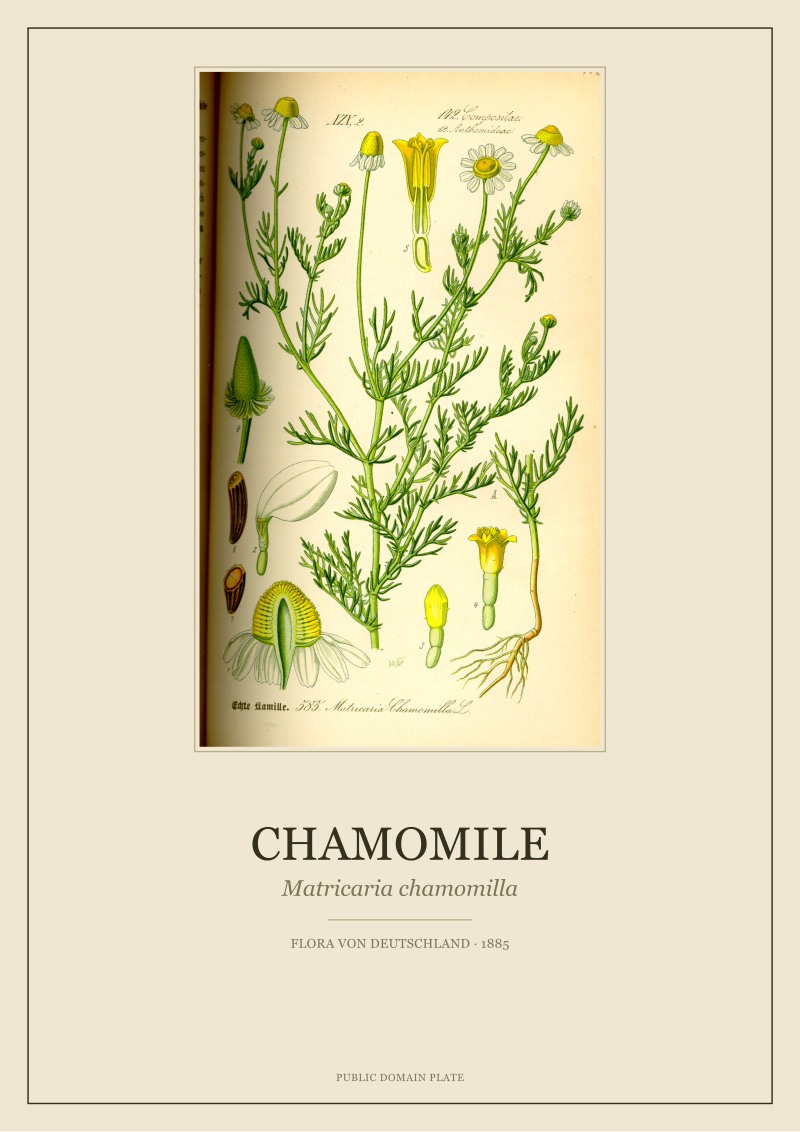
We spent a week last month arguing about a single chamomile. Not the plant — the plate. Matricaria chamomilla, drawn by Otto Wilhelm Thomé for his Flora von Deutschland, Österreich und der Schweiz in 1885, sitting on the studio scanner at 1200 dpi while three of us disagreed about what to call it. One of us said botanical illustration. One said botanical art. The third, our restorer, said the question was silly and we should go back to work. She was mostly right. But the question is not silly, and the fact that most writing online treats it as settled is the reason we are writing this at all.
Type "difference between botanical illustration and botanical art" into any search bar and you will get the same tidy paragraph, rephrased a hundred times. Illustration is scientific and serves accuracy. Art is expressive and serves feeling. Illustration goes in floras and taxonomy papers. Art goes in galleries and on walls. Everyone nods. Everyone moves on. Nobody has actually looked at the plate.
The tidy paragraph is not wrong, exactly. It is just doing very little work. It draws a line where there isn't one and it draws no line where there is one. What follows is what we think, after handling several hundred plates from the late nineteenth century and rebuilding a few dozen of them pixel by pixel. We would rather be useful than balanced.
The Distinction Only Matters When You Are Holding the Plate
The internet handles this question at the level of definitions. That is the first mistake. Definitions are downstream of practice, and the practice here is drawing a plant on paper, and the practice has almost nothing to do with what museum wall labels later call it.
Botanical illustration, in its narrow professional sense, is a working drawing made in service of identification. It exists so that a botanist in Utrecht in 1902 can open a book and be certain the specimen on their desk is the same species as the specimen a botanist in Kraków pressed in 1874. Everything about the drawing is bent toward that goal. The habit of the plant is shown at scale. A flower is dissected and each part is drawn separately and labelled with a letter. A cross-section of the ovary sits next to a full-length root. Colour, when present, is subordinated to structure — which is a polite way of saying that if the pigment obscures the venation, the pigment loses.
Botanical art is the same drawing, made by the same hand, hung on a wall. That is the entire trick. The category shifts because the room shifts.
This sounds like a joke and it is not. If you look at the wall of any serious plant sciences library — Kew, the Linnean Society, the Natural History Museum in Vienna — you will find framed plates from published floras hanging as art. Nobody there is confused about what the plates originally were. They know exactly. The plates were made to be diagnostic. They were also made by human beings who cared about balance, weight, negative space, the way a stem crosses a fold, the way a colour repeats between petal and stamen. Those choices did not evaporate because the intent was scientific. They were baked in. You cannot draw a plant well without also making a picture.
The people who say botanical illustration is not art are usually the people who have never tried to make one. The people who say botanical art is a separate lineage are usually selling watercolours. The truth is drearier and better: there is one activity, drawing plants carefully, and it has been done for six hundred years, and where the drawing ends up determines what we call it.
We say this not to be provocative but because we have restored plates that were bound into a heavy folio as reference material for pharmacy students, and we have restored plates from the same series that were framed above someone's dining table for eighty years. Same plate. Same year. Same printer. The difference is a piece of glass and a wall.
Thomé Drew a Chamomile That Would Be Useless as Art and Perfect as Both
The chamomile plate we argued about is a good case because it is boring in exactly the right way.
Thomé's Matricaria chamomilla, plate published in 1885, does everything a working illustration is meant to do. The habit is drawn at the top of the composition — a full flowering stem, foliage stripped back enough to read the leaf division without ambiguity. Below it, dissections: a single capitulum in profile so the ray florets and disc florets are legible, a longitudinal section through the receptacle so you can see it is hollow (which is how you tell the real chamomile from its several look-alikes, a fact Thomé assumed his reader already knew), a disc floret magnified and separated, a ray floret magnified and separated, an achene rendered at a scale that reveals its ribbing. Each element labelled. Each element positioned so the eye moves top to bottom, whole plant to detail, without the compositional strain that would happen if the artist did not know what they were doing.
Now consider that we hang this plate on a wall in a domestic room and it works. It doesn't just work, it works better than most things sold as botanical wall art. The reason is that the compositional decisions Thomé made in service of identification also happen to be the compositional decisions that make a picture read from four metres away. He gave the plant room. He balanced the diagnostic details on the lower half so the flowering stem gets the top third of the page — which is exactly what a picture editor would tell you to do if you were designing a wall print in 2026. He kept the palette narrow. The line weight varies but does not shout.
The people who taught Thomé — because you don't just draw a plate like this by feeling — were working inside a tradition that had already worked out the answers to visual questions. What you call "botanical art" today is largely a decorative echo of choices that were made for scientific reasons in the 1880s. This is the unlovely truth of the field. The most decoratively successful botanical images ever made were nearly all made as science. The chromolithographs of Thomé, of Sowerby, of the Curtis's Botanical Magazine printers, of the Kohler crew — these are the ones people frame. They were not trying to be beautiful. They were trying to be right, and being right, in this narrow domain, produced the kind of beauty that lasts a century and a half without going out of fashion.
We think Thomé is underrated because he lacks the biography that makes it easy to sell him. He wasn't a wealthy patron's protégé. He wasn't a hermit with a mystical relationship to weeds. He was a German schoolteacher who compiled a flora over decades because German schools needed one. He hired lithographers, he checked their work, he corrected them, and his name went on the spine. He didn't sign each plate the way a fine artist would. He had no affiliate program, no marketing budget, and a foreign name in the English-speaking print market. So the wall-art trade sells you Redouté roses and pretends the rest doesn't exist. The rest exists. It is better. It costs less to reproduce because it is public domain. Nobody talks about it because nobody profits from talking about it.
 Chamomile
The print from this article · from €29.95
View the print →
Chamomile
The print from this article · from €29.95
View the print →
The Word "Art" Is Doing Too Much Work in This Argument
Half the confusion in this question is that "art" means at least three different things, and people arguing about it switch between meanings mid-sentence without noticing.
Meaning one: art is what a specific institutional apparatus — galleries, dealers, biennales, art history departments — decides to call art. Under this meaning, botanical illustration is not art because the apparatus does not treat it as such. Publications like Curtis's Botanical Magazine are not covered by contemporary art criticism. Nobody's writing a review of a new fascicle of a modern flora. Fine. This is a real observation about how the culture allocates attention. It is not a claim about the drawings.
Meaning two: art is skilled visual work that carries expressive intent. Under this meaning, botanical illustration is obviously art, because you cannot render a plant across four square feet of paper without expressing something — attention, patience, taste in line, a specific relationship to the natural object. To claim otherwise is to claim that the illustrator was a machine. They were not. They were a person, and the picture bears their hand.
Meaning three: art is decorative object. Under this meaning, everything hanging on a wall is art and the question is meaningless. This is the meaning most home-decor writing uses. It is also the least interesting meaning, so we will leave it alone.
The tidy internet paragraph collapses all three meanings and pretends they are one. It presents the institutional distinction (meaning one) as if it were a distinction in the drawings themselves (which would require meaning two, which contradicts meaning one). This is intellectually lazy. It is also commercially convenient — it lets marketplaces sort inventory into two buckets, price the "art" bucket higher, and never explain why.
We think the honest position is that botanical illustration is a genre of drawing that produces objects which function as art in the second and third senses and are excluded from art in the first sense. That is a complicated sentence. It refuses to give you a single-word answer. That is deliberate. The single-word answers on this topic are all wrong, and the field's writing is full of them because clean answers are easier to sell than accurate ones.
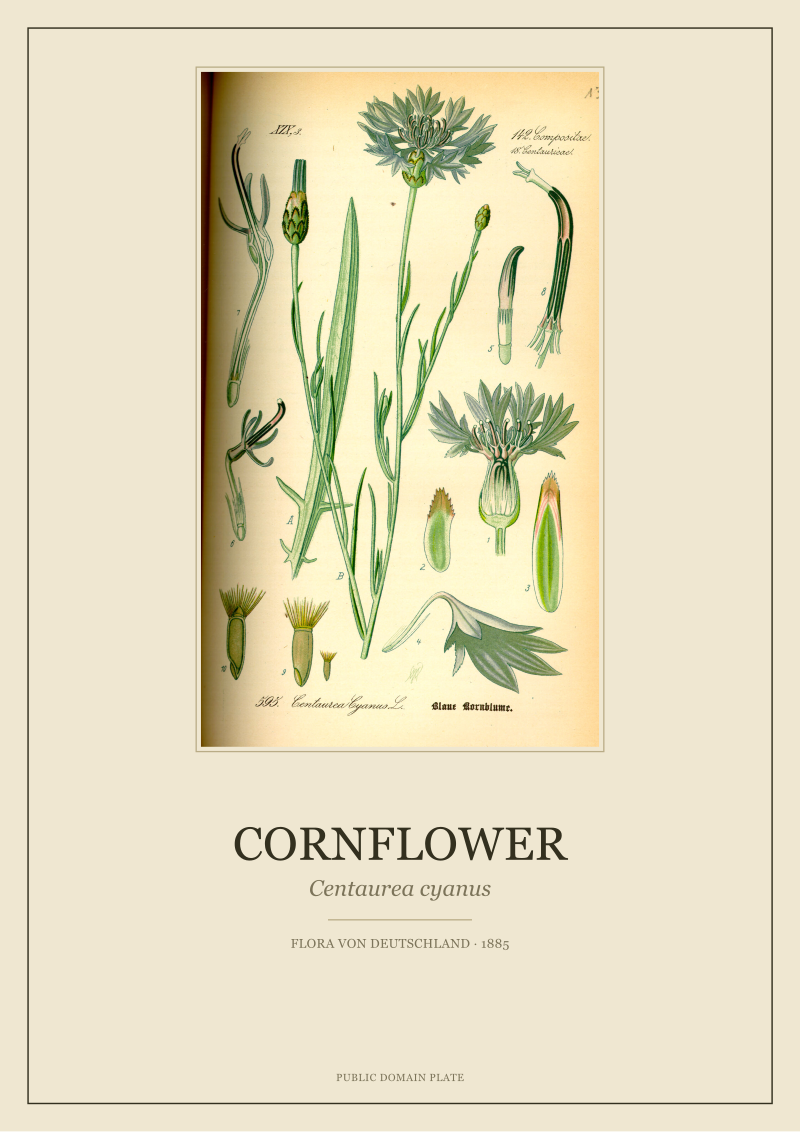
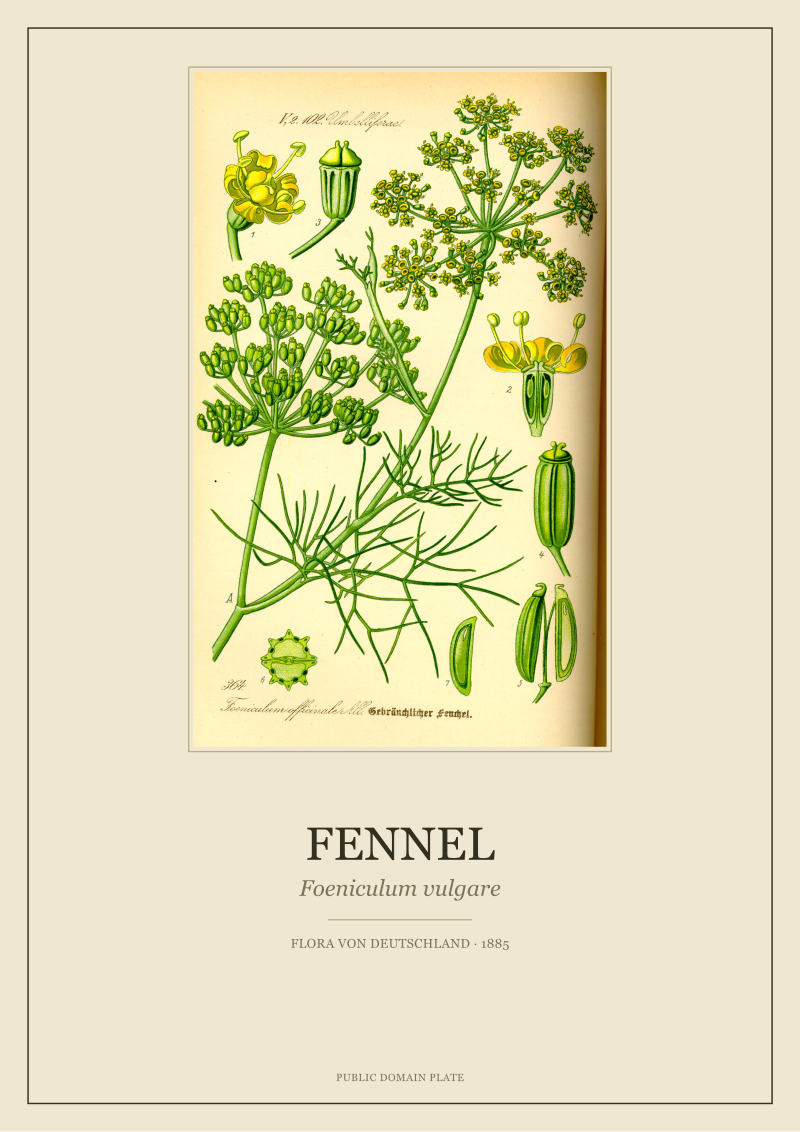
If you are buying a print, this matters practically. You are not buying "art" or "not art". You are buying a particular drawing, made by a particular hand, in service of a particular intent, printed by a particular process, on a particular paper, that has survived to reach you. Thomé's chamomile, Hedera helix as he drew it climbing an implied wall, his cornflower with the involucral bracts rendered clearly enough that you could still use them to identify Centaurea cyanus in a hedgerow today, his fennel with the umbels drawn at three stages of maturity — these are all "illustrations" and all "art" and the distinction is doing nothing for you at the moment you decide which one goes above the sofa.
This started as an argument in the studio about how to caption a scan and turned into a small manifesto about why the field's vocabulary is broken. We had planned to write a shorter piece with a firmer verdict and a checklist. The verdict got firmer. The checklist collapsed, because the more we looked at the plates on our own scanner, the more we realised the checklist was covering for the fact that the categories don't behave the way people say they do. So we killed the checklist and wrote what we actually think. If you would rather have the tidy paragraph, it is available in ten thousand places online. This one at least reflects an argument we had.
This piece does not cover the history of contemporary botanical art societies — the ASBA in the United States, the SBA in the United Kingdom — and how their exhibition standards codify their own working definition, which is worth its own essay. It does not cover the vexed question of how digital botanical illustration (rendered in Procreate, printed on demand) sits inside this tradition, which is a live debate we are not neutral about. And it does not cover the market side: why identical plates sell for wildly different sums depending on framing, provenance and whether the seller says "vintage" or "antique". Each is a separate argument, and we would rather write three honest pieces than one that covers everything and says nothing.
FAQ
Is botanical illustration considered art in a museum context?
It depends on which museum. Natural history museums treat botanical plates as scientific artefacts with aesthetic dimensions, and hang them accordingly. Fine art institutions historically excluded them from the contemporary art canon, though this has softened since the 1990s. The Royal Botanic Gardens at Kew, the Hunt Institute in Pittsburgh, and the Natural History Museum in Vienna all treat illustrated floras as both. So the honest answer is: yes in the buildings that specialise in plants, occasionally in the ones that specialise in art.
Was Otto Wilhelm Thomé an illustrator or an artist?
Thomé compiled and edited Flora von Deutschland, Österreich und der Schweiz, published in the 1880s, and worked with lithographers to produce the plates. He functioned as a scientific author-editor rather than a fine artist in the gallery sense. But calling the resulting plates "not art" ignores how compositionally sophisticated they are. The vocabulary breaks down here, which is exactly the argument the article makes. Thomé is best described as a botanical author whose plates are also, incidentally, some of the most durable wall art of the nineteenth century.
Do modern botanical illustrations have the same quality as Thomé's 1885 plates?
Modern botanical illustration is technically more accurate — pigment ranges, printing resolution and reference material have all improved. But the chromolithographic process used for late-nineteenth-century floras produced a specific layered ink density that flat inkjet output does not replicate. So "quality" splits: modern work is scientifically better, older work is often physically more beautiful as printed objects. This is why our studio focuses on public-domain plates from that specific window rather than commissioning new work.
Why are Thomé's plates in the public domain?
Copyright terms for works published in the 1880s have long since expired under every major jurisdiction's copyright framework. Flora von Deutschland, Österreich und der Schweiz was first issued in 1885, and Thomé died in 1925, which places the plates comfortably in the public domain worldwide. This is why the plates can be scanned, restored, and printed without a licence — which is the reason a serious restoration studio can afford to obsess over each one.
Is a hand-painted watercolour of a plant automatically botanical art rather than illustration?
No, and this is the sharpest confusion in the field. Many contemporary botanical watercolours are made under strict scientific conventions — measured proportions, dissections, diagnostic detail — and are illustrations by every functional definition. Meanwhile, some historical "illustrations" were painted so expressively they read as landscape studies. Medium tells you nothing about category. Intent and structure tell you almost everything.
Which plate would you recommend for someone starting a botanical wall collection?
We would start with a species that has strong compositional balance in the source drawing — Matricaria chamomilla and Centaurea cyanus both work at any size because the flower head sits well in the frame. Foeniculum vulgare and Hedera helix are more demanding because their compositions are longer and more directional, which means they need more careful placement in the room. If in doubt, begin with a plant whose visual weight is centred rather than trailing.
Does calling something "botanical art" instead of "botanical illustration" mean it is worth more?
In the print market, yes — the word "art" carries a price premium, even when the underlying object is a reproduction of a nineteenth-century scientific plate. This is a marketing convention, not a statement about the drawing. A restored Thomé plate is the same object whether the seller labels it illustration or art. If you are shopping, look at the plate, the print quality, the paper and the provenance. Ignore the word.
Where can I see the restored plates the studio works on?
The plates discussed in this essay — the chamomile, the ivy, the cornflower and the fennel from Thomé's 1885 flora — are available as restored prints through our shop at /shop/, where each plate carries its full attribution and a note on what was cleaned, mended and rebuilt in the scan. The rest of our writing focuses on the plates themselves rather than on selling them, which is the way we prefer it.
 Cornflower
The print from this article · from €29.95
View the print →
Cornflower
The print from this article · from €29.95
View the print →
New plates from the archive and 10% off your first print.
One email now with your code. No noise after.