Most price tags on antique botanical prints are not pricing the print. Hear me out. The 1885 lithographs from O.W. Thomé's Flora von Deutschland, Österreich und der Schweiz are public domain — the image itself carries zero intellectual-property cost in 2026. What a buyer pays for is one of four layers: an original sheet of 140-year-old paper, restoration labor, framing, or the dealer's overhead. Decomposing a single invoice across those four layers tells a buyer what the money actually bought. Whether 180 euros for a chamomile plate is reasonable has no abstract answer. It depends on which layer dominates. What follows walks three composite buyers through the math.
Three buyers are useful because the same visual object — say, a *Matricaria chamomilla* plate from the 1885 Thomé — carries wildly different prices depending on which layer of the stack the buyer is actually purchasing. Imagine the plate as a four-column invoice: paper substrate, image labor, frame, overhead. One buyer pays almost nothing for the first column and almost everything for the fourth. Another pays the opposite. The third pays a flat sum where no single column dominates. Walking through the three — hypothetically, as composite illustrations rather than named clients — shows what the receipt means before the buyer signs it.
Scenario 1: The First-Wall Buyer With One Chamomile Plate and 90 Euros
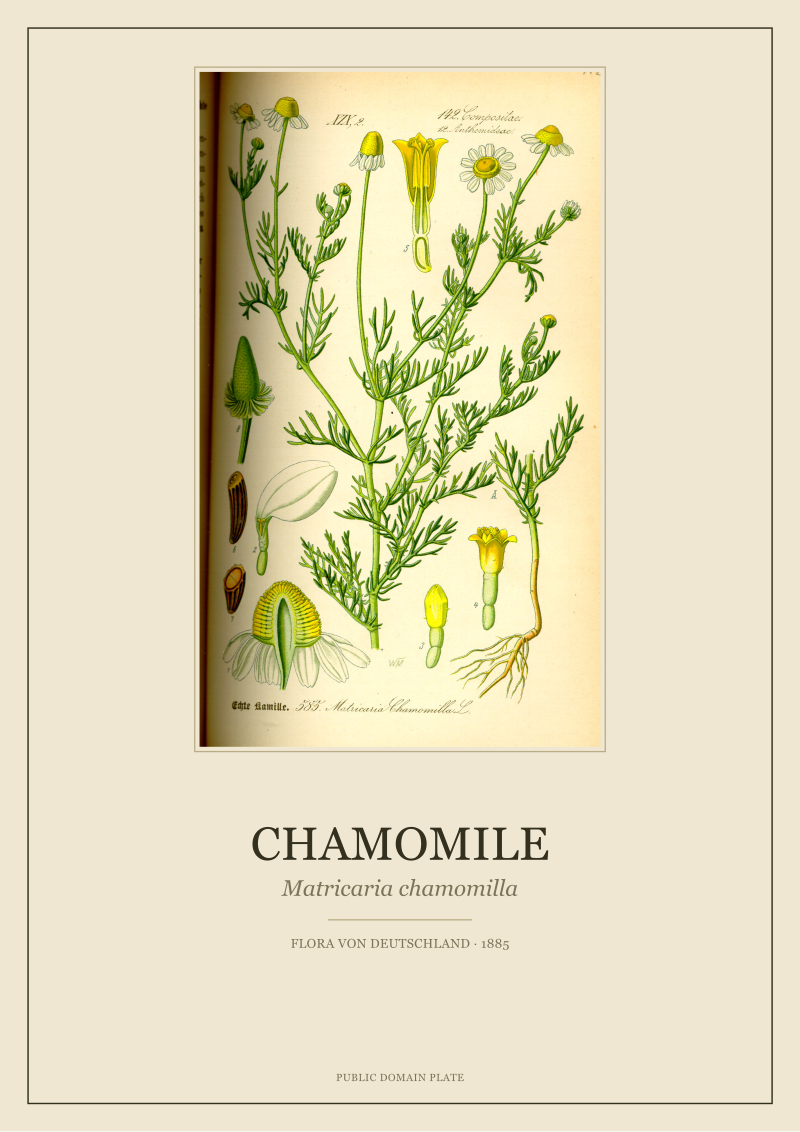
Picture a buyer furnishing their first apartment. One empty wall above a small desk. They have 90 euros earmarked for art, not 900. They search "antique botanical prints for sale" and surface three listings for a chamomile plate — *Matricaria chamomilla*, drawn by O.W. Thomé for the 1885 *Flora von Deutschland, Österreich und der Schweiz*. One listing is 320 euros. One is 140. One is 68. All three show what looks like the same image. The buyer wants to understand what the 68-euro print is, and whether it is the same thing as the 320-euro print.
It is not. The 320-euro listing is almost certainly an original sheet pulled from a disbound 1885 copy of Thomé's flora. Chromolithograph on roughly 140-year-old wove paper, printed in Gera-Untermhaus, trimmed to roughly 24 by 15 centimetres. The buyer is paying for the paper. The image is incidental. If the plate has clean margins, no foxing beyond the ordinary, and legible registration of the colour stones, 320 euros tracks the current ceiling for a single disbound Thomé plate before framing. Take the paper away and the price collapses.
The 140-euro listing is usually a modern archival reprint on cotton rag or acid-free matte, framed. The seller has sourced a public-domain scan, run it through a basic colour correction, printed it on a wide-format inkjet, and dropped it into a 40-by-30 frame from a wholesale supplier. Materials cost: roughly 18 euros for the frame, 6 for the paper and ink, 2 for the glazing. Labour, markup, and listing fees fill the rest.
The 68-euro listing is the same reprint without the frame, or with a thinner one. In most cases the file is the raw scan from a public archive — occasionally with no restoration at all, so the buyer gets inherited foxing, scanner moiré, and compressed shadows. For a first wall above a small desk, this may still be fine. The buyer should know they are paying 68 euros for 4 euros of consumables plus the dealer's time to list and ship.
A 90-euro budget forces honesty. The buyer cannot buy the original paper. What they can buy is a well-restored reprint — the chamomile line redrawn to clean edges, the yellows corrected back toward the stone colour, foxing lifted without flattening the paper texture. In our studio shop, that is roughly where chamomile sits. Nothing on this wall is 1885. Everything on it is honest about that.
Scenario 2: The Flora Collector Hunting a Specific 1885 Thomé Impression
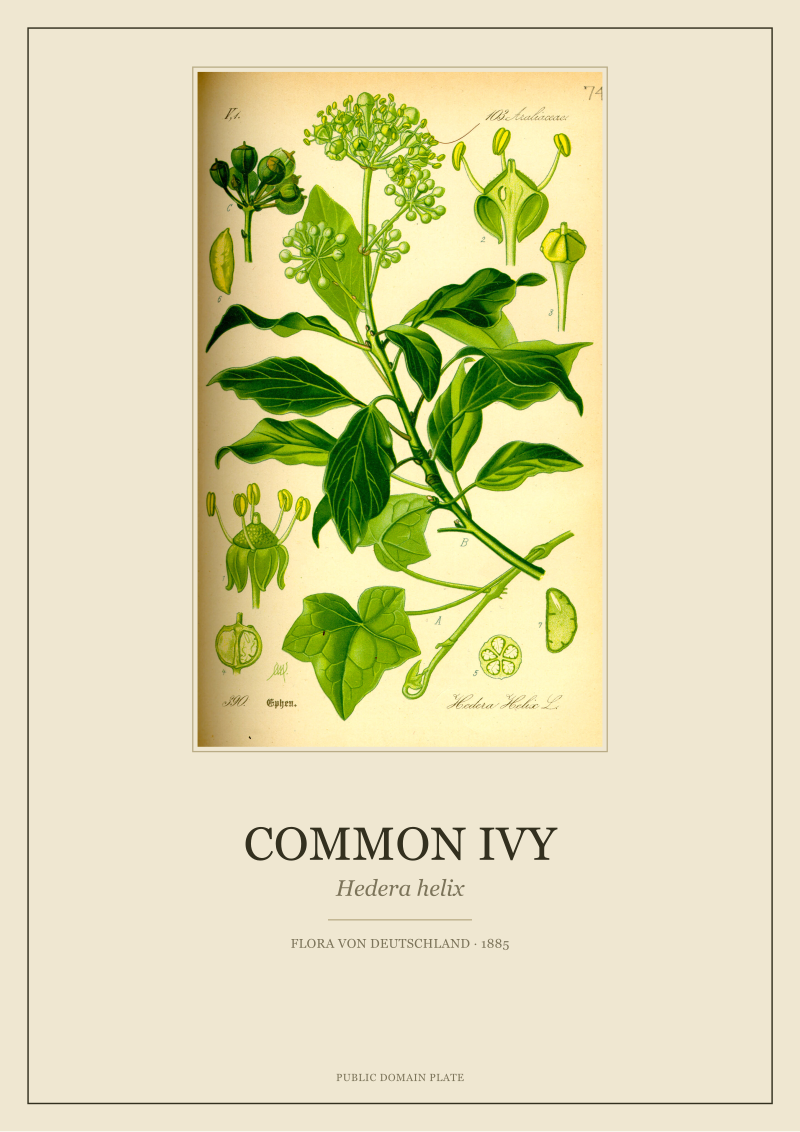
Let us say a different buyer. Mid-career, five walls already filled, three Thomé plates framed in oak. They want *Hedera helix* — common ivy — specifically from the 1885 Thomé edition, not the later 1903-1905 reprint runs and not the 1938 Köhler-adjacent reissues. The image is similar across editions. The paper is not. For this buyer, paper is the entire argument.
The 1885 Thomé plates were printed by chromolithography at Fr. Eugen Köhler's workshop in Gera-Untermhaus — the plate is identified in the lower margin, usually in a thin serif line the first-wall buyer will never read. The paper is a lightly sized wove, slightly cream, with a specific weight and surface that fluorescence tests separate cleanly from the 1930s reissue stock. The ivy sheet, trimmed, ranges from roughly 180 to 420 euros in 2026 depending on condition, provenance, and whether the dealer specialises in natural history prints or treats botanicals as general-interior stock.
Decompose a 340-euro invoice for an ivy plate from a specialist dealer:
- Paper substrate (1885 wove, original pull): roughly 220 euros. This is what the buyer came for. Without it the invoice goes to zero.
- Condition premium (clean margins, no trimming into the image, foxing contained): 60 euros. A heavily foxed sheet of the same plate drops to 160 total.
- Dealer overhead (sourcing, cataloguing, provenance verification, insurance, listing): 60 euros. Specialist dealers run on roughly 20-25% gross; non-specialists sometimes less, but they rarely surface the 1885 Köhler imprint distinction, which costs the buyer certainty.
The restoration layer is zero in this invoice because the buyer is specifically not restoring. The point of a collector purchase is to keep the sheet as-pulled. Framing is deferred — collectors frequently store sheets in acid-free portfolios and rotate what they frame. A frame for *Hedera helix* in a hinged museum mount, UV glazing, oak profile, adds 180-240 euros from a conservation framer.
Common ivy is instructive for this buyer because it is Thomé's full-plate treatment of a plant most of his readers walked past daily. The composition shows the climbing habit, the mature leaf, the juvenile leaf, and the flowering umbels in late summer — four states that a photographer in 1885 could not have shown on one sheet. The plate itself argues for why botanical illustration survived photography. The invoice argues that the paper from 1885 is the only part of that argument the buyer cannot reproduce.
 Chamomile
The print from this article · from €29.95
View the print →
Scenario 3: The Interior Designer Specifying a Four-Plate Set for a Client Install
Imagine a third profile. An interior designer with a residential client in a coastal apartment, two symmetrical niches in the dining area, each requesting a vertical pair of botanical plates. Four prints total, matched in frame, mat, and sightline. The budget for art in those niches is 1,600 euros. The brief is: "warm, botanical, nothing medical, nothing kitchen-chic."
A collector-grade solution is out. Sourcing four condition-matched 1885 Thomé originals, each with comparable margins and colour fidelity, is a six-month hunt and roughly 1,400 euros of paper alone before framing. The install date is in five weeks. The designer specifies restored reprints — plates where the public-domain scan has been cleaned, re-registered, printed on cotton rag at the original dimensions, and framed in a matched profile.
Decompose the 1,600-euro invoice:
- Four restored plates (chamomile, cornflower, fennel, common ivy): 320 euros, or 80 per plate. The studio's labour here is image preparation — removing scan artefacts, lifting foxing from the digital file without softening the line, correcting the yellows and blues back to the chromolithograph's stone colours rather than the yellowed paper they have aged into. A single plate takes 4-6 hours of operator time plus pass-off review.
- Printing and paper: 180 euros total. Cotton rag at 310 gsm, pigment inks, matched sheet size.
- Framing (four frames, hinged mats, UV glazing): 820 euros, roughly 205 per frame. Oak profile from a conservation framer.
- Install, delivery, hanging hardware, designer's handling margin: 280 euros.
The paper substrate layer, in this invoice, is near zero. The buyer is not purchasing 1885 wove. They are purchasing a restoration of the image that reads correctly at viewing distance in a specific room with specific light. The dominant layer is framing — more than half the invoice. For a four-plate symmetrical install in a residential sightline, that ratio is normal. Dealers who sell "antique botanical prints" and quietly fold 60% framing into a single sticker price are not overcharging; they are bundling. The problem is only when the invoice does not say so.
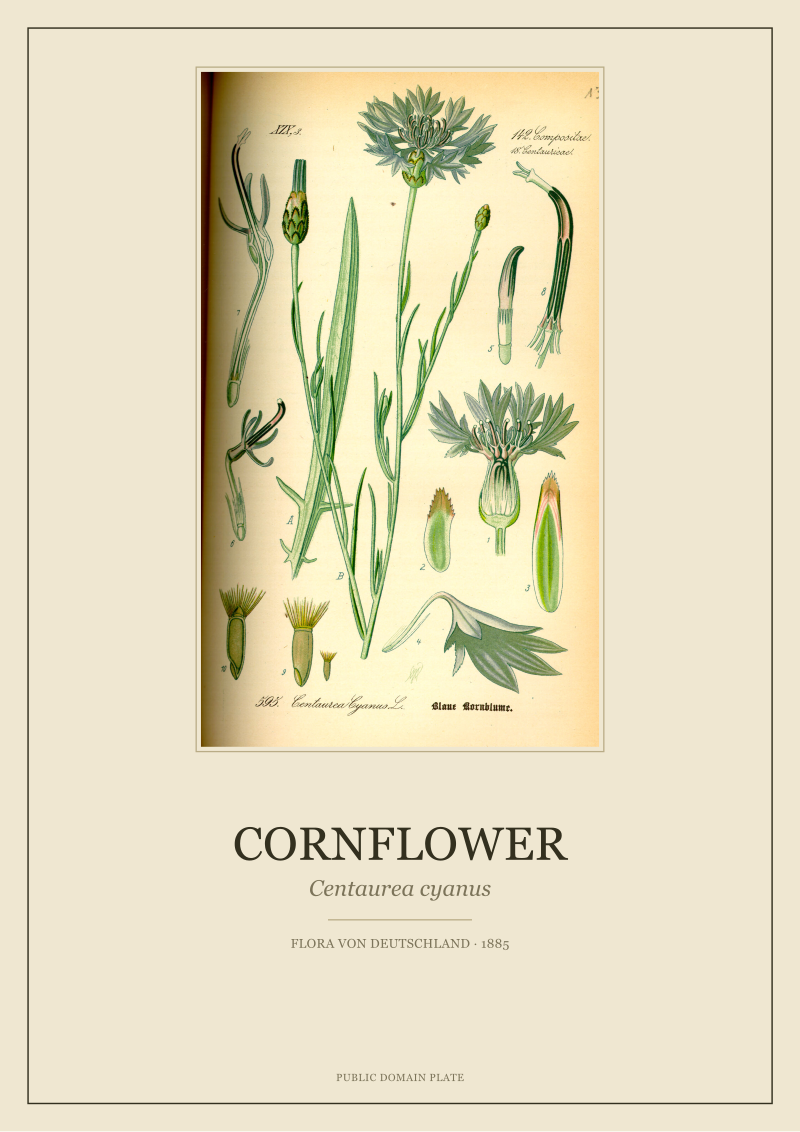
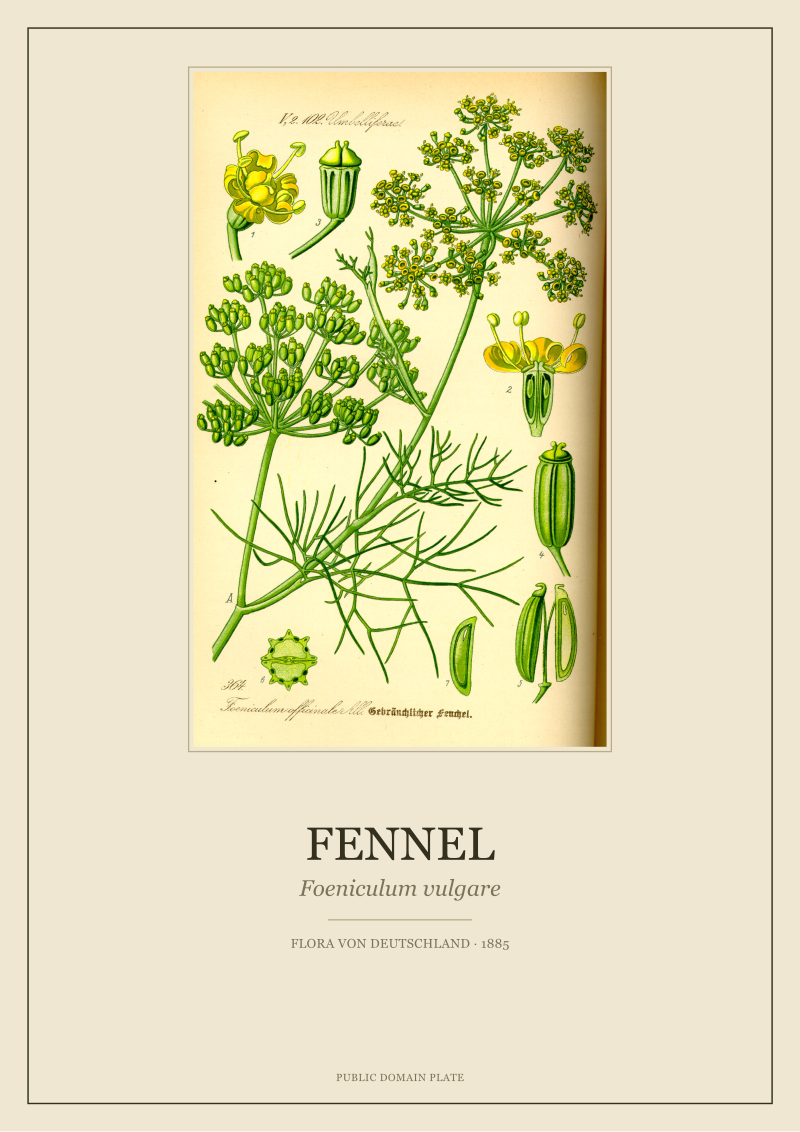
The composition itself matters here too. Chamomile, cornflower, fennel, ivy — four plants that cover meadow, field, kitchen garden, and wall. A set that reads as deliberate rather than assembled. Thomé's compositions already have the balance; the designer is relying on 1885 editorial decisions to carry the room.
What All Three Buyers Are Actually Paying For
Three invoices, three dominant layers. The first-wall buyer paid for restoration labour plus a modest frame. The flora collector paid for 1885 paper and the dealer's expertise in verifying it. The designer paid for framing and install, with the plate itself as a minor line item.
The pattern is this: the image is free. *Matricaria chamomilla*, *Centaurea cyanus*, *Foeniculum vulgare*, *Hedera helix* — as Thomé drew them in 1885 — carry no intellectual-property cost. Every euro on every invoice goes to one of four columns: paper, labour, frame, overhead. Which column dominates depends on who the buyer is and what they want the object to do on their wall.
Two consequences follow. First, "antique botanical print for sale" as a search phrase describes four different products that happen to share one visual signature. A buyer who conflates them will consistently overpay for the wrong column or underpay for a column they actually wanted. Second, dealers who refuse to unbundle the invoice are not necessarily dishonest, but they are forcing the buyer to buy the whole stack whether they wanted it or not. A good dealer tells the buyer which column dominates their price. A great one lets the buyer buy only the columns they want.
The studio practice we work from — restoring the 1885 Thomé plates by hand and code, then printing them at archival spec — sits deliberately in the restoration-labour column. We do not sell 1885 paper. We sell the image, cleaned to a state Thomé would recognise, on paper and ink that will outlast the frame. The buyers for whom that is the right column know who they are. The buyers for whom paper is the point should hunt specialists.
 Common Ivy
The print from this article · from €29.95
View the print →
Which Scenario Is Yours, Read From the Invoice Up
Here is the diagnostic. Pull up the listing you are considering. Ignore the headline price. Ask four questions. One: is the paper substrate original to 1885, or is it a modern archival sheet? If the listing does not say, assume modern. Two: has the image been restored, or is this a raw public-domain scan? Restoration shows in the margins, the yellows, and the absence of scanner moiré. Three: is the frame included, and at what grade — conservation framer or wholesale? Four: who is the dealer and what is their margin structure?
If answers one and four dominate, you are the collector in Scenario 2. If answers two and three dominate, you are the first-wall buyer or the designer, depending on scale. If no one answer dominates and the price is still four figures, you are being asked to pay a specialist premium without a specialist's inventory behind it.
Our shop at /shop/ sits in a specific place in that matrix: restored 1885 Thomé plates, printed to archival spec, honest about what we are and are not selling. If that is your column, we are here. If 1885 paper is the point, we will happily name three dealers who do that work better than we would pretend to.
This piece does not cover auction-house dynamics for institutional buyers; the price formation at Christie's or specialist natural-history sales runs on different rails. It does not cover the 1903-1905 Thomé reissues, which deserve their own invoice decomposition. And it does not address shipping, insurance, and customs for cross-border purchases of original sheets, which can add 15-30% to a collector invoice depending on jurisdiction. Each of those is a separate argument.
FAQ
Are 1885 Thomé plates genuinely public domain in 2026?
Yes. Otto Wilhelm Thomé died in 1925, placing his work out of copyright across every major jurisdiction under life-plus-70-years rules. The 1885 plates from *Flora von Deutschland, Österreich und der Schweiz* carry no residual intellectual-property claim. What a dealer can still charge for is the physical sheet, the restoration labour applied to the scan, the printing, or the framing — not the image itself. A seller invoking "copyright" on the Thomé plates in 2026 is either mistaken or dishonest.
How can I tell an original 1885 sheet from a modern reprint?
Four signals, in order of reliability. One: the paper. Original Thomé plates are on a lightly sized wove with a specific cream tone and weight; a modern cotton rag reprint feels crisper and heavier. Two: the Köhler imprint in the lower margin, usually "Druck v. Fr. Eugen Köhler" or similar, in thin serif type. Three: edge wear and plate indentation consistent with 140 years of handling. Four: provenance paperwork from a dealer who specialises in natural-history prints.
Why does the same chamomile plate cost 68 euros from one seller and 320 from another?
Because they are not the same product. The 68-euro listing is almost always a reprint of a public-domain scan on modern paper, often with no restoration applied. The 320-euro listing is almost always an original 1885 sheet, disbound from a copy of Thomé's flora. The image looks identical at thumbnail resolution. The invoice is pricing the paper substrate, not the picture. A buyer deciding between them should decide whether they are purchasing 1885 wove or purchasing a wall-ready restoration.
Is restoration of a scan dishonest if it changes the colours?
Only when the restorer pretends they did not. The 1885 chromolithographs were pulled from registered stones, each stone laying one colour. Over 140 years the paper yellows and the pigment layer shifts; what the eye sees today is not what Thomé's audience saw in Gera-Untermhaus. A responsible restoration pulls the image back toward the stone colours and documents what was done. A dishonest one applies arbitrary filters and markets the result as "the original". Ask the restorer what they changed. If they cannot answer, do not buy.
Can framing really be more than half the invoice?
Routinely, for conservation-grade framing. A hinged museum mount, acid-free backing, UV-filtering glazing, and a solid hardwood profile from a conservation framer runs 180-280 euros per piece in European markets in 2026. On a four-plate residential install with matched profiles, framing can account for 50-60% of the total before design fees. The invoice decomposition in Scenario 3 reflects a representative ratio, not an outlier.
Should I buy a set or build the wall one plate at a time?
It depends on whether you are the designer or the collector in the scenarios above. Sets purchased together guarantee frame and mat consistency and let a studio batch-process the image preparation, lowering per-plate cost. Plates purchased one at a time let a buyer live with each image before committing to the next and often produce more interesting walls. Collectors almost always build one plate at a time; designers working to a brief and install date almost always commission sets.
Where does your studio sit in the four-column stack?
In the restoration-labour and printing columns, by choice. We restore the 1885 Thomé plates — chamomile, cornflower, fennel, common ivy, and others — from public-domain source files, then print to archival spec on cotton rag. We do not sell 1885 original sheets; buyers who want the paper substrate itself should go to specialist natural-history dealers. The studio shop at /shop/ is honest about which column it fills, which is the only invoice principle this article is really about.
New plates from the archive and 10% off your first print.
One email now with your code. No noise after.