The correct number of botanical prints for a gallery wall is between five and eleven, and the number is determined by three measurements, not by taste. That range is not editorial preference. It is the output of dividing available wall area by average frame footprint, subtracting a fixed spacing coefficient, and rounding to the nearest odd integer. Most published advice — pick seven, pick nine, pick an odd number — skips the arithmetic entirely and hopes the reader's wall matches the photograph. Ours rarely do. What follows is the math, run against a standard interior wall and four plates from O.W. Thomé's *Flora von Deutschland, Österreich und der Schweiz*, 1885.
The Standard Advice Assumes A Wall That Does Not Exist
The recommendation to hang seven or nine botanicals in a grid is repeated in interiors columns with the confidence of a coefficient. It is not one. It is a photograph. Specifically, it is a photograph of a wall roughly 240 cm wide and 180 cm tall, unobstructed by cornice, radiator, or door frame, shot with a 24 mm lens that slightly exaggerates the length of the frame array. That wall exists in about four percent of European apartments built before 1970 and in an even smaller share of those built after.
Measure the wall above a standard three-seat sofa. In most flats the sofa is 210 cm long. The wall above it, from cushion line to picture rail or ceiling molding, is usually between 110 cm and 140 cm. The horizontal run is bounded by whatever is beside the sofa: a bookshelf on one side, a doorway on the other. Usable width lands closer to 180 cm than 240 cm. The wall the advice was written for is, on average, twenty-eight percent larger than the wall the reader actually has.
Now apply the seven-print rule to that smaller wall. A modest A3 frame is 34 cm × 47 cm. Seven of them in a grid — three across, two rows plus one — need at least 108 cm of horizontal footprint and 100 cm of vertical, before you allow for spacing. Add a conservative six centimetres between frames and the array grows to 120 cm × 106 cm. That fits. Nine A3 frames in a three-by-three grid need 120 cm wide by 153 cm tall. On a 140 cm high wall above a sofa, it does not.
The advice is not wrong. It is untested against the reader's dimensions. The number of prints and the wall are one problem, not two, and treating them separately produces the sort of gallery wall that looks correct in the shop assistant's phone photo and slightly wrong in the room.
The Real Number Falls Out Of Three Measurements, Not A Guess
Three inputs decide the count. Measure them once, in centimetres, in this order.
Available width is the horizontal span of the wall minus a symmetric margin. The margin exists because a botanical print pushed to within two centimetres of a doorframe reads as an accident, not a decision. Twelve centimetres on each side is standard. On our 180 cm sofa wall, available width becomes 156 cm. Available height is the vertical span from the top of the sofa back — not the seat, the back — to the picture rail or twenty centimetres below the ceiling, whichever is lower. On a 140 cm gross wall with a sofa back at 88 cm from the floor, available height is roughly 110 cm minus a ten-centimetre breathing gap above the sofa, so 100 cm.
The third measurement is the frame footprint plus its spacing coefficient. For an A3 print with a two-and-a-half centimetre mount and a slim frame, the outer dimension is 34 cm × 47 cm. Spacing between frames should equal roughly fifteen percent of the shorter frame edge, which puts the coefficient at five centimetres. The effective footprint of each print in the grid is therefore 39 cm × 52 cm.
Divide. Horizontal: 156 ÷ 39 rounds down to four columns. Vertical: 100 ÷ 52 rounds down to one row, or two rows if you accept a slightly tighter three-centimetre gap that yields 105 cm needed against 100 cm available — reject. One row of four A3 prints. That is your count. Four.
But four is even, and even-count grids read as furniture rather than composition. The correction is not to add or subtract a print. The correction is to change one variable. Reduce frame size to A4 (24 cm × 34 cm), effective footprint 29 cm × 39 cm, and the wall now holds five columns across and two rows down — ten prints. Increase mount depth to reach an effective footprint of 32 cm × 42 cm and you get four across and two down — eight. Introduce one larger anchor plate at A2 (46 cm × 63 cm) and cluster smaller prints around it and the count drops to five or seven, depending on how the smaller frames tile.
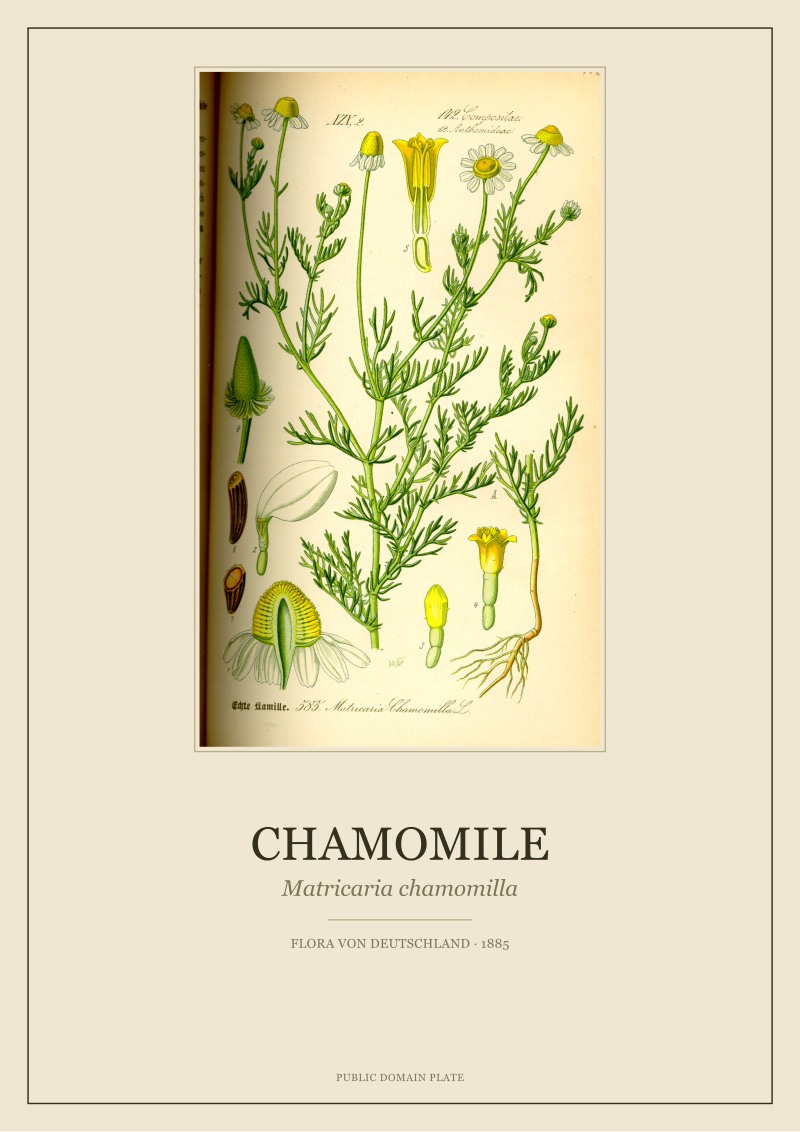
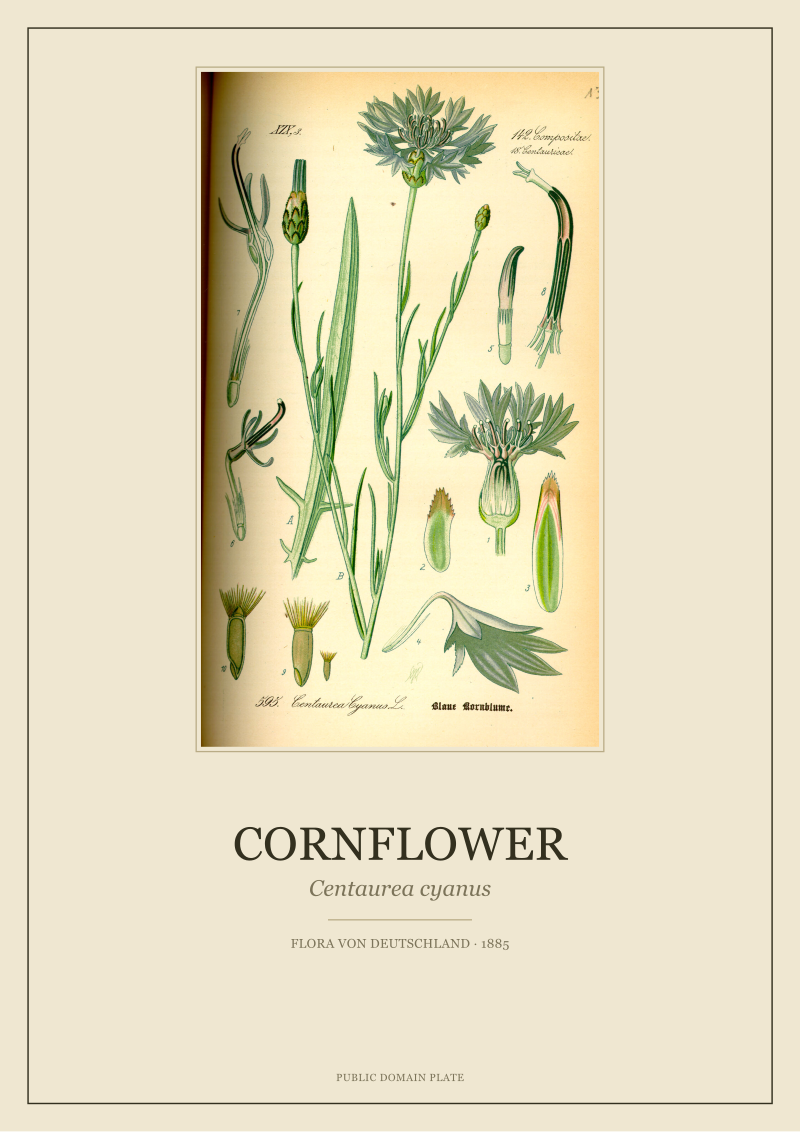
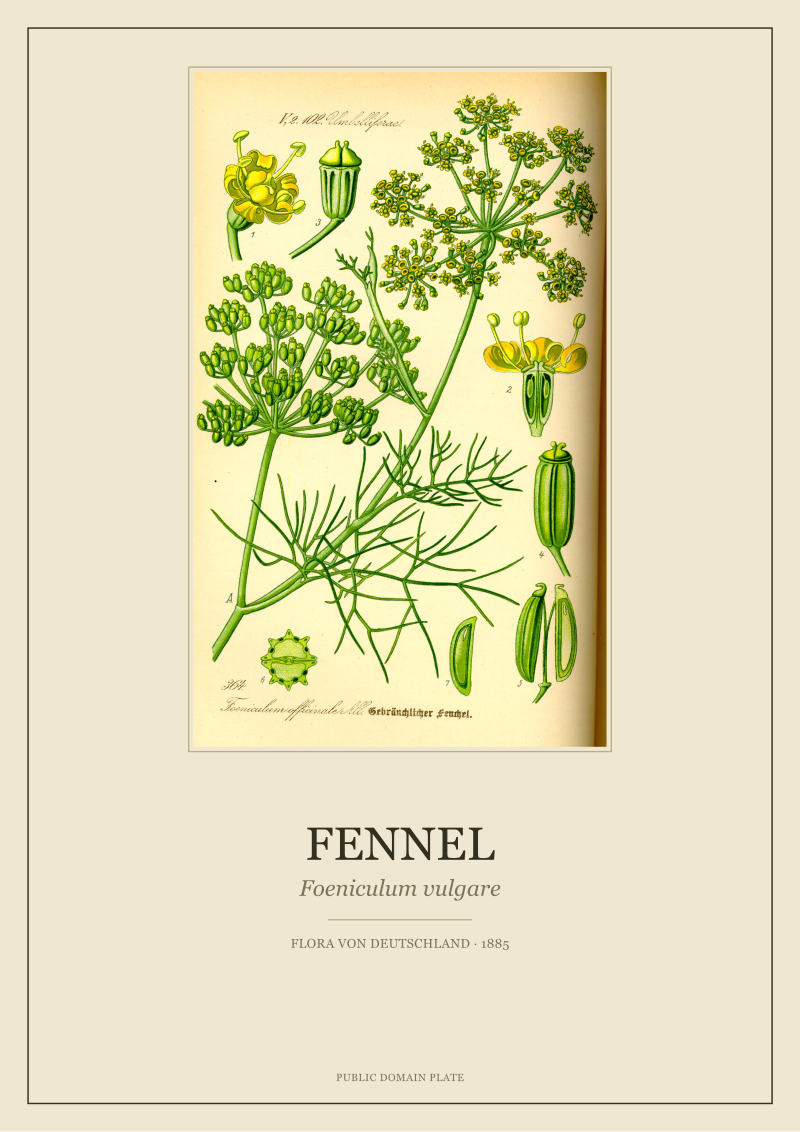
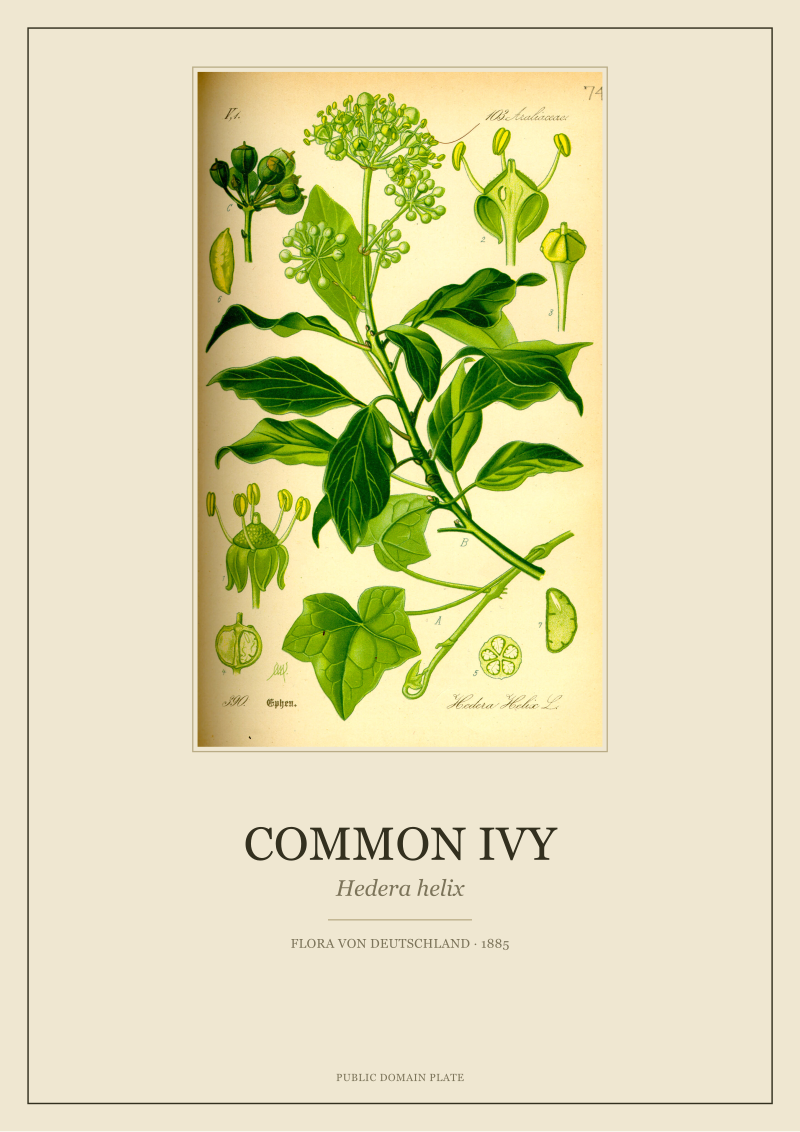
The Chamomile, Common Ivy, Cornflower and Fennel plates from Thomé's 1885 folio all share the same original page dimensions — the folio was standardised — so any grid you compose from them tiles cleanly at any single frame size. Mixing sizes is where the arithmetic gets interesting, and where three of our four studio walls end up.
The output is not one number. The output is the smallest count that fills the wall without gaps larger than the coefficient and without collisions at the margin. For most sofa walls in most European apartments, that number is five, seven, or nine. For a stairwell run, eleven. For the two-metre wall between a kitchen and a hallway, three. The rule was never seven. The rule is division.
 Chamomile
The print from this article · from €29.95
View the print →
Chamomile
The print from this article · from €29.95
View the print →
Odd Counts Only Matter When The Spacing Math Has Already Failed
The odd-number heuristic — always hang three, five, seven — is genuine, and it is downstream of everything above. It matters at the composition stage, not the count stage. It is a rule about asymmetry, not about density. If your wall arithmetic returns four or six or eight, the odd-number rule does not override it. The correct move is to check whether the composition needs a visual anchor, and if it does, whether an asymmetric arrangement of the same even count reads as odd to the eye.
Consider six prints on a wall that mathematically fits six. A three-by-two grid is even and reads as even — it presents as a window pane. Break the grid: place four in a two-by-two square and offset the remaining two vertically to the side, one high and one low. The count is still six. The reading is odd, because the eye counts the square as one mass and the two floating prints as two, arriving at three visual units. This is the trick the odd-number rule was trying to codify without saying so.
The Chamomile plate is the natural anchor in almost any grouping. Thomé's composition places the flower head high in the frame with the root system trailing to the lower third, which gives the plate a strong vertical axis. Hung centre-left in a cluster, it pulls the eye and lets smaller supporting plates — a Fennel, a Cornflower — orbit without competing. The Ivy plate, by contrast, resists anchoring because its composition is diagonal; it works as an edge piece, terminating a horizontal run.
None of this changes the count. It changes which frames go where. If the arithmetic gives you seven and you feel the pull to make it nine, the honest answer is not that seven is wrong. The honest answer is that you are looking at a photograph of a nine-print wall in a magazine and translating envy into a rule. Add two more prints and the spacing coefficient collapses, the frames crowd, and the wall reads as busy rather than composed. Subtract to five and it reads as thin. Seven, on that specific wall, is the number the wall gave you. Trust the division.
If the maths has already returned an odd number, the odd-number rule is redundant. If it has returned an even number, the rule is about arranging the count you have, not changing it. The heuristic was invented for people who never measured.
This piece began as a short reply to a customer who asked whether she should buy seven prints from our /shop/ or nine, and turned into an argument that the entire question was wrongly posed. She had a 165 cm wall and wanted a nine-print grid; the arithmetic said five, at a stretch six. She bought five. The wall closed. What this leaves open, and where the more interesting work sits, is the question of scale and hierarchy — whether a single A1 restoration hung alone is doing more work in a room than any grid, and under what wall conditions the honest answer is one print, not five. That calculation runs on different inputs, and it is where the next piece begins.
 Cornflower
The print from this article · from €29.95
View the print →
Cornflower
The print from this article · from €29.95
View the print →
New plates from the archive and 10% off your first print.
One email now with your code. No noise after.