A free vintage botanical PDF is not free. It is a 140-year-old scan someone else did not finish, offered to you at the price of your own labor. The plates in circulation are largely from one book — O.W. Thomé's *Flora von Deutschland, Österreich und der Schweiz*, published in 1885 — and yes, those pages are public domain. The image on your screen, though, is a compressed JPEG inside a PDF wrapper, foxed, tilted, and color-shifted. You do not need to be a professional to use it. You do need to understand ten words. Here they are, in the order they will matter.
Public Domain
Public domain means the copyright has expired and no one owns the reproduction rights to the underlying work. For Thomé's *Flora von Deutschland, Österreich und der Schweiz* — first issued in 1885 — the plates cleared that threshold decades ago in every jurisdiction that follows the standard life-plus-seventy rule. You can download, print, sell, remix, and reframe them without asking anyone.
That is the legal fact. It is also where most readers stop reading and start believing the file itself is free of consequence. A public-domain status attaches to the 1885 lithograph. It does not attach to the quality of the 2011 scan a volunteer uploaded to a university repository, nor to the JPEG compression the archive applied on the way out. When we open a plate of *Matricaria chamomilla* from Thomé, we are opening a legal freedom wrapped around a technical mess. The freedom is real. The mess is the work. Every subsequent term in this glossary is about the mess.
The Plate
A "plate" is the numbered full-page illustration bound into a botanical work — not a page of text with a small figure, but a dedicated sheet built to display one species (occasionally two) at printable scale. In Thomé's *Flora*, each plate carries the Latin binomial, the German common name, the plant's habit drawn to size, and separate detail studies: a flower dissected, a seed in cross-section, a leaf underside.
This matters because when someone posts "vintage botanical print, free PDF", they may be posting a plate, a fragment of a plate, or a text page with a small woodcut. Only the first survives contact with a wall. The *Hedera helix* plate in Thomé is a plate in the strict sense — the ivy is drawn climbing, with a separate flowering-fruiting detail and a leaf study, on a page composed as a single image. That composition is what makes the plate hangable. A cropped detail of the same drawing is a decoration, not a portrait, and paper at A2 size will tell you the difference within six weeks.
Chromolithography
Chromolithography is color lithography — a printing process where each color in the final image is drawn onto a separate limestone (or later, zinc) plate, and the sheet is run through the press once per color, in register. A single plate in Thomé's *Flora*, printed in 1885, typically went through the press between six and twelve times. That is where the softness of the green, the muted rose of a cornflower petal, and the shadow gradients on a fennel umbel come from: physical stones, physical ink, physical alignment done by a person.
The reason 1885 plates look better on a modern wall than most 2020 prints is not nostalgia. It is that a lithographer who spent a week separating tones by hand made choices — where to hold a highlight, where to let a leaf recede — that no automatic color separation replicates. When your "free PDF" arrives as a flattened four-color CMYK export, you are looking at a photocopy of that decision-making, not the decision itself. The restoration work below is largely about recovering what CMYK flattened.
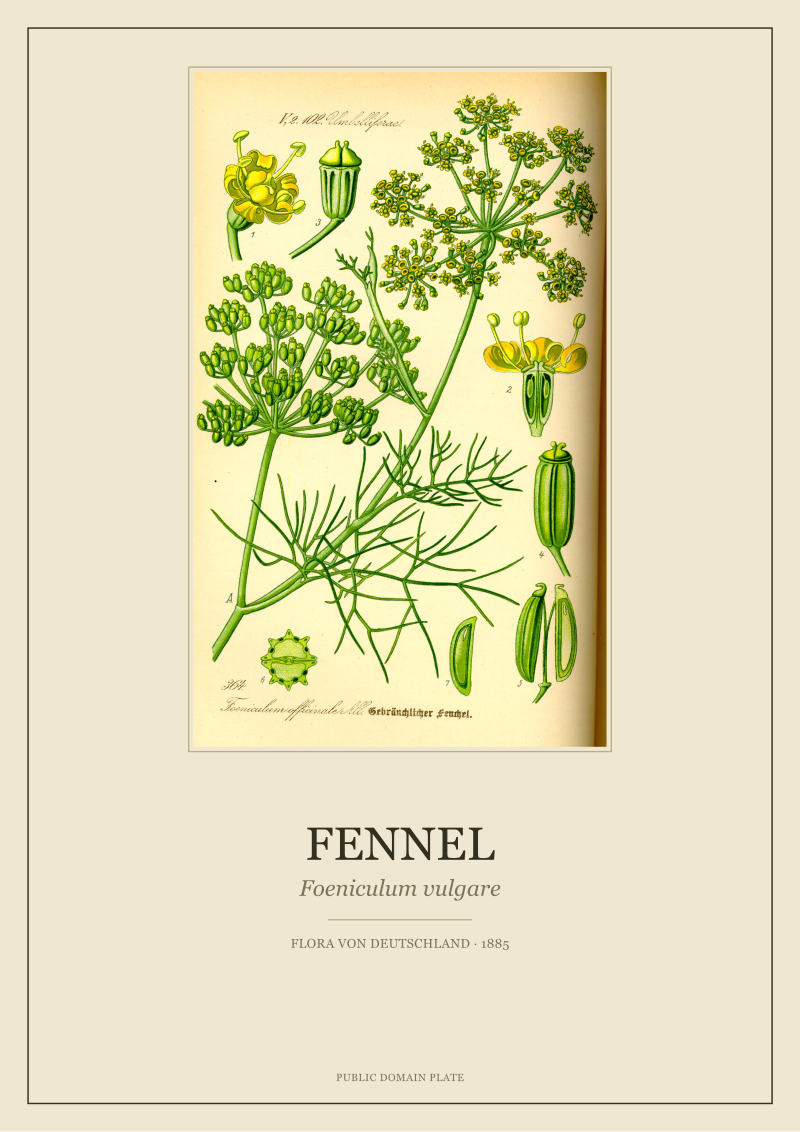 Fennel
The print from this article · from €29.95
View the print →
Fennel
The print from this article · from €29.95
View the print →
Scan DPI
DPI, dots per inch, is the resolution at which the physical plate was digitized. The number determines the largest size at which the file will still look like a drawing rather than a mosaic. For fine botanical linework — the vein pattern on a *Hedera helix* leaf, the feathery pinnae of *Foeniculum vulgare* — the working minimum is 600 DPI at the plate's original dimensions. Below that, the finest lines dissolve into the JPEG's block artifacts and the plant looks blurred even in a small frame.
Most freely circulating PDFs of Thomé are downscaled. A common lineage traces back to a single 2011 Wikimedia Commons upload where the original scans sat around 300 DPI at book size — perfectly adequate for on-screen reading, and inadequate the moment you try to print above roughly A5. If a listing does not disclose DPI, assume it is low. If a PDF is under 5 MB per plate, it is almost certainly below the printable threshold. This is the first place "free" starts to cost.
Foxing
Foxing is the reddish-brown speckling that appears on old paper — small, irregular spots caused by a combination of iron impurities in the paper pulp, humidity over decades, and microbial activity that has long since stopped. On a 140-year-old Thomé plate, foxing is not damage in a moral sense. It is the paper aging correctly. On a book collector's shelf it is a patina. On a wall, at scale, it is a rash of orange dots that competes with the illustration.
Every scan of Thomé's *Flora* in the wild carries some foxing. The chamomile plate is particularly prone because the white margin around *Matricaria chamomilla* offers the eye an empty field where each spot is visible from across the room. Removing foxing without also erasing the fine watercolor stippling on the flower's ray florets is a manual job — mask, sample surrounding paper tone, patch, then feather. A free PDF has not had this done. That labor is what you inherit the moment you decide to print.
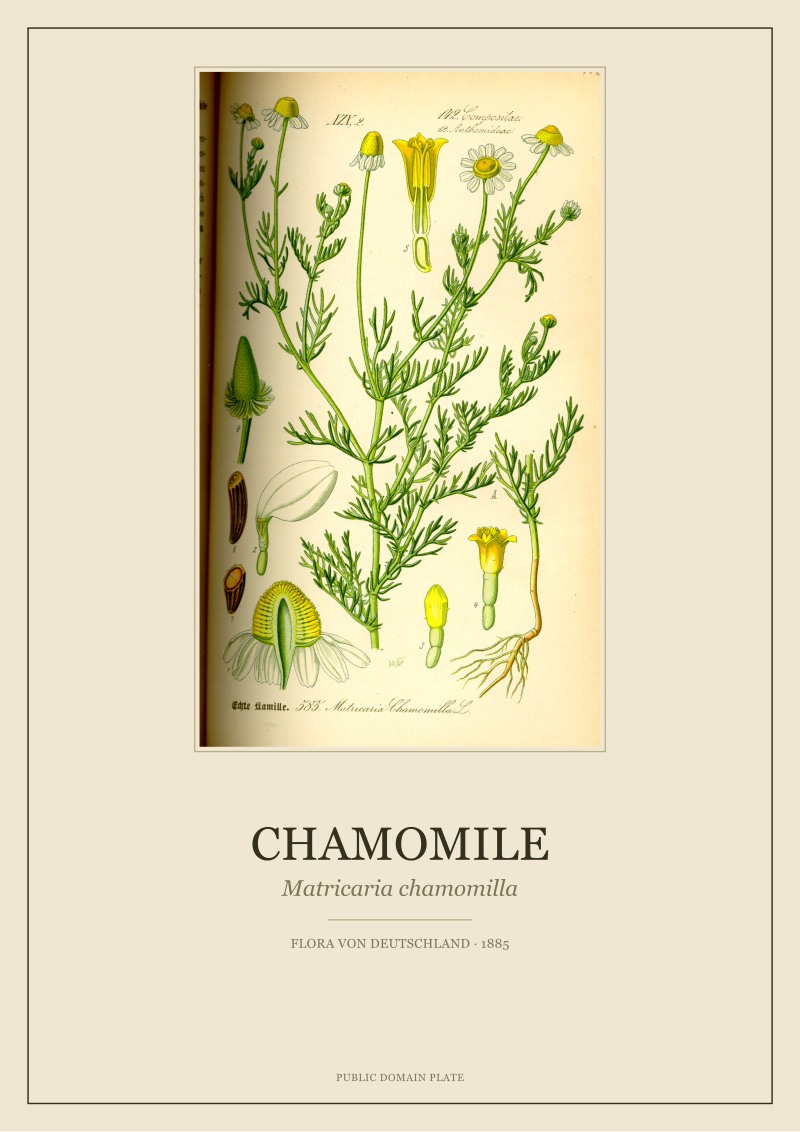 Chamomile
The print from this article · from €29.95
View the print →
Chamomile
The print from this article · from €29.95
View the print →
Color Cast
Color cast is an overall tint that skews an image away from neutral — usually toward yellow, orange, or green — introduced by aging paper, storage conditions, or the scanner's white-balance guess. A Thomé plate scanned inside a bound book, with the scanner's lid pressing an off-white page against a cold sensor, almost always comes out warmer than the original ink.
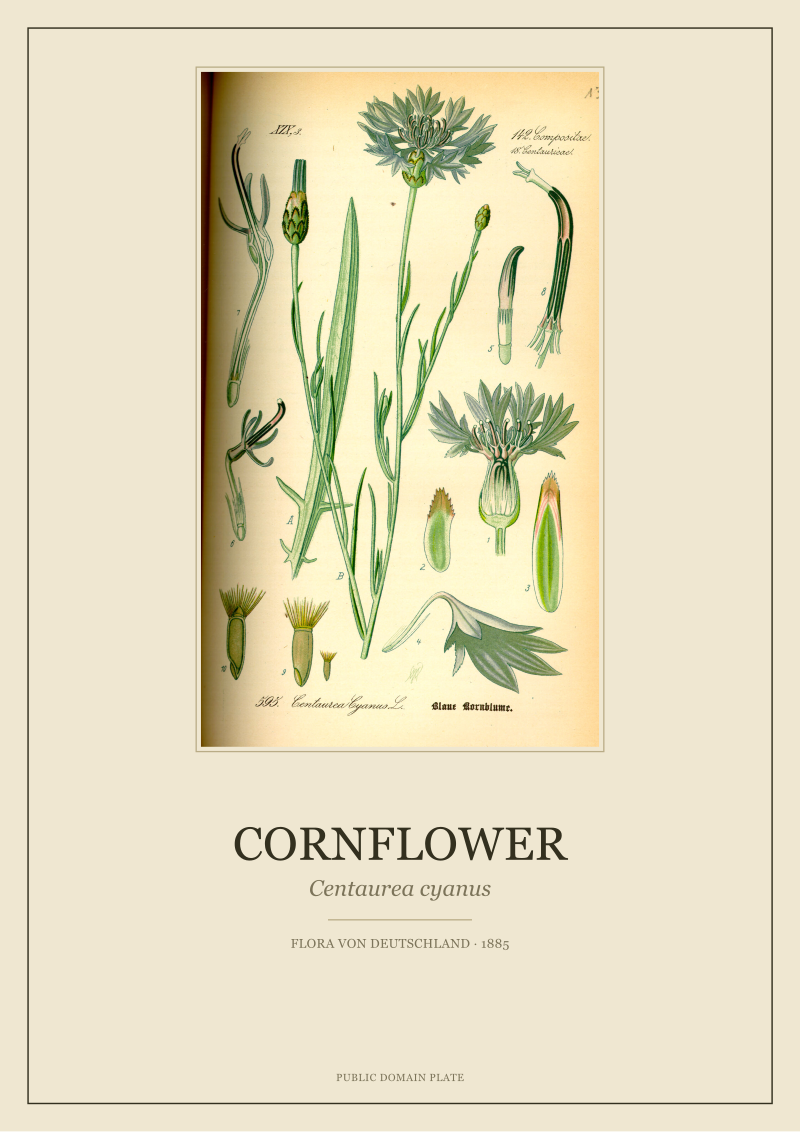
The consequence is not academic. The *Centaurea cyanus* plate — cornflower — depends on the specific blue-violet of *cyanus* for its entire visual argument. A 12% yellow cast turns that blue into a muddy periwinkle and quietly reassigns the plant to a different mood. Correcting for it means identifying a neutral reference point on the plate (a paper margin, a pencil-gray detail line), sampling it, and rebalancing the whole file against that anchor. It is a five-minute job in the right software and an invisible one — done well, no one notices; done poorly, the whole plate looks bleached. The free PDF ships with the cast. You decide whether to keep it.
Botanical Latin
Botanical Latin is the two-part naming convention — genus and species — that identifies a plant precisely enough to survive translation. *Matricaria chamomilla* is chamomile in English, Kamille in German, matricaria in Italian, and the same plant in every herbarium in the world. The system is Linnaean in structure and, in Thomé's plates, printed in italic beneath the German common name.
This matters for anyone downloading a "free vintage botanical PDF" because the Latin is the only reliable search key. A file labeled "vintage flower print" tells you nothing. A file labeled *Foeniculum vulgare* tells you it is fennel, that Thomé drew it as a mature umbel with feathery foliage and a habit detail, and that the plate can be cross-referenced against every serious digital archive of nineteenth-century floras. When we catalogue our own restorations, the Latin binomial is the primary field. It is also the way to spot the mislabelled: a plate captioned as "wild fennel" that is quietly *Anethum graveolens* — dill — is a common online error, and the Latin catches it immediately.
Restoration
Restoration, in the context of a public-domain botanical scan, is the process of taking a raw 1885 file and returning it to a state the original lithographer would recognize — without inventing anything the plate did not contain. It is not enhancement. It is not filter stacking. It is a sequence: deskew the tilted scan, remove foxing spot by spot, correct the color cast against a neutral reference, rebuild the paper tone in the margins, sharpen the linework without haloing it, and hold the original color relationships as ground truth.
For the *Hedera helix* plate — ivy, with its many small leaves and dense linework — a careful restoration takes several hours. Most of that time is spent inside a 200% zoom on individual leaves, choosing whether a mark is a foxing spot or a shadow the lithographer drew. That is the labor you either do yourself, hire someone to do, or skip and hang the result of skipping. There is no software button that performs the judgment.
Bleed and Margin
Bleed is the extra image area extended past the intended trim line of a print, and margin is the negative space held between the image and its frame. Bleed exists so that when a printer trims a sheet, small alignment errors do not produce a thin white edge. Margin exists so that a botanical plate breathes inside its frame rather than crashing into the moulding.
A free PDF almost never accounts for either. The scan ends where the paper ended in 1885, meaning the plate's original narrow margin becomes the entire margin of your print, and any trim shift crops into the illustration. For a Thomé plate to hang correctly at, say, 50×70 cm, roughly 3 mm of bleed needs to be added on each side (usually by extending the paper tone outward) and a generous surrounding margin needs to be composed — anywhere from 4 to 8 cm depending on frame proportion. This is compositional work, not automatic. Ignore it and the *Foeniculum vulgare* umbel that felt airy in the file feels claustrophobic on the wall.
Print-Ready File
A print-ready file is a document that a professional printer can accept, load, and press without asking you questions. In practice that means: a TIFF or PDF/X-1a at the final output dimensions; embedded color profile (typically Adobe RGB for gallery print, or a CMYK profile matched to the specific paper if the printer requests it); minimum 300 DPI at output size — meaning higher, if the scan permits, when the print is large; bleed of 3–5 mm depending on the printer's spec; and no active layers, no clipping paths, no residual foxing.
A downloaded PDF of Thomé's *Matricaria chamomilla* is not this. It is a source. Turning a source into a print-ready file is the difference between a picture on a screen and a plate on a wall, and it is where the honest cost of "free" finally becomes visible. If any of the ten words above are unfamiliar when you send the file to a printer, the file will not survive the trip. If they are all familiar, the plate does what the plate was drawn in 1885 to do — hold a room from across it. Our own restorations of these four plates, along with the rest of the Thomé cycle, live at see the Fennel print when the ten-word audit becomes ten hours of work you would rather not do.
FAQ
Are Thomé's Flora von Deutschland plates really in the public domain?
Yes. *Flora von Deutschland, Österreich und der Schweiz* by O.W. Thomé was first published in 1885, and the plates cleared copyright globally under the standard life-plus-seventy rule long ago. You can download, print, sell, and modify them without permission. What is *not* covered is any modern derivative work: a specific restoration, a re-colored version, or a curated book of the plates may carry its own copyright on the added labor, even though the underlying illustration is free.
What DPI do I actually need to print an 1885 botanical plate at poster size?
For prints up to A3, aim for 600 DPI at the plate's original book dimensions in the source scan. For A2 and larger, you want the scan sampled at 600 DPI relative to the *output* size — which usually means starting from a high-resolution archival capture, not a downloaded PDF. Below 300 DPI at output size, the fine linework in plants like *Foeniculum vulgare* dissolves into JPEG artifacts, and the print reads blurred even to an untrained eye.
Can foxing be removed without ruining the illustration?
Yes, but only manually. Automatic dust-and-scratch filters either miss the smaller spots or blur the plate's fine stippling — the ray florets on *Matricaria chamomilla* are exactly the scale that gets eaten first. Real foxing removal is spot-by-spot: mask each mark, sample the surrounding paper tone, patch, feather. On a moderately foxed plate this is one to three hours of quiet work. Skipping it produces a print with a visible orange rash from across the room.
Why do the free PDFs of Thomé look so yellow?
Because paper ages toward warm tones and scanners rarely correct for it. When a 140-year-old page sits under a scanner lid, the sensor reads the aged paper as its white reference, and the whole file tilts warm. The effect is invisible on screen and catastrophic in print — most obviously on the *Centaurea cyanus* plate, whose blue is the entire point of the drawing. Correcting the cast means anchoring the file to a neutral reference and rebalancing from there.
Is the Latin name really necessary or is the common name enough?
The Latin binomial is the only search key that works across archives and languages. "Wild fennel" retrieves mislabelled files; *Foeniculum vulgare* retrieves the plate itself. It is also the only reliable way to confirm you have the plant you think you have — several nineteenth-century plates are commonly miscaptioned online, and the Latin under Thomé's illustration is the primary evidence. If a free PDF lacks the binomial in either its filename or metadata, treat that as a cataloguing failure and verify before printing.
How much time does a proper restoration actually take?
On a moderately damaged Thomé plate — light foxing, mild color cast, standard deskew — a careful restoration takes three to six hours. On a heavily foxed plate with fine linework, such as the *Hedera helix* ivy composition, expect closer to a full working day. Most of that time is spent at 200% zoom deciding which marks are damage and which are the lithographer's original shadow work. Software accelerates the mechanical steps; the judgment does not accelerate.
What is the difference between a plate and a decorative crop?
A plate is the full composed page as the original artist and printer conceived it — plant, detail studies, caption, margin. A decorative crop is a fragment of that composition sold as a standalone image, usually a single leaf or flower isolated on a white background. Plates are portraits and hold a wall at scale. Crops are ornaments and lose their scale reference the moment they leave the book. Vintage-print sellers routinely blur the distinction; the file's proportions and the presence of Latin caption usually reveal which one you have.
New plates from the archive and 10% off your first print.
One email now with your code. No noise after.