Most vintage botanical scans should not be restored. That is the direct claim, and it holds under the only test that matters: whether the finished file still shows what O.W. Thomé drew in 1885 for Flora von Deutschland, Österreich und der Schweiz — the source of every plate this desk works with, including the Chamomile, Common Ivy, Cornflower, and Fennel. Restoration is a set of controlled subtractions — dust, foxing, paper yellowing, misregistered ink — carried out without adding a single stroke that was not on the plate. The line between conservation and invention is measured in pixels, not intent. What follows is a decision tree in prose. Three questions route the file toward a defensible restoration, or toward the folder marked "do not publish."
Question 1: Is the file a true first-generation scan, or a copy of a copy?
This is the fork that decides whether the rest of the work is honest. A first-generation scan is a direct capture of the physical plate — flatbed or overhead camera, uncompressed, at 600 dpi or higher, saved as TIFF. A copy of a copy is anything downstream of that: a JPEG someone posted to a wiki, a re-scan of a 1970s reprint, a PDF page extracted at screen resolution. The two look similar at thumbnail scale. At 100% they are different objects. One preserves the lithographic stipple that Thomé's engravers cut into the stone. The other preserves compression artefacts that a decoder invented in 1998.
The test is mechanical. Zoom to 400% on a leaf vein or a stamen filament. On a first-generation scan you will see the ink as a series of discrete dots or hatches, sometimes with the paper fibre visible between them. On a downstream copy you will see 8×8 pixel blocks, chromatic fringing around dark edges, and a soft blur where the JPEG quantiser rounded the high frequencies away. If you see the blocks, stop. Nothing you do in Photoshop puts information back that the codec threw out. You can smooth the blocks, but the leaf vein you end up with is your leaf vein, not Thomé's.
If Yes
Proceed, but log the source. The Chamomile, Common Ivy, Cornflower and Fennel plates from Flora von Deutschland (1885) exist in first-generation scans held by several public-domain repositories at capture depths of 16 bits per channel. Work from those files, keep the original untouched in a `_source` folder, and do every edit on a copy with layer masks. If the restoration ever needs to be defended — to a print client, to a museum, to a future intern who inherits the archive — the original must be reachable in one click.
If No
Abandon the file. This is the survival rule most restorers refuse to accept: a downstream copy cannot be rescued into a defensible plate. It can be tidied for a blog thumbnail, but it cannot carry a print at A2 and it cannot represent the 1885 work honestly. The correct move is to source the first-generation scan and restart. If no first-generation scan exists in the public domain for the specific plate, the plate does not enter the catalogue. There is no exception for "close enough".
Question 2: Is the work subtraction (removing damage) or addition (inventing what was never there)?
Every restoration move belongs to one of two categories. Subtraction removes something the paper acquired after 1885 — foxing spots, silverfish nibbles, yellowing from acid migration, dust from a century of shelving, misregistered chromolithographic plates that shifted by half a millimetre during printing. Addition puts something on the file that was not on the original plate — a redrawn stamen, a colour-corrected petal, a "cleaned up" Latin label re-typed in a modern serif. Subtraction is defensible. Addition is fabrication. There is no middle category, and the pressure to invent a middle category is where most restorations lose their integrity.
The reason the distinction matters is that damage and drawing overlap. A foxing spot on the Cornflower plate may sit exactly where Thomé placed a stamen. Remove the spot with a clone-stamp brush and you also remove the stamen; replace the stamen from your imagination and you have added a mark that never existed. The honest move is to leave the spot, note it in the file metadata, and let the reader see the paper as it survived. A plate with three visible foxing marks is a plate with three visible foxing marks. It is not a failure of restoration.
If Yes
You are subtracting. Work non-destructively — adjustment layers, layer masks, frequency separation for foxing that overlaps ink. Set a rule for yourself before you start: no clone-stamping across any pixel that contains ink. Dust on the paper margin, remove. Dust on a leaf, leave. If a scratch crosses a vein, mask around the vein and heal only the paper on either side. When the mask gets fiddly, that is the file telling you the damage and the drawing are the same object.
If No
You are adding. Stop and re-classify the job. What feels like "just cleaning up the outline" is redrawing. What feels like "restoring the original green" is colour invention — the 1885 chromolithograph used a specific pigment set that has faded unevenly across surviving copies, and no measurement of a single surviving copy can tell you what Thomé approved on press day. If the plate cannot be published as it survives, the plate does not get published. Addition is where the restoration becomes a lie, and the lie is visible under any decent zoom.
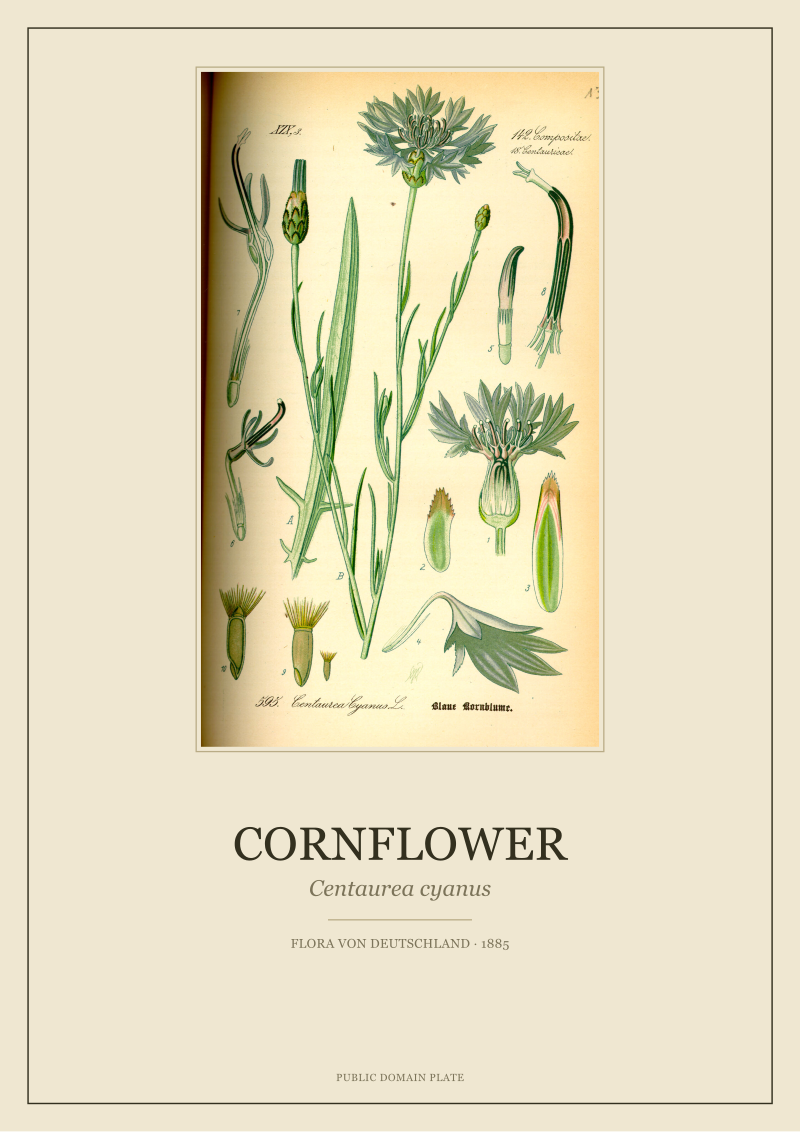 Cornflower
The print from this article · from €29.95
View the print →
Cornflower
The print from this article · from €29.95
View the print →
Question 3: Will the output be printed at plate scale, or displayed only on a screen?
The medium sets the tolerance. A screen at 1× density forgives a great deal — soft edges, mild colour drift, foxing that reads as texture at 1200 pixels wide. A print at plate scale — the original Flora plates were roughly 22 × 30 cm — forgives nothing. Every artefact you left in the file appears at the size the human eye evolved to read. A misjudged clone stamp on a Fennel umbel looks like nothing on a phone. On a framed A3 print, it looks like a smudge someone put there in 2026.
This question also decides colour space and bit depth. A screen-only deliverable can live in sRGB at 8 bits per channel and nobody notices. A print deliverable needs to hold 16 bits through every adjustment layer, convert to the print profile only at export, and be soft-proofed against the actual paper stock. The Ivy plate has a range of greens that clip to a single flat tone if you edit in 8-bit sRGB and then push the saturation. The clipping is permanent. You cannot recover the tonal separation once the histogram has been crushed.
If Yes
You are printing. Work in 16-bit ProPhoto RGB or Adobe RGB, keep every edit on a masked adjustment layer, and export a soft-proofed copy for the specific paper you will print on. Test-print a 10 × 10 cm crop of the busiest area of the plate — usually the flowering head — before committing to a full run. The test print will show clone-stamp seams, colour banding, and margin dust that were invisible on the monitor. Fix them on the master file, not on the print export.
If No
You are publishing to screen. The tolerances are gentler, but the temptation is worse. Screen output invites over-processing because the results look punchy on the monitor and the client sees them the same way. Set an export ceiling: no saturation boost above the source, no contrast curve steeper than a gentle S, no sharpening beyond one pass at plate scale. If the plate looks dull on screen, that is because 1885 paper is dull. The Cornflower blue in Flora is a specific muted pigment, not the neon a modern eye expects. Do not correct the century out of the file.
If You Answered Everything: The Recommendation Table
Eight combinations, eight routes. Read your three answers, read the row.
| Q1: First-gen scan? | Q2: Subtraction only? | Q3: Print output? | Recommendation |
|---|---|---|---|
| Yes | Yes | Yes | Proceed. 16-bit workflow, masked non-destructive edits, soft-proof, test-print before full run. |
| Yes | Yes | No | Proceed. 16-bit master, sRGB export, no saturation or contrast boosts beyond the source plate. |
| Yes | No | Yes | Stop. Addition on a print-scale output is a fabrication that will be visible in the frame. Reclassify or abandon. |
| Yes | No | No | Stop. Screen-only does not license invention. If it is not on the plate, it does not go on the file. |
| No | Yes | Yes | Abandon. A downstream copy cannot carry a plate-scale print regardless of how careful the subtraction is. |
| No | Yes | No | Abandon and re-source. A tidied JPEG is a tidied JPEG; the catalogue only holds first-generation work. |
| No | No | Yes | Abandon immediately. Addition on a downstream copy at print scale is the worst-case combination. |
| No | No | No | Abandon and re-source. Two failures compound; no screen-only shortcut redeems the file. |
Five of the eight rows say abandon. That ratio is the honest one. Restoration is mostly saying no — to files that were never good enough, to edits that would cross into invention, to output specifications the source cannot support. The three rows that say proceed are the ones where the plate deserves the studio's time and the reader deserves what comes out of it. The Chamomile, Ivy, Cornflower and Fennel plates in the current studio catalogue at see the Cornflower print all sit in row one. Every other candidate this year was routed to one of the five abandon rows, and none of them are missed.
None of this tells you what to do with a plate that passes all three questions but still looks unremarkable — the ones where the source is clean, the edits are honest, the output is defensible, and the finished file is simply dull. That is where the next question starts, and it is a question about editorial selection rather than restoration technique. This handbook ends at the point where the file is defensible. Whether it is worth publishing is a different desk.
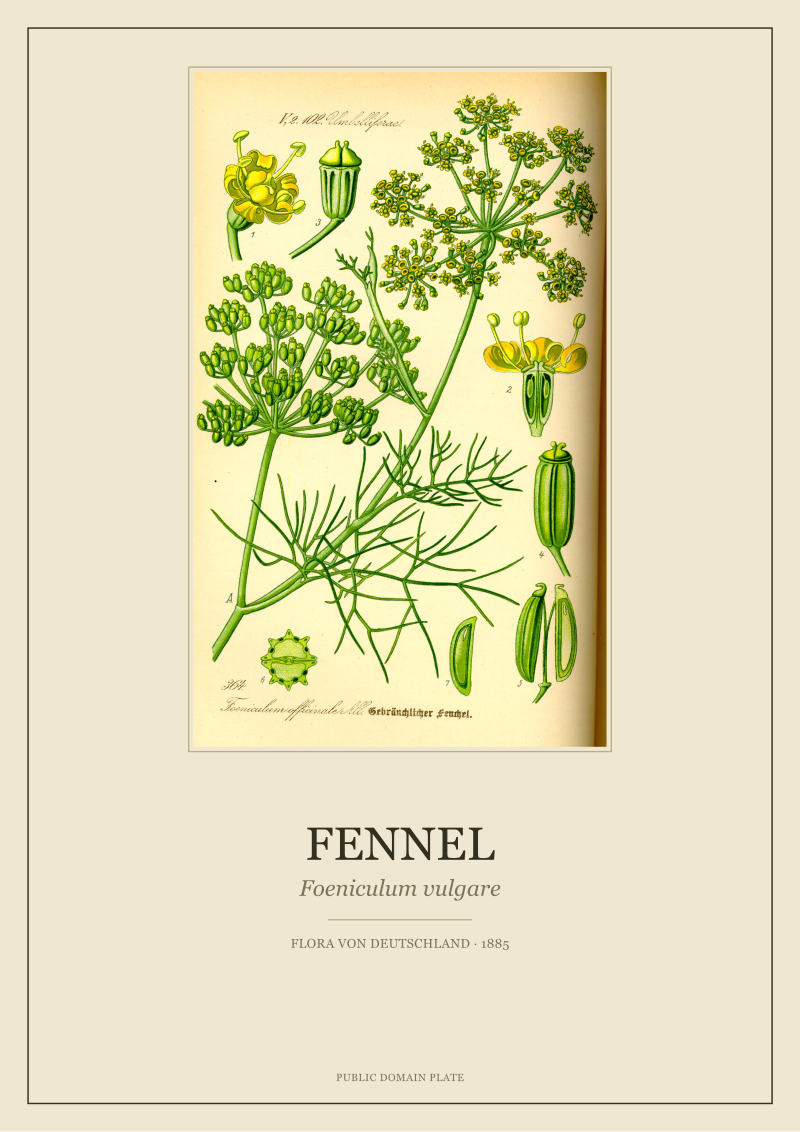 Fennel
The print from this article · from €29.95
View the print →
Fennel
The print from this article · from €29.95
View the print →
FAQ
What resolution counts as a "first-generation scan" for a 1885 botanical plate?
The working floor is 600 dpi optical (not interpolated) at the plate's original physical size, captured as an uncompressed TIFF at 16 bits per channel. For a plate around 22 × 30 cm that yields a file in the 400–600 megabyte range. Anything below 600 dpi cannot resolve the individual lithographic stipples reliably, and anything saved as JPEG at capture stage has already thrown away information that no later step can rebuild.
Is it acceptable to remove foxing spots that overlap the drawn ink?
No. Foxing that sits on paper margin can be cleaned; foxing that overlaps ink cannot be removed without also removing the ink and then reconstructing what was underneath from imagination. The rule this desk applies is: no clone-stamping across any pixel that contains original ink. A plate with three surviving foxing marks over the drawing is catalogued and displayed with three surviving foxing marks. That is the honest state of the paper.
Can I colour-correct a faded plate back to its 1885 appearance?
No, because no one alive knows the 1885 appearance. The chromolithographic pigments in Flora von Deutschland have faded unevenly across surviving copies, and no single copy is a reference. Colour "correction" toward a supposed original is invention. What is defensible is neutralising the yellow cast from acidic paper ageing on the white margins, using a levels adjustment sampled from the paper itself, without touching the drawn areas.
Does the public-domain status of the plates cover the restored files as well?
The 1885 source works by O.W. Thomé are public domain worldwide. A restored file derived from a public-domain source remains in the public domain in most jurisdictions because purely faithful reproduction does not create new copyright. This desk publishes restored plates under that assumption and does not claim new rights over them. Anyone can reuse the restored files; the studio's value is the restoration labour and the physical print, not exclusivity.
Why not just use AI upscaling to rescue a low-resolution scan?
Because AI upscalers hallucinate detail. A neural upscale of the Ivy plate at 200 dpi will produce leaf veins that look plausible and are not the veins Thomé drew. Under Question 1 that counts as a copy of a copy plus fabrication — the two worst failures at once. The output may be visually pleasing; it is not the 1885 plate, and it fails the only test the survival handbook enforces.
How long does an honest restoration of a single plate take?
For a first-generation scan of a Flora plate — Chamomile, Fennel and similar complexity — the desk logs between 12 and 30 hours across cleaning, foxing masking, colour neutralisation and print soft-proofing. Plates with heavier damage or denser drawing (multiple flowering heads, cross-sections) sit at the upper end. Any workflow that claims sub-hour turnaround for a plate-scale deliverable is either skipping the mask work or accepting clone-stamp seams that will show in print.
Should the final file preserve any of the original paper's imperfections?
Yes, deliberately. Margin texture, mild uneven tone across the sheet, and the faintest paper fibre visible through pale ink are all part of what the plate is. Sanding those out produces a file that looks like a modern vector illustration of a 19th-century plate rather than the plate itself. The subtraction rule stops at damage acquired after 1885; the material character of the paper stays.
When is it correct to abandon a plate mid-restoration?
When any of three signals appears: a clone-stamp move requires guessing at ink that is missing, the colour of a drawn area cannot be neutralised without a subjective choice, or a test print at plate scale shows an artefact that cannot be fixed without addition. Any one of those signals routes the file to the `do_not_publish` folder. The abandon decision is cheap at hour eight and expensive at hour twenty-eight, so the survival handbook rewards abandoning early.
From the collection
New plates from the archive and 10% off your first print.
One email now with your code. No noise after.