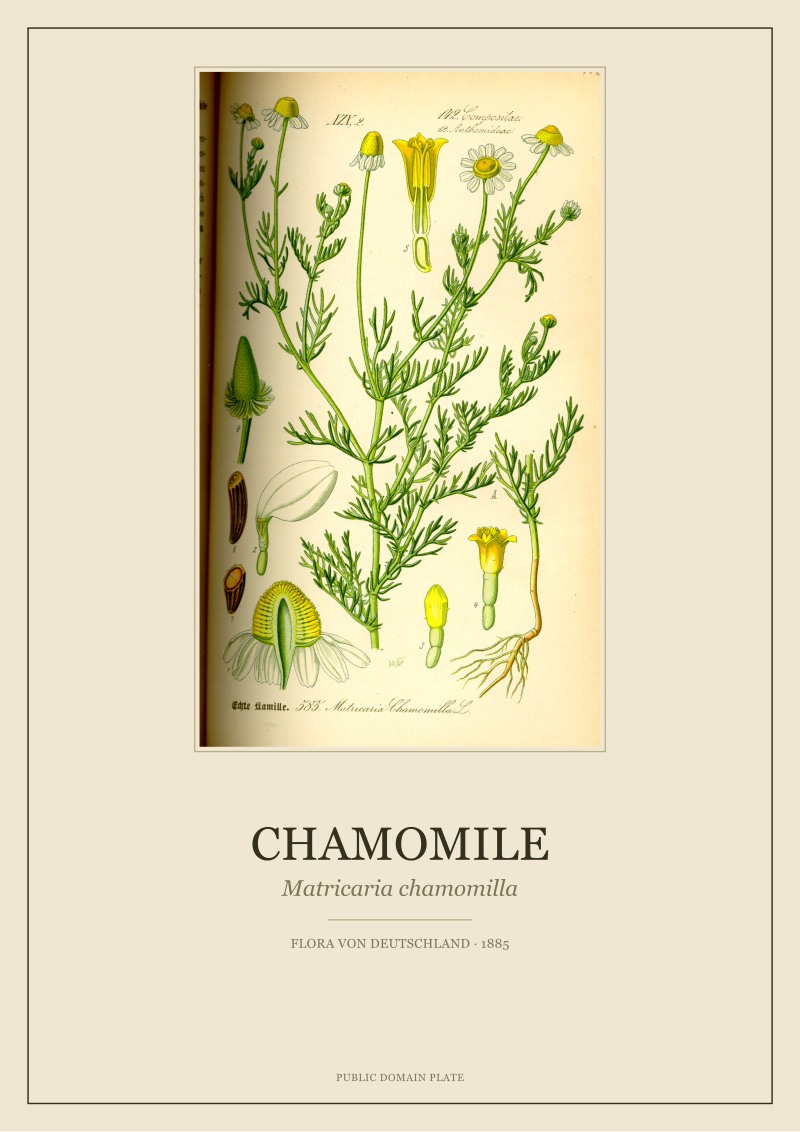
Last month we opened a frame that had sat above a south-facing sofa since 2011. The chromolithograph inside — a Matricaria chamomilla plate we had not restored, only reframed for a client — had shifted three shades warmer along the top inch and developed a faint brown speckling near the mat window. The mat was labelled "acid-free" on the back. It was not, in the sense that matters. That two-week autopsy is what this glossary is built on: the terms a framer uses at the counter, what they actually mean once the frame is sealed, and where the labelling industry lies by omission.
Acid-Free
"Acid-free" describes paper or board with a pH at or above 7.0 at the moment of testing. That is a smaller claim than most buyers hear. The industry sticker permits a board that leaves the factory at pH 7.2 and drifts to pH 5.5 within eight years, provided nothing else on the label is contested. The Chamomile mat from the 2011 frame tested at pH 4.8 when we pulled it — clearly acidic, still legally "acid-free" at the point of sale.
The practical consequence is a brown bevel line where the mat window met the print, and warm-tone migration into the top inch of the sheet. Acid does not stay put. It moves from wood-pulp board into whatever is touching it. When you read "acid-free" on the back of a frame at a chain store, treat it as the ceiling of the claim, not the floor. Ask for the fibre source instead.
Lignin
Lignin is the structural polymer in wood pulp that turns yellow and then brown as it oxidises. It is what makes a 1990 newspaper look the way it does today. Standard wood-pulp board contains 20 to 30 per cent lignin. "Lignin-free" board, when the term is used honestly, contains under one per cent, achieved by chemically stripping the pulp or by starting with a non-wood fibre.
Lignin is the villain in the Chamomile autopsy. Acid was the label; lignin was the mechanism. The mat's core was standard wood pulp with an alpha-cellulose facing paper — a common trick that lets a board pass a surface pH test while rotting from the inside. When you buy framing materials, "lignin-free" is a stronger claim than "acid-free" and less commonly misused. It also costs roughly three times more per square metre, which is why the chain-store mat did not have it.
 Chamomile
The print from this article · from €29.95
View the print →
Chamomile
The print from this article · from €29.95
View the print →
Cotton Rag Board
Cotton rag board is mat and backing board made from cotton fibre rather than wood pulp. It is the material museums use for original works on paper. Cotton has no lignin to strip out, its cellulose chains are longer and more stable than wood cellulose, and a well-made rag board holds a neutral or slightly alkaline pH for a century or more without buffering games.
Our shop mounts every restored plate — the Hedera helix, the Centaurea cyanus, the Foeniculum vulgare, all four Thomé 1885 plates in the current inventory — on 100 per cent cotton rag, four-ply, sourced from a mill in Massachusetts that has been making it since 1962. The cost difference at retail is about eleven euros per A3 frame. The lifespan difference, based on comparable archival testing, is roughly a decade versus a lifetime. If a framer cannot tell you the fibre content, they are selling wood pulp.
Buffered vs. Unbuffered
Buffered board contains an alkaline reserve — usually calcium carbonate at two to three per cent by weight — designed to neutralise acidic pollutants the board will encounter over time. Unbuffered board has no such reserve and holds a neutral pH by virtue of the fibre itself. The distinction sounds academic and is not.
Buffered board is correct for most paper items, including nineteenth-century lithographs on the wood-based papers common to Thomé's period. Unbuffered board is correct for protein-based materials — silk, wool, some photographs, cyanotypes — where an alkaline environment causes its own damage. Framers who default to buffered board for everything are usually right; framers who default to unbuffered are usually wrong. For a chromolithograph like the Chamomile plate, buffered four-ply cotton rag is the studio standard. A framer offering "archival" board without knowing whether it is buffered is answering a question they have not thought about.
Japanese Paper Hinge
A Japanese paper hinge is a narrow strip of long-fibre kozo paper, adhered with wheat-starch paste, that attaches a print to its backing board along the top edge only. It is the reversible alternative to tape. The hinge holds the sheet in place while allowing it to expand and contract with humidity, and it can be removed with a damp cotton swab in under a minute without damaging the print.
The Chamomile frame from 2011 was not hinged. It was taped, with a linen-backed pressure-sensitive tape sold as "archival" in 2010 and reclassified as damaging by 2015. When we tried to lift it, the adhesive had bonded permanently to the sheet along the top three centimetres. The paper came off in fragments. A proper kozo hinge and wheat paste, applied by any competent framer, would have separated cleanly. Every hinge decision is a decision about what a future conservator will inherit.
Spacer
A spacer is a thin strip of inert material — usually acrylic or a folded strip of rag board — placed between the glazing and the print to prevent them from touching. In a matted frame the mat itself provides the spacer. In an unmatted or "float-mounted" frame, a dedicated spacer is required. Direct contact between glass and paper causes ferrotyping (a shiny bond) at worst and moisture-trap microclimates at best.
We use eight-millimetre acrylic spacers in every float-mounted plate the studio ships, including the smaller Hedera helix format where the mat would visually crowd the illustration. The gap serves two functions: it keeps the sheet off the glazing, and it creates a small volume of air that buffers humidity swings across the day. A frame without spacers is not archival regardless of what the mat is made of. This is the single most common omission in retail framing, and the most invisible on the shelf.
UV-Filtering Glazing
UV-filtering glazing — glass or acrylic treated to block roughly 97 to 99 per cent of ultraviolet light between 300 and 380 nanometres — slows the fading of pigments and papers under exposure. Standard uncoated glass blocks about half that. The three-shade warm shift on the Chamomile plate happened under standard glass in indirect sunlight; UV-filtering glazing would have cut the fade rate by an order of magnitude but not eliminated it.
The specification to ask for is 97 per cent minimum UV blocking, verifiable against a manufacturer data sheet. "Museum glass" is a marketing term that usually implies UV filtering plus anti-reflective coating; "conservation glass" usually implies UV filtering alone. Acrylic variants weigh less and matter more for shipping, but scratch more easily. No glazing blocks visible-light fade. If the plate hangs opposite a window, it will still shift over decades — slower with the coating, faster without.
Dust Seal
A dust seal is a strip of gummed paper tape applied around the perimeter of the frame's back, sealing the join between the backing board and the frame moulding. It keeps out dust, insects and — more consequentially — the pulsed exchanges of humid air that occur every time the room temperature swings.
An unsealed frame breathes. Every warm afternoon pushes air out through the gap between backing and moulding; every cool night draws it back in, carrying particulates and moisture with it. Over years, that pumping is what deposits the fine grey line you sometimes see at the edge of an old mat window. The 2011 Chamomile frame had no dust seal — the backing was retained by four rusted brads and nothing else. Applying a proper kraft-paper seal takes a framer under ten minutes and costs cents in materials. Its absence is a signal that the shop treated the job as decor, not conservation.
Foxing
Foxing is the brown or reddish-brown spotting that appears on old paper, named for the fox-coloured tone the marks develop. The exact mechanism is contested — iron impurities in the pulp interacting with fungal metabolism is the leading theory, humidity fluctuation is the reliable accelerator — but the observable pattern is not. Foxing appears where moisture, cellulose and trace metals meet, and it is largely irreversible without aggressive bleaching that damages the sheet.
The faint brown speckling near the Chamomile mat window was early-stage foxing, ten years into the frame's life. The mat had drawn moisture from the acidic board into the paper margin, and the trace iron in the 1885 pulp did the rest. Prevention is the entire game: cotton rag mat, buffered board, sealed frame, stable room. Once foxing is visible, no framer can undo it. A conservator can reduce it. The plate is never quite the same.
Reversibility
Reversibility is the principle that every intervention on a print — hinging, mounting, cleaning, mat-cutting — must be undoable by a future conservator without damaging the object. It is the ethical spine of paper conservation and the reason we obsess over wheat paste instead of PVA, kozo instead of linen tape, mechanical fasteners instead of adhesives on the frame itself.
Reversibility is what separates a plate that survives four owners from a plate that becomes a permanent record of one framer's shortcuts. When we open a frame from a previous life — as we did with the Chamomile — the first question is what the last shop made irreversible. Taped hinges, glued mats, trimmed margins and dry-mounted backings are the four common answers, and each one narrows the plate's future. Every choice we make in the studio is filtered through this question: could the next generation undo what we just did? If the answer is no, we do not do it.
FAQ
Does a plate really need archival framing if it is a reproduction and not the original?
Yes, if you want the reproduction to look the same in ten years. A modern giclée or restored chromolithograph is still pigment on paper, and pigment on paper fades, yellows and foxes under the same conditions that damage originals. Our restored Hedera helix and Foeniculum vulgare prints are contemporary paper, but the ink stability and mat interaction rules do not care about the plate's age. Archival framing extends any print's usable life; skipping it shortens any print's usable life. The math is the same.
How much more does proper archival framing cost than a chain-store frame?
For an A3 botanical, the honest range is €120 to €180 for a small independent framer using 100 per cent cotton rag, UV-filtering glazing, kozo hinges and a dust seal, compared to €35 to €60 for a chain-store frame with acid-neutral (not lignin-free) mat and standard glass. The premium is roughly triple. The lifespan differential, measured against comparable prints in comparable conditions, is roughly tenfold. On a per-year basis, archival framing is the cheaper option.
Is "museum glass" the same as UV-filtering glass?
Usually but not always. "Museum glass" is a trade term that most manufacturers use for glazing that combines UV filtering (typically 97 to 99 per cent block) with anti-reflective coating. "Conservation glass" typically means UV filtering only. Some retailers use "museum" loosely to mean any premium glazing, so ask for the specification sheet or the UV-block percentage in writing. If the framer cannot produce either, treat the label as decorative.
Can I frame a botanical print myself at home and still have it be archival?
Yes, if you source correctly. The bottleneck is materials, not skill. Buy pre-cut 100 per cent cotton rag mats from a conservation supplier, use pre-made kozo hinges with wheat starch, choose a frame with a rebate deep enough for spacers and a proper backing board, and add a dust seal at the end. What you cannot do at home is cut a bevelled mat cleanly without a professional cutter, and you cannot easily source UV-filtering glass in one-off sizes. Both are solvable; both add cost.
How do I tell if an existing frame is archival without opening it?
You mostly cannot, which is the honest answer. Signs that suggest it is not: no dust seal on the back, visible wood-pulp brown at the mat bevel, condensation marks between glass and print, warm-tone shift concentrated near the mat window. Signs that suggest it might be: a labelled backing board with fibre content and pH, a framer's stamp with a date, a matching certificate. When in doubt, a framer can open and inspect for a small fee, which is cheaper than replacing a damaged print.
Do south-facing walls really destroy botanical prints?
They accelerate every failure mode. The Chamomile plate we autopsied fared badly not because 2011 sunlight was unusually harsh but because the frame lacked UV-filtering glazing and a proper dust seal, and the mat was reactive. On a north-facing wall the same frame would have shown milder shifts over the same decade. If you must hang on a south-facing wall, upgrade the glazing to UV-filtering, add a dust seal, and expect to inspect the frame every three years rather than every ten.
Is foxing repairable once it appears?
Partially, by a trained paper conservator, using controlled bleaching with agents like calcium hypochlorite or light bleaching under UV in a humidified chamber. Neither is a home procedure. Both remove some paper strength along with the spots, so the trade-off is aesthetic recovery against structural cost. In practice we recommend intervention only when foxing is disfiguring; light speckling is often better left alone and prevented from worsening by rehousing the plate in proper materials.
What is the single biggest mistake people make when framing a botanical print?
Taping the print to the backing board with any adhesive tape sold as "archival" at a general-purpose stationer. The tape's adhesive migrates into the paper within three to five years, bonds permanently, and cannot be removed without tearing the sheet. Every other mistake in this glossary is recoverable to some degree. A permanently bonded tape stain along the top edge of a Centaurea cyanus or Matricaria chamomilla plate is not. Use kozo hinges and wheat paste, or ask the framer to do so in writing.
New plates from the archive and 10% off your first print.
One email now with your code. No noise after.