The Flora von Deutschland, Österreich und der Schweiz, published by Otto Wilhelm Thomé in 1885, holds thousands of plates. On the studio shelf behind us, four of them are open: Matricaria chamomilla, Hedera helix, Centaurea cyanus, Foeniculum vulgare. Chamomile, ivy, cornflower, fennel. No red rose in the stack. Hear me out. Nearly every search for a red rose to print returns the same AI-upscaled stock bouquet cropped from a photograph taken last decade. That is not a botanical print. That is a photograph of a rose, sold under a borrowed word, and the confusion is quietly reshaping walls that could have been doing better work.
Four plates. Zero roses. That is the receipt we started this piece with, and the rest of the article is us reacting to it.
What the 1885 Catalog Actually Contains
Pull the four plates off the shelf and lay them flat under studio light. Chamomile first: a slender upright, finely divided leaves, that small white ray-flower with the yellow dome at the center. Thomé drew the whole plant — root, stem, flower, dissected floret — on one page, as a nineteenth-century flora was obliged to do. The plate is didactic in a way a photograph never is. Every piece a student might need to identify the species in a meadow is present, labelled, and composed on the sheet like a visual sentence.
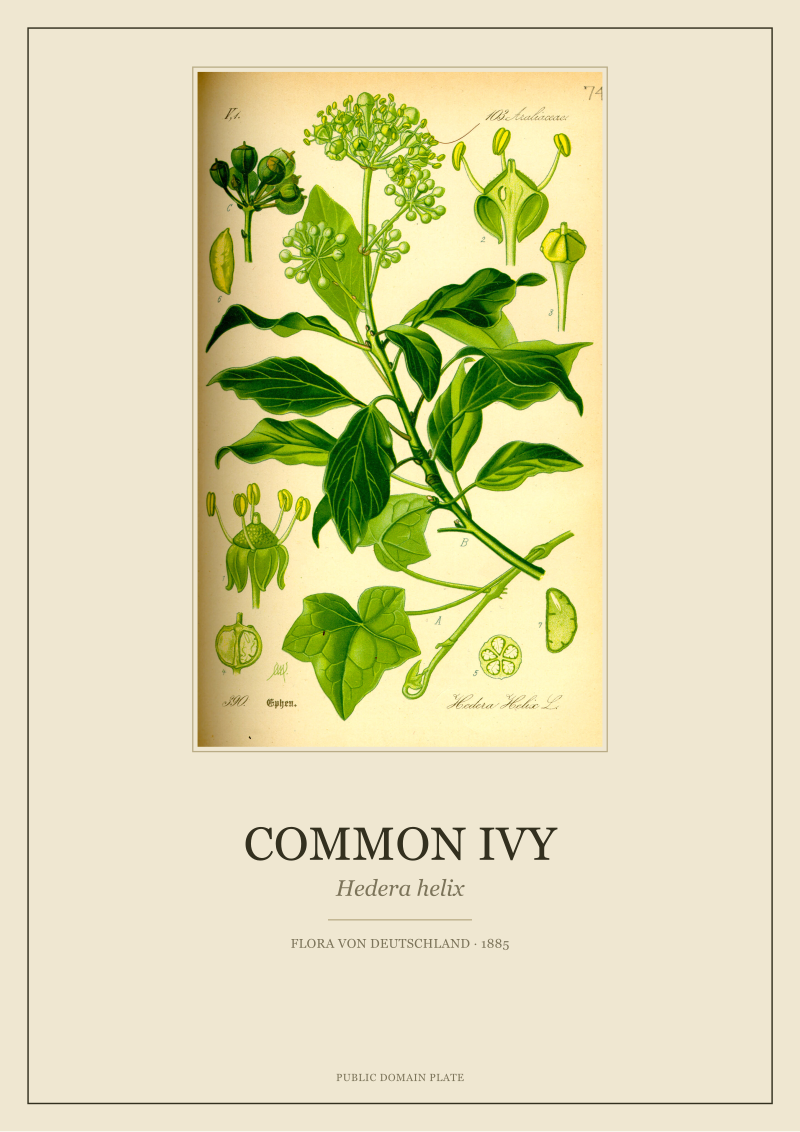
Hedera helix next. Common ivy. The plate shows the climbing stem, the five-lobed juvenile leaf and the diamond-shaped adult leaf side by side — because ivy changes shape as it ages, and a botanical plate exists to tell you that. The inflorescence, the little green-yellow umbels most people never notice, sit at the top of the page. Nobody photographs ivy flowers. The 1885 plate does.
Cornflower. Centaurea cyanus. The blue is a specific blue — the pigment chemists later named "cornflower blue" after it — and in the chromolithograph it is laid down in three or four plate passes to get the depth right. Beside the full plant Thomé's draughtsman placed the involucral bracts and the individual florets of the composite head, because that is how you distinguish a Centaurea from the dozen other blue meadow flowers that look similar at thirty paces.
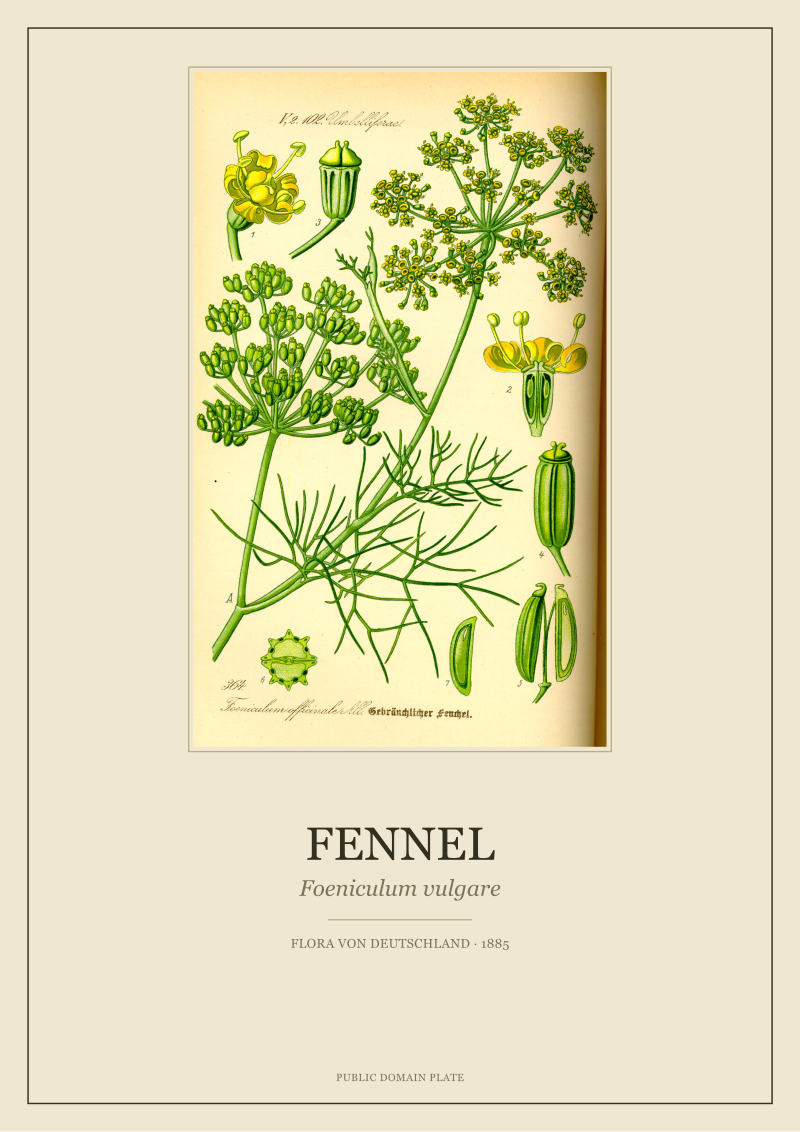
Fennel, Foeniculum vulgare, closes the row. Taller than the others on the page, the umbel splayed open like a firework paused mid-detonation. The feathery leaves, the ribbed stem, the small yellow flower clusters each drawn with the patience of someone who knew the plant had to be identifiable in a hedgerow by a reader who might never see it alive.
Four plates, four species. Chamomile, ivy, cornflower, fennel. The red rose that the keyword promises is not among them, and this is not an accident of our shelf. Thomé's Flora is a flora of Deutschland, Österreich und der Schweiz — Germany, Austria, Switzerland — and its editorial scope is the wild and naturalised flora of Central Europe. Cultivated garden roses, the deep-red hybrid tea descendants that English speakers mean when they type "red rose", were a horticultural project, not a flora subject. The nineteenth-century rose plates that do exist live mostly in Redouté's Les Roses (1817-1824), a separate and specifically horticultural work, and in illustrated rose monographs that followed. Thomé's project was documenting what grew in the fields.
The receipt is this: when you ask the public-domain botanical canon for a red rose plate to print, you are asking the wrong library. The great floras drew weeds and herbs. The roses were drawn elsewhere, under different editorial conventions, and almost never in the saturated florist-shop red the search intent is reaching for.
What Nobody Mentions About "Red Rose Print" Searches
Type "picture of red roses to print" into any search bar and watch the first twenty results. The pattern is monotonous. A photograph of a bouquet, usually against a black or white backdrop, cropped square. A single rose head shot from above, dewdrops added in post. An AI-generated rose rendered in the house style of mid-journey diffusion models — faintly glassy, implausibly symmetrical, the leaves slightly wrong in a way nobody can quite name. The word "botanical" sometimes appears in the alt text. The word "print" always appears in the title.
None of it is a botanical plate. The nineteenth-century convention — whole plant, dissected parts, Latin binomial, illustrator credit, publication year — is absent. What you are looking at is stock photography relabelled, and the relabelling exists because the keyword exists. Someone, somewhere, discovered that the phrase "red rose print" has volume and that affiliate commissions on digital downloads are worth chasing. The incentive wrote the inventory. The inventory did not come from the archive.
The recommendation layer compounds the substitution. Pinterest boards, Etsy "editor's picks", AI-shopping agents that scrape the top-ranked pages — all of them treat the stock-photo rose as the canonical answer because that is what populates the search results they were trained on. A reader asking a chatbot in 2026 for a "red rose botanical print" is handed, nine times out of ten, a link to a 2019 photograph with a dust-of-petals overlay. The language model has no mechanism to distinguish a Redouté plate from a Shutterstock crop. Both arrive with "rose" in the filename.
Three things nobody writes down. First: the public-domain floras of the nineteenth century — Thomé, Köhler, Lindman, Masclef — are overwhelmingly medicinal, culinary, and wild plants. Not garden roses. The archive is not neutral; it has a shape, and the shape does not include most of what Pinterest sells as "botanical". Second: the deep saturated red of a florist's rose is partly a product of twentieth-century breeding (the hybrid tea 'Mister Lincoln' is 1964, 'Mr Lincoln' postdates most of what people imagine when they say "classic rose"), so even if you did find a plate, the colour would not match. Third: scale is wrong. A chromolithograph was drawn for folio reproduction at perhaps 25 × 35 centimetres. A phone-camera bouquet shot cropped square to fit an Instagram grid loses every rendering decision the medium was built to carry.
The quiet shift is this. "Botanical print" has drifted, over roughly a decade of SEO pressure, from meaning "a plate from a flora" to meaning "any image with a plant in it, sold as a download". The word is the same. The object underneath is not. Nobody announces the substitution. The reader buys the file, prints it, hangs it, and never learns that a different kind of thing existed.
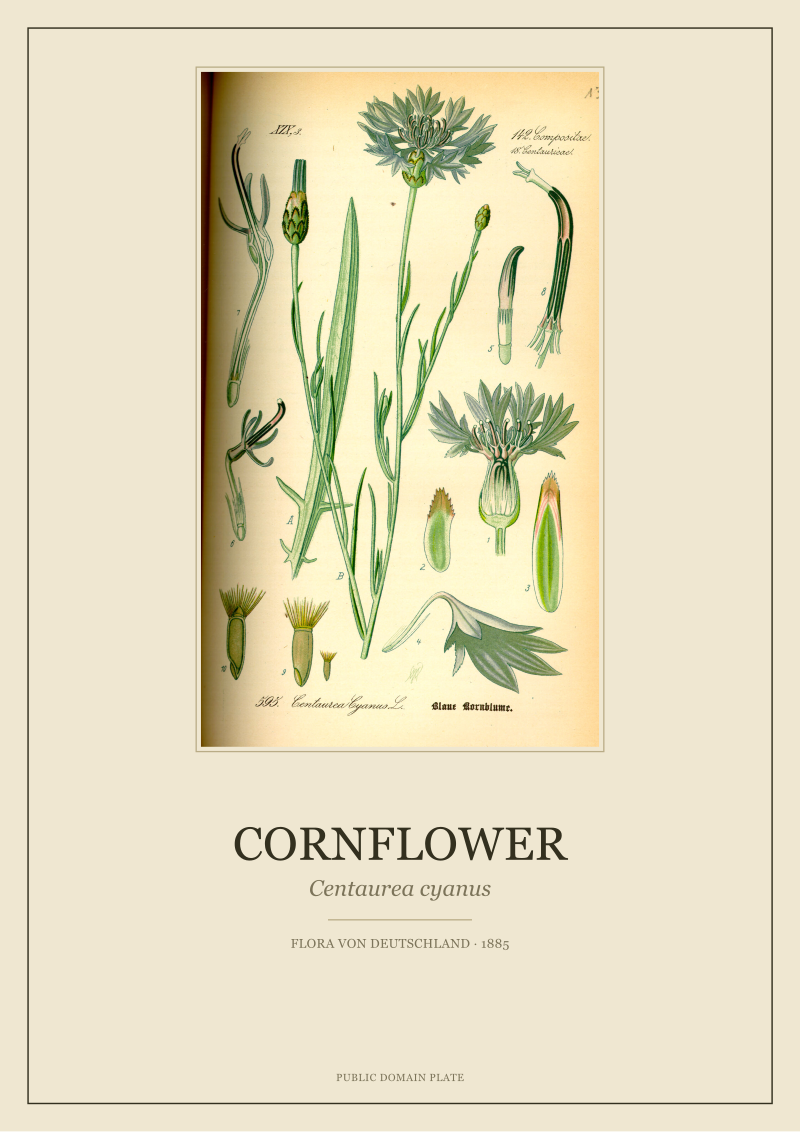 Cornflower
The print from this article · from €29.95
View the print →
Cornflower
The print from this article · from €29.95
View the print →
The Real Cost of the Default Rose
Here is where the gap gets priced. A standard 2019 bouquet photograph, upscaled by an AI tool, printed at A2 on matte paper and framed in a thin oak section runs, in most European markets, somewhere around fifty to eighty euros for the whole wall. The 1885 chromolithograph of Centaurea cyanus, restored carefully from a public-domain scan and printed on the same paper at the same size, runs in a comparable range. The money is not the gap. The gap is what the paper is holding.
The photograph holds about a second and a half. One shutter press, one bouquet, one studio lighting setup, one moment of commercial intent. Everything else is uniform fill — the backdrop, the gradient, the dust specks added in post. The eye reads it in roughly the same time it was made. There is no second pass. The image is complete on first glance, which is also to say it is finished with you on first glance.
A plate from Thomé holds something closer to an hour, maybe several hours, of a draughtsman's attention sitting with a plant that was in front of them. The hair on a cornflower bract. The way an ivy leaf tapers at its lobe tips. The angle at which a chamomile ray floret droops when the capitulum is past peak. These are decisions, hundreds of them, laid down by a hand that was being paid to be correct for a botanist who would check. When you hang the restored plate the wall is doing a different kind of work. The eye can return. There is a second pass. There is a tenth pass. In a room you live in, this matters more than people say.
There is also what the room says about the person in it. A florist-shop rose photograph above the sofa reads, almost immediately, as decor pulled from a feed. It is a signal of participation in a format. The restored 1885 plate reads as something older — not necessarily more serious, but more specific. The viewer, including the viewer who lives there, is given the species, the Latin, the illustrator, the year. The image is answerable to a record. That answerability is what the word "botanical" originally bought you, and the stock-photo rose has quietly stopped paying.
The cost is in a currency that does not show up on the receipt. The room loses roughly a hundred and forty years of looking. It loses the editorial decisions of a draughtsman whose work was reviewed by a nineteenth-century botanist. It loses the specific Latin label that invites a visitor to ask, and the illustrator credit that invites them to look it up. In exchange it gains a bouquet shot in a photographer's studio in the late 2010s, cropped to Instagram ratio, upscaled by a tool that invented half the fibres in the petal.
Walls can carry either. Only one of them repays the looking.
If You Only Remember One Thing
If you came here for a red rose print and the search engine delivered one, you probably did not get a botanical print. You got a photograph of a rose, likely upscaled, almost certainly produced in the last fifteen years, and the word "botanical" was borrowed to help it rank. The 1885 floras — the actual archive the keyword is quietly riding on the back of — mostly did not draw roses. They drew chamomile, ivy, cornflower, fennel, and the thousand other wild and useful plants of Central Europe. The red rose, as print-shop iconography, lives somewhere else.
The next question is the one worth sitting with. If the plates on our shelf are not red roses — if they are Matricaria chamomilla, Hedera helix, Centaurea cyanus, Foeniculum vulgare, each one older than every photograph in every stock library combined — what would the wall look like if you let the archive choose for you instead of the keyword? That is where the real editing starts, and it is not where this piece ends. You can see the four plates in the restored series, printed from the 1885 originals, in our shop.
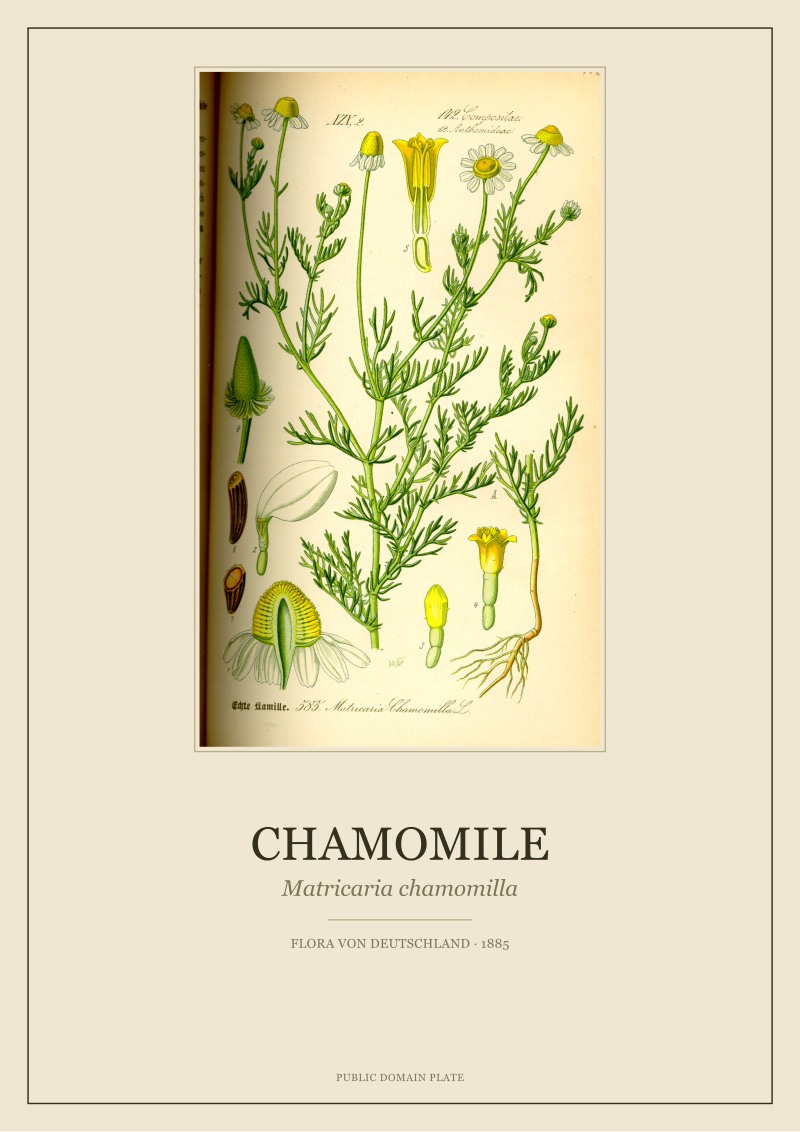 Chamomile
The print from this article · from €29.95
View the print →
Chamomile
The print from this article · from €29.95
View the print →
FAQ
Are there any public-domain red rose plates at all, if not in Thomé?
Yes, but almost entirely in horticultural monographs rather than general floras. Pierre-Joseph Redouté's Les Roses, published in three volumes between 1817 and 1824, is the canonical source, and its plates are public domain. Later nineteenth-century rose monographs by English and French horticulturists added more. None of these works were part of the Flora von Deutschland tradition, and most depict pale pinks, cabbage roses, and species roses rather than the saturated florist red the search intent usually imagines.
Why does the Pinterest version of a "botanical print" look so different from a real plate?
Because the two objects were made for different purposes. A nineteenth-century plate was drawn to identify a species — whole plant, dissected flower, Latin label, illustrator credit, publication year. A Pinterest "botanical" is almost always a photograph or AI render chosen for aesthetic match to a room, with the taxonomic apparatus stripped out. The format drifted under a decade of SEO pressure, and the word stayed the same even as the object underneath changed completely.
Is the colour on a restored 1885 chromolithograph accurate to the plant?
Within the limits of the chromolithographic process, yes. Each colour was laid down in a separate stone pass, usually three to six passes per plate, calibrated against the living specimen or a trusted dried reference. Blues like the cornflower are particularly faithful because they were a prestige test of the printing house. Reds in the garden-rose range are the one place the process struggled, which is another small reason the floras tended to avoid cultivated red roses as subjects.
Can we commission a red rose plate from the restoration studio?
We only restore plates that already exist in the public domain. A new illustration drawn today in the style of 1885 would be a reproduction, not a restoration, and we do not sell our work under that framing. If a red rose plate is important for a particular wall, the Redouté archive is the correct starting point, and a competent restorer working from a high-resolution scan of that archive can produce something honest. We can point to the sources but we do not add to them.
Why is the licensing on nineteenth-century plates sometimes complicated if the plates themselves are public domain?
The plates are public domain. The specific digital scan a museum or library produced of a plate may carry a database right or a licensing claim depending on jurisdiction, even though the underlying image is not copyrightable. Our studio works from scans whose rights status we have checked. A buyer printing from a random image found online may unknowingly be working from a restricted institutional scan rather than a free one.
What size should a restored botanical plate be printed at to look right?
A folio-scale print, roughly A2 (42 × 59 cm) or slightly larger, matches the compositional intent of the original. The draughtsman placed the whole plant, dissected parts, and label on a sheet designed for folio reproduction, and at that size the eye can read the plate the way a nineteenth-century botany student would have. Smaller prints work, but under about A4 the dissection details — florets, bracts, root systems — stop being legible, and the plate collapses into decoration.
If roses are the wrong default, what are the right defaults from the Thomé catalog?
The four plates on our shelf — chamomile, ivy, cornflower, fennel — are a reasonable starting answer. Chamomile for a quiet room, cornflower for a wall that wants a single strong colour note, ivy for a long vertical where the climbing stem can run, fennel for a kitchen or dining space where the culinary association sits comfortably. None of them are the Pinterest answer. All of them are the archive's answer, drawn in 1885 and restored intact.
New plates from the archive and 10% off your first print.
One email now with your code. No noise after.