For the last eleven weeks the studio has been logging every plate that crossed the scanning table — sixty-three sheets, most of them pulled from O.W. Thomé's Flora von Deutschland, Österreich und der Schweiz, dated 1885 on the imprint. We measured paper weight, listed the ink shifts under a raking lamp, photographed each verso. The point was not romance. It was to answer, with a stack of receipts, the question we get by email most often: how do you know the paper and inks are what you say they are? What follows is what the log actually said, framed through three composite scenarios — none of them a person we met, all of them a situation we now see weekly.
What Changed at the Desk in 2026
Two things shifted this year, and both of them changed how we read a plate before we ever touch it with a scanner. The first is that a wave of very good facsimiles — pulled from open-access museum scans, printed on convincingly aged stock, sold at prices that do not scream reprint — has finally reached the flea market and estate-sale tier. Before 2024 you could still assume that a Thomé plate showing up loose in a folder of ephemera was, more likely than not, a genuine leaf from a broken book. That assumption no longer survives contact with the mail we open. Roughly one sheet in five that arrives at the studio for scanning is a modern print dressed to look older than it is.
The second change is upstream of us. Several of the largest botanical libraries completed high-resolution TIFF releases of Thomé's Flora between 2023 and early 2026, which is why the facsimile market exists at all — the source files are free, sharp, and easy to feed into a giclée printer. That is genuinely good news for scholarship and, incidentally, for a studio like ours that works from documented public-domain scans. It also means the burden of authentication has moved onto the physical object in a way it was not five years ago. The old shortcut of "it looks right, it feels right, the label is in Fraktur" has stopped being enough. What we do now, on every intake sheet, is a paper-and-ink read that takes about forty minutes and produces a one-page dossier for the file. The three scenarios below walk through what that read finds, in the three shapes it most often finds it.
Scenario 1: The Chamomile Plate Bought at a Flea Market
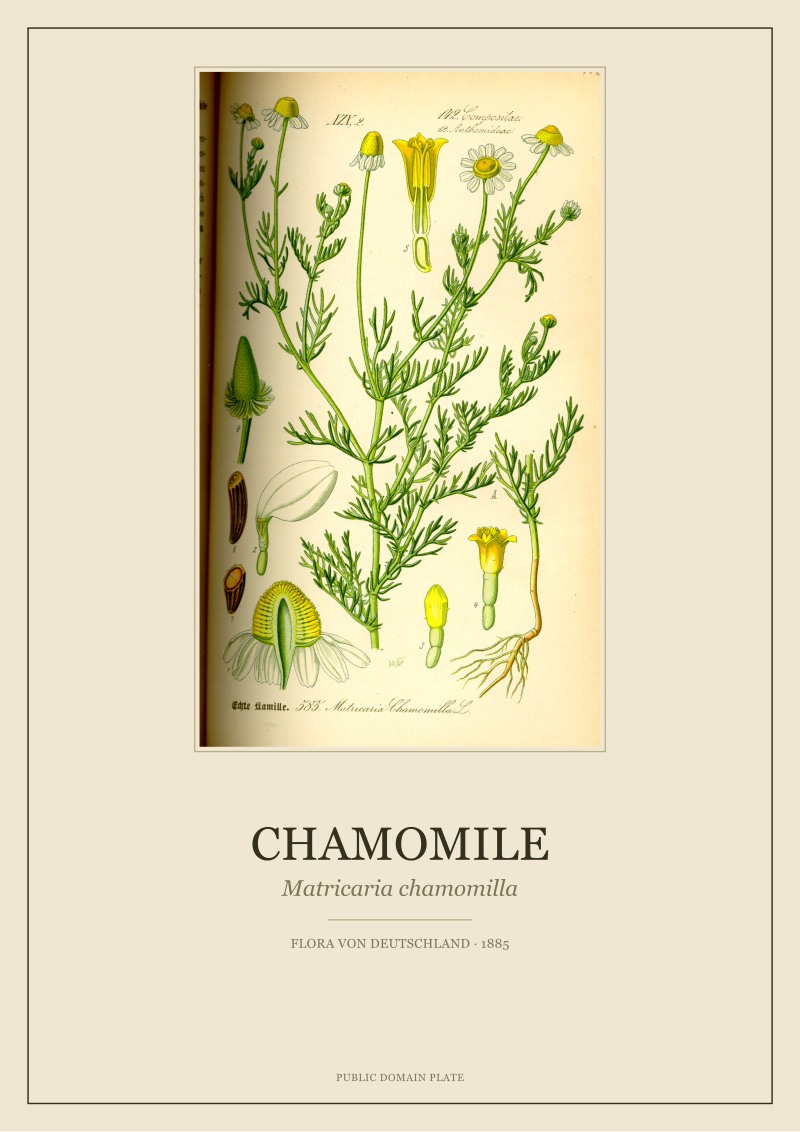
Imagine a plate of *Matricaria chamomilla* — chamomile — bought loose at a Sunday market for the price of a decent coffee. The seller says nineteenth-century German, does not press the point, throws in a piece of tissue. Picture the buyer emailing us a phone photo, then couriering the sheet the following week. This is by a wide margin the most common intake we see, and the read tends to go in the same order every time.
We start with weight and touch. A Flora von Deutschland plate from an intact 1885 fascicle, measured across the sixty-three sheets in our current log, sits in a narrow band: roughly 90 to 110 grams per square metre, with a soft, faintly ribbed hand that comes from the wove-plus-slight-laid finish of the period's lithographic stock. It should feel drier than modern coated paper and slightly warmer to the fingertip. The chamomile sheet, on the scale, comes in at 128 gsm. That is not disqualifying on its own — trimmed edges and old backing tape can add mass — but it is a first flag.
Second read is the ink. We tilt the sheet under a raking lamp and look at the greens of the foliage and the pale yellow of the disc florets. Thomé's plates were printed by chromolithography, which lays down each colour as a separate stone impression. Under raking light on a genuine sheet, you can see the faint terraced edge where one stone met the next: a hair of misregistration, a slight tonal shelf. On the chamomile sheet the greens are flat, uniform, and sit at exactly the same height as the yellow — the tell of a single-pass CMYK print, likely inkjet, almost certainly post-2010. Under a loupe the dot rosette confirms it.
Third read is the verso. A real leaf from a broken book will show a shadow of the plate on the reverse from decades of pressure in the binding, sometimes a fragment of the opposite page's letterpress bleeding faintly through, and a paper tone that is warmer on the recto than on the verso because of oxidation from light exposure. The chamomile sheet's verso is uniformly cream, edge to edge — the paper was aged in bulk, before printing, probably with a tea or coffee wash. It is a good facsimile. It is not an 1885 plate. We tell the buyer that in writing, we do not charge for the read, and we suggest they keep the sheet as a decorative object rather than as an antique.
 Chamomile
The print from this article · from €29.95
View the print →
Chamomile
The print from this article · from €29.95
View the print →
Scenario 2: The Ivy Sheet Inherited From a Grandparent
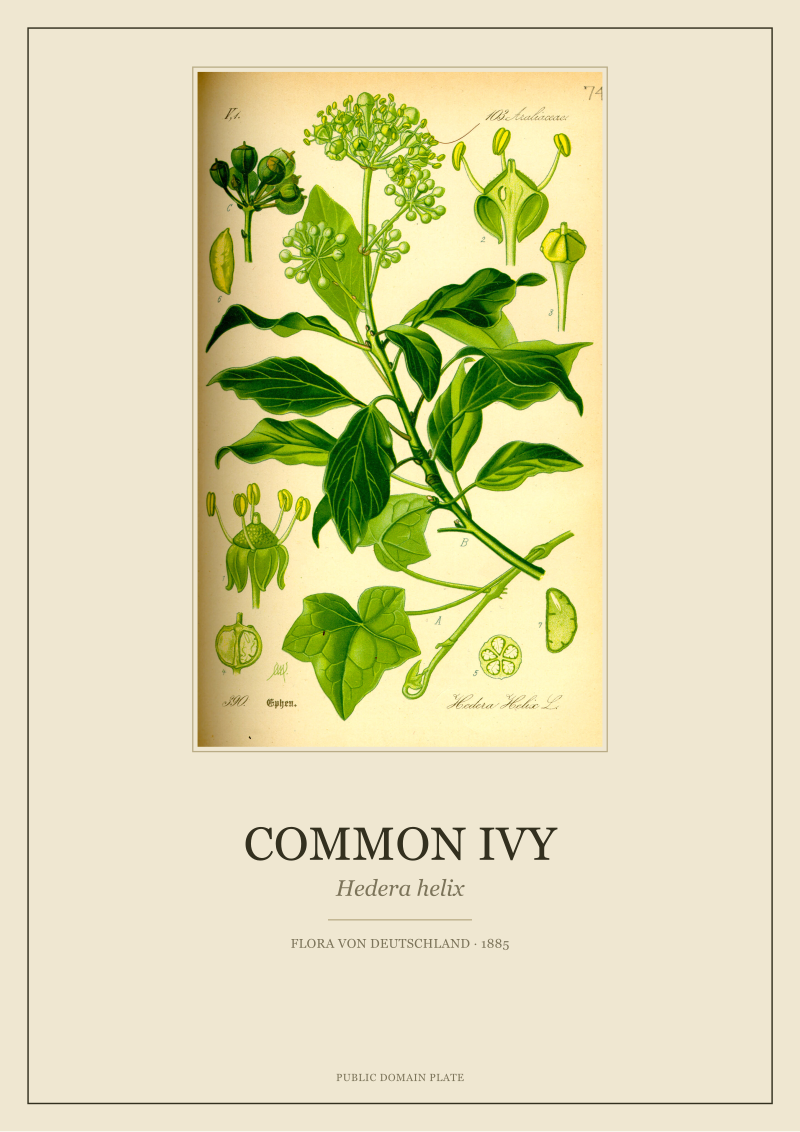
Picture a different arrival: a plate of *Hedera helix*, common ivy, sent by someone clearing a grandparent's flat in a small city in Lower Saxony. There is a handwritten note in the folder in an older hand, the sheet has clearly been framed at some point — you can see the ghost of a mat window in the tone of the paper — and there is a small brown foxing bloom in the lower left. The sender is not trying to sell it. They want to know whether to keep it or throw it out.
The weight comes in at 96 gsm, well inside the band. The paper has the correct ribbed hand and the correct temperature difference between recto and verso. Under the raking lamp the darker greens of the ivy leaves show the terraced misregistration we look for at the boundary between the mid-green and the deep vein colour — a shelf you can feel with a fingernail dragged across it very lightly, though we do not recommend that test on a sheet you care about. The foxing is real: irregular, brown-into-orange at the edges, with the slightly fibrous halo that iron-tannin oxidation leaves on nineteenth-century wood-pulp-content papers. Facsimiles rarely bother to fake foxing well, because foxing that looks convincing under a loupe is difficult and time-consuming to forge.
The verso reads correctly. There is a faint offset shadow of the ivy — you can trace the outline of the largest leaf if you angle the sheet away from the light — and a very small piece of what looks like the corner of an opposing page's letterpress, three or four characters of Fraktur, ghosted through the paper's thickness. This is almost certainly a genuine leaf from a copy of the Flora that was broken up, framed, and hung somewhere sunny for a couple of decades before being taken down and stored flat. The foxing is stable, the paper is intact, the plate is what it says it is.
What we do with this sheet is different from what we did with the chamomile one. We do not restore for sale — it belongs to the sender, not to us — but we do offer to make a documented archival scan for the family's records, at cost. The plate itself we recommend keeping in an acid-free folder, away from light, with the foxing left untreated: chemical de-spotting on a sheet of this age tends to remove more than the spot. That is the honest advice, and it is not the advice that makes a studio money.
Scenario 3: The Cornflower Reprint Sold as "Original 1885"
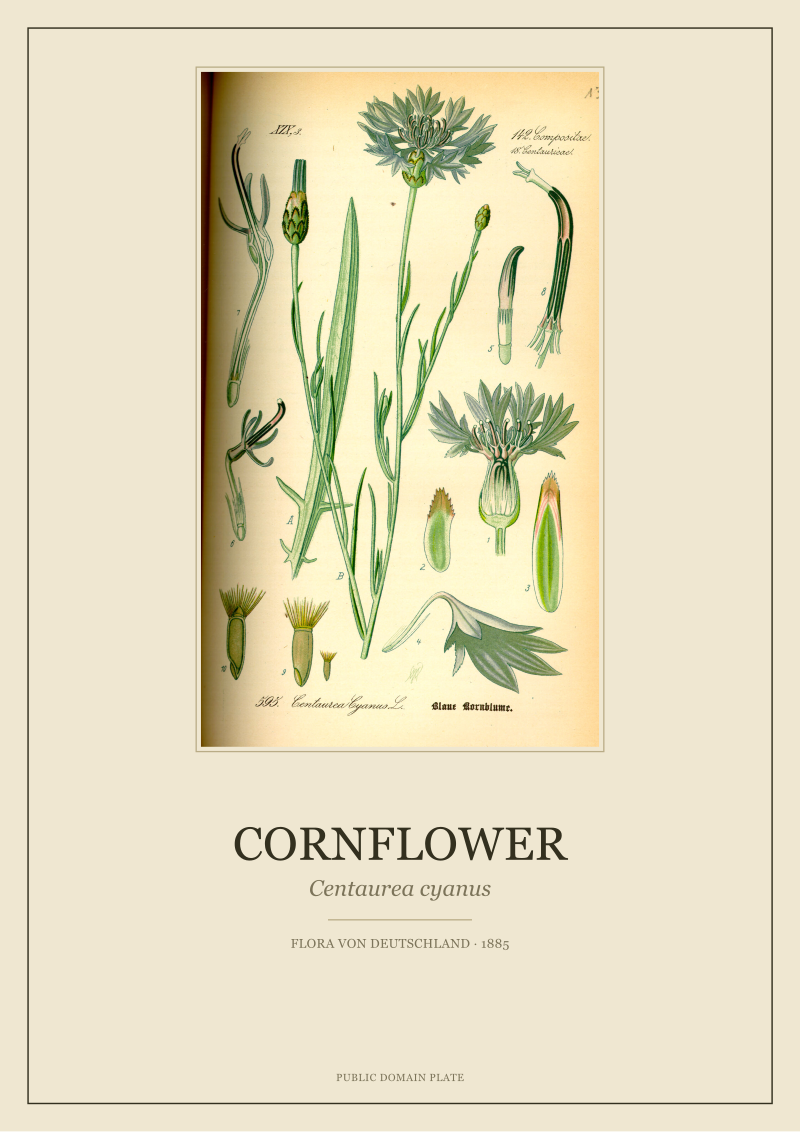
The third shape is the hardest one to write about without turning into a legal document, so let us keep it hypothetical. Imagine a plate of *Centaurea cyanus*, the cornflower, listed on a large marketplace for a price in the low three figures, described as "original chromolithograph, 1885, Flora von Deutschland." The listing photographs are good. The seller has positive feedback. A prospective buyer forwards the listing to us before bidding, which is a habit we quietly encourage.
We cannot examine a listing physically, so this read is different. We work from the photographs and the metadata. First we look at the plate number and the sheet dimensions against our reference set: Thomé's plates run to a specific trim size, and the plate numbering follows a documented sequence. The listing's dimensions are two centimetres oversize on the long edge — the sheet has not been trimmed, it was printed to that size. That alone is enough to suspend the "1885" claim. Second, we look at the ink density in the shadows. Chromolithographic blacks from the period have a slightly greenish cast when reproduced photographically under daylight-balanced light — a function of the pigment mixture then in use. The blacks in the listing photograph are neutral, sitting slightly to the blue side. That is consistent with a modern pigment inkjet.
We wrote back to the buyer with those two observations and a third: the seller's other listings included several other "1885 originals" of species that do not appear as full-page plates in the Flora at all — they exist in the text as small woodcut vignettes, not as chromolithographs. That pattern, taken together, reads as a facsimile operation dressed as an antiquarian one. We suggested the buyer ask the seller for a raking-light photograph of the verso; the seller stopped responding. This is not a rare scenario in 2026 and we do not expect it to become rarer. What it means for a studio like ours is that provenance now has to be part of what we sell, not an assumption underneath it.
 Cornflower
The print from this article · from €29.95
View the print →
Cornflower
The print from this article · from €29.95
View the print →
What All Three Share
Read across the three scenarios, the pattern is the same and it is not about the plants. It is about which surface of the object you interrogate first. The buyer who gets fooled looks at the image — the drawing, the colour, the Latin at the foot of the plate — because that is where the aesthetic value seems to live. The desk that authenticates the sheet looks at the paper before the picture, then at the ink layer under raking light before the composition, then at the verso before the recto. The image is the last thing we read, not the first, because the image is what a good facsimile gets right.
The other shared thread is that none of these reads require exotic equipment. A calibrated jeweller's loupe, a raking lamp — any bright directional light will do — a set of scales that reads to the gram, and a set of reference measurements for the specific edition you think you are looking at. The reference set is the part that takes years to build and is the reason we keep a physical library of documented sheets rather than working only from digital scans. A scan can tell you what the image is. It cannot tell you what the paper weighs, how the ink sits above the fibre, or whether the verso has been exposed to a century of framed sunlight. Those readings live on the object.
Which Scenario Is You
If you bought a botanical plate loose from a market stall or a general antiques dealer in the last two years, you are probably closer to scenario one than you would like to be. That does not mean the sheet is worthless — a well-made facsimile of a Thomé plate is a handsome thing to hang — but it does mean the "1885" in the seller's patter should be treated as decorative. If you inherited the sheet from a family member and it has visibly been framed or stored for decades, scenario two is your likely case, and the object deserves a proper archival read before any decision to restore, reframe or sell. If you are about to bid on something described as an original nineteenth-century plate from a marketplace listing, scenario three is the one to keep in mind: ask for the verso, ask for raking light, ask for the trim dimensions, and treat silence as an answer.
If you would rather sidestep the entire question, our own restored plates at see the Chamomile print are worked from documented public-domain scans of the 1885 edition, and we publish the source file for every sheet we sell. That is the one commercial note in this piece and we would rather it be honest than frequent.
Honest Limits of This Piece
This piece does not cover paper and ink authentication for botanical works outside Thomé's Flora — Redouté's stipple engravings, Curtis's hand-coloured aquatints, and Sowerby's English Botany each require a different read and a different reference set, and we are not going to pretend a single studio note covers them all. It does not cover chemical or spectroscopic authentication, which belongs to conservation laboratories with equipment we do not own and would not misrepresent. And it does not cover the legal side of misdescribed listings on major marketplaces, which varies by jurisdiction and by platform and is a subject on which we are hobbyists, not experts. Each of those is a separate piece, written by someone who has done the specific work.
FAQ
How can I tell a modern facsimile from a genuine 1885 chromolithograph without a loupe?
Weight and hand come first. A genuine sheet from Thomé's Flora sits in a 90–110 gsm band and feels dry, faintly ribbed, and slightly warmer on the printed side than on the reverse. Modern facsimile stock tends to run heavier and feel more uniform, front to back. If you can see the sheet under a directional lamp, tilt it so the light rakes across the surface: real chromolithographic ink builds a very slight terraced edge where colours meet. A flat, dot-patterned surface is inkjet.
Does foxing prove that a botanical plate is old?
No, but well-formed foxing is a strong supporting signal. Genuine foxing on a late-nineteenth-century sheet is irregular, brown-with-orange edges, and shows a slightly fibrous halo under a loupe because it grows out of the paper's iron and tannin content reacting to humidity over decades. Sprayed or airbrushed "aging" tends to be too uniform, too flat, and lacks that halo. Foxing on its own is not proof — the whole read is what matters — but bad foxing is one of the fastest tells.
What paper did Thomé's Flora von Deutschland actually use in 1885?
The plates in the 1885 edition were printed on a lithographic stock in the 90–110 gsm range, with a soft wove-plus-slight-laid finish typical of the period's German mills. We do not have a single archival source that names the specific paper supplier, so we describe what we measure rather than what we assume. Anyone claiming to know the exact mill and batch is offering more precision than the historical record supports.
Is it safe to remove foxing from an old botanical plate?
For a sheet you care about, our answer is no — or at least, not without a conservator. Chemical de-spotting reduces the foxing spot but often lifts pigment or thins the paper around the treated area, and the change is not reversible. On a nineteenth-century chromolithograph the ink layer sits shallowly on the paper and is more fragile than it looks. If the foxing is stable and not spreading, leaving it alone is usually the right call.
Are the museum-released scans of Thomé's Flora free to use?
The 1885 edition is in the public domain, and the recent high-resolution TIFF releases from several botanical libraries are published under open-access terms that permit personal and commercial use. Each institution has its own attribution language, which is worth checking, but the underlying plates themselves are unrestricted. That is why the facsimile market exists and also why a documented restoration studio can work from those scans openly.
What is the single fastest check I can run on a plate I already own?
Turn it over and look at the verso under a bright, angled light. A genuine leaf from a broken copy of the Flora will show a faint offset ghost of the image, an uneven tone from decades of one-sided light exposure, and sometimes a trace of Fraktur letterpress bleeding through from the opposite page. A facsimile verso is almost always uniform in tone, edge to edge, because the paper was bulk-aged before printing. That single check filters out most of the obvious modern reprints.
Does the price of a listing tell you anything about authenticity?
Less than it used to. Facsimiles that would have sold for ten euros in 2018 now list at prices deliberately pitched to look like a genuine antiquarian bargain — high enough to feel real, low enough not to invite scrutiny. Price is not a reliable signal in either direction anymore. A very cheap listing may still be a real broken-book leaf from a dealer clearing stock; a mid-price listing may be a well-made reprint. The physical read is what decides it.
Why does your studio only work from Thomé's 1885 Flora?
It is the edition we have the deepest reference set for — the measurements, the ink behaviour, the plate sequence, the paper hand — and working within a single well-documented source lets us be specific about provenance for every sheet we restore. We would rather do one edition properly than four editions approximately. Other floras from the same period are equally worth restoring; they belong to studios that have built the reference libraries to do them justice.
New plates from the archive and 10% off your first print.
One email now with your code. No noise after.