The query "red rose printable image" arrives at our desk roughly once a week, and the honest answer is that it depends on the room, the paper, and the rest of the wall. We restore 1885 plates from O.W. Thomé's *Flora von Deutschland, Österreich und der Schweiz* — chamomile, common ivy, cornflower, fennel — and from that vantage the rose question is rarely about the rose. It is about scale, pairing, and whether a single scarlet note belongs beside the muted ochres and leaf-greens of a Thomé page. So instead of recommending a file, we walk through three hypothetical rooms.
Three rooms, three readers, three different answers. None of these readers exists; they are composite illustrations stitched together from the questions that actually reach us. Picture them clearly, though, because one of them will be close enough to your own wall that the answer transfers. The point is not to tell you what to download. The point is to show you the questions a restorer asks before a single pixel is sent to paper.
Scenario 1: The Reader Who Already Framed a Chamomile
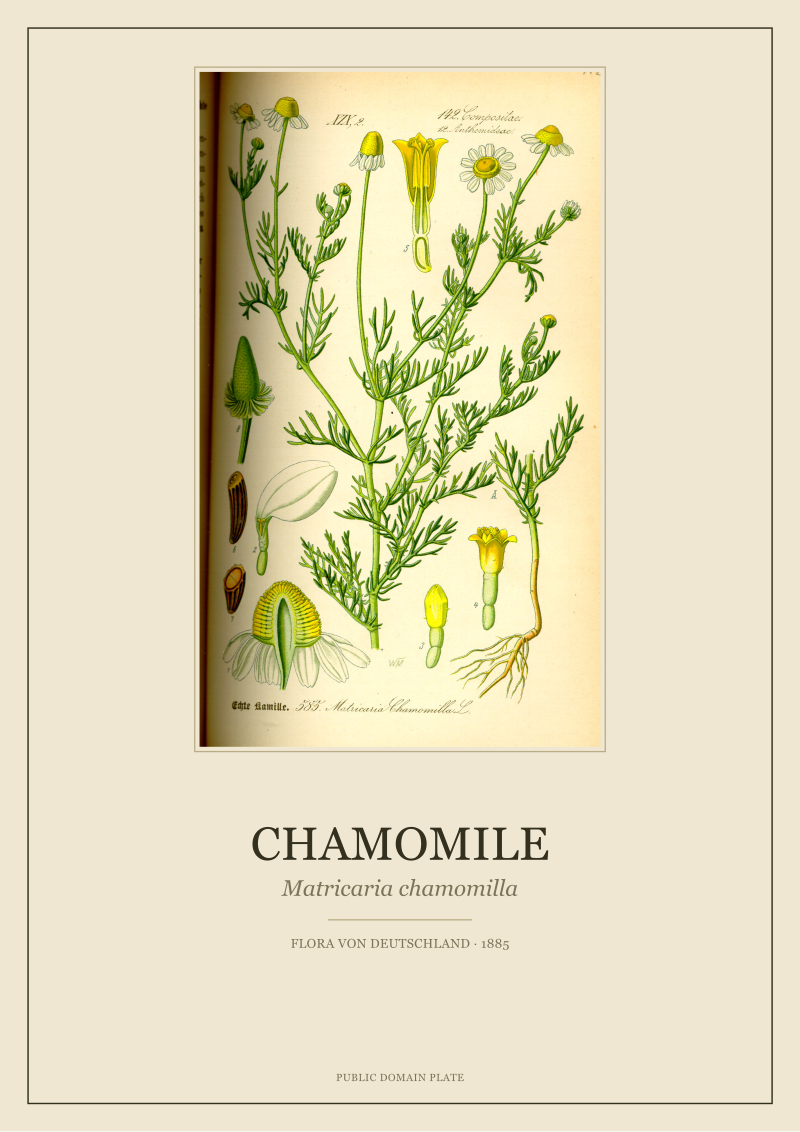
Imagine a reader who, six months ago, framed a restored *Matricaria chamomilla* plate from Thomé's 1885 folio and hung it above a reading chair. Picture a narrow living room, north light, oak floors that have gone slightly honey with age. The chamomile plate is doing what Thomé plates do: pale ivory ground, the small daisy-head rendered in two or three greens and a very restrained yellow, Latin label set in a nineteenth-century serif at the foot of the sheet. The reader has lived with it long enough to notice it in the morning and stopped noticing it by noon. Now they want a second plate for the opposite wall, and the first word that came to them was "rose".
Let us walk the math of what happens if they go find a red rose printable image online and print it at A3. The chamomile plate, in its restored state, sits at roughly 94% L* on the paper white, with chroma values rarely exceeding C* 35 in the warmest leaf passages. A standard red rose stock image — the kind that fills the first screen of any search — is engineered for maximum saturation. It will arrive on the wall at C* 70 or higher, essentially double the chromatic weight of the chamomile. The eye reads this instantly. The chamomile stops being a plate and becomes a pale thing next to a loud thing. The whole wall tilts.
There is a second problem, and it is one restorers see constantly: the register mismatch. Thomé worked in chromolithography, a technique that laid colour in flat planes separated by hairline keyplate drawing. A photograph of a rose, however good the camera, is continuous-tone — gradients the whole way through. Put the two side by side and the eye understands, without being told, that one is a drawing and one is a photograph. They do not belong to the same visual century.
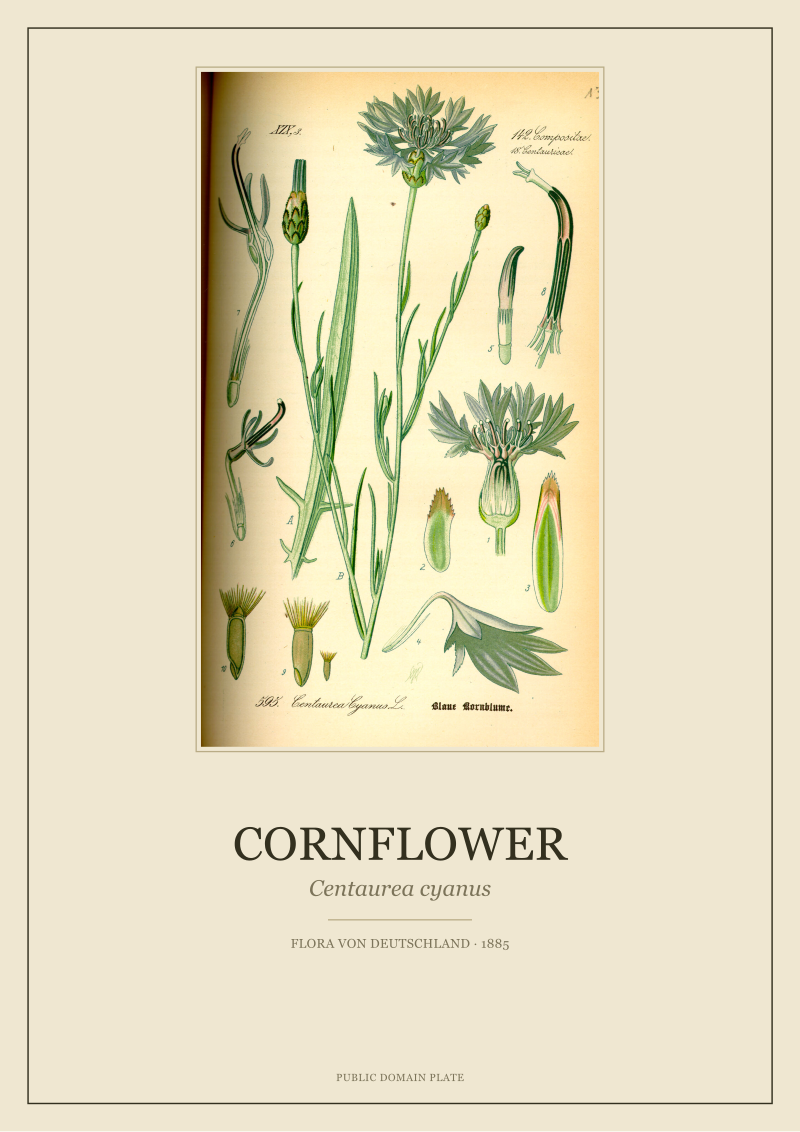
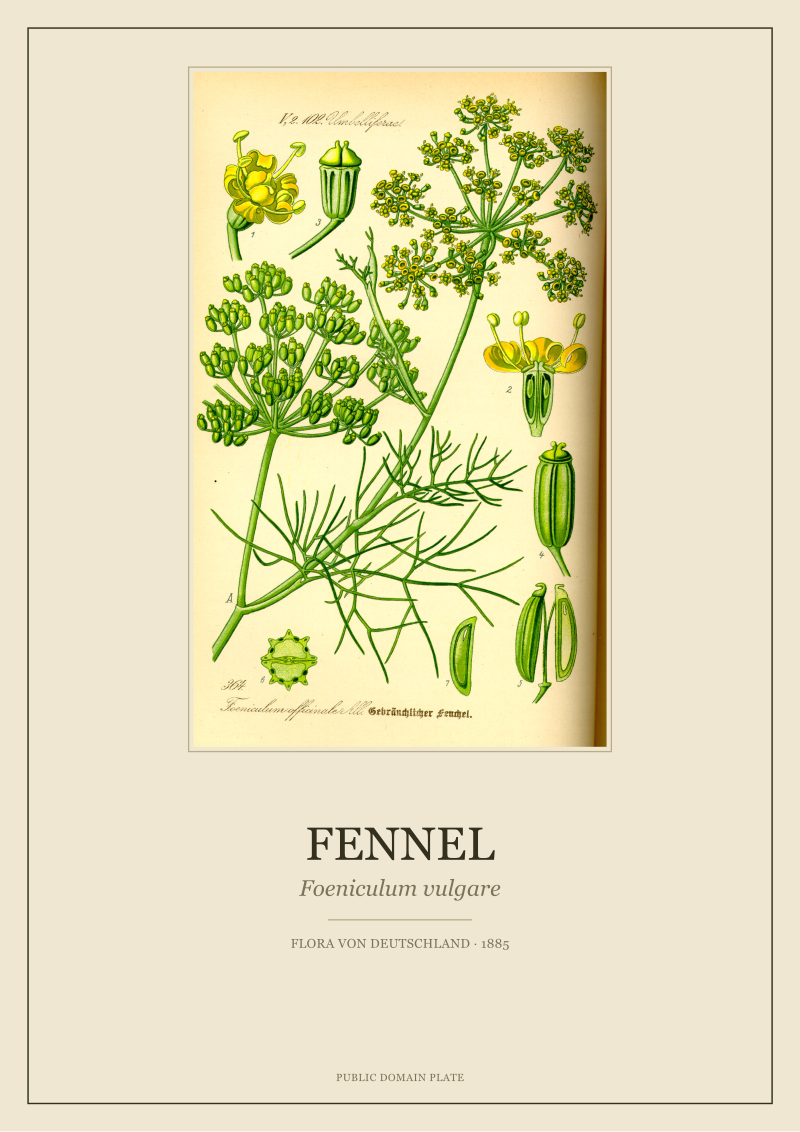
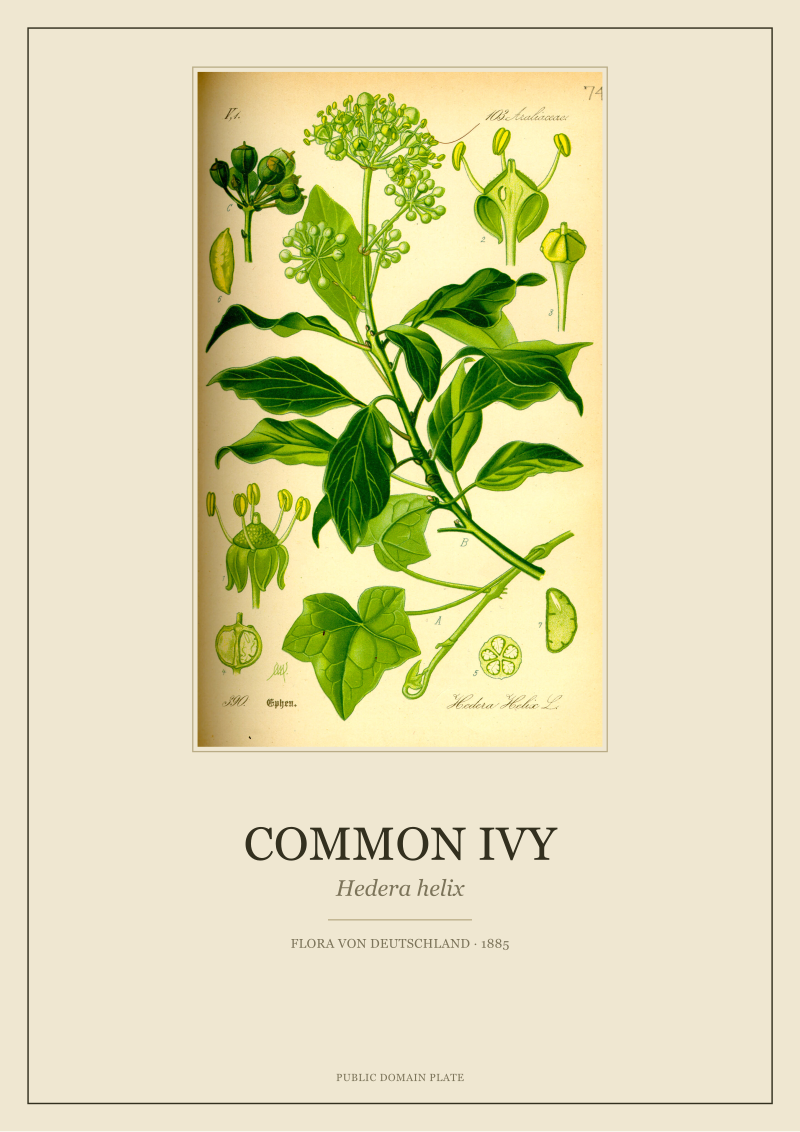
For this reader, the honest advice is to step away from the rose entirely and look at what Thomé actually drew in red registers. Common ivy — *Hedera helix* — carries berries that read deep purple-black with a wine undertone, and a mature leaf will throw a bronze flush in autumn plates. Fennel — *Foeniculum vulgare* — brings yellow-ochre umbels that pair with the chamomile palette almost seamlessly. If the reader insists on something warmer across the room, cornflower (*Centaurea cyanus*) sits in a cooler key but gives the wall a focal point without shouting.
If the rose is non-negotiable, the restoration path is to find a nineteenth-century rose plate from a comparable folio — not Thomé, who did not plate the garden rose at scale in this edition — and have it restored to the same paper white, the same chroma ceiling, the same keyplate feel. Anything else will fight the chamomile.
Scenario 2: The Reader Furnishing a First Rental in One Afternoon
Picture a reader who signed a lease on a Tuesday and must have the walls populated by Sunday because the parents are visiting. Studio apartment, 34 square metres, one feature wall above a secondhand sofa, a budget somewhere under what any framer would call reasonable. They have typed "red rose printable image" into three search engines in rapid succession and are now looking at a tab of free downloads, most of them watermarked, several of them AI-generated, one that is actually a scan of a greetings card.
Let us say they print the top result on 160gsm matte at A2 and tape it to the wall. The seams of what has happened are visible from the far side of the room: AI-generated roses have a particular problem with leaf veining and thorn placement, because the training data averaged across ten thousand rose photographs and the model does not know which thorn goes where. Watermarked prints betray themselves at any distance under two metres. Scanned greetings cards carry the halftone dot pattern of commercial print, which, blown up to A2, becomes a visible rosette moiré.
The arithmetic for this reader is different. They do not have the budget for a restored plate and framing, and they do not have the week it takes to make a considered decision. What they have is one afternoon and roughly €40 to spend. The best use of that money is almost never a single large print of something generic. It is one small, considered piece at eye level and the rest of the wall left honestly empty until a better answer arrives.
If a red rose is genuinely what pulls them — not just what the algorithm served first — the better move is a single small plate in the 20×30cm range on a decent 300gsm cotton paper, framed in something unfussy. At that scale, the register problem is forgiven: the plate reads as the small object it is, not as a wall statement that has to carry the room. A larger print at the same budget almost always lies about its own quality.
Our own shop at /shop/ offers restored Thomé plates in that small-format range, specifically because this scenario is so common. None of them is a red rose, which is the honest answer to this reader's search: there is no rose in Thomé's 1885 selection that matches the query. If the rose cannot be given up, the research hour is better spent finding a legitimately public-domain nineteenth-century rose plate from a different folio than it is downloading the first ten search results and picking the loudest one.
 Chamomile
The print from this article · from €29.95
View the print →
Scenario 3: The Reader Building a Twelve-Plate Botanical Wall
Imagine a reader planning the long project — twelve botanical plates arranged in a grid above a dining table in a converted townhouse. The grid will be four across and three down, each plate framed identically in natural oak with an off-white mat, each plate at the same 30×40cm sheet size. They have been thinking about this wall for months. The question of whether to include a red rose has become, in their head, a question about the grid as a whole.
The grid is where the red rose problem compounds. Across twelve plates, assume eleven of them are drawn from the Thomé palette — the chamomile, the common ivy, the cornflower, the fennel, with analogues chosen for similar restraint. The dominant chroma across the wall will sit in the greens and the muted blue-violets, with yellows and ochres as supporting notes. A single red rose plate at Thomé-matched chroma — meaning a restored nineteenth-century rose, not a modern photograph — can work in this grid, but only in a specific position.
The math is quadrant placement. In a 4×3 grid, the twelve positions are not equal. The two central positions on the second row are read first; the four corners are read last. A high-chroma plate placed in a central position dominates and the eleven other plates become background. A high-chroma plate placed in a corner anchors the composition without stealing it. For this reader, the rose, if it enters the wall at all, enters at the bottom-right or top-left corner. Not in the middle.
The second decision is scale within the sheet. A rose plate from a nineteenth-century folio where the botanical illustration fills perhaps 60% of the sheet, with generous Latin label and generous paper margin, will sit calmly inside the oak frame. A rose plate that fills 90% of the sheet with the bloom edge-to-edge will read as a different kind of object entirely, and the grid will register the inconsistency the way a wall of serif text registers a single sans-serif line.
For this reader, our actual advice is to build the wall first in its eleven-plate green-and-ochre form, live with it for a month, and then decide whether the rose is still wanted. In practice, roughly half the readers who plan twelve-plate walls decide, after thirty days, that the eleventh plate completed the room and the rose was a holdover from an earlier version of the plan.
What All Three Share
The three rooms do not share a style, a budget, or a wall. They share a question that was never, on close inspection, really about the rose. The chamomile reader wants a second plate that extends what the first plate said. The rental reader wants the wall to stop being empty in a hurry. The grid-builder wants a composition that reads as one object across twelve frames. The word "rose" is doing different work in each case, and the printable image search returned the same ten results to all three.
The pattern underneath is a pattern restorers see every week: the search query is the vocabulary the reader uses to name a feeling, and the feeling is usually about scale, pairing, and whether the room has enough weight on it or too much. A red rose is read, in English visual culture, as warmth and classicism and a certain compressed romantic charge. All three readers are, in some version, asking for that charge. None of them is asking for a specific plate.
The three also share the paper problem. A printable image is a file; a plate is a file printed on a particular paper at a particular size and framed in a particular way. The gap between the two is where almost all wall-decoration regret lives. A good file printed badly looks worse than a mediocre file printed well. A free rose JPEG on glossy 120gsm paper will fail in all three rooms. The same file, if it were restored to archival standards and printed on 300gsm cotton rag, might still fail, but it would fail for better reasons.
And all three share the issue of neighbours. Every botanical print on a wall is in conversation with the other prints, the furniture, the paint, the light. The red rose question is really a question about who the rose will be sitting next to. The chamomile reader has already answered that. The rental reader has not thought about it. The grid-builder has thought about little else.
 Cornflower
The print from this article · from €29.95
View the print →
Which Scenario Is You
If you have already framed one or two botanical plates in restrained nineteenth-century register, you are closer to the chamomile reader than you think, and your second plate is almost certainly not a red rose. You are looking for continuity. Common ivy, cornflower, or fennel will serve you better; a rose, if it must enter, needs to be from a folio that speaks the same chromolithographic dialect.
If the wall is empty, the move is urgent, and the budget is tight, you are the rental reader. The honest advice is to buy less, buy smaller, and leave the wall partly empty until a better answer arrives. One considered 20×30cm plate at eye level does more work than one A2 print of a saturated flower that will look wrong by the second week.
If you are planning a twelve-plate grid and the rose is on the shortlist, you are the grid-builder, and the question is less about whether the rose belongs than about which corner it goes in and whether it survives the thirty-day test. Build the wall without it first.
Whichever scenario you recognise, the next question — the one this piece does not answer — is which specific restored plate, from which specific folio, actually fits your room. That question starts with your own light, your own paper preference, and the plates you already live with. It is not a question a printable image search was ever going to answer, and it is not where this article ends. It is where the real decision starts.
New plates from the archive and 10% off your first print.
One email now with your code. No noise after.