In 1885, Otto Wilhelm Thomé published Flora von Deutschland, Österreich und der Schweiz — a state-supported schoolbook whose plates now sit in the public domain. Four of them run through this piece: Matricaria chamomilla, Hedera helix, Centaurea cyanus, Foeniculum vulgare. Each is 140 years old this year. Each still gets framed, sold, and hung on walls people paid to paint. The question is why. Not sentimentally — mechanically. What did chromolithography do in 1885 that photography and vector art have not undone in 2026? This piece is a flowchart in prose. Three questions route you to an answer. Answer honestly.
Question 1: Are You Buying the Plant, or the Plate?
The distinction is not rhetorical. It routes to different objects.
If you want a plant on the wall — a botanically legible portrait of Matricaria chamomilla, so a friend can identify the species from across the room — nearly any competent modern illustration will do the job. A photograph will do the job. A vector print from a print-on-demand studio will do the job. Botanical legibility is a solved problem in 2026.
If you want the plate — the specific object printed in 1885, with its diagnostic conventions, its lithographic line, its labelled organs and habit-cluster composition — the field narrows sharply. Only a nineteenth-century flora, restored honestly from a public-domain scan, will hand you that object.
The question matters because most buyers do not know which one they want until the frame is on the wall.
If Yes: You are buying the plant
Skip the antique market entirely. A well-lit macro photograph of chamomile, printed on matte cotton paper at 300 dpi, will deliver more colour information and higher taxonomic detail than any 1885 lithograph. Modern field guides — Blamey and Fitter on the British side, the Kosmos series in German — offer plates drawn from living specimens within the last forty years, with revised taxonomy and cleaner colour separation. Buy those. Frame them. Move on.
The failure mode here is buying an antique plate because it "looks vintage" and then discovering, six months in, that you cannot actually tell what plant it depicts because the pigment has shifted and the label is in botanical Latin you never learned to read. If the plant itself is the point, do not route yourself into the plate market by aesthetic instinct alone.
If No: You are buying the plate
Now the 1885 date does work. Thomé's Flora is a plate-first object. The Centaurea cyanus plate shows the whole habit — root, stem, cauline leaves, involucre, floret, achene — laid out as a diagnostic assembly rather than a bouquet. That is the convention of nineteenth-century floras and it is not a convention modern botanical illustration preserves; modern field guides prefer isolated organs on white ground with numbered callouts.
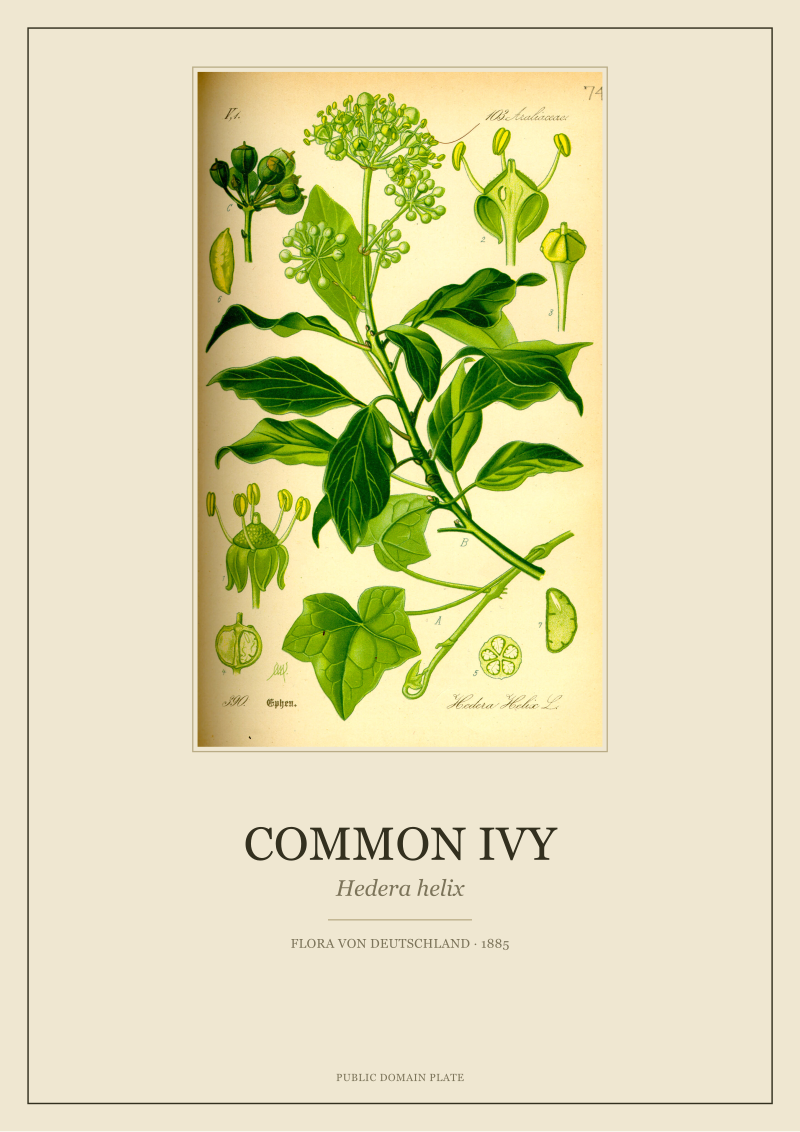
You are buying the convention. You are buying the fact that a labelled Hedera helix habit-plate was drawn to teach a schoolchild in central Europe and now hangs above a coffee table in 2026 without asking permission. The plate is the object.
Question 2: Do You Trust a 140-Year-Old Line More Than a Modern One?
Lithographic line and vector line render differently under lamplight. The difference is measurable, and it is the single technical reason nineteenth-century plates keep selling.
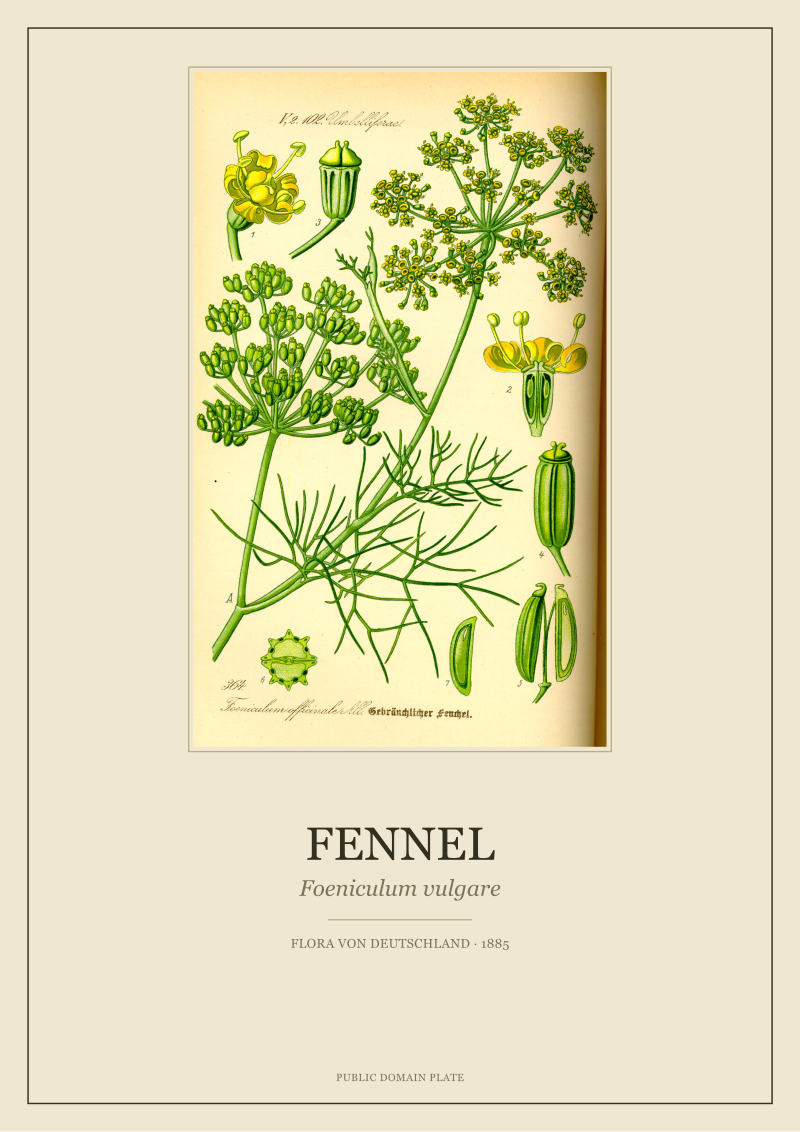
A chromolithographic plate from 1885 was drawn by hand onto limestone by an artist who understood the plant's structure and understood the print medium's tolerances. The Foeniculum vulgare plate carries linework whose thickness varies with the drawing pressure of a specific human hand on a specific stone in a specific week. That variation, invisible in isolation, produces a warmth of line under diffuse light that a mechanically-generated stroke does not reproduce. Modern vector prints run at uniform stroke weight because that is what vector software outputs. Photographs run at zero stroke weight because they have no lines.
The claim is not that old is better. The claim is that old is different, and the difference is legible on the wall.
If Yes: You trust the older line
Then the object you want has three physical properties. Look for these before you look at anything else.
First, printed grain from the original scan should be visible when you stand within one metre of the framed print. If it is not — if the surface reads as impossibly clean — the file has been over-sharpened or vectorised. A restored plate should show the paper it was scanned from.
Second, the labelled organs (roots, sepals, floret dissections) should be legible without a magnifying glass. The Matricaria chamomilla plate carries a floret cross-section in its lower quadrant; if you cannot see the individual disc florets, the scan resolution was insufficient or the compression was too aggressive.
Third, the pigment palette should sit inside the range of stone-lithography inks available in 1885 — muted greens, ochres, iron reds, chalky blues. If a plate has been "restored" into saturated cyan-and-magenta CMYK, someone has re-coloured it and the object is no longer the 1885 object.
If No: You do not trust the older line
Then the antique-plate market is not for you and no editorial argument should push you into it. A living illustrator working today on Winsor & Newton gouache will produce a Centaurea cyanus that is technically accurate, chromatically controlled, and taxonomically current. Botanical Art & Artists' registry lists working illustrators in more than forty countries. Buy from one. The nineteenth century does not have a monopoly on the form.
The failure mode here is buying an old plate because a design magazine said old plates were "back". They have not left; they are simply cyclically visible. If the older line does not do something for your eye specifically, no fashion cycle will make it start doing so.
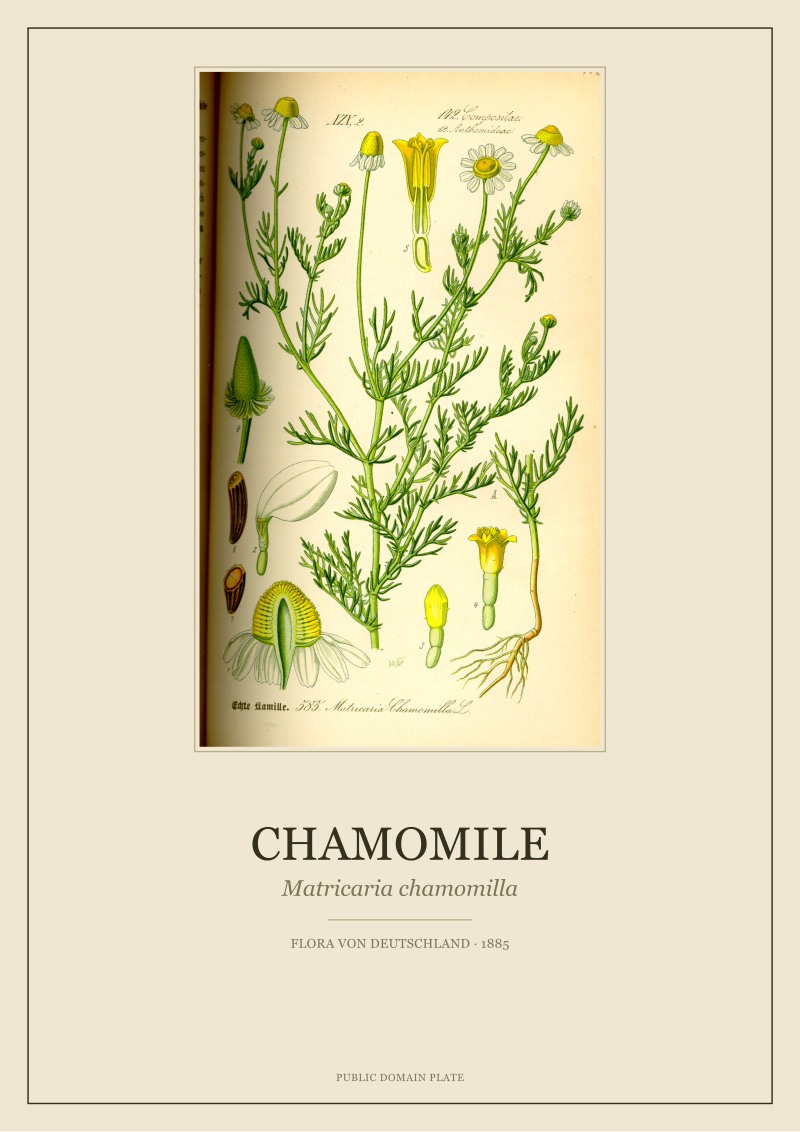 Chamomile
The print from this article · from €29.95
View the print →
Chamomile
The print from this article · from €29.95
View the print →
Question 3: Does Public Domain Matter to You, or Only the Frame?
Copyright law is not usually a decorative concern. In botanical prints, it becomes one. The answer determines who you can buy from and what you are actually paying for.
Thomé's 1885 Flora is in the public domain in every jurisdiction that follows the Berne Convention's life-plus-seventy rule (Thomé died in 1925; his work entered public domain in 1996) and in every jurisdiction with a shorter term. This means the underlying plates — Matricaria chamomilla, Hedera helix, Centaurea cyanus, Foeniculum vulgare among the roughly seven hundred in the work — are free to reproduce, print, and sell. They are also free to be scanned badly and sold expensively.
A modern botanical illustration, by contrast, is under active copyright for the illustrator's lifetime plus seventy years. When you buy a modern print, you are paying (in part) for the illustrator's time and licence. When you buy a plate from Thomé, you are paying only for the scan quality, the restoration labour, the paper, and the printing. The plate itself costs nothing.
If Yes: Public domain matters
Then buy from studios that disclose their source scans and their restoration process. Any studio selling 1885 Thomé plates should be able to tell you which library scan they started from (the Biodiversity Heritage Library holds the most cited digitisations), what colour restoration they performed, and whether the final file was upscaled or held to native resolution. If a studio will not disclose these things, they are either scraping other studios' restorations or hiding a low-resolution source.
At Botanic Walls we publish source scan and restoration steps for every plate in /shop/. This is not marketing; it is the minimum a public-domain buyer is entitled to know.
If No: Only the frame matters
Then the plate market is functionally identical to any other decorative print market. Price sensitivity governs. Aesthetic fit governs. The 1885 date is a fact about the file, not a fact you are paying for.
In this case, buy the print that fits the wall. Buy from whoever has the best paper, the cleanest frame, the least offensive markup. The nineteenth-century pedigree does no work for you if you do not care about it, and pretending otherwise is a slow way to overpay.
If You Answered Everything: The Recommendation Table
Three yes/no questions produce eight combinations. Each routes to a different recommendation. Read your row.
| Q1: Plant or Plate? | Q2: Trust old line? | Q3: Public domain matters? | Recommendation |
|---|---|---|---|
| Plant | Yes | Yes | Buy a modern PD-scan reissue of a Kew or Curtis's Botanical Magazine plate; skip Thomé. |
| Plant | Yes | No | Buy a modern photograph or a licensed contemporary illustration; pedigree is wasted spend. |
| Plant | No | Yes | Buy a public-domain photograph from a museum's open collection; frame simply. |
| Plant | No | No | Buy any competent modern botanical print; optimise price and paper, not provenance. |
| Plate | Yes | Yes | Buy a restored Thomé 1885 plate from a studio that discloses source scan and restoration. |
| Plate | Yes | No | Buy a restored Thomé 1885 plate from any competent seller; disclosure is optional for you. |
| Plate | No | Yes | Commission a contemporary illustrator on public-domain licence terms; niche but possible. |
| Plate | No | No | You have contradicted yourself; re-read Question 2 and answer again. |
The last row is not a joke. Wanting the plate as artifact while distrusting the older line is not a coherent position; it usually indicates the buyer answered Question 1 by aesthetic reflex rather than by intent. Re-answering is cheaper than re-framing.
The endurance of nineteenth-century botanical plates is not mystery and it is not nostalgia. It is a stack of small technical facts — a schoolbook budget that funded seven hundred plates, a stone lithography process that carried a human line, a legal quirk that placed the whole work in public domain by 1996, a modern scanning capacity that arrived in the 2010s — and each fact does small work. Stacked, they explain the wall.
This piece did not cover three things. It did not cover framing choices — glass type, mat depth, hanging height — each of which is its own decision. It did not cover which Thomé plates work best in groupings versus alone, which depends on room and eye and is not resolvable in prose. And it did not cover the growing market in AI-generated botanical prints, because that argument requires its own piece and the honest answer to it is not yet stable.
FAQ
How can I tell if a plate marketed as "1885 Thomé" is actually restored from a nineteenth-century source?
Ask for the source scan reference. Legitimate restorations start from a named digitisation — most often the Biodiversity Heritage Library's or a university herbarium's — and can cite it. If the seller cannot name the scan, or claims the file is "proprietary", the plate is likely a copy of someone else's restoration or an AI reconstruction. Native scan resolution matters more than final print resolution; a 6000-pixel-wide source restored honestly beats a 12000-pixel upscale of a poor scan.
Is chromolithography the same as photolithography or offset printing?
No. Chromolithography, the process that produced Thomé's plates in 1885, used successive limestone plates — one per colour — hand-drawn by lithographers. Each stone was inked and pressed onto paper in sequence. Photolithography uses photographic transfer to metal plates. Modern offset printing uses rubber blankets and CMYK ink separations. The chromolithographic line has a hand-drawn variation the others do not reproduce, which is the single most consistent visual signature of nineteenth-century plates.
Why does a public-domain plate still cost money?
Public domain means the intellectual property is free. It does not mean the physical print is free. You are paying for the source-scan sourcing (some sit behind institutional paywalls), colour and damage restoration (typically five to twenty hours per plate for careful work), archival paper, pigment-stable ink, framing-ready sizing, and the labour of the studio. A five-euro digital file and a one-hundred-and-fifty-euro framed print represent the same underlying plate at very different processing stages.
Are Thomé's plates botanically accurate by modern standards?
Broadly yes for morphology, occasionally not for taxonomy. Thomé worked with the nomenclature current in 1885, some of which has since been revised — species have been split, merged, or reassigned to different genera. The morphological drawings, however, hold up well against modern references; the diagnostic conventions (whole habit, floret dissection, root system) are the same then as now. Treat the Latin name as an 1885 name; if you need the current accepted name, cross-reference against Kew's Plants of the World Online.
Can I use a Thomé plate for commercial purposes — a product label, a book cover, a print I resell?
Yes, in every jurisdiction where the work is in public domain, which is essentially everywhere. You do not need permission and you do not owe royalties to Thomé's estate or to any modern reissuer. What you cannot do is claim copyright on a specific studio's restoration and reproduce that as your own; the restoration labour attracts thin copyright in some jurisdictions. Start from a raw library scan if you plan commercial reuse, not from a studio's restored file.
Which four plates run through this piece and why those?
Matricaria chamomilla, Hedera helix, Centaurea cyanus, and Foeniculum vulgare — chamomile, common ivy, cornflower, and fennel. They are the four Thomé plates our studio has restored and handled most recently, so we can speak about their line, pigment, and paper behaviour from direct handling rather than from theory. Each covers a distinct plant family and a distinct compositional shape, which is useful when the argument turns on convention rather than on any single species.
How is a nineteenth-century plate different from a Victorian botanical illustration you might see in a British collection?
The Victorian tradition — Curtis's Botanical Magazine, Sowerby, Fitch — was heavily English and prioritised chromolithographs of ornamental garden specimens and orchid collections aimed at collectors. Thomé's Flora was German, state-funded, and educational; it aimed to represent the flora of central Europe systematically, from cornflowers to grasses, with the same visual weight regardless of ornamental value. Both are chromolithographic; the editorial intent differs, and the plates read differently on a wall as a result.
Does the paper the plate is printed on affect how it ages on a wall?
Substantially. A Thomé plate printed on 100% cotton archival paper with pigment inks, framed behind UV-filtering glass, will hold its colour for decades under normal indoor light. The same plate on wood-pulp poster paper with dye inks will visibly yellow and shift within a few years. Ask sellers for paper composition (cotton percentage), ink type (pigment vs dye), and glass type (UV filtering vs standard). These three variables account for most long-term difference between an "antique-look" print that ages well and one that does not.
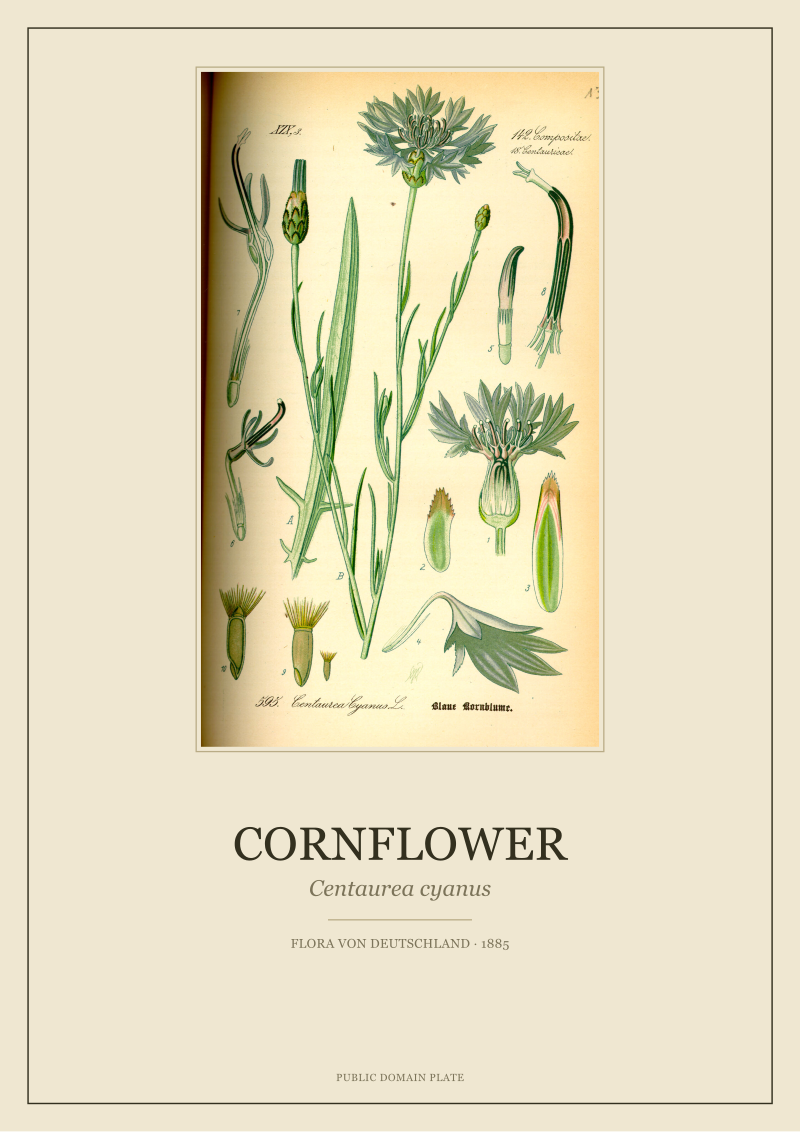 Cornflower
The print from this article · from €29.95
View the print →
Cornflower
The print from this article · from €29.95
View the print →
New plates from the archive and 10% off your first print.
One email now with your code. No noise after.