At 11:14 on a Tuesday in our studio, a reader emailed the same question we get roughly four times a month: how do you actually do botanical printing. The answer is not one method. It is at least three distinct crafts — chromolithography of the kind O.W. Thomé's engravers used for the 1885 Flora von Deutschland, modern pigment printing of restored public-domain plates, and the hands-on contact techniques that press a living Hedera helix leaf into paper. The route depends on three questions. This piece is that flowchart, written in prose, with the branches marked. Answer in order.
Question 1: Are You Trying to Make a Print, or Understand One?
This is the fork most beginners skip, and it determines whether the next six months of your weekends involve a press or a magnifying glass. "Botanical printing" is a phrase that covers two incompatible pursuits. One is production: you want paper to come out the other side with a plant on it. The other is literacy: you want to look at an 1885 chromolithograph of Matricaria chamomilla and know what you are reading — the lithographic key, the hand-colouring layer, the engraver's crosshatch under the wash. Both are legitimate. They require different libraries, different vocabularies, and different Tuesdays.
The reason the fork matters is that the production-first reader who starts with history gets bored by week three, and the understand-first reader who starts with a borrowed press breaks something that cost more than their rent. We have seen both. The question is honest with yourself about which drawer you are packing.
If Yes — You Want to Make a Print
Go operational. You are looking at three practical sub-crafts: contact printing with living plant matter (botanical contact prints, sometimes called eco-prints, where a leaf of Hedera helix or a sprig of Foeniculum vulgare is pressed between dampened paper under weight or heat); relief printing where you carve a plant form into a block; and modern pigment printing of a digital file onto fine art paper. The first two are hands-on and messy. The third is a workflow problem: colour calibration, paper selection, ink longevity. Pick one before you buy anything. Beginners who buy a press and a scanner in the same month tend to use neither.
If No — You Want to Understand a Print
Go archival. Start with the physical object. Thomé's Flora von Deutschland, Österreich und der Schweiz, published across the 1880s with its canonical 1885 plate set, is the entry text for the German tradition, and most of the plates we restore come from it. Learn to see the three layers: the printed key line (the engraver's drawing, usually black), the chromolithographic colour (laid down in registration from multiple stones), and in some editions the hand-corrected highlight. If you can look at the Centaurea cyanus plate and point to where the stone changed, you have passed the first lesson. No press required.
Question 2: Is Your Source a Living Plant, or a Public-Domain Plate?
Having chosen production, the next fork is about source material, and it changes almost everything downstream — the room you work in, the paper you buy, the time of year you can work, and the law. Working from a living plant is a seasonal, chemical, botanical practice. Working from a public-domain plate is a digital-restoration and printing practice. The two share a word and almost nothing else.
The confusion is understandable because the pictures look adjacent on a wall. In the drawer, they are not adjacent. A dried fennel umbel and a 600 MB TIFF of Thomé's fennel plate are not interchangeable inputs. The first fades. The second does not. The first demands a mordant bath. The second demands a profiled monitor.
If Living Plant — Contact Printing Routes
You are now in the botanical-contact tradition. The core move is simple to describe: a leaf — ivy because it tolerates handling well, chamomile because the flower leaves a legible disk, fennel because the umbels print like fine lace — is arranged on dampened watercolour paper, often with a mordant such as iron, then compressed under heat or sustained weight. The plant's own tannins and pigments transfer to the fibre. The output is unrepeatable: each print is a monoprint, since the leaf is spent after one impression. Timing is governed by the plant: Hedera helix leaves hold through autumn, Centaurea cyanus flowers lose colour within hours of picking, Matricaria chamomilla heads dry quickly and are better used fresh. This is a kitchen-adjacent craft. Expect stained hands, and keep a notebook, because the only way to repeat a result is to have recorded the variables that produced it.
If Public-Domain Plate — Restoration and Pigment Routes
You are now in the archival-reproduction tradition, which is what our studio does. The input is a scanned 19th-century chromolithograph — in our case, mostly plates from Thomé's 1885 Flora. The work is in three stages: acquisition (sourcing a scan clean enough to restore, which is harder than it sounds), restoration (removing foxing, correcting the yellowed paper substrate without lying about the pigments, repairing where the plate was folded or torn), and output (printing on a fine art paper that respects the original paper's weight and surface). The copyright position is clear: Thomé died in 1925, and the plates are long out of copyright, meaning they are public domain and can be reproduced. The ethical position is less clear, and we return to it below.
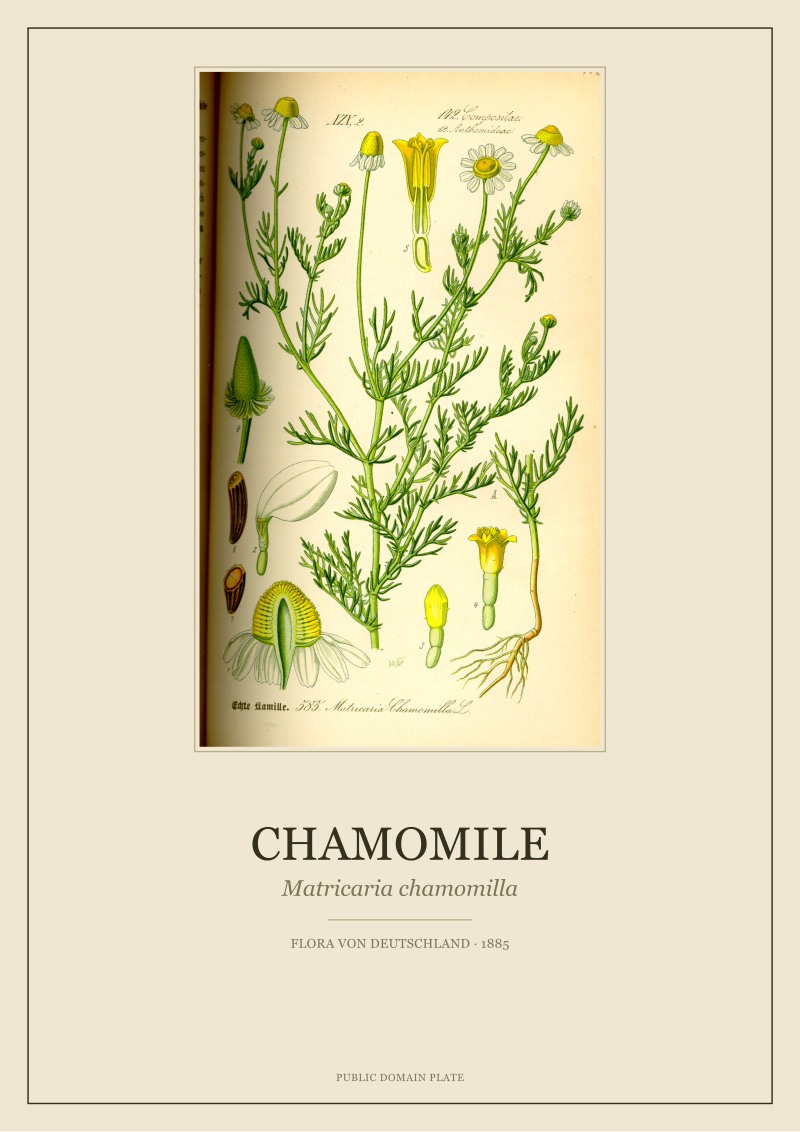 Chamomile
The print from this article · from €29.95
View the print →
Chamomile
The print from this article · from €29.95
View the print →
Question 3: Will the Finished Print Leave the Drawer?
This is the question most studios skip and we think it is the one that decides whether the work is worth doing. "Leaving the drawer" means the print will be seen — framed on a wall, sold to a stranger, hung in a corridor where afternoon sun hits it, posted somewhere public. It raises three issues at once: longevity, framing, and intent.
A print made for your own drawer can tolerate almost anything. The paper can be ordinary. The ink can be fugitive. The margins can be uneven. A print that will leave the drawer must survive light, humidity, handling, and in some cases a buyer's expectation of permanence. If you are honest that the print will stay in the drawer, you can skip the next list of expenses. If you are honest that it will leave, you cannot.
If Yes — The Print Will Leave the Drawer
Everything upgrades. Paper: 100% cotton rag, acid-free, 300gsm or heavier, with a surface appropriate to the method — a hot-press for pigment work on a restored Hedera helix plate, a cold-press or rough for contact prints where the texture is part of the image. Ink: pigment, not dye, with a documented lightfastness rating; the industry baseline is Wilhelm Imaging Research's archival ratings, and anything below 75 years under glass is a problem. Framing: UV-filtering glass or acrylic, acid-free mat, a backing that does not off-gas into the print over a decade. These are not luxuries. They are the minimum conditions under which a botanical print made in 2026 is still recognisable in 2056.
If No — The Print Stays in the Drawer
Relax almost all of the above. Experiment freely. Keep a logbook — the only loss from a drawer print is the loss of what you learned making it, and a logbook recovers that. Use ordinary paper for contact-print tests. Print digital restorations on whatever stock the printer accepts. The drawer is where craft is actually learned, and the mistake many beginners make is treating every print as if it were going on a wall. Most of ours do not. The ones that do are the ones that survived the drawer stage.
If You Answered Everything: The Route Table
Each row is a complete answer sequence through the three questions, followed by the recommendation we would give that reader on a Tuesday morning.
| Q1 (Make or Understand) | Q2 (Living or Plate) | Q3 (Leaves Drawer) | Recommendation |
|---|---|---|---|
| Make | Living | Yes | Invest in cotton rag paper, iron mordant, and a logbook; expect two productive seasons per year. |
| Make | Living | No | Start with ivy and chamomile on cheap watercolour pads; the goal is reps, not keepers. |
| Make | Plate | Yes | Commission a restored public-domain scan, print on 300gsm cotton, frame under UV glass. |
| Make | Plate | No | Download a Thomé scan, restore it in software, print A4 on house paper to study the layers. |
| Understand | Living | Yes | You are a botanist with a wall; buy a restored plate for context and keep collecting live specimens. |
| Understand | Living | No | Pair a field guide with a monocular; the "print" you are making is in your head. |
| Understand | Plate | Yes | Buy one properly restored Thomé plate and sit with it; one deep print beats a wall of thin ones. |
| Understand | Plate | No | Read Blunt and Stearn's botanical illustration history before buying anything at all. |
The table is not meant to flatter any single route. The honest reading is that most people who email us belong in the "Make / Plate / Yes" row, and most people who think they belong in "Make / Living / Yes" are actually in "Make / Living / No" for at least a year. The seasons are long and the learning curve is steeper than Instagram implies. There is a reason the 1885 engravers worked in guild-trained teams.
If none of the rows describes you, the honest answer is that your question is not yet specific enough. Rewrite it, answer the three forks again, and try the table a second time. The exercise sharpens what you actually want. We keep a printed version of this table pinned near the restoration desk because it is useful for us too, when a plate is giving us trouble and we need to remember why we are working on it. Our in-house restorations of plates like these live at /shop/ for readers who have routed themselves into the "Make / Plate / Yes" row and would rather buy one restored once than restore one themselves.
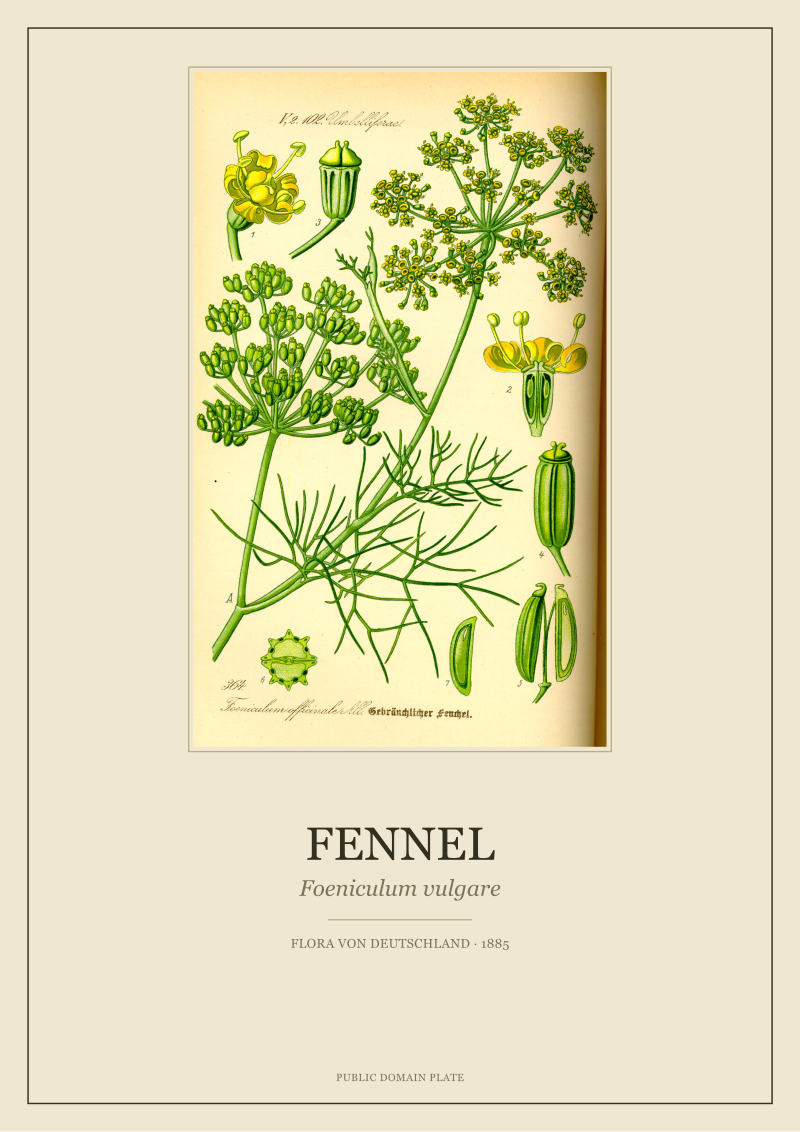 Fennel
The print from this article · from €29.95
View the print →
Fennel
The print from this article · from €29.95
View the print →
Honest Limits
This piece does not cover the chemistry of mordants in any depth — the iron, alum, and tannin baths that govern contact-print colour deserve their own treatment, and we are not qualified to write it in the register a dyer would recognise. It does not cover the business of selling prints, which involves pricing, provenance documentation, and edition control that are a separate argument. And it does not cover the specifics of digital restoration workflow — the software choices, the resolution thresholds, the colour-management chain from scanner to printer — because that is a technical essay rather than a decision tree. Each of those gets its own piece when we are ready to write it honestly.
FAQ
What is the difference between botanical printing and botanical illustration?
Illustration is the original act: drawing a plant with scientific intent, often from a living specimen, with the goal of taxonomic clarity. Printing is the reproduction step that followed. Thomé's 1885 Flora is both — the plates began as illustrations, then were engraved and chromolithographed so a schoolteacher in Dresden could own what previously existed only as a drawing. The distinction matters because when readers ask about "botanical printing" they often mean one and not the other.
Can I legally print and sell copies of Thomé's 1885 plates?
Yes, in most jurisdictions, because the plates are in the public domain. O.W. Thomé died in 1925, and the engravings themselves predate 1900, placing them well beyond any standard copyright term. What you sell is your restoration work and your printing — the labour of cleaning the scan, correcting the paper substrate, and producing the modern object. The underlying plate is free for anyone to use. Local framing or publishing law may still apply to how you describe the work.
How long does a contact print with living plants take?
A single impression can take anywhere from two hours in a hot bundle to five days in a cold press, depending on the plant, the mordant, and the paper. Hedera helix leaves release pigment slowly and reward patience. Chamomile transfers quickly but fades without correct mordanting. The honest answer is that nobody masters the timing without a season of logged failures; our studio's first ivy prints took us a full autumn to get consistent.
Do I need an actual printing press to do this?
No. Contact prints use weight — stacked books work for small formats, a flower press works better, and a bookbinder's nipping press is the step after. Modern pigment reproduction of a restored plate uses an inkjet printer with pigment inks, not a traditional press at all. The lithographic press that produced Thomé's originals is a historical object; almost no one working in botanical printing today uses one, and that is fine.
What paper should a beginner buy?
For contact prints, start with a 200–300gsm cotton watercolour paper in cold-press surface — it absorbs mordant evenly and takes pressure without buckling. For pigment reproduction of restored plates, a 300gsm cotton rag in a smooth hot-press surface is the studio default. Avoid cheap cellulose papers for anything you want to keep: they yellow within a decade and off-gas into the pigment. The paper is more than half of what the eye reads as "quality."
Is it ethical to reproduce 19th-century plates?
The copyright answer is clean. The ethical answer is that you should be honest about what you are selling. A restored Thomé plate is a collaboration across 140 years: the engraver's hand, the lithographer's stones, the modern restorer's software, and the printer's paper. Describing it as "a 1885 original" is a lie. Describing it as "a modern archival print of an 1885 plate, restored by hand" is accurate. The ethics are in the label, not the act.
How do I tell a good restoration from a bad one?
Look at three places. The whites: have they been bleached flat, or do they retain the warm cream of the original paper. The outlines: has the engraver's key line been sharpened artificially, or does it still show the hand that cut it. The colour layers: do they sit in correct registration, or has an aggressive filter smeared them together. A good restoration removes damage without removing evidence that the plate was made in 1885. A bad one makes it look like a 2020 vector file, which is the opposite of the point.
New plates from the archive and 10% off your first print.
One email now with your code. No noise after.