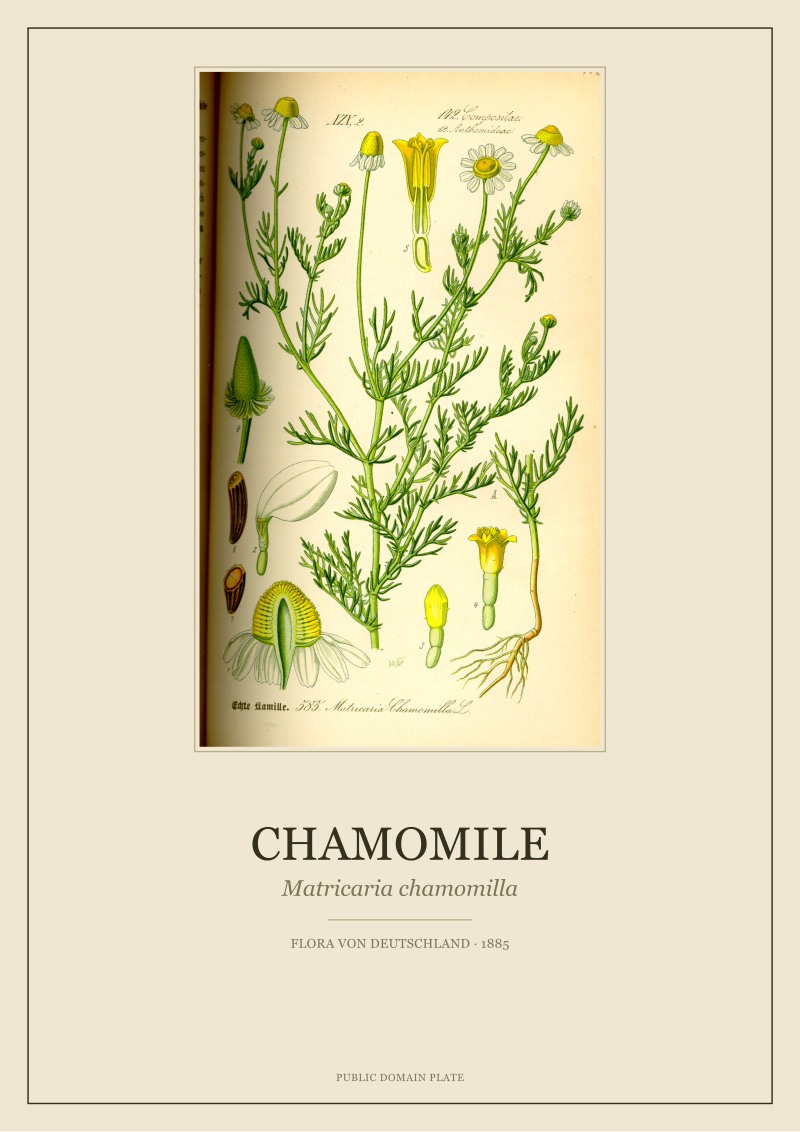
How did the botanical plates on museum walls get made before a camera could do the job in a fraction of a second? In the summer of 1885, in a printing house preparing Otto Wilhelm Thomé's Flora von Deutschland, Österreich und der Schweiz, a chromolithographer laid down stone after stone for a plate of Matricaria chamomilla — one stone per ink, up to a dozen passes before a single sheet was finished. Photography was forty-six years old that year. Cameras existed in every capital. But no camera could show what Thomé's plate showed on one page: the whole plant, its dissected flower, its seed, its habit, drawn from life and verified against Latin description. The reason has a history, and the history has dates.
1530: Hans Weiditz Cuts the First Honest Herbal
The story starts in Strasbourg, in a print shop preparing Otto Brunfels's Herbarum vivae eicones. Brunfels wrote the text. The woodcuts were the work of Hans Weiditz, a young artist trained in Augsburg who had done broadsides and portraits and was, by every account of the book that survives, an unusual hire for a herbal. He drew plants from specimens on his table.
That sentence looks small on a screen. It was a revolution. The herbals that came before Brunfels — the Latin manuscripts copied and re-copied through the medieval centuries — showed plants that had been drawn from other drawings, sometimes for a thousand years running. A plant in a 1480 herbal often traced back, image to image, to a Byzantine copy of a late-Roman copy of a Greek original. The plants no longer looked like plants. They looked like ideograms of plants: symmetrical, generic, botanically useless.
Weiditz worked differently. He drew what was in front of him — leaves half-eaten, stems bent by weight, roots washed but still knotted. He included wilted leaves. He drew asymmetries. Printers of the period found this unsettling; several early buyers of Brunfels complained that the illustrations showed damaged specimens. Weiditz did it on purpose. The whole point was that these were pictures of actual plants a reader could recognise in a field.
The technique was woodcut: a design drawn onto a block of pearwood or boxwood, then carved so the design stood in relief. The block was inked and pressed. Colour, when it appeared, was added by hand — brush over print — in the shop or by the buyer. It was slow. It was also, for the first time in European print, honest.
1737: Linnaeus Gives the Illustrator a Job Description
Two centuries later, in a book called Genera Plantarum, Carl Linnaeus formalised the system that still governs the plates we restore today. Genus and species. Binomial nomenclature. A plant was Foeniculum vulgare, not "fennel of the gardens" or "sweet fennel of Provence". The Latin name was the plant's passport across every language on Earth.
What is easy to miss is what this did to the illustrator's job. Before Linnaeus, a herbal illustration served the reader who wanted to find the plant. After Linnaeus, an illustration also had to serve the botanist who wanted to classify it. Which meant the drawing had to show the specific structures Linnaeus's system used to sort species — the number of stamens, the arrangement of pistils, the shape of the fruit, the section through a flower.
This is why the plates in Thomé — a century and a half after Linnaeus — still show a habit view of the whole plant beside dissected details of a single flower, a cross-section of a seed, a magnified stamen. The convention is Linnaean. The illustrator was told, in effect: draw the plant so a stranger can key it out.
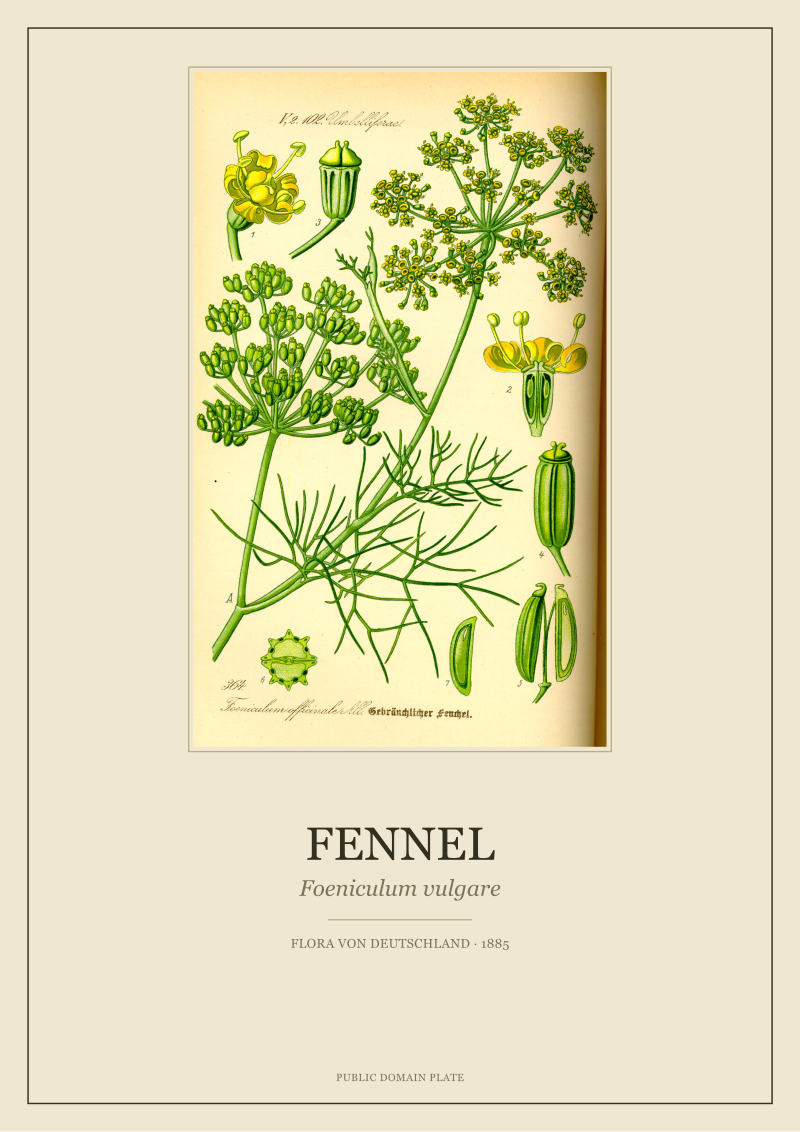
For Foeniculum vulgare, that meant showing the compound umbel, the finely divided leaves, the ridged fruit that the herbalists called a seed. For Matricaria chamomilla, it meant showing the hollow receptacle in section — the diagnostic character that separates true chamomile from its lookalikes. The illustrator became half-artist, half-diagnostician. The work was verified by botanists before publication. Errors were corrected against fresh specimens.
1799: Redouté and the Stipple Engraving That Ended Guesswork
Pierre-Joseph Redouté was a Belgian painter working in Paris when he began experimenting with a printing technique called stipple engraving. He had already been drawing plants for Marie Antoinette's collection at the Petit Trianon. In 1799 he began the plates for Les Liliacées, a project that would eventually run to eight folio volumes.
Stipple engraving replaced the harsh lines of ordinary engraving with a tissue of dots. Thousands of them, cut into the copper plate with a curved tool called a roulette, produced tonal gradations that mimicked the softness of watercolour. Printed in a single dark ink, then completed by hand-colouring, a stipple engraving could render the translucent edge of a petal, the velvet of a leaf's underside, the exact fall of light on a bulb.
Redouté worked from living specimens whenever possible. He kept them alive on his workbench, painted them in the hours before wilting, and returned to gardens for repeated sittings when a flower opened in stages. His pupils — a small workshop, mostly women — did the hand-colouring, matching pigments against the plant itself.
Why does this matter for a piece about illustration before photography? Because Redouté proved that a printed plant portrait could be scientifically exact and aesthetically alive at the same time. Before Les Liliacées, botanical books tended toward one or the other: rigorous but flat, or beautiful but loose. After Redouté, publishers understood that the market rewarded plates that did both. Every folio flora of the nineteenth century — Thomé's included, though at a different price point — inherited the standard Redouté set.
1843: Anna Atkins Prints the First Photographic Book — and Botany Notices
In October 1843, in her house at Halstead Place in Kent, Anna Atkins issued the first part of Photographs of British Algae: Cyanotype Impressions. It was the first book in history to be illustrated with photographs. The plates were cyanotypes — blue-print silhouettes made by laying a specimen directly on paper coated with light-sensitive iron salts and exposing the whole thing to sunlight.
Atkins made her own paper. She wrote her own text in cyanotype, letter by letter. She produced roughly a dozen copies of the finished work between 1843 and 1853 and distributed them privately. The book is now held by the British Library, the Metropolitan Museum, and a handful of other institutions; a complete copy has not passed through the market in living memory.
For our story, the interesting thing is what did not happen next. Photography did not replace botanical illustration. It could not. Atkins's cyanotypes showed the silhouette of an algae specimen — a flat, laid-out ghost of it — with astonishing accuracy. But they showed nothing of colour. Nothing of the third dimension. Nothing of the internal structures Linnaean botany required. A cyanotype of Hedera helix would show you the leaf's outline. It would not show you the way the young leaf is palmately lobed while the flowering shoot's leaf is entire, a difference Thomé's illustrator captured in a single composed plate a generation later.
Photography kept improving through the 1850s and 1860s. Wet-plate collodion, then dry plates, then the first practical colour processes at the end of the century. Botanists watched carefully. They kept commissioning drawings. The reason was straightforward: a good plate is a synthesis of many specimens, many seasons, and many dissections. A photograph is a moment.
1885: Thomé's Flora von Deutschland and the High Watermark of Chromolithography
By the time Otto Wilhelm Thomé assembled the plates for Flora von Deutschland, Österreich und der Schweiz in 1885, the printing trade had a new tool that was, in its way, more revolutionary than photography: chromolithography.
Lithography had been invented in Bavaria in 1796 by Alois Senefelder. It worked on a simple principle — grease repels water — and used a flat stone of limestone from Solnhofen, a quarry outside Munich whose fine-grained rock is still the reference material for the technique. An artist drew on the stone with a greasy crayon. The stone was wetted; ink adhered only to the greased drawing; a sheet of paper pressed against the stone took the image.
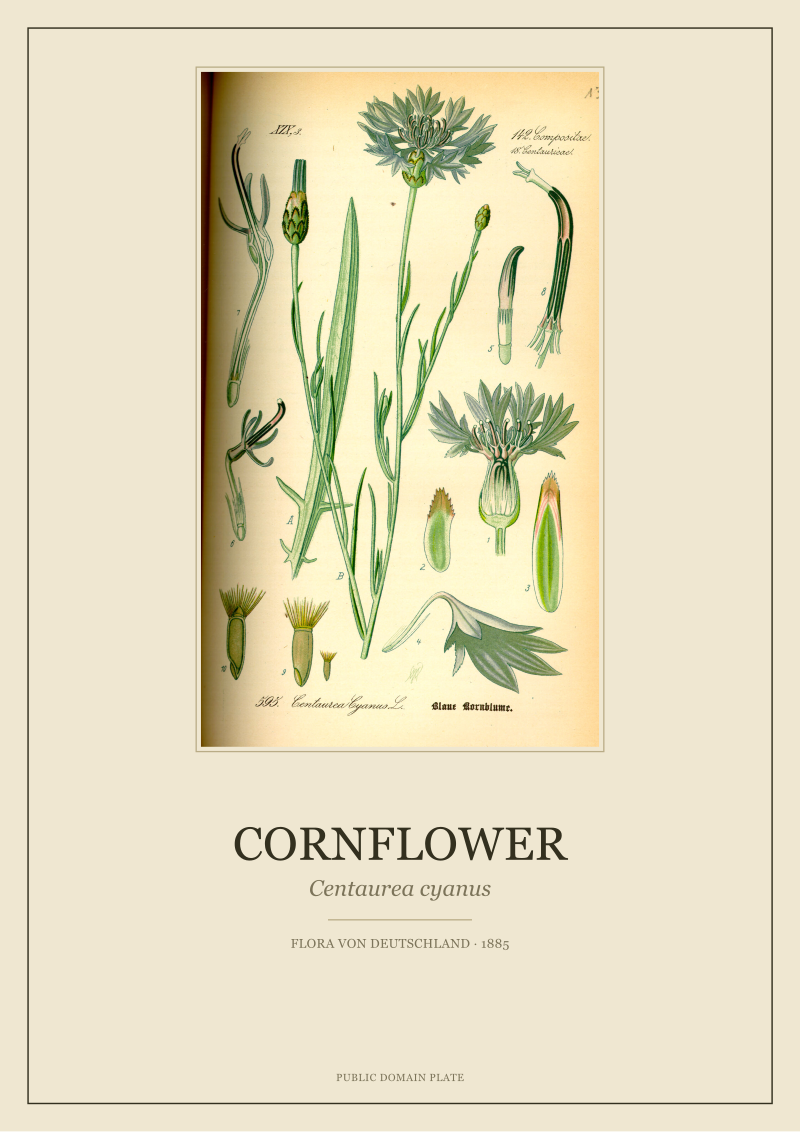
Chromolithography added colour by using one stone per ink. A Thomé plate — a plate of Centaurea cyanus, say, with its cornflower-blue ray florets and grey-green foliage and darker calyx bracts — required a separate stone for each colour, sometimes eight, sometimes more than a dozen. Every stone had to register precisely against every other stone. A misalignment of half a millimetre and the blue slid off the petal.
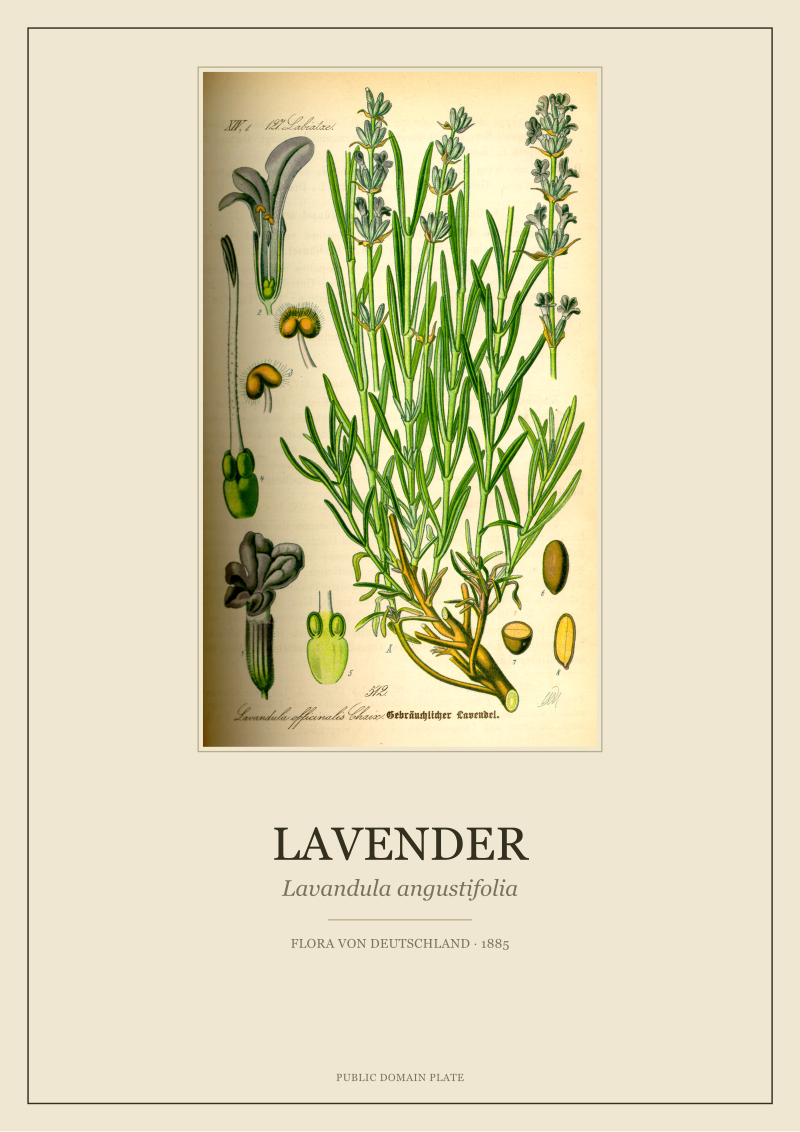
Thomé's studio worked with lithographers in Gera, Germany. The illustrators drew from living specimens — herbarium sheets for reference, but living plants where the season allowed. The plates were composed in the Linnaean style, a century and a half after Genera Plantarum: a habit view of the whole plant, one or more dissected flowers, a seed, sometimes a cross-section. The Matricaria chamomilla plate shows the hollow receptacle. The Foeniculum vulgare plate shows the umbel and the ridged fruit. The Hedera helix plate shows both leaf forms. The Centaurea cyanus plate shows the composite flower head opened and its bracts labelled.
These are the plates our studio restores. When we scan them at high resolution and clean the foxing and re-register the colour, we are working with the last great flowering of a technique that photography could not, then, do. The camera had existed for forty-six years. It would be another fifty before a colour reproduction on a printed page rivalled a good chromolithograph. The 1885 plate held its ground because it did work no other medium could do.
 Cornflower
The print from this article · from €29.95
View the print →
Cornflower
The print from this article · from €29.95
View the print →
What It All Means: Why Hand-Drawn Botany Outlived the Camera
The tempting story is that photography arrived and the illustrators lost their jobs. That story is wrong by about a hundred years. Photography arrived in 1839. Botanical illustration for scientific publication continued, and in some quarters flourished, into the 1960s. A working understanding of why explains what we sell.
A photograph records one instant of one specimen from one angle. A plate synthesises. The illustrator of Thomé's Centaurea cyanus did not draw a single cornflower on a Tuesday afternoon. She drew what a cornflower is — a composite of many specimens, many stages, many dissections, verified against the description in the Latin key. The plate carries information that no single photograph could hold, because the plate is not a photograph of a plant; it is an argument about a plant, made in ink on stone.
There is a second reason the plates outlived the camera. They are beautiful in a way that continues to work on a wall in a room. The Weiditz woodcut in 1530, the Redouté stipple in 1799, the Thomé chromolithograph in 1885 — each one solved the aesthetic problem of showing a plant with dignity, on paper, at a size a person can live with. A good scientific photograph is admirable. A good botanical plate is companionable. Our whole studio is built on the difference.
We restore Thomé's 1885 plates because they sit at the exact hinge point of this story. They are Linnaean in structure, Redoutéan in composition, chromolithographic in execution, and quietly stubborn in the face of a camera that could not yet do their job. The plates in our /shop/ — Matricaria chamomilla, Hedera helix, Centaurea cyanus, Foeniculum vulgare — are those plates, digitally restored and printed for a wall in a room. They were drawn by hand from a plant on a table by a person who knew the Latin.
FAQ
Why did botanical illustration continue after photography was invented in 1839?
Because a photograph shows one specimen at one moment from one angle, and a botanical plate shows a synthesis: whole plant, dissected flower, seed, cross-section, all composed on a single sheet. Nineteenth-century photography also could not render colour. A cyanotype of a leaf gave you its silhouette. A Thomé plate of the same species gave you the diagnostic features a botanist needed to key it out, drawn from many specimens and verified against Latin description.
What was the earliest herbal to use illustrations drawn from real plants?
Otto Brunfels's Herbarum vivae eicones, published in Strasbourg beginning in 1530, is the usual answer. The woodcuts were by Hans Weiditz, who drew from specimens on his table rather than copying from older manuscripts. He included wilted leaves and broken stems, which some early buyers found unsettling. The book marked the end of a medieval tradition in which plant images were copied image-to-image across centuries without a plant being consulted.
What is chromolithography, and why did it matter for botanical prints?
Chromolithography is colour printing from lithographic stones — one stone per ink, sometimes a dozen or more per plate, each registered precisely against the others. It was developed in the mid-nineteenth century from Alois Senefelder's 1796 invention of black-and-white lithography. For botanical publishing it mattered because it could reproduce hand-painted colour in editions of thousands, at a fidelity that colour photography would not match until well into the twentieth century.
Who was Anna Atkins and what did she publish?
Anna Atkins was an English botanist and photographer who in October 1843 issued the first part of Photographs of British Algae: Cyanotype Impressions, the first book in history illustrated with photographs. The plates were cyanotypes — blue silhouettes made by contact-printing specimens onto light-sensitive paper. She produced roughly a dozen copies over ten years, made the paper herself, and lettered the text in cyanotype. Complete copies are now held by major institutions.
Why does a plate in Thomé's Flora show a dissected flower next to the whole plant?
Because the composition follows the Linnaean convention established in the eighteenth century: a plate should show both the habit of the plant — how it looks in life — and the diagnostic structures a botanist uses to classify it. Number and arrangement of stamens, shape of fruit, section through a flower or receptacle. For Matricaria chamomilla the crucial detail is the hollow receptacle, shown in cross-section, which separates true chamomile from lookalike species.
Are the plates we restore public domain?
Yes. Otto Wilhelm Thomé's Flora von Deutschland, Österreich und der Schweiz was first published in 1885 and its plates are long out of copyright everywhere they were originally issued. What our studio produces is a restoration of the scanned plate — foxing removed, colour re-registered, paper texture recovered — printed on archival stock. The underlying botanical illustration is public domain; the restoration and print are the studio's craft.
Did all nineteenth-century botanical artists draw from living plants?
The best of them did, at least for the primary composition, and consulted herbarium sheets and preserved material for details out of season. Pierre-Joseph Redouté kept flowers alive on his workbench and returned to the same specimens over days as they opened. Thomé's studio combined fresh material where the calendar allowed with pressed specimens for winter work. Drawing purely from dried herbarium sheets was possible but tended to flatten the plate, which is exactly the fault Weiditz had corrected three centuries earlier.
 Chamomile
The print from this article · from €29.95
View the print →
Chamomile
The print from this article · from €29.95
View the print →
New plates from the archive and 10% off your first print.
One email now with your code. No noise after.