Most botanical prints on fabric fail at the first wash, and the reason is almost always the file — not the printer, not the ink, not the cotton. We restore 19th-century chromolithographs for a living (Matricaria chamomilla, Hedera helix, Centaurea cyanus, Foeniculum vulgare, all drawn by O.W. Thomé for Flora von Deutschland, Österreich und der Schweiz in 1885), and every month a reader writes asking whether they can put one of our plates on a tea towel, a cushion cover, a linen panel. This piece is for them. It is a flowchart written in prose. Three questions decide whether what you print survives contact with soap, sunlight, and time; a short matrix at the end tells you what to do with your answers.
Question 1: Is Your Source File a Clean, High-Resolution Public-Domain Scan?
This is the first fork and it decides more than the next two combined. A botanical print is only ever as good as the file that goes into the printer. If the file is a 72 dpi JPEG pulled off a Pinterest board, the fabric cannot save it — no cotton weave is fine enough to compensate for compression artefacts that were baked in at the source. Fabric does not forgive the way matte paper forgives; it amplifies. Every scanned foxing mark, every colour cast left by yellowed 1920s varnish, every soft edge from a cheap flatbed will show up at double the apparent weight once the ink sits on fibres instead of coated stock.
The honest baseline for a Thomé plate is this: 300 dpi at the final print size minimum, 600 dpi preferred, scanned (or re-scanned) from a copy in public domain, and then cleaned. Cleaned is the operative word. The plates printed in 1885 were pulled on stone with pigments that have drifted for 140 years. Raw scans from the Biodiversity Heritage Library or botanicus.org are honest archive documents — they are not print-ready files. The paper around Thomé's Hedera helix plate, for instance, holds a warm ivory tint that reads as a shadow on white linen; untouched, the ivy leaves float on a grey rectangle. Restoration either keys the background to true paper white or, better, cuts the figure out and places it on transparency.
If Yes
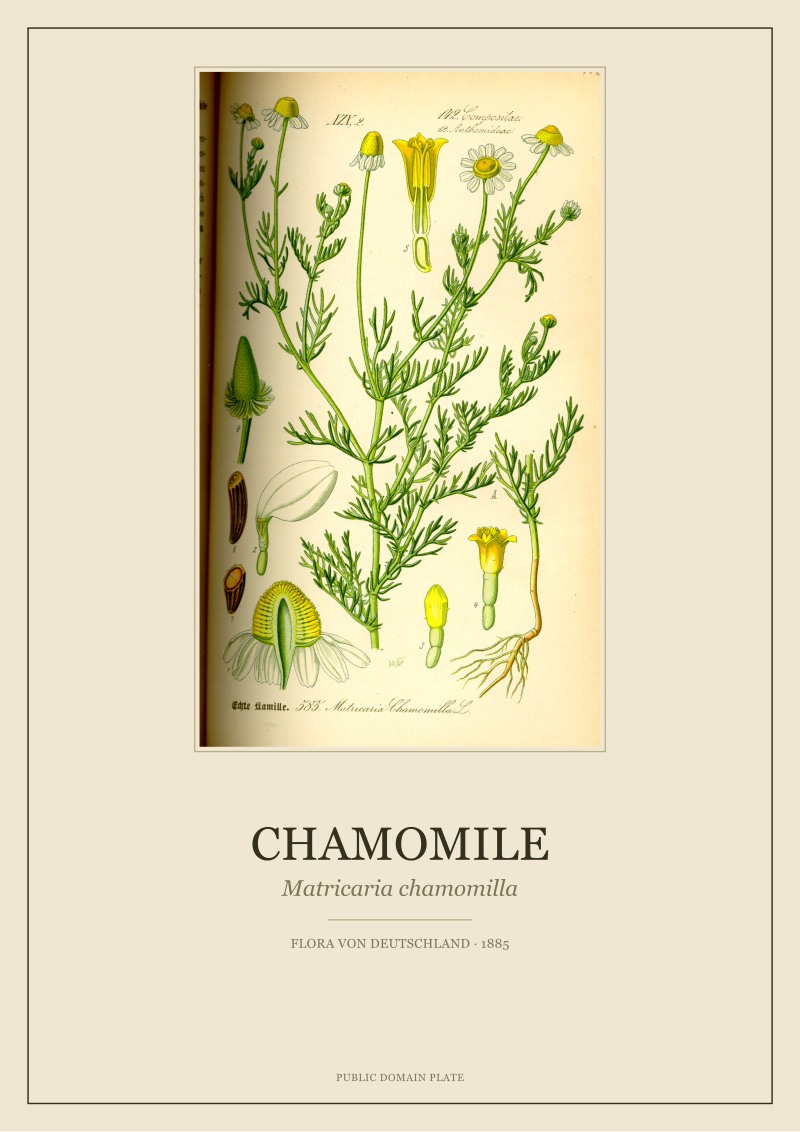
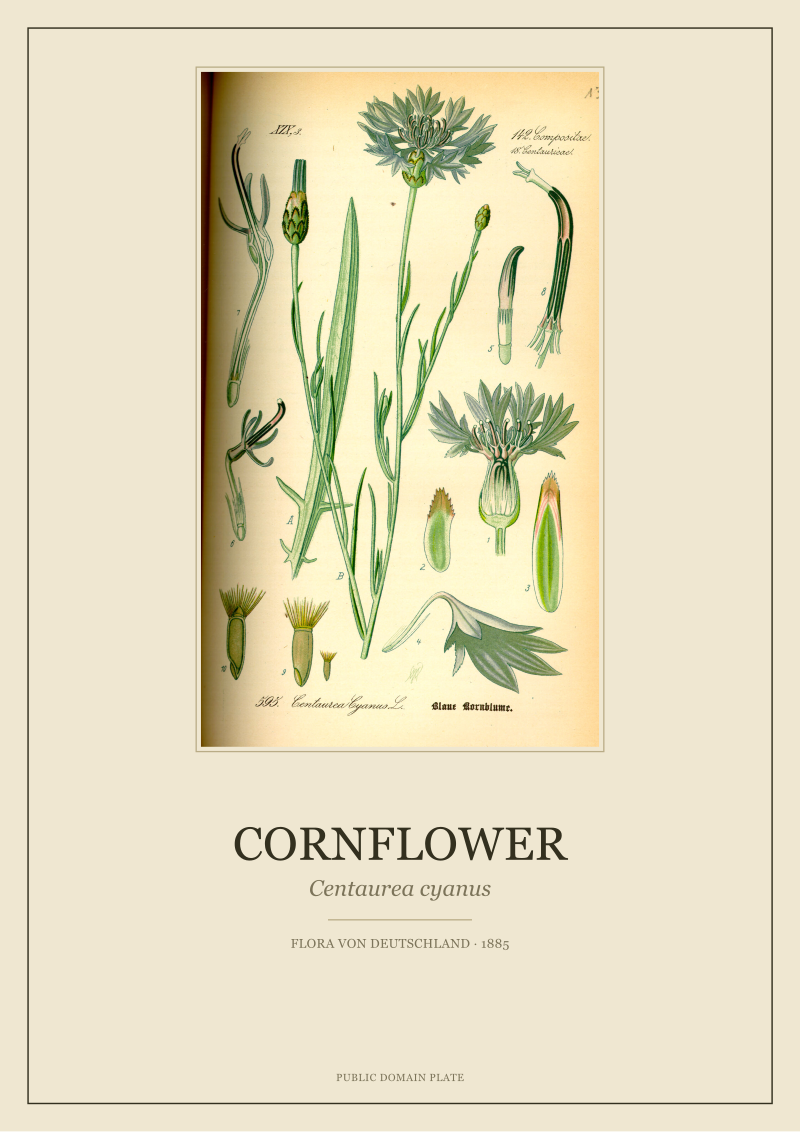
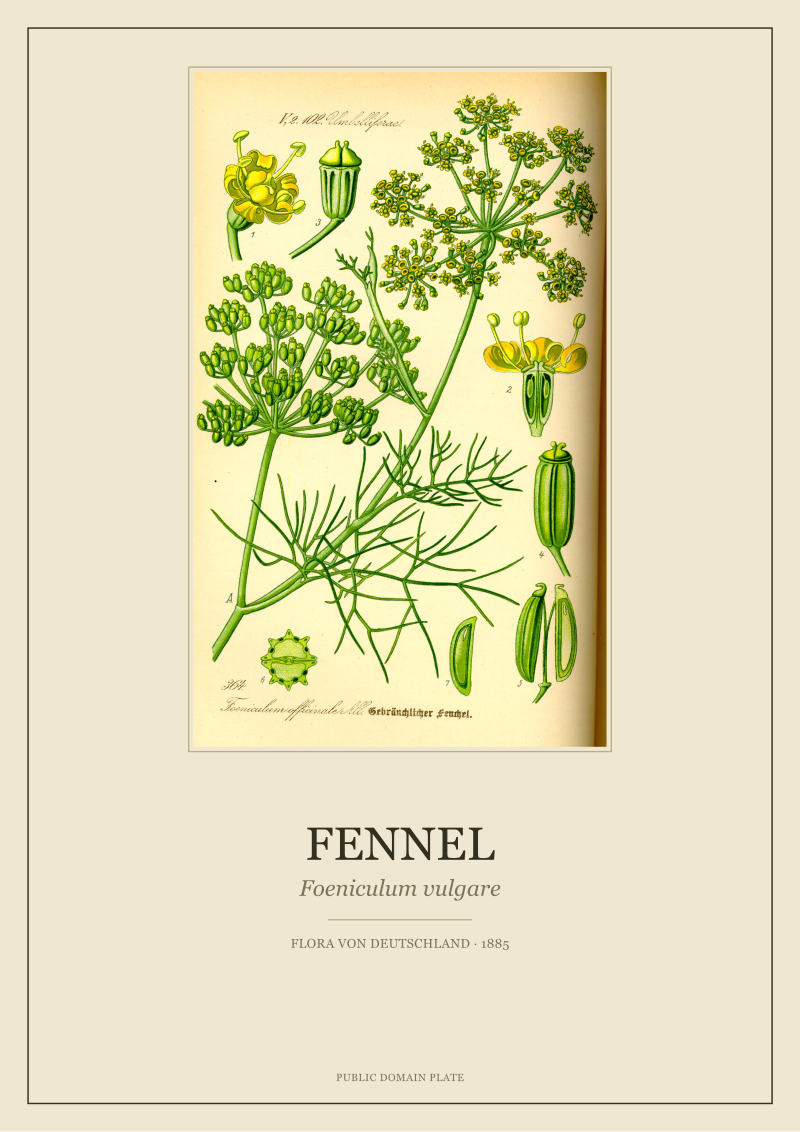
If your file is a cleaned, 300–600 dpi scan with transparent background and documented public-domain provenance, you can proceed. You have a chance. Hold the file open at 100% on screen and look at the hairline strokes — the stamen fibres of the chamomile, the ray-florets of the cornflower, the pinnate detail of the fennel umbels. If those lines are still crisp with no step-stair pixelation, print will hold them.
If No
If your file is scraped from a search result, screenshotted, or re-saved as JPEG more than twice, stop. There is nothing a printer can do with it that will not look amateur on fabric. Either locate a proper scan from BHL or similar archives and clean it yourself (plan on four to eight hours per plate, honestly), or buy a restored file from a studio that has done the work. Our own restored plates are at /shop/ and ship as print-ready files; there are other serious studios too. What is not an option is pretending a bad file will be rescued by good fabric.
Question 2: Is the Fabric Natural Fibre or a Synthetic Blend?
Fabric chemistry is the second fork, and it is the one most tutorials gloss over because the honest answer forecloses whole categories of project. There are two main consumer-grade routes to put ink on cloth at home or through a small-run service: pigment-based direct-to-garment (DTG) printing, and dye-sublimation. These two technologies print on almost opposite materials. Choose wrong and the plate will either bleed, fade, or crack off in flakes within three washes.
Dye-sublimation uses heat to convert solid dye into gas, which bonds molecularly with polyester. On 100% polyester, sub prints are extraordinary — fine lines hold, colour is saturated, wash-fastness is near-permanent because the dye is now part of the polymer. On cotton, linen, or any natural fibre, sublimation does nothing. The dye has no polyester to bond with and simply sits on the surface until the first wash takes it off. If you want a Centaurea cyanus plate on a cushion cover and the cover is poly or a poly-dominant blend (above roughly 65% synthetic), sublimation is the right call.
DTG uses water-based pigment inks pushed onto the fibre and set with a heat press after a pre-treatment coating. On 100% cotton or linen, properly pre-treated and cured, DTG delivers acceptable detail and reasonable wash life — twenty to forty washes with care. On synthetics, DTG inks will not cure correctly; the garment will feel plasticky and the print will crack. If the fabric is a natural-fibre tea towel, a linen panel, or a cotton cushion, DTG is the answer. Reactive-dye printing (used by larger run-based services like Spoonflower's "petal signature cotton" line) is the professional-grade variant and gives even better longevity on cottons, at the price of higher minimums.
If Yes
If your fabric is 100% natural fibre (cotton, linen, hemp, cotton canvas) or 100% polyester, you have a clean technology match. Natural fibre routes through DTG or reactive printing. 100% polyester routes through sublimation. Match the technology to the substrate and the first barrier to failure disappears.
If No
If your fabric is a blend — 50/50 poly-cotton, triblend tees, "poly-linen look-alikes" — accept that you are in compromise territory. Sublimation on a 65% polyester blend will print, but the result will be lower saturation and the cotton portion will fade first, producing a vintage-wash look that may be fine for a graphic tee and absolutely wrong for a botanical plate. If you want our Foeniculum vulgare plate to look like a Foeniculum vulgare plate and not a bleach ghost, pick a single-fibre substrate.
 Chamomile
The print from this article · from €29.95
View the print →
Chamomile
The print from this article · from €29.95
View the print →
Question 3: Will the Finished Piece Be Washed, or Only Looked At?
The third fork is about use. A botanical print on fabric that lives on a wall and never meets water is a different object from one that lives in a kitchen and meets detergent twice a week. The printing decisions, the ink choices, and even which plates to use change based on this answer.
Decorative-only fabric — a stretched linen panel, a framed textile piece, a wall hanging that will be gently dusted and nothing more — can tolerate almost any technology. Pigment prints, inkjet-on-pre-treated-cotton, even archival giclée onto cotton canvas all behave well when the only enemy is time and UV. For these pieces, the correct variable to optimise is lightfastness. Keep the piece out of direct south-facing sun, choose pigment inks over dye inks where possible (pigment inks are the slower-fading option), and accept that even museum-grade display shortens the life of any coloured ink.
Washed fabric — tea towels, napkins, aprons, pillowcases, duvet covers — is a stricter problem. Wash cycles abrade the fibre surface where pigment inks sit; detergents (especially those containing optical brighteners or enzymes) attack colour over time; heat drying is worse than air drying by roughly a factor of two in print lifespan. The honest range for a well-made DTG print on cotton washed in cold water with mild detergent and air-dried is twenty to forty washes before visible degradation begins. Reactive-dye printing on cotton can push past a hundred. Sublimation on polyester is effectively permanent — the limit becomes the garment, not the print.
If Yes
If the piece will be washed, specify reactive-dye printing on cotton if you can afford the minimums, or sublimation on polyester if your plate reads well on synthetic. Treat DTG as the budget option — fine, but temporary. Set expectations: a chamomile tea towel printed via home DTG is a two-year object, not an heirloom.
If No
If the piece will only be looked at, you have the widest latitude. Pigment inkjet on primed cotton or linen gives gallery-grade results. This is the branch where the plates themselves can shine: the Matricaria chamomilla plate's pale yellow ray-florets, which fade first in any washed application, hold their value for decades behind glass or stretched on a frame. Use the washed/not-washed answer to decide which plates you commit to which object.
If You Answered Everything: The Decision Matrix
| Q1: Clean file? | Q2: Natural fibre? | Q3: Washed? | Recommendation |
|---|---|---|---|
| Yes | Yes (natural) | Yes | Reactive-dye print on 100% cotton; cold wash, air dry. |
| Yes | Yes (natural) | No | Pigment inkjet on primed linen or cotton canvas; frame or stretch. |
| Yes | No (polyester) | Yes | Dye-sublimation on 100% polyester; near-permanent, saturated. |
| Yes | No (polyester) | No | Sublimation works, but pigment-on-cotton gives better botanical feel. |
| Yes | Blend | Either | Pick a single-fibre substrate first, then re-answer Q3. |
| No | — | — | Stop. Restore or source a proper file before touching fabric. |
Six rows, not eight, because two branches collapse the moment the file is wrong — there is no fabric decision to make if the source is unusable. The matrix is less a scorecard than a filter: it tells you where the chain breaks first and keeps you from paying a printer to confirm a problem you could have caught in Preview.
One footnote worth adding: these recommendations assume you want the plate to look like a botanical plate — meaning fine linework held, muted period palette preserved, the plate's register of a scientific document kept intact. If you want a stylised, washed-out, "farmhouse chic" rendering, the rules loosen because the aesthetic forgives degradation. We cannot speak to that intent; our bias is toward prints that honour what Thomé actually drew.
This piece did not cover three adjacent problems and we should name them. It does not cover screen printing of botanicals, which is a different craft with its own ink-and-mesh constraints that we are not expert enough to teach. It does not cover eco-printing or hapa-zome — the folk practice of pounding real plant matter into fabric — because that is a plant-contact craft, not a plate-reproduction one, and the two deserve not to be confused. And it does not cover copyright for 20th-century botanical art; we work almost exclusively in material from the 1800s where public domain is clean, and later illustrators (Blossfeld, Rössler, mid-century field-guide artists) raise questions a one-section footnote cannot answer honestly.
 Cornflower
The print from this article · from €29.95
View the print →
Cornflower
The print from this article · from €29.95
View the print →
FAQ
Can I print a public-domain botanical plate on fabric and sell the finished item commercially?
Yes, if the plate itself is in the public domain in your jurisdiction and the printed object is a new creative work (a cushion, a tea towel, a scarf). What you cannot sell is the raw high-resolution file as if the restoration were your own labour — if you bought or downloaded a restored file, the studio's terms usually permit printed-object resale but reserve the file. Read the licence. For the Thomé plates we restore, the 1885 originals are public domain worldwide; our restoration work is separately licensed.
Why does the first wash ruin so many home-printed botanical fabrics?
Three overlapping reasons. The ink is often dye-based rather than pigment-based and bonds weakly to the fibre; the pre-treatment step is skipped or under-applied; and the cure temperature or time is below spec, so the print never fully sets. Fabric also moves — a wall print lives in stasis, a tea towel is twisted, wrung, abraded. Any of these failures alone is survivable; stacked, they take the plate off in a single wash cycle.
Is 300 dpi really enough, or should I always aim higher?
For prints up to roughly A3 on fabric, 300 dpi at final size is honest working minimum. For anything larger — a linen panel at 70×100 cm, a duvet cover — plan on 600 dpi at the file's original scale, and ideally source the plate at a resolution that lets you upscale without interpolation. Fabric reveals pixel structure faster than paper does because the fibre weave adds its own low-frequency texture that beats against the pixel grid.
Which of the four Thomé plates named here holds up best on washed cotton?
Hedera helix, by a comfortable margin. The ivy plate is dominated by deep greens and strong leaf outlines, which survive the inevitable 10–15% colour shift of repeated washing without reading as damaged. The chamomile and cornflower plates rely on pale yellow and desaturated blue respectively, and both show wash fatigue first. The fennel plate sits in the middle — its umbels have enough linework to tolerate colour drift, but the pale greens age visibly.
Can I print directly onto antique linen or vintage fabric to make it feel period-appropriate?
Technically yes, practically no. Vintage linens are often weakened at the fibre level by decades of light and detergent exposure; the heat press stage of DTG or sublimation can crack the weave. More importantly, pre-treatment chemicals interact unpredictably with aged, unknown finishes. If you want a period feel, print on new natural-fibre fabric and age the finished piece gently (tea-tint, sun-expose for days not months) rather than running antique material through modern print tech.
Why does the studio recommend reactive-dye printing over DTG when both work on cotton?
Reactive-dye printing bonds the dye to the cellulose molecule itself — the colour becomes chemically part of the fibre, not a layer sitting on top of it. DTG lays pigment on the fibre surface and holds it with binder. Both look fine on day one. By wash twenty, the reactive print is still almost intact; the DTG print has lost roughly a quarter of its colour density and begun to show fibre texture through the image. For a plate meant to live on a tea towel for a decade, that gap matters.
What about printing botanicals on silk?
Silk is a protein fibre, which rules out standard sublimation (needs polyester) and makes standard DTG tricky. The right route is acid-dye printing, which is a professional process not widely available at hobbyist scale. Done well, botanical plates on silk are exceptional — the way silk takes light brings out the chromolithograph's layered pigments. Done badly, silk mottles. If you have never printed on silk before, send the file to a specialist print house; this is not the fabric to learn on.
Is there a way to test a file before committing to a full fabric run?
Yes, and we recommend it unconditionally. Have the printer do a 15×15 cm swatch on the exact fabric you intend to use, in the exact ink and process, and wash it five times under the conditions the finished object will face. A swatch test costs a few euros and five days; a failed run costs the full fabric, the full print, and the time to redo it. We swatch every plate before we approve a licensing partner for cushions or textiles, and the swatch has saved us from embarrassment more than once.
New plates from the archive and 10% off your first print.
One email now with your code. No noise after.