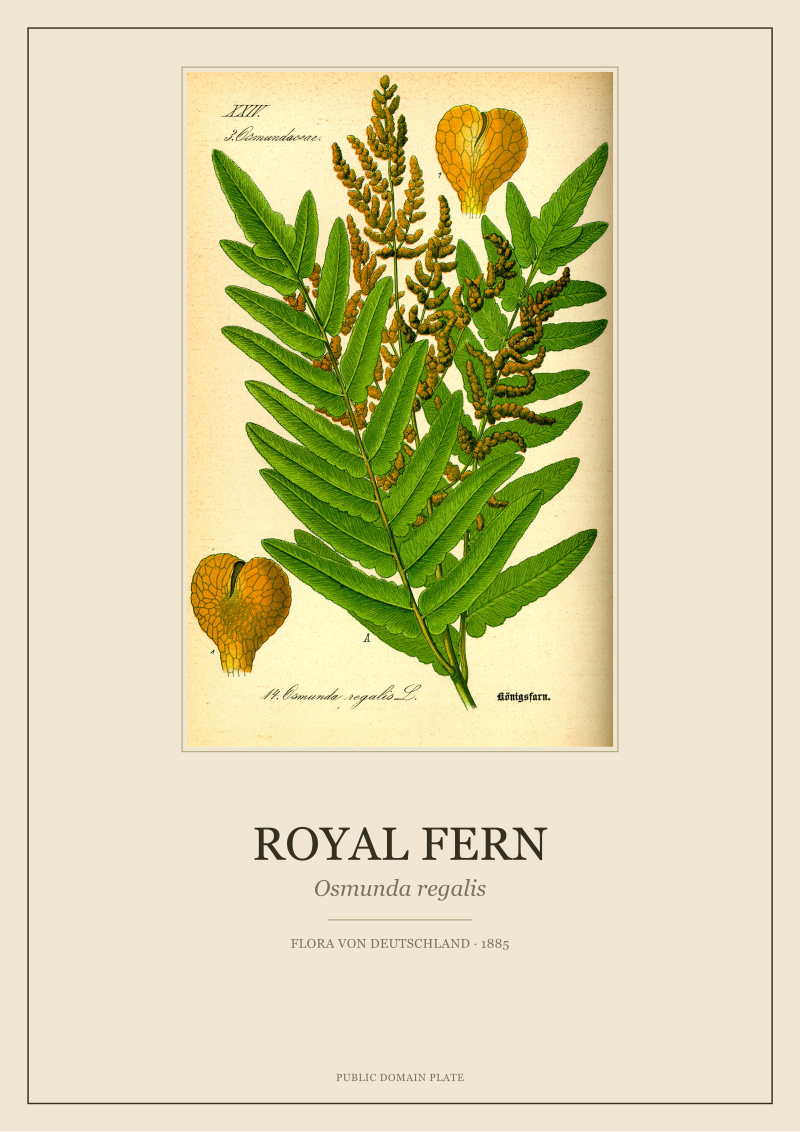
The plate is dated 1885. The species is Osmunda regalis. The illustrator is O.W. Thomé, and the work is Flora von Deutschland, Österreich und der Schweiz. Four facts, one card in the studio drawer. If you searched "royal fern botanical print" this morning, most of what you would find recommends the wrong plate for the wrong reason. Hear us out. The consensus favors whichever royal fern image ranks first on a print-on-demand marketplace, cropped to a square, filtered for a phone screen. Thomé did not draw it for a phone screen. He drew it to be read, in the order a botanist reads a specimen.
What the Numbers Actually Say
Four data points on the studio card, in the order we usually write them. Year: 1885. Binomial: *Osmunda regalis*. Illustrator: O.W. Thomé. Work: *Flora von Deutschland, Österreich und der Schweiz*. Each of those is a lever the plate uses. Move any one of them and the design stops working.
Start with 1885. This is the mature phase of German scientific chromolithography — a technique that had been refined for roughly three decades and would begin its decline within twenty years. The plate belongs to a very narrow window in which colour printing was accurate enough to teach from and not yet cheap enough to be careless. That window closed. The prints that came before were duller; the prints that came after were faster and looser. 1885 is the peak of a curve that no longer exists.
Now the binomial. *Osmunda regalis* is not a decorative label. It is a locator. It tells the reader which family (Osmundaceae), which order (Osmundales), and which lineage — one whose fossil record predates the appearance of flowering plants. Thomé did not need to include the phrase "older than flowers" anywhere on the plate. Placing the fern under its Latin name in a flora of Central Europe was already saying it, in the register a nineteenth-century reader understood.
Then the illustrator. O.W. Thomé — Otto Wilhelm — was a schoolteacher and botanist producing an atlas for classroom use. That word, classroom, matters. He was not drawing to sell a print. He was drawing so a fifteen-year-old could identify the plant in a wet German meadow the following spring. Every line has to survive being copied by a student and cross-referenced against a real specimen. It is illustration as verifiable claim.
Finally the work: a flora of three German-speaking countries. Not a global botanical atlas, not a curated selection, not a beautiful-things album. A regional inventory. That framing is the reason the royal fern gets a full plate rather than a corner sketch — in Central Europe it is a keystone wetland species, and the flora is committed to giving keystones their due. The commercial print market has spent a hundred and forty years pretending Thomé chose Osmunda regalis for its silhouette. He chose it because it belonged in the book.
What Nobody Mentions
The reproductions we see everywhere skip the parts that carry the argument. Look at how the mainstream marketplace crops a Thomé plate. Almost always: the largest frond, tilted, filtered for warmth, the label at the base cropped off or replaced by a boutique wordmark. This is not restoration. It is a costume.
What gets removed, item by item. The scientific label — the printed Latin binomial and the plate number — is nearly always gone. Without it the plate loses its origin address and becomes a generic fern. The scale relationship between fertile and sterile fronds — Thomé consistently drew both, because royal fern is dimorphic and that distinction is the plant — is flattened or cropped. The subtle indication of habit (how the plant sits in space, the crown angle, the base) gets tightened into a bouquet posture. And the paper texture, which in the 1885 originals reads as slightly warm cream rather than modern white, gets pushed to either bleached-white or sepia, both of which are wrong.
The frond angle deserves a paragraph of its own. Thomé's fronds do not stand vertically like flags. They lean at an angle characteristic of the plant's natural gesture — arching, with the fertile pinnae reaching up above the sterile blades. That angle is a diagnostic feature, not a decorative choice. A royal fern that stands straight up in a print has been redrawn by someone who has never seen one growing. Almost every print-on-demand version we have audited has been redrawn or straightened. You can spot it in ten seconds if you know what you are looking at.
The composition also carries a hierarchy. The main figure is centered but not symmetrical. The supporting details — enlarged sporangia, a pinna cross-section, a labelled root fragment — occupy the plate margins in the order a botanist would want them. Left, then right, then base. It is a reading order. When a marketplace version crops those margins away, it removes the entire pedagogical logic of the plate and leaves only the pretty part in the middle. It is like selling a page from an anatomy atlas with the labels erased.
And nobody mentions the label typography. Thomé's plates use a specific German scientific typeface for the binomial and a lighter caption below it. The letterforms are part of the object. A print that replaces them with a modern sans-serif is no longer a Thomé plate. It is a costume, again — a nineteenth-century plant wearing twenty-first-century clothes and being sold as an antique.
 Royal Fern
The print from this article · from €29.95
View the print →
Royal Fern
The print from this article · from €29.95
View the print →
The Real Cost
Put a number on what the mainstream recommendation actually costs the person who wants a royal fern print on their wall. We do not mean money. We mean information — how much of the original design survives the trip from 1885 to a printed rectangle in 2026.
Take a full Thomé plate. It carries roughly six units of information: the plant's habit, the frond dimorphism, the reproductive detail, the scale reference, the printed binomial, and the plate typography. Call each of those one point. A faithful restoration keeps six out of six. A responsible restoration keeps five out of six — a studio might reasonably enlarge the reproductive detail for legibility and slightly clarify the label without redrawing it. A print-on-demand crop typically keeps two out of six: habit (partial, because it is cropped) and the coloured surface of the main frond. The other four are gone.
Two out of six is a two-thirds loss. That is not a small compromise. It is the difference between owning a page from a botanical atlas and owning a stock photograph of a fern. Both may end up on a wall; only one is Thomé's argument. If the wall is meant to say "we care about the plant and its history," a two-out-of-six version quietly says the opposite — that the buyer accepted whatever was fastest.
There is a second cost, less visible. A stripped Thomé plate does not survive being looked at for years. The first week it reads as botanical decor. The second month it starts to look thin — because the eye slowly notices that the object has no supporting detail, no label, no crown, no scale. Design that has been cropped for a thumbnail exhausts its argument in a thumbnail-length glance. The full plate rewards ten seconds, then two minutes, then two years, because there is always another piece of the reading order to notice. Botanical illustration is a slow object. The commercial market has been selling fast versions of slow objects and calling them the same thing.
The corrective is not exotic. Find a plate reproduced from a public-domain scan (the original is out of copyright — this is not gatekept), presented at its intended proportions, with the printed binomial preserved, on paper closer to warm cream than to white. That is the design Thomé engineered. Our own restoration of this specific plate — the one whose reference card sits in the drawer we mentioned at the beginning — lives on our shop page and follows those rules. It costs more than a marketplace crop. What it costs the wall is less.
If You Only Remember One Thing
The plate is a document, not a decoration. Thomé drew a royal fern in 1885 so that someone could identify one in the wild, and that intention is still visible in every design decision on the sheet — the leaning frond, the printed label, the marginal details in botanist's reading order, the paper temperature. A print that keeps those decisions is a Thomé plate. A print that removes them is a picture of a fern.
If you want a royal fern print, ask one question first: does this version preserve the binomial, the reproductive detail, and the frond angle Thomé actually drew? If yes, you are looking at the design. If no, you are looking at a costume with a plant inside it. The distinction is small on paper and enormous on a wall.
This piece did not cover Osmunda regalis as a garden plant, or how to grow it, or what conditions it needs — that is a gardener's article, not ours, and there are people better placed to write it. It did not cover the full production history of chromolithography as a printing technology; that deserves its own plate-by-plate essay. And it did not cover the other ferns in Thomé's flora, of which there are many, each with its own compositional logic. Each is a separate reading.
FAQ
Who was O.W. Thomé and why does his name still matter?
Otto Wilhelm Thomé was a nineteenth-century German botanist and schoolteacher who compiled *Flora von Deutschland, Österreich und der Schweiz*, published in 1885. His name matters because his plates were designed for scientific verification, not decoration — the discipline of that intent is precisely what makes the images continue to hold up on a wall a hundred and forty years later.
What does *Osmunda regalis* mean and why is it "older than flowers"?
*Osmunda regalis* is the Latin binomial for the royal fern, a species in the family Osmundaceae. Ferns as a lineage predate the appearance of flowering plants in the fossil record by a very wide margin, which is what allows the shorthand "older than flowers." The 1885 plate does not spell that out because the Latin name and family placement already carry the information for its intended reader.
Is Thomé's *Flora* actually in the public domain?
Yes. *Flora von Deutschland, Österreich und der Schweiz* was published in 1885, which places the illustrations well outside any copyright regime that could still apply. The plates can be reproduced legally. The relevant question is not licensing but restoration: whether a given reproduction preserves the original design or crops it into something else.
Why do Thomé's fronds lean instead of standing straight up?
Because royal ferns lean in life. Thomé drew the plant's characteristic arching gesture — with fertile pinnae reaching above the sterile fronds — as a diagnostic feature, not a stylistic flourish. A print that shows a rigidly vertical royal fern has been redrawn by someone working from a template rather than from the original plate or a real specimen.
What is chromolithography and why does 1885 matter for it?
Chromolithography is a nineteenth-century colour printing process that layers stone-lithographed inks to build a full-colour image. By 1885 the technique had matured enough for accurate scientific reproduction, and had not yet been overtaken by cheaper photomechanical methods. That narrow window is why plates from this period read as precise without feeling clinical.
How do I tell a faithful restoration from a marketplace crop?
Check three things. Does the reproduction keep the printed Latin binomial rather than replacing it with a modern wordmark? Does it show the reproductive detail — the fertile pinnae or sporangia — rather than only the largest sterile frond? And does the paper read as warm cream rather than bleached white or heavy sepia? Two or more failures indicate a costume, not a restoration.
Does the studio sell the royal fern plate discussed here?
Yes. Our restored version of the 1885 *Osmunda regalis* plate lives on the /shop/ page, presented at its intended proportions with the original label and marginal details preserved. It is the plate the article describes, restored in the way the article argues for.
What did this article deliberately not cover?
Three things. It did not cover how to grow royal fern as a garden plant — that belongs to a gardener's desk, not ours. It did not cover the full technical history of chromolithography, which deserves a plate-by-plate essay of its own. And it did not survey the other ferns in Thomé's *Flora*, each of which uses a slightly different compositional logic worth reading on its own terms.
New plates from the archive and 10% off your first print.
One email now with your code. No noise after.