There is a pattern I keep noticing whenever the history of orchid illustration comes up in conversation, and it runs against almost everything the popular retelling gets sentimental about. The plates were not, in most cases, made as art. They were made as inventory. Hear me out. Our desk spends its days restoring public-domain floras — chiefly O.W. Thomé's Flora von Deutschland, Österreich und der Schweiz from 1885, alongside plates of Matricaria chamomilla, Hedera helix, Centaurea cyanus, Foeniculum vulgare — and that daily contact with 19th century botanical printing makes the orchid plate legible for what it actually was: a receipt.
The Field Intelligence Pattern: When Plates Were Made to Be Read, Not Hung
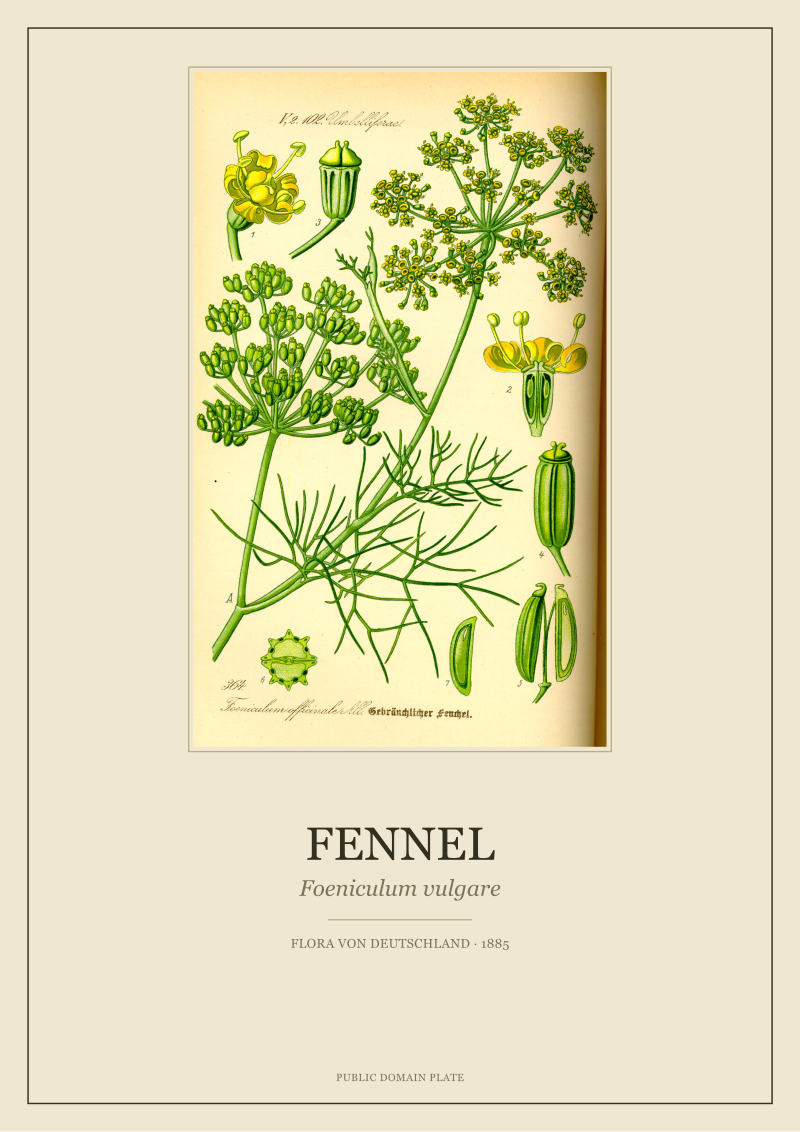
Every time a customer writes in asking about "vintage orchid prints" and expects us to talk about beauty first, we notice the same thing. The plates that survive from the great orchid decades of the nineteenth century are, at the sentence level of their captions, closer to a shipping manifest than a still life. Habit, altitude, flowering interval, leaf count, sepal shape, column detail cross-sectioned in the corner — the language is diagnostic. You read a Thomé plate of something modest like Foeniculum vulgare and you can already see the grammar at work: full plant, dissected flower, seed, root system, each item numbered against a key. The orchid plates of the same century use that grammar for stakes that were not culinary.
The stakes were commercial and geographic. When a European collector paid an agent to travel to Colombia, to Assam, to Borneo, and to send back plants, the plates that came back with the crates were how buyers at the other end could tell what they were bidding on. A watercolour done in the field, then engraved and hand-coloured for a folio in Ghent or London, functioned as a kind of specimen identity card. Painters who worked for the nurseries — the Linden operation in Belgium is the standard reference here — were part of the supply chain, not the gift shop.
This is why so many of the orchid plates that reach us for restoration have that strange affect where the flower is almost too legible. There is no atmosphere. The background is bone-white or a flat wash. The leaves are arranged like exhibits. That flatness is not the artist's failure of imagination. It is the artist doing the job the plate was commissioned for, which was to let a buyer three thousand miles away decide whether the plant in the crate matched the plant on the paper.
The Proof-of-Ownership Pattern: How Illustration Underwrote a Speculative Market
The second pattern only becomes visible once you understand what the plates were replacing. The nineteenth-century orchid market was a genuine speculative bubble — historians of horticulture routinely place it alongside the tulip episode of the seventeenth century as one of the clearer examples of a plant becoming a financial instrument. But orchids were harder. A tulip is a bulb; a bulb is countable, storable, gradable. An orchid, freshly landed in a European port after weeks in a Wardian case, might be misidentified, might be a common species dressed up as a rarity, might be dead in six months. Buyers needed a document.
Illustration was that document. When a nursery advertised a new find and a chromolithographed plate accompanied the sale, the plate functioned as something between a prospectus and a title deed. Collectors bought the plate first, sometimes literally — subscriptions to serialised orchid works were paid in advance, and the plates arrived before the plants themselves reached auction. If you owned the plate, you had proof that the species existed, that a botanist somewhere had verified it, that the market for it was worth capitalising.
The orchid plate did for a Victorian speculator exactly what a certified assay does for a bullion trade: it converted a private inspection into a public claim.
This is where the illustration record and the auction record start to interlock in ways that later historians have found difficult to untangle. Prices reached in the London auction rooms in the 1890s for a single plant of a supposed new species were, in adjusted terms, extraordinary — but the reference point for those prices was almost never the plant in the room. It was the plate that had circulated in the months before. Buyers had studied the plate. Buyers had underlined the diagnostic features on the plate. Buyers arrived at the sale already having decided what the plant was worth on the strength of a piece of paper. The plant itself was, in a sense, a delivery mechanism for a document.
The Attribution Blur: Why Nobody Remembers Who Actually Drew the Orchids
The third pattern is the one that undoes most popular writing on this subject. Ask a general audience to name a Victorian orchid illustrator and, on the rare occasions when a name comes back, it is nearly always the name of the naturalist who published the folio, not the artist who drew the plates. This is not an accident of forgetting. It is a feature of how the work was produced.
Nineteenth-century botanical publishing operated as a division of labour that had almost nothing in common with the atelier tradition people project backwards onto it. The person who found the plant in the field, the person who preserved it in spirits or pressed it, the person who painted it from a living specimen once it reached Europe, the person who transferred that painting to a lithographic stone, the person who ran the printing press, the person who hand-coloured each print, the person whose name went on the folio's title page — these were almost always at least six different people. Sometimes more, once you count the women employed in colouring studios whose labour has been almost entirely erased from the record.
We see the residue of this every time we restore a Thomé plate. Thomé's name is on the work; the individual lithographers who executed the plates are, in most cases, invisible in the finished object. And Thomé's flora was a comparatively straightforward operation — a national reference work with a single editorial hand. The great orchid folios of the same period were far messier, involving multiple artists over years of production, with signatures often removed from the stones during preparation because the folio's brand mattered more than any individual attribution. The obsession we now romanticise as collector passion was, at the production end, a workflow. It has left behind more receipts than authorships.
The Afterlife Pattern: What Happens to Collector Documents When the Collector Dies
The fourth pattern is the one that keeps the restoration desk in business, and it is the least sentimental of the four. Collector documents — plates, folios, hand-annotated auction catalogues, nursery correspondence — are surprisingly fragile as a category because their meaning is contingent. As long as the collector is alive and the market is live, an orchid plate is a working document. Once the collector dies and the market for that species collapses, the plate becomes something else: an object whose original function is no longer legible, whose paper is often already yellowing, whose folio has usually been broken up for individual sale.
The break-up is the critical event. A nineteenth-century orchid folio that survives intact is rare because the economics of the estate sale almost always favoured the dealer who was willing to remove the plates and sell them one by one. This is why so many orchid plates on the market today are orphans. They arrive at auction with no textual apparatus, no key, no diagnostic caption, no reference back to the volume they came from. What survives is the pretty part — the flower, painted in a way that reads as decorative — with the receipt part cut off.
Our work, when we restore one of these plates for public-domain release, is partly forensic. Where possible we reconstruct the caption, verify the plate number against a surviving folio held by a library, and note the publication history alongside the image. What we do not do is pretend the plate was made as a piece of wall art in the first place. It was not. It became one, but its origin is documentary. That distinction matters when you are deciding how to hang one, which is where the next pattern begins.
So What Do You Actually Do With an Orchid Plate in 2026
The honest advice, if you have inherited an orchid plate or bought one in a second-hand shop and want to know what to do with it, is to first find out whether you have a plate or a print of a plate. The former was pulled from a lithographic stone in the nineteenth century on rag paper and has a physical weight and a slight impression under the ink. The latter is a modern reproduction, sometimes very good, printed onto lookalike paper. Both can be worth living with. Only one of them is a piece of documentary history, and the difference matters if you are ever asked what you own.
If it is a genuine plate, resist the impulse to reframe it in something that fights the object. The plate was made to sit in a folio, flat, read at close range. It survives best in a frame that respects that origin — neutral mount, deep enough spacer to keep the glass off the paper, hung out of direct light. A working nineteenth-century document has already survived a hundred and forty years of oxygen and probably a bad estate sale; the next hundred years are largely up to how you frame it and where you put it.
And if you want a restored plate to live with — a Chamomile from Thomé's 1885 Flora, or an Ivy, a Cornflower, a Fennel, all pulled from the same 1885 work our desk has spent the last several years cleaning and preparing — those are the plates we hold in the studio's own shop, released back into the public domain in a form that acknowledges what they always were: documents first, decoration second, and only decoration by our permission.
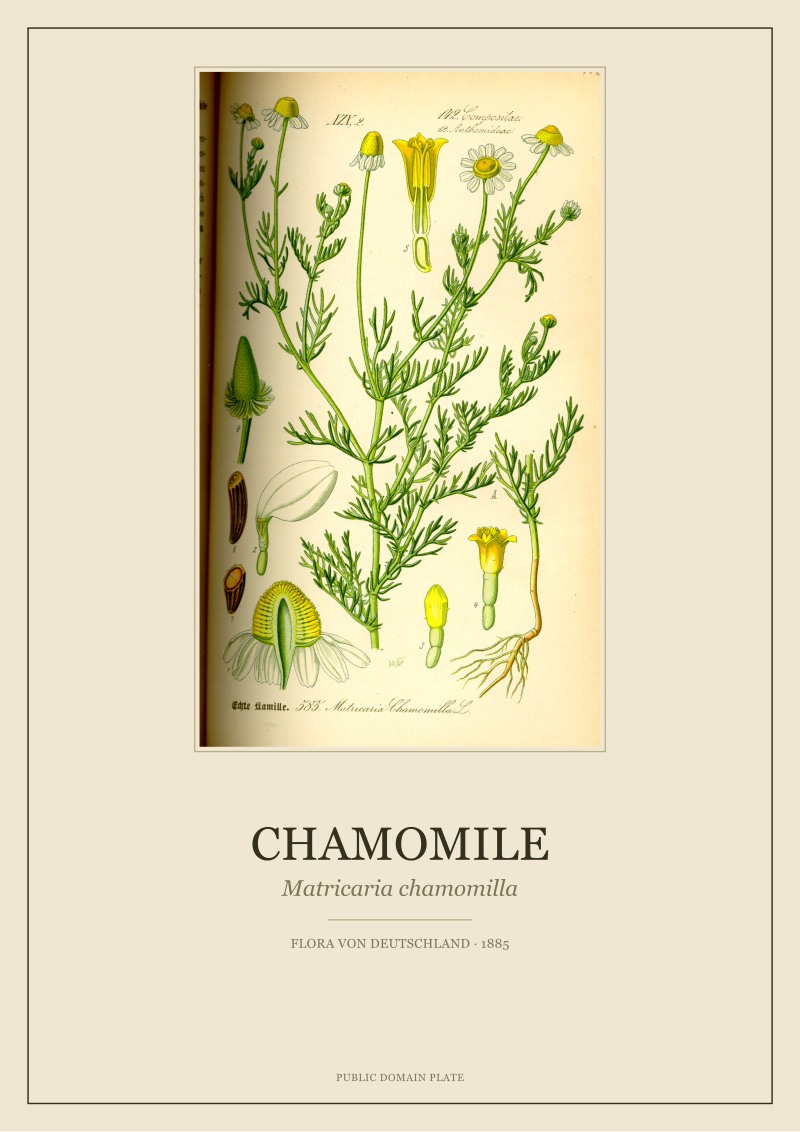 Chamomile
The print from this article · from €29.95
View the print →
Chamomile
The print from this article · from €29.95
View the print →
FAQ
Were orchid plates really used as sale documents, or is that a modern reading?
It is contemporary rather than modern. Nineteenth-century nursery catalogues from the major Belgian and British orchid houses explicitly advertised subscriptions to illustrated folios as part of the buyer's due diligence, and auction records from the 1880s and 1890s reference plates as the point of comparison in disputed sales. The documentary function is well established in the horticultural history literature; it is only the popular presentation that tends to reduce the plates to decoration after the fact.
Why does the Victorian orchid market get compared to the tulip mania?
Because both episodes involved a plant becoming detached from its horticultural utility and functioning as a speculative instrument, with prices set less by the object than by the paperwork around it. The comparison is imperfect — orchid speculation lasted decades rather than months and never collapsed in a single crash — but the structural similarity is real: rarity claims, subscription markets, illustrated prospectuses, and buyers acting on documents rather than on the plants themselves.
Is Thomé's Flora von Deutschland an orchid work?
No, and the distinction is worth making clearly. Thomé's Flora von Deutschland, Österreich und der Schweiz, published in 1885, is a national reference flora covering the wild plants of the German-speaking countries. It includes native orchids of central Europe but is not part of the tropical orchid folio tradition that drove the collector market. Our desk restores Thomé plates like the Chamomile, Ivy, Cornflower and Fennel because they exemplify the visual grammar of nineteenth century botanical printing — a grammar the tropical orchid folios inherited and adapted.
How can I tell if an orchid plate I own is original or a reproduction?
The first tell is paper — original plates are on rag or heavy wove paper with a physical thickness and a slight impression under the ink where the lithographic stone pressed. Reproductions on modern paper feel flat and often too white. The second tell is registration: hand-coloured original plates show tiny colour boundaries that do not perfectly match the printed line, because a human applied them. Reproductions have machine-perfect colour registration. When in doubt, ask a paper conservator rather than a dealer.
Why are so many orchid plates sold without their captions?
Because the plates are worth more, as decoration, once the diagnostic text is removed. When a nineteenth-century folio was broken up for the estate market — which is what happened to most of them — the dealer would frequently trim away the caption, key and plate number to make the remaining image sit better in a standard frame. This is why so many orphaned plates on the market today lack any textual apparatus at all. It is not accidental damage; it is deliberate market preparation, and it is what makes attribution work slow.
Who actually painted the plates in the great orchid folios?
Usually a team of artists whose names were subordinated to the folio's editorial brand, plus a colouring studio staffed largely by women whose contributions went uncredited. The naturalist whose name appears on the title page was often a scientific editor rather than a painter; the field collector who obtained the specimen was frequently uncredited entirely. Reconstructing individual attributions is possible for some plates and impossible for others, and any dealer who claims otherwise without archival evidence is guessing.
Is it ethical to hang a restored public-domain plate at home?
Yes, provided the plate has genuinely entered the public domain — which for works of the 1885 vintage is uncontested — and provided any restoration is presented honestly. The ethical issue in botanical printing is not private display of long-out-of-copyright work; it is the misrepresentation of reproductions as originals, or the removal of documentary context to inflate decorative value. A clean, honest restoration hung on a wall is arguably closer to the plate's second life than any museum vitrine.
What should I look at next if this history interests me?
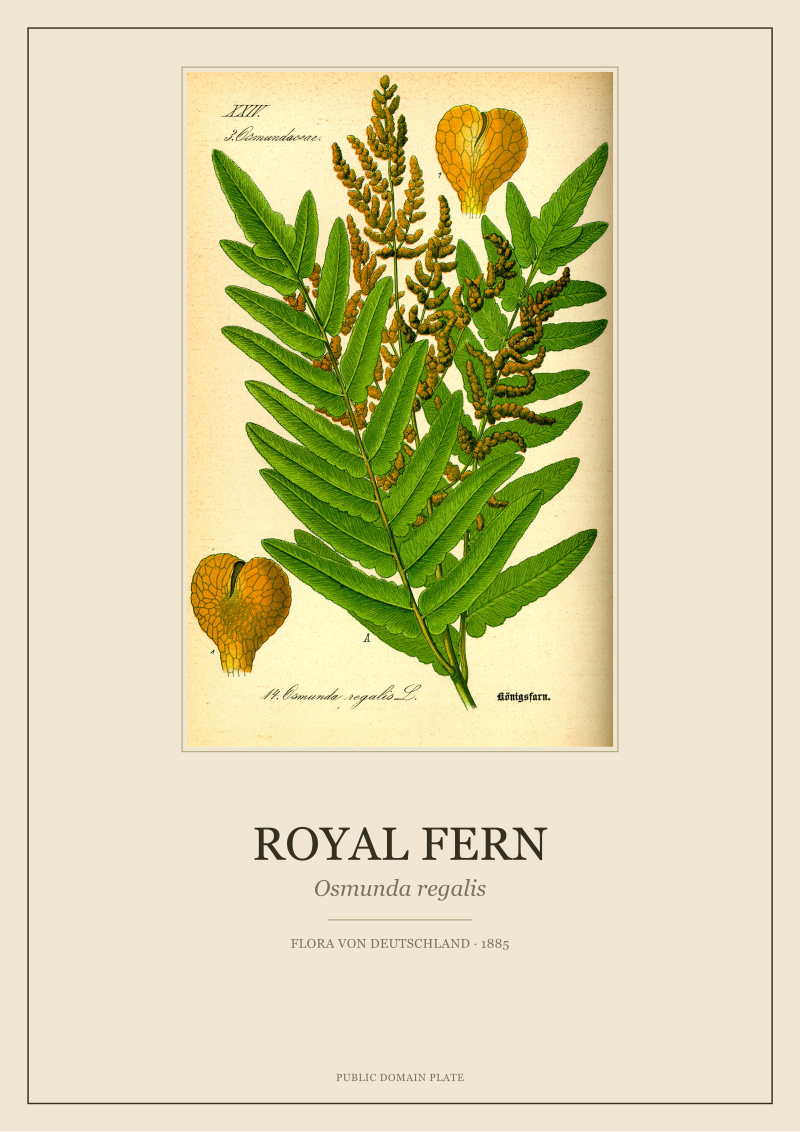
The most useful next question is not about orchids at all — it is about how the nineteenth-century supply chain for exotic plants shaped what got illustrated and what did not. Fern collecting, alpine collecting, and the parallel market for cultivated hybrids all left their own paper trails, and reading the orchid record against those other records is where the sharper history begins. That is where the real work starts, and it is not where this piece ends.
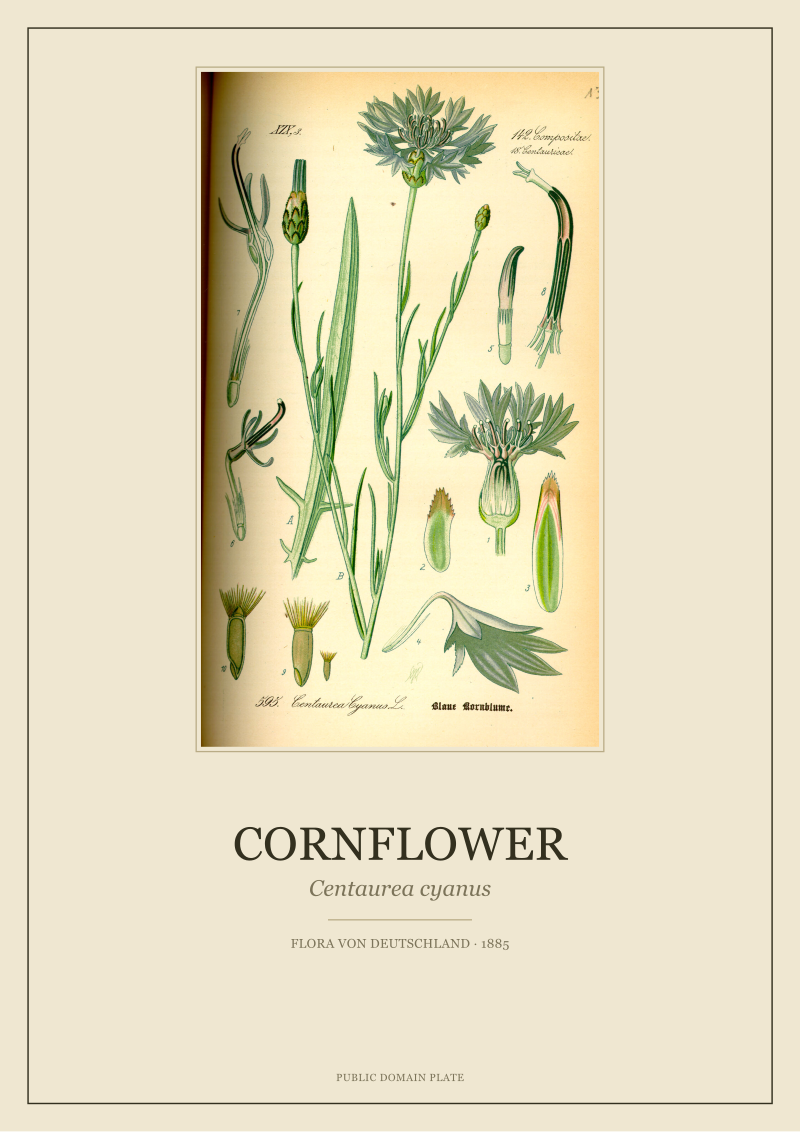 Cornflower
The print from this article · from €29.95
View the print →
Cornflower
The print from this article · from €29.95
View the print →
New plates from the archive and 10% off your first print.
One email now with your code. No noise after.