There is a pattern we keep noticing when we lay Mediterranean art out on the studio table in chronological order: the olive tree is almost never absent, and almost never the same tree twice. It is a coin motif in Athens in the fifth century BCE, a mosaic border in Roman Africa, a background in Sienese altarpieces, a foreground in Van Gogh's Saint-Rémy series, and — in O.W. Thomé's Flora von Deutschland, Österreich und der Schweiz of 1885 — a single lithographed specimen of Olea europaea, drawn cold, in the register of science.
The Pattern of the Silver Leaf Across Mediterranean Painting
The pattern is this: whenever a painter working in a Mediterranean tradition wants to signal light without shouting, they reach for the olive. It is the tree that lets the sky through. Its leaf is narrow, its underside pale, and when wind passes over a grove the whole hillside flickers between grey and green. Painters figured this out early and never entirely let it go.
You see it in Sienese and Florentine panels of the fourteenth and fifteenth centuries, where scenes of the Agony in the Garden almost invariably sit under olive canopy. The choice is theological — Gethsemane, in Greek, is a press for oil — but the choice is also optical. Egg tempera does not love dense foliage. It loves the kind of tree that can be rendered with a scatter of pale strokes on a dark ground, or dark strokes on a pale ground, and read from the far end of a chapel as a shimmer. The olive obliges. Its habit of holding its leaves at all angles at once means a painter can lay down a handful of near-random ticks and the eye will read it as a tree in wind.
By the time you get to the Provençal end of the story, the silver leaf becomes the subject rather than the setting. In Vincent van Gogh's Saint-Rémy period, in the summer and autumn of 1889, the olives around the asylum enter the paintings as a full-time preoccupation. He wrote to his brother about them as a problem he could not solve — the leaves were neither silver nor green, the ground beneath them was neither ochre nor mauve, the whole scene refused any single palette. What he ends up painting is not an olive grove but the fact of an olive grove being hard to paint. That is a very old Mediterranean problem, and Thomé's 1885 plate, tidy as it is, sits inside the same problem: how do you draw a tree whose defining feature is the wind.
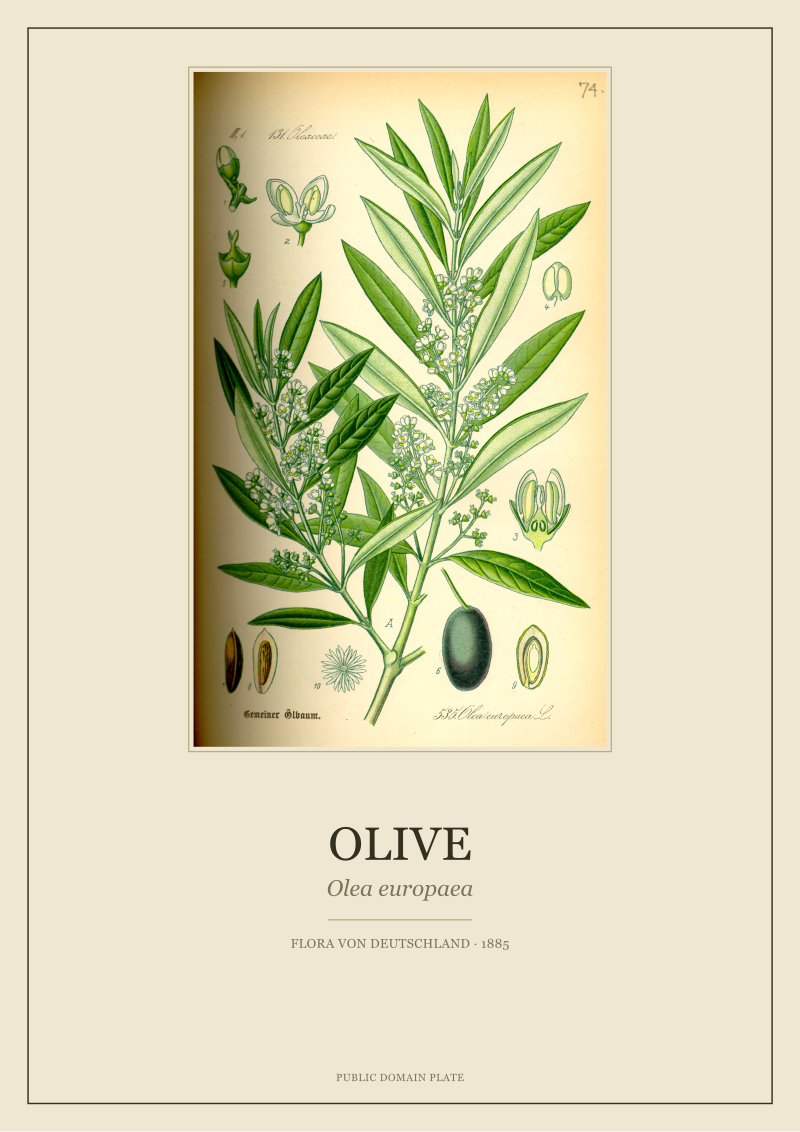
Look at the plate itself. The engraved leaf on Thomé's page is shown from above and from below in the same frame — the darker upper surface and the pale under-surface next to each other on the same twig — because that is the honest thing to do with olive. A single-sided leaf on the page would be a lie about the tree.
The Pattern of Peace: Why the Branch Keeps Returning
The other pattern is that the olive branch, once it enters an image as a symbol, is extraordinarily hard to get rid of. It survives every regime change in Mediterranean visual culture, which is a long list.
The branch is on the coins of Athens in the classical period because the city's founding story assigns it to Athena. It is in the paw of the Roman eagle on victory reliefs as a counterweight to the thunderbolt. It is in the beak of the dove returning to the ark in Christian mosaics from Ravenna onward — Genesis 8, told as a picture of leaf and water. It is on the reverse of the Great Seal of the United States in 1782, held in the same eagle claw as thirteen arrows, and it is on the flag adopted by the United Nations in 1946, wrapping a world map on both sides. That is a continuous run of roughly two and a half thousand years in which the same species, drawn from the same tree, keeps being asked to mean the same thing: the war is over, or the war does not have to happen.
The interesting question, from a studio perspective, is why the symbol never quite wore out. Our reading is that the olive branch is a symbol with a body. It is not an abstract flag or a made-up herald. The tree is real, the branch is real, the oil pressed from its fruit was for centuries the currency of the entire basin, and the object being offered — a cut length of leaf and unripe drupe — is something anyone in Portugal, Palestine, Tunisia or Sicily could pick up on the way to a negotiation. Symbols that survive tend to be symbols you can walk out and touch.
Which is also why Thomé's plate matters here, quietly. The Flora von Deutschland, Österreich und der Schweiz was published in 1885 as a working botanical reference, not a poem. Its job was to make sure the reader could identify the plant in the field. The olive gets a plate not because Germany, Austria and Switzerland are the natural range of Olea europaea — they are not — but because the tree is culturally present enough, through trade, cultivation in the southernmost cantons and the classical education of the readership, that a European flora of the late nineteenth century could not politely leave it out. The symbol pulled the specimen into the book.
Every symbol that has survived the fall of the empires that first drew it turns out to be a symbol you could still walk out into a field and cut.
 Olive
The print from this article · from €29.95
View the print →
Olive
The print from this article · from €29.95
View the print →
The Pattern of the Botanical Plate: Thomé, 1885, and the Olive as Specimen
Then there is what happens when the olive enters the specifically botanical tradition, which is a different visual grammar from painting. Here the pattern is that the tree gets flattened, dissected, and told to hold still.
Otto Wilhelm Thomé's Flora von Deutschland, Österreich und der Schweiz appeared in 1885 with a colour plate for each of the species it described. The plates were produced by chromolithography, the dominant colour-printing technology of the late nineteenth century, which allowed multiple stones to lay down successive ink colours in exact registration. The result, on the Olea europaea page, is what botanical illustration had spent three centuries learning to do: a habit sketch of the plant in its overall form, a detail of the flower with its parts laid out for the eye, a detail of the drupe in cross-section, and — the crucial move — the leaf shown from both sides at once. Nothing romantic. Nothing atmospheric. The tree presented as a set of facts.
Compare that with almost any earlier painted olive and you can feel the change in register. A Sienese olive is a mood. A van Gogh olive is a nervous system. A Thomé olive is a specimen. The plate does not want to move you, it wants you to be able to walk into a garden in the Ticino and confirm what you are looking at.
This is not a lesser tradition — it is a different one, and, we would argue, the tradition that finally lets the olive be seen. Symbolic art tends to abbreviate the tree to a branch and a bird. Devotional painting tends to reduce it to a canopy above a figure. The botanical plate is the first place in Mediterranean visual culture where the olive is the whole subject, drawn without a saint or a soldier standing under it. When we restore Thomé's 1885 Olea plate in the studio — cleaning the scan, correcting for the yellow the paper has taken on in a hundred and forty years of light, holding the original line under the correction — we are not restoring a decorative object. We are restoring one of the few Mediterranean images in which the olive is treated as itself.
We keep it in the shop for that reason. The plate is available among our restored 1885 botanicals in the /shop/, alongside the other Thomé specimens, and it hangs, in our experience, as a quiet correction to the more famous romantic olives — a picture of the tree with all its rhetoric put down.
The Pattern of the Sacred Grove: Olives as Place, Not Just Plant
The last pattern is that the olive is almost never drawn alone. Even in the botanical plate, where a single specimen has to stand in for the species, the tree is haunted by its grove. This is because in the Mediterranean the olive is not really a plant at all — it is a piece of land.
An olive grove is a form of durable architecture. A tree can live for hundreds, in some documented cases arguably over a thousand, years. A grove planted in Roman Andalusia might still be producing under Umayyad, Castilian, Napoleonic and European Union administration. That is a length of biography no other cultivated tree in the region can match, and it shows up in the art. When a Byzantine mosaicist puts an olive in a border, they are not just placing a plant — they are placing an inheritance. When a Renaissance predella shows Christ praying under an olive, the tree in the picture is meant to be older than the scene it contains. When Cézanne paints the olive slopes above Aix, he is painting land whose lines were drawn by Roman surveyors.
The botanical plate is quieter about this, but it is there too. Thomé draws a single branch, a flower, a drupe. He does not draw a grove. And yet the reader in 1885 could not open to the Olea page without knowing that the specimen in front of them was cut from a system that predated their nation-state. The plate is a portrait of an individual whose family tree is a landscape.
For a studio that works with plates rather than paintings, this matters practically. We hang the restored Olea europaea 1885 knowing that it is not a decoration in the way a chromolithograph of a garden tulip is a decoration. It carries the grove behind it. Put it in a room and, if the room is honest, it changes the age of the wall.
The next question, of course, is what happens when you start reading other Mediterranean plates from the same 1885 volume next to this one — the vine, the fig, the pomegranate, the myrtle — and whether the same patterns of symbol, silver leaf, slow branch and inherited land run through those too. Our current hunch, from the studio table, is that they do, but not in the same proportions. That is the reading that starts here and does not end in this piece.
 Fig
The print from this article · from €29.95
View the print →
Fig
The print from this article · from €29.95
View the print →
FAQ
Why is an olive tree included in a German-language flora from 1885?
Thomé's Flora von Deutschland, Österreich und der Schweiz covered plants of the German-speaking countries, but its remit stretched to species widely cultivated, encountered in trade, or taught in the classical curriculum of the period. The olive was all three. Southern Switzerland has long grown it in warm microclimates, and any nineteenth-century European reader with a Gymnasium education would expect Olea europaea to appear. The plate reflects cultural range as much as strict botanical geography.
What is chromolithography, and how does it change the way the olive looks on the page?
Chromolithography is a nineteenth-century colour-printing process in which each ink is laid down from a separate lithographic stone, registered precisely on top of the last. For a plant like the olive, that meant the pale under-leaf and the darker upper leaf could be printed in two distinct greens on the same twig without muddying. The technique is a large part of why 1885 plates still read as clean and quiet against the wall — the colours are separated, not blended.
Why does the olive branch specifically mean peace?
The visual convention comes from several overlapping traditions: Athena's gift of the olive to Athens in Greek myth, the dove returning to Noah's ark with an olive leaf in Genesis 8, and the Roman use of the branch as a counterpart to the sword or thunderbolt. The symbol survived across regimes because the object was real and portable — an actual cut branch could be handed over. That physicality is unusual among long-lived symbols.
Is the plate we restore actually from 1885, or a later reproduction?
The image is Thomé's original chromolithograph published in the 1885 edition of Flora von Deutschland, Österreich und der Schweiz. The plates are in the public domain. What our studio does is restoration: cleaning the high-resolution scan of a genuine 1885 impression, correcting the paper yellowing that light has caused since publication, and preserving the original line and colour without redrawing.
How is Van Gogh's olive different from Thomé's olive?
Van Gogh's olives, painted in Saint-Rémy in 1889, are studies of the tree as sensation — colour, wind, changing light. Thomé's olive, printed in 1885, is a study of the tree as identifiable species — habit, leaf, flower, fruit. They belong to two different Mediterranean traditions of looking at the same plant: painting the mood the tree produces, and drawing the plant so you could name it in a field.
Can I hang a botanical olive plate in a room that already has olive-branch symbolism elsewhere?
Yes, and in our experience the two registers coexist rather than compete. A branch used as a peace symbol reads as heraldry. A botanical plate reads as portrait. The plate tends to slow the room down and make any nearby symbolic use of the olive feel more grounded, because the eye has already been shown what the actual tree looks like from close in.
Does the studio ever change the colours of the plate during restoration?
No. Restoration in our studio means removing the effects of time — paper yellowing, dust, minor foxing — not altering what Thomé and his printers put down. Where the original chromolithograph used a specific green for the upper leaf and a paler tone for the under-leaf, we hold to those. Changing the palette would turn the plate into a design object; keeping it turns it back into the picture it was in 1885.
New plates from the archive and 10% off your first print.
One email now with your code. No noise after.