The cornflower is a small blue problem. It is called the national flower of Germany, but no German parliament ever voted on that. It was once so common in rye fields that farmers cursed it, and now it is rare enough to sit on protected-species lists. It is the flower of a dead emperor, a wartime badge, a supermarket bouquet. To read O.W. Thomé's 1885 plate honestly, you need the vocabulary the plate assumes you already have. This piece is that vocabulary, one term at a time.
Centaurea Cyanus
The binomial is doing more work than it looks. *Centaurea* is the genus Linnaeus assigned to a cluster of thistle-adjacent composites, named after the centaur Chiron, who — the old herbals claimed — used a related species to dress a wound. *Cyanus* is the Greek word for dark blue, and it is the entire reason the plant survives in symbolic memory. Not the leaves, not the growth habit, not the seed. The colour.
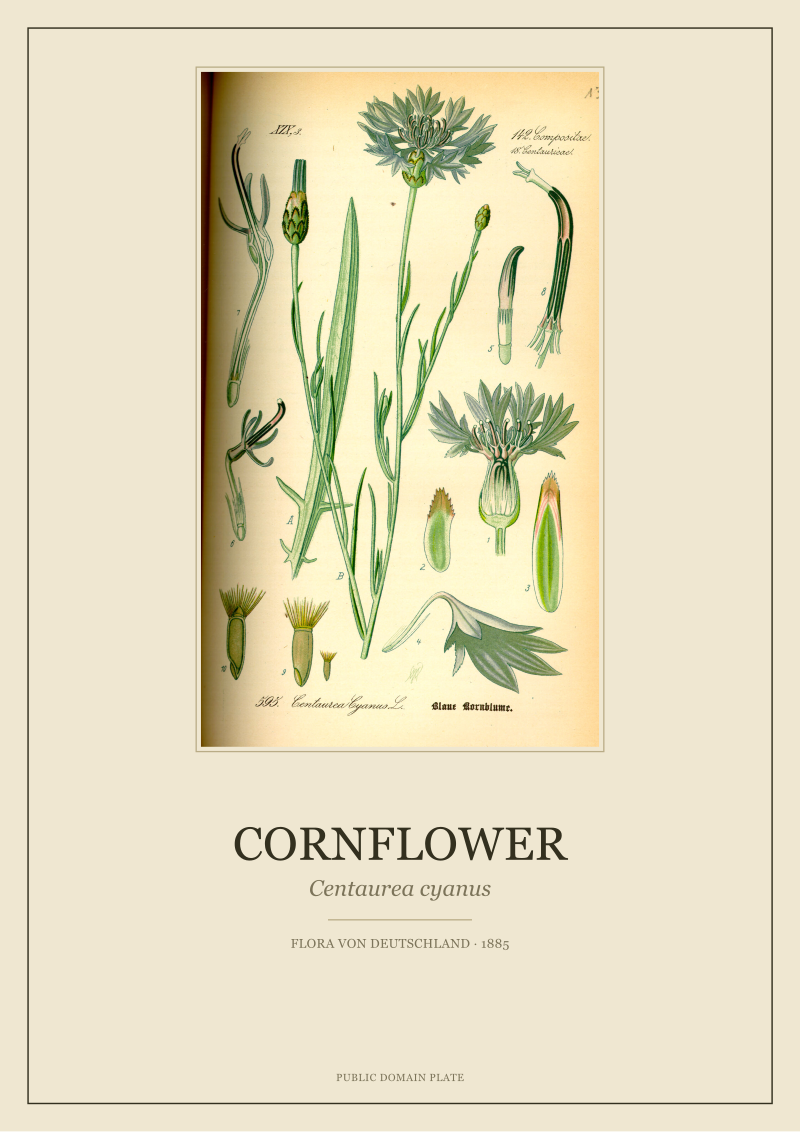
On the 1885 plate the binomial sits in italic beneath the German name, in the neutral Latin that lets a Berlin botanist and a Zürich pharmacist talk about the same organism without arguing. This is the register Thomé's *Flora von Deutschland, Österreich und der Schweiz* was built for: a school-and-cabinet reference book that expected the reader to move between vernacular and scientific names on the same page. When we restore the plate, we leave the binomial exactly as engraved. It is the plant's passport, and it has not needed a reissue in 140 years.
Kornblume
*Kornblume* is the German common name and it is a compound doing quiet historical work. *Korn* means grain — in most of northern Germany, specifically rye — and *Blume* means flower. The name places the plant in a field, not a garden. It does not describe what the plant looks like. It describes where you find it.
That is important because the English word "cornflower" carries a false cognate for American readers. *Corn* in German has never meant maize; maize is *Mais*. When Thomé's plate labels the species *Kornblume*, a German reader in 1885 sees a rye field in Pomerania or Silesia, not a Nebraska cornfield. The name is a habitat marker, and the habitat is a specific one: the loose, weedy edges of a cereal monoculture harvested by scythe, on soils not yet treated with the selective herbicides that would arrive in the 1950s. Change any of those variables and the *Kornblume* stops being common. The German language recorded the plant's ecology before ecology was a word.
 Cornflower
The print from this article · from €29.95
View the print →
Cornflower
The print from this article · from €29.95
View the print →
Cornfield Weed
For most of its documented history the cornflower was a weed, in the working farmer's sense: an unwanted plant competing with the crop for light, water and nitrogen. Rye fields across the North European Plain hosted it by the million. Nineteenth-century agricultural manuals list *Centaurea cyanus* alongside corn poppy and corncockle as the classic *Ackerunkräuter* — the arable weeds — and describe removal by hand-weeding before harvest.
The weed status is the whole reason there is a symbol later. A flower nobody has to work around does not become the emblem of anything. The cornflower's blue was familiar to every rural household in the German-speaking lands because it was unavoidable, the way a specific shade of dandelion is unavoidable in a lawn today. When the plant later became a royal favourite and then a national symbol, it was travelling on 300 years of pre-existing visual literacy. Everyone already knew what a cornflower looked like against ripe rye. The symbolism did not have to teach the image; it had to appropriate one that was already free.
Kaiserblume
*Kaiserblume* — the Emperor's flower — is the nickname that stuck to the cornflower in nineteenth-century Prussia, and the story behind it is the sort of anecdote that is impossible to prove and impossible to kill. The version told in German popular history has Queen Louise of Prussia fleeing Berlin with her children in 1806, hiding in a field, and calming the young Wilhelm — the future Kaiser Wilhelm I — by weaving cornflowers into a wreath. Wilhelm is then said to have kept a lifelong affection for the flower, wearing one in his buttonhole on official occasions after his coronation in 1871.
Whether the field scene happened is a question for historians, not restorers. What is documented is the outcome: by the time Thomé is engraving his plate in 1885, the cornflower already carries an imperial second meaning in the German press. It is the Hohenzollern flower. When a Berlin reader in 1885 opens the *Flora* to the *Kornblume* page, they are not seeing a neutral species portrait. They are seeing a plant that has been quietly annexed by a dynasty within living memory.
Prussian Blue Emblem
There is a colour running underneath all of this and it is worth naming. Prussian blue is a synthetic pigment first produced in Berlin around 1706 and adopted almost immediately for Prussian military uniforms — the dark blue coats that defined the visual identity of the Prussian army from Frederick the Great through Wilhelm I. By the late nineteenth century "Prussian blue" was both a chemistry term and a nationalist shorthand.
The cornflower's blue is not Prussian blue; the pigments are different, the botany is not synthetic. But the visual rhyme was inescapable to a Berlin audience. A blue flower on a Hohenzollern lapel in 1885 was legible against a hundred years of blue uniforms and blue banners. This is the layer beneath the *Kaiserblume* story: the flower did not have to argue for its symbolism, because the colour was already claimed. When restoring the plate, we pay close attention to the exact chroma of the ray florets — Thomé and his lithographers chose it precisely, and any drift toward turquoise or violet in a modern reprint quietly severs the plate from the political colour it was originally speaking to.
Thomé's 1885 Plate
Otto Wilhelm Thomé published *Flora von Deutschland, Österreich und der Schweiz* beginning in 1885 as a school and household reference to the flora of the German-speaking lands. The work eventually ran to hundreds of chromolithographed plates, one species per plate in most cases, each accompanied by descriptive text intended for pupils and interested amateurs rather than academic specialists.
Thomé's *Centaurea cyanus* plate follows the convention of the series. Full habit of the plant at scale, with a flowering stem centred on the sheet. Analytical details — single floret, seed, involucral bract — arranged around the main figure at magnifications useful for identification. The colour is separated across multiple lithographic stones, one per hue, printed in careful register. The plate is signed and dated, and it entered the public domain long ago; the license line on our restoration file records this explicitly. What we do with the plate is remove 140 years of paper yellowing and foxing without touching a single one of Thomé's lines or a single one of his colour choices.
Chromolithographic Blue
Chromolithography is the printing process that made a plate like Thomé's cornflower possible at scale and at price. It uses a separate limestone block for each colour, drawn by hand with greasy crayon or ink, then inked and printed one colour at a time onto the same sheet in careful register. A plate with green leaves, blue ray florets, purple disc florets and brown seed detail needed at least four stones, often more, printed in sequence with drying time between passes.
The blue of the cornflower plate is the reason the whole apparatus was worth the labour. Botanical illustration before chromolithography relied on hand-tinted engravings, which meant every copy was slightly different and truly saturated blues were expensive because the pigment had to be applied by brush. Chromolithography allowed a Berlin publisher to print thousands of identical blue cornflowers on identical paper at a price a schoolteacher could afford. That is the invisible economic fact inside the 1885 plate. The blue is not just beautiful; it is industrially reproducible for the first time.
National Flower Status
The cornflower is repeatedly described as the national flower of Germany, and the claim needs a careful footnote. Germany has no legally designated national flower. There is no parliamentary act, no federal decree, no equivalent to the way the maple leaf is codified in Canada. The status is a matter of long popular custom, reinforced by association with the Hohenzollern dynasty in the nineteenth century and with commemorative culture in the twentieth.
The custom is not trivial for being unlegislated. The cornflower appears on postage, in civic bouquets, in political lapels across the ideological spectrum at different periods, and — more recently — as a symbol used in the annual remembrance of the victims of the Nazi regime. It has carried, over 150 years, meanings that flatly contradict one another: royalist, republican, mournful, celebratory. What holds the meanings together is the flower itself, which is legible at a glance and comes with pre-installed emotional weight. That is what a de facto national flower is. Not a law. A shared reflex.
The Weed That Vanished
Here the story turns. The same cornflower that was a common weed of German rye fields for centuries is, in 2020s Central Europe, a species of active conservation concern. Intensive cereal cultivation from the 1950s onward — deeper ploughing, seed-cleaning that removes weed seeds before sowing, and above all selective broadleaf herbicides that target dicots like *Centaurea cyanus* while sparing the monocot grain — collapsed the wild populations across most of the German cultural range.
The plant survives, but as a garden ornamental, a bouquet filler, a component of seed mixes for pollinator strips at field margins, and a rarity in the wild agricultural landscape it used to define. Regional red lists in parts of Germany now record it as threatened or in decline. The symbolic weight has held while the ecological base has thinned. When Thomé's reader in 1885 walked past a rye field, the plate was a record of an obvious thing. When we restore that same plate and hang it on a wall in 2026, it is a record of a landscape most Germans no longer see. The restoration is not nostalgia. It is a document of what the countryside contained when the book was printed.
Reading The Plate Today
Put all of this back on the plate and read it once through with the vocabulary installed. The *Centaurea cyanus* is a technical passport, indifferent to politics. The *Kornblume* is a habitat marker pointing at a nineteenth-century rye field. The weed status explains why every German reader in 1885 recognised the shape without instruction. The *Kaiserblume* story loads a Hohenzollern second meaning onto a colour that already rhymes with the Prussian uniform. The chromolithographic blue is the industrial fact that let this specific plate reach ten thousand desks. The national-flower claim is a custom, not a statute. The conservation status is the ecological turn that has happened since Thomé put down his pencil.
None of that vocabulary is on the plate itself. Thomé assumes it. So does every subsequent reader who has walked past the *Kornblume* in a field, worn one on a lapel, or received one at a state ceremony. The restored plate does not add the vocabulary back. It refuses to remove it. What we frame and ship at /shop/ is the object that all of these meanings once attached themselves to — the blue that Prussia annexed, the weed that agriculture erased, the emblem no one ever voted for. The plate holds them. The rest is reading.
FAQ
Is the cornflower officially the national flower of Germany?
No, not in any legal sense. There is no federal statute, no parliamentary resolution, and no state decree that designates *Centaurea cyanus* as Germany's national flower. The status is entirely customary, built up over the nineteenth century through Hohenzollern association and reinforced by twentieth-century commemorative use. When German media and civic bodies call it the national flower, they are describing a shared reflex rather than citing a law. This is common for older European national symbols and is not unusual.
Why is the cornflower nicknamed the Kaiserblume?
The nickname attaches to Kaiser Wilhelm I and a widely retold story about his mother, Queen Louise of Prussia, weaving cornflowers into a wreath for him during their 1806 flight from Napoleon's advance on Berlin. Whether the specific episode occurred is unverifiable; what is documented is that by the time Wilhelm was crowned German Emperor in 1871, the cornflower was firmly attached to his public image, and it kept that association through the imperial period.
What plant does Thomé's 1885 plate actually depict?
It depicts *Centaurea cyanus*, the common cornflower of Central European cereal fields, in the standard scientific-illustration convention of the *Flora von Deutschland* series. The main figure shows the full flowering habit at a legible scale, and smaller analytical details — a single floret, involucral bracts, seed — surround it at higher magnification. The plate is chromolithographed, signed, dated 1885, and long in the public domain, which is the license status our restoration file records.
Why has the cornflower become rare in the wild in Germany?
Twentieth-century agriculture is the direct cause. Post-1950 cereal cultivation combined deeper ploughing, industrial seed-cleaning that strips weed seeds before sowing, and selective broadleaf herbicides that specifically target dicot weeds while sparing grain grasses. *Centaurea cyanus* is a dicot annual dependent on disturbed cereal ground for its life cycle, so all three changes hit it at once. Populations have collapsed across the historic range, and several regional German red lists now record the species as in decline.
What is chromolithography and why does it matter for this plate?
Chromolithography is a multi-stone lithographic printing process where each colour in the image is drawn on a separate limestone block and printed one at a time in precise register. It was the first technology that allowed richly coloured botanical plates — including deep saturated blues — to be mass-produced at prices ordinary readers could afford. Thomé's 1885 cornflower exists as a widely available object, rather than a hand-tinted rarity, entirely because of this process.
Is Prussian blue the same as the cornflower's blue?
No. Prussian blue is a synthetic iron-based pigment first produced in Berlin around 1706, and it is a specific chemical compound. The cornflower's blue comes from anthocyanin pigments in the ray florets, a completely different chemistry. What matters for the plate's cultural reading is that the two blues visually rhyme, and by the nineteenth century Prussian blue was so tied to Prussian military uniforms that any dark blue emblem — including a blue flower on an imperial lapel — carried the association whether or not the pigment was chemically identical.
Can I use the Thomé plate image freely?
The original 1885 chromolithograph is in the public domain, so the underlying image carries no copyright restriction. What our studio offers is a specific restored file — cleaned of foxing, corrected for paper yellowing, colour-calibrated against reference sources — and the restoration work is the labour we ship. Anyone can access the raw public-domain scan through library archives; the restored plate available at /shop/ is a different object, produced by a specific editorial process.
New plates from the archive and 10% off your first print.
One email now with your code. No noise after.