A scientifically accurate botanical plate is not a portrait of one plant. Hear us out. When O.W. Thomé closed the drawings for his Flora von Deutschland, Österreich und der Schweiz in 1885 — the source of the chamomile, common ivy, cornflower and fennel plates that pass through our restoration desk — the illustrators he directed were not painting the specimen in front of them. They were painting the species: a composite, an argument about what a plant is once the accidents of the individual are stripped away. Accuracy, in that tradition, means something specific. It almost never means what a modern reader assumes.
To make the point concrete, we walk through three hypothetical scenarios below. None is a real illustrator we have interviewed; each is a composite of working methods well documented in the flora tradition of the late nineteenth century. Picture the desk, picture the plant, and picture the choices. Then, at the end, decide which of the three describes the way you have been reading these plates on a wall.
Scenario 1: The Field Botanist Drawing Chamomile From a Living Specimen
Imagine a field botanist opening a field portfolio at the edge of a Bavarian pasture in July, a fresh sprig of *Matricaria chamomilla* laid flat on the board. The plant is real, it is in front of them, and yet the plate they are preparing for Thomé's Flora is not going to look exactly like this sprig. This is where the modern reader stumbles first.
The living chamomile in the field is a mess of accident. One capitulum is half-open, another is chewed, a third leans because of the wind that morning. The stem forks in a way that is not typical of the species; it happens to be typical of this plant. If the illustrator drew what they saw, the plate would document a specimen, not a species — and Thomé's Flora is a species flora. So the artist begins editing while looking.
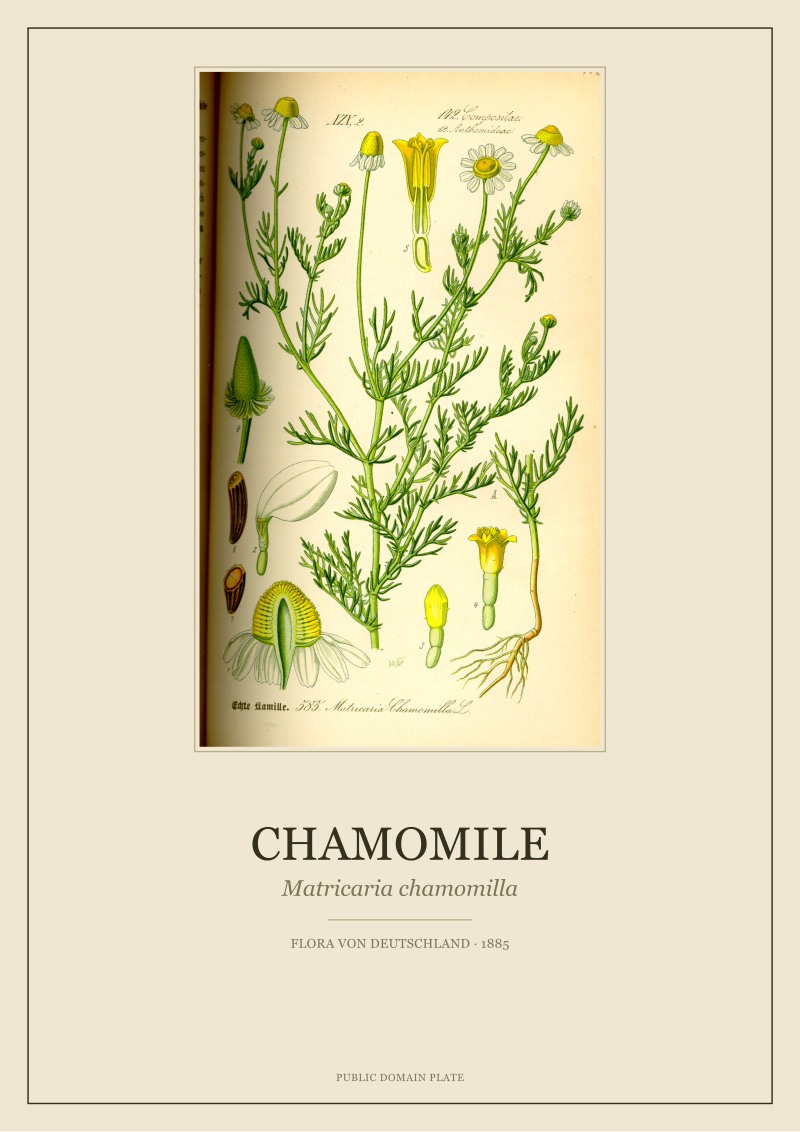
They will draw the leaf shape from a leaf that is undamaged. They will draw the capitulum from one that is at the exact stage of anthesis that shows the disc florets and the ray florets clearly, because the point of the plate is to let a reader identify chamomile against its lookalikes — scentless mayweed, corn chamomile — where the difference lives in the receptacle. So the plate will also include, off to the side, a longitudinal section through that receptacle. That section is not something the reader would see standing in the pasture. It is something the reader needs to see to name the plant.
The disc floret gets its own enlarged drawing. So does the achene. Scale bars, or an implied comparative sizing, tell the reader how large each element is relative to the others. The finished plate is, in a real sense, four or five drawings of chamomile stacked on one page: habit sketch, floral section, individual floret, achene, sometimes leaf detail. Each is drawn from a specimen that showed that particular feature at its most typical.
Accuracy here is not "I painted what was on my desk." Accuracy is "I painted what a competent reader needs to see in order to key this plant out." The living specimen is a reference, not a subject.
Scenario 2: The Herbarium Copyist Reconstructing Common Ivy From a Pressed Sheet
Let us say a second illustrator is working in a museum room in Berlin, in winter, with no living ivy available. On the table is a herbarium sheet of *Hedera helix* — pressed, dried, mounted with linen tape, annotated in a curator's hand. The label gives a locality, a date, a collector. The plant itself is flat, discolored to the brown-green of pressed material, and about two-thirds of the way to being unrecognizable to anyone who has only ever seen ivy alive on a wall.
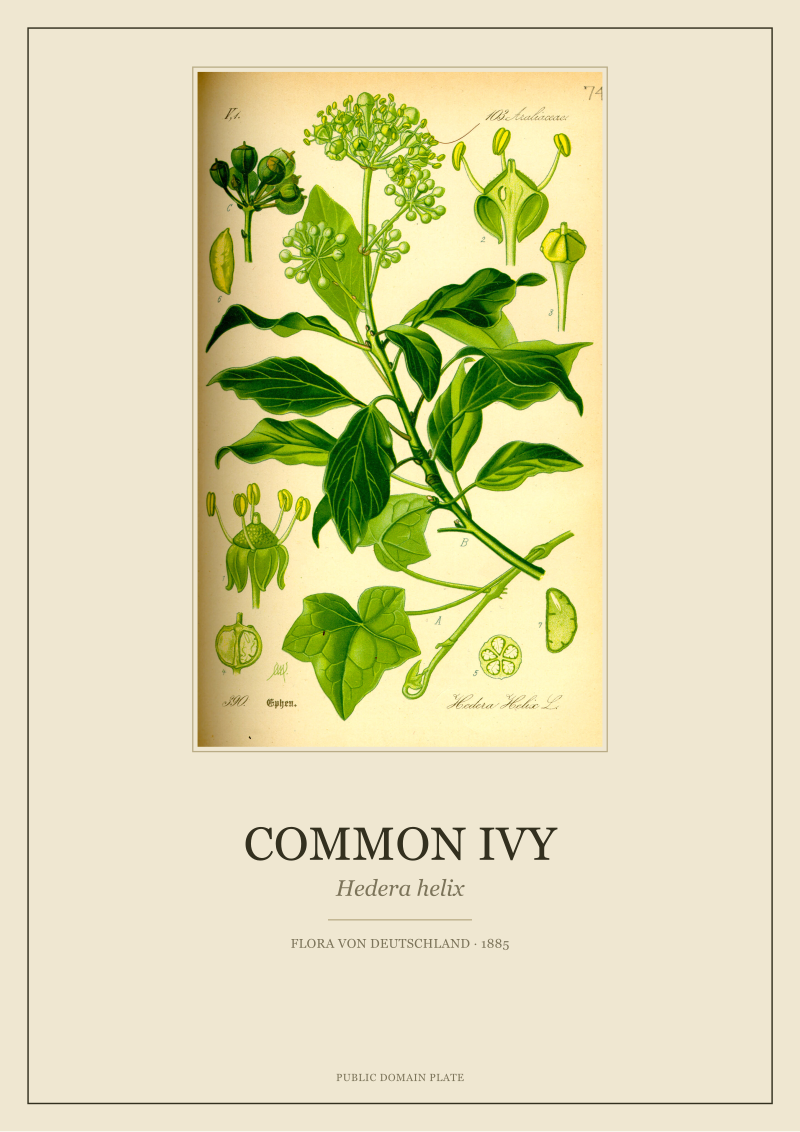
The illustrator's job is to reconstruct. Common ivy, uniquely and famously, is a plant of two lives: the juvenile climbing form with the lobed leaves everyone recognizes, and the adult arborescent form with entire, ovate leaves and terminal umbels of flower that most people never notice. Both belong on the plate. The pressed sheet in front of the artist may show only one; a good species portrait shows both, so the reader understands that the flowering "different-looking" ivy on an old wall and the climbing juvenile creeping across a courtyard are the same organism.
So the artist works from the sheet for morphology — leaf outline, venation, petiole length, the fine detail of the umbel — and from memory and reference for color and habit. Pressed material tells you the shape of the leaf; it does not tell you the exact green of the cuticle, the sheen, the way the juvenile leaves cluster at the shoot tip. Those come from live observation, either the artist's or another botanist's, cross-checked.
The result is honest and reconstructed. It is not a lie. It is a species portrait built from the best available evidence for each feature: the herbarium sheet for structure, live reference for habit and color, and the flora's whole editorial apparatus for what counts as the diagnostic set. When the plate is finished, the ivy on the page shows both leaf forms, the umbel, the drupe. No single plant, alive or pressed, ever presented all of these to any single observer on any single day. The plate is a synthesis. It is accurate about ivy in a way no photograph of one wall of ivy could ever be.
 Chamomile
The print from this article · from €29.95
View the print →
Chamomile
The print from this article · from €29.95
View the print →
Scenario 3: The Studio Compiler Assembling a Cornflower From Three Sources
Now picture a third illustrator, a compiler by trade, at a studio desk in the 1880s. In front of them are three references for *Centaurea cyanus*: a rough field sketch by another artist done the previous summer near a wheat field, a herbarium specimen borrowed from a university collection, and a plate of the cornflower from an earlier flora — perhaps a decade or two older — used for cross-check on details the first two sources leave ambiguous.
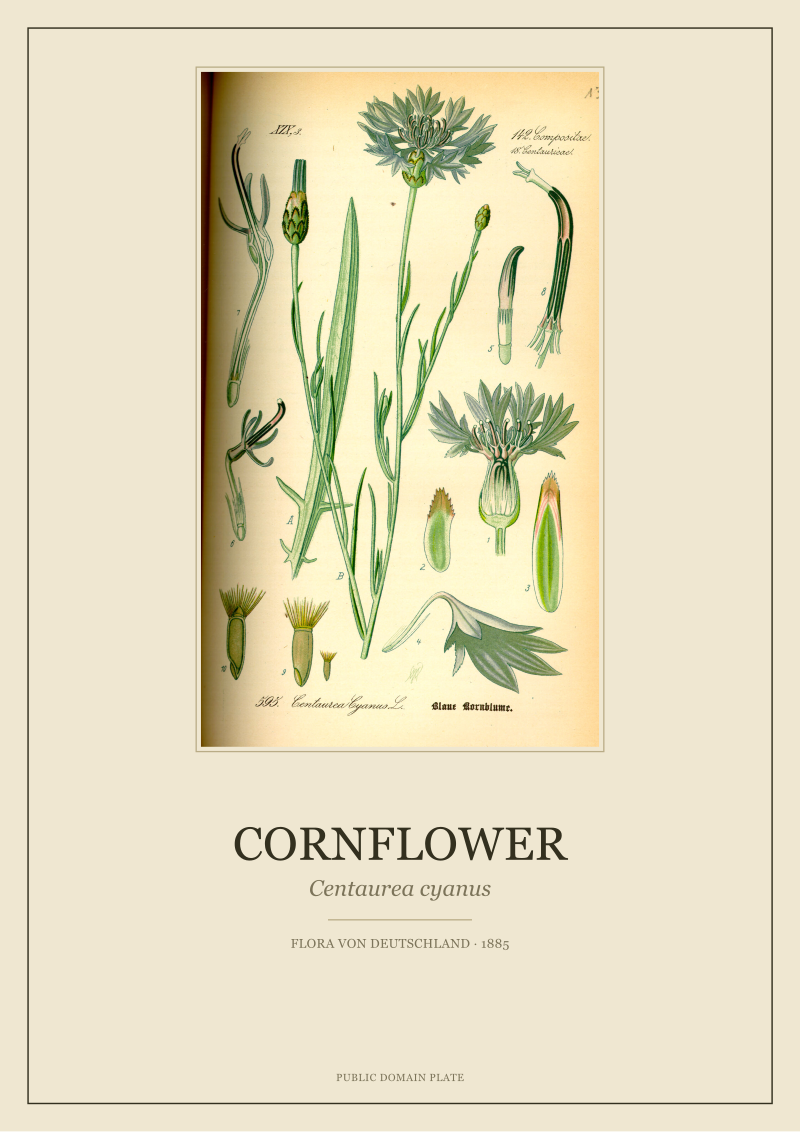
This is the least sentimental of the three scenarios and probably the most common in a big project like Thomé's Flora. The compiler is not attempting to inject personal observation. They are attempting to draw what the species is, judged from the aggregate of sources, in a style consistent with the rest of the volume. The cornflower on the finished plate has the correct pinnately lobed lower leaves and the correct linear upper leaves; the involucral bracts with their distinctive fringed appendages get an enlarged detail because that is where the genus lives; the ray florets flare their unmistakable blue; the achene, plumed, sits in its own labeled enlargement.
Where the field sketch is uncertain, the herbarium sheet decides. Where both are silent, the older plate is consulted, and if the older plate is wrong — as older plates sometimes are — the compiler must catch it. This is the hardest part of the job. A studio can quietly propagate an error across decades if nobody goes back to a real plant. Rigorous compilers did; less rigorous ones inherited mistakes and passed them on.
What matters for our reading: the cornflower on the Thomé plate is neither the plant in the wheat field nor the plant on the herbarium sheet. It is a considered summary. Its accuracy is measured by whether a botanist, holding a real cornflower, would agree that the plate has correctly identified the features that separate this species from every plant it could be confused with. That test — the identification test — is the only test that mattered.
What All Three Share: Accuracy as Argument, Not Photograph
Across all three scenarios, the plate is doing something a photograph cannot. A photograph documents a single specimen at a single moment under a single light. A plate documents a species. That difference is not a limitation of nineteenth-century technology; it is the whole point of the form.
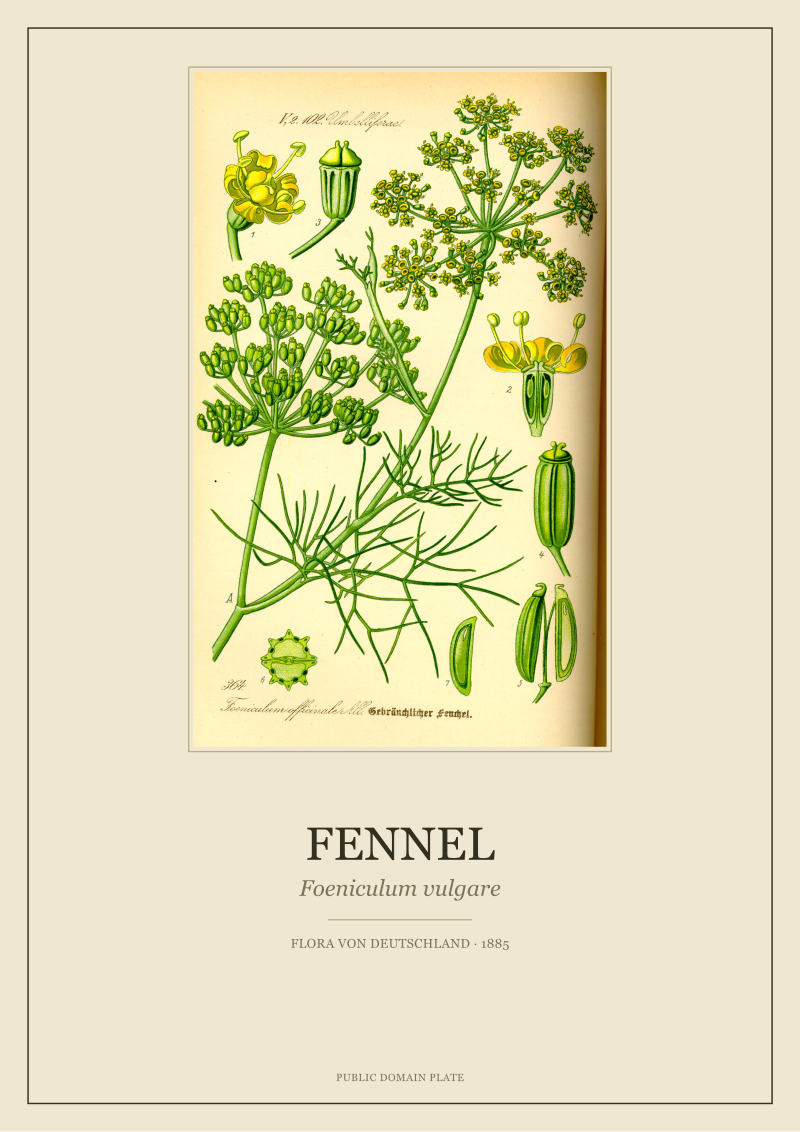
Every accurate botanical plate we restore, from *Matricaria chamomilla* to *Foeniculum vulgare*, shares four discipline choices. First, features that matter for identification are enlarged and dissected on the same page as the habit view. Fennel's fruit, sectioned to show its vittae, is not there for decoration; it is there because that is how you know it is fennel and not a lookalike umbellifer. Second, features that vary randomly between individuals are drawn from a specimen where they took their typical, not their eccentric, form. Third, features the artist could not see on any single day — the two leaf forms of ivy, the full flowering-to-fruit cycle of chamomile — are combined into one composed image. Fourth, style is subordinated to legibility. The line does its job; the color separates; the label anchors.
An accurate plate is therefore an argument. It argues: *this is the set of features by which you can know this species*. When that argument is well made, the plate outlives the specimen, the illustrator and the flora. It is why plates drawn in 1885 remain useful to a botanist in 2026. And it is why, on a wall, they carry a quiet authority that a photograph rarely has.
 Cornflower
The print from this article · from €29.95
View the print →
Cornflower
The print from this article · from €29.95
View the print →
Which Scenario Is You: Reading a Plate Once You Know How It Was Made
If you have looked at a botanical plate and thought "the artist painted this plant" — you were reading scenario one. The reality is closer to scenario three for most plates in a big flora, with a great deal of scenario two mixed in. Once you know that, the plate opens up. You start noticing the sectioned floret next to the habit view. You start noticing that the ivy has two leaf shapes, and you realize the artist is telling you something about the plant that you can no longer unsee. You start noticing that the cornflower's involucral bract has been given its own small enlargement, and you understand that the artist thought that was where the species lived.
The plate stops being decoration and starts being a document you can read. That is the shift we hope every restored plate we place at our shop invites in the room it hangs in.
This piece did not address the specific engraving and chromolithographic workflow that turned these hand-drawn plates into printed sheets — that is a different craft with different fidelity questions, and it deserves its own article. It did not cover the older tradition of watercolor florilegia, in which portraiture of individual specimens was often the point, and where a different definition of accuracy applied. And it did not address the modern digital reconstruction our studio does on the 1885 originals, where the accuracy question shifts again, from "what did the illustrator argue" to "how do we honor that argument without inventing anything of our own." Each of those is a separate conversation.
FAQ
What does "scientifically accurate" actually mean on a botanical plate?
It means the plate correctly represents the diagnostic features by which a species can be identified and distinguished from lookalikes. It does not mean the artist painted a single specimen photographically. On a Thomé plate from 1885, accuracy is a composite: the habit view, the enlarged floral parts, the fruit or achene section, and any species-specific structure are all present on one page, each drawn from whatever source best showed that feature typically.
Were the illustrators of Thomé's Flora working from live plants?
Sometimes, but not always, and not for every part of the plate. The four plates we restore most often — chamomile, common ivy, cornflower and fennel — combine live observation, herbarium specimens and earlier reference plates. A field illustrator, a museum copyist and a studio compiler represent three real working methods of the period. Most published plates in a flora of that scale reflect at least two of the three.
Why do so many plates show a plant, then a small enlargement next to it?
Because a species is often distinguished by a feature too small to read at habit scale — a floral section, a fringed bract, a fruit with characteristic ridges, an achene with a specific plume. Enlargements are diagnostic. On the fennel plate in Thomé's Flora, the enlarged fruit showing its oil canals is doing the identification work; the habit view above it is context.
Is a photograph more accurate than an 1885 botanical illustration?
For documenting one specimen on one day, yes. For documenting a species, no. A photograph cannot combine leaf forms, growth stages and dissected floral structures into one legible image, and it cannot subordinate accidental features of an individual to typical features of the species. Those are exactly the tasks a good botanical plate was built for, and Thomé's illustrators built for them intentionally.
Does "composite" mean the plates are inaccurate or invented?
No. Composite here means composed — assembled from multiple typical sources under a species-identification standard. A composite plate is not a fantasy plant. Every element is grounded in real specimens; the discipline lies in choosing which specimen shows which feature best, and in refusing to draw an eccentric individual as if it were the species. A well-composed plate is more accurate about the species than any single specimen could be.
Why is common ivy usually drawn with two different leaf shapes?
Because *Hedera helix* has two life phases. The juvenile climbing form carries the familiar lobed leaves; the adult arborescent form carries entire, ovate leaves and produces the umbels of flower and the drupes. A species plate that shows only one leaf form fails the identification test in the field, so nineteenth-century illustrators routinely composed both forms into a single image. It is one of the clearest examples of the composite method at work.
Are the plates in Thomé's Flora in the public domain?
Yes. The plates from Otto Wilhelm Thomé's Flora von Deutschland, Österreich und der Schweiz, published in 1885, are in the public domain. That is what allows a studio like ours to restore them from high-resolution scans, correct the damage of 140 years of paper aging, and reprint them without invention. The restoration is our craft; the botanical argument on the plate is Thomé's and his illustrators'.
New plates from the archive and 10% off your first print.
One email now with your code. No noise after.