The receipt on our desk is a single line from a catalogue card: Rosmarinus officinalis, drawn by O.W. Thomé, published in Flora von Deutschland, Österreich und der Schweiz, 1885. That is the entire provenance — one Latin binomial, one illustrator, one work, one year, public domain. From those four facts a whole reading of rosemary is often built: Mediterranean shrub, funeral wreath, wedding sprig, herb of remembrance. Before we let the lore in, we sat with the plate itself and asked what the 1885 image can and cannot tell us about a plant that has been drawn, quoted and buried with for centuries.
What the 1885 Plate Actually Shows
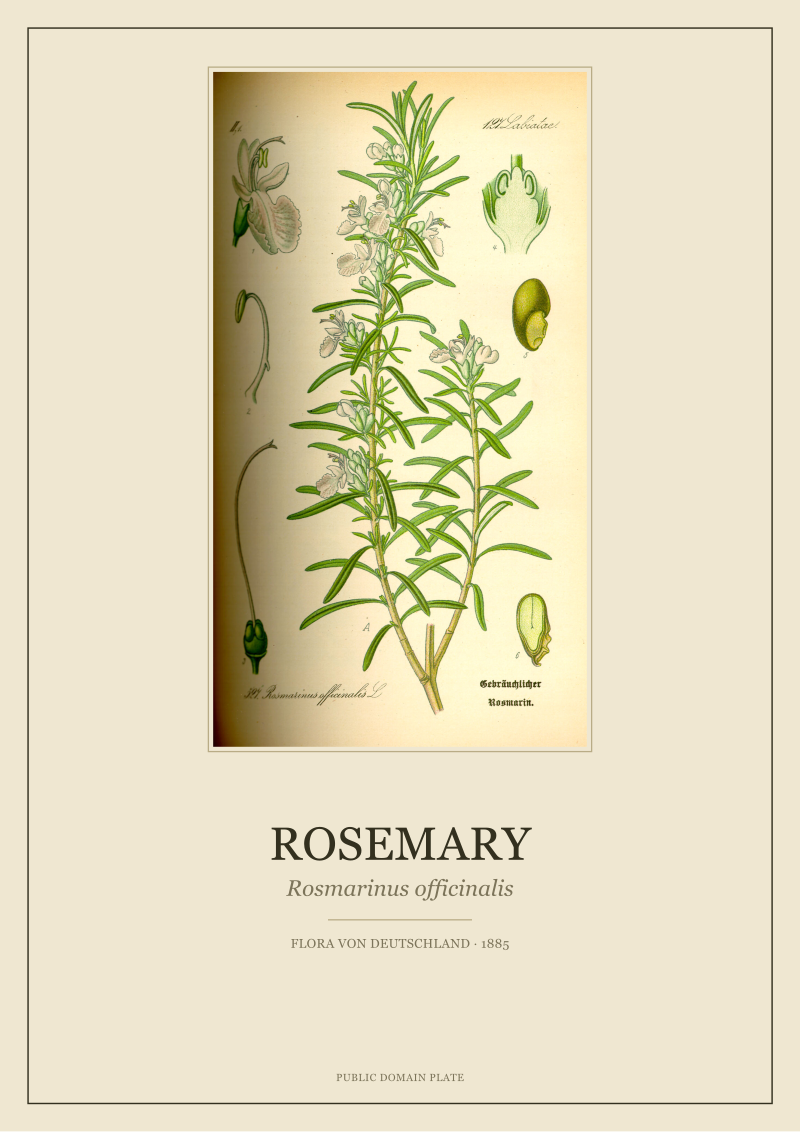
The sheet is quiet. A single upright stem, a few side branches, leaves arranged in the tight opposite pairs the species is known for, and a small clutch of flowers drawn with the patient exactness of a plate meant to teach. There is no landscape behind it, no gardener's hand, no vase, no censer. Thomé's convention across the Flora is to isolate the specimen against paper so the eye has nothing to argue with. What you get is the plant, and only the plant.
Read from the outside in, the drawing gives you the plant's habit first. Rosemary in the wild is a woody shrub, not a soft herb, and the plate lets you see that: the stem thickens toward the base, the branching is stiff rather than trailing, the whole silhouette holds itself upright the way a small evergreen would. The leaves are the second reading — narrow, blunt-tipped, with a slight inward curl that makes them look darker along the midrib. On an intact copy of the plate the underside of a leaf is often turned to show a paler, felted surface, which is one of the field marks a 19th-century student would have been taught to check.
The flowers are where a good illustrator earns their line. Rosemary's blooms are small, two-lipped and pale — usually described as blue-violet, sometimes closer to lilac, occasionally almost white. Thomé draws them clustered along the leaf axils rather than crowning the stem, which is botanically correct and quietly separates rosemary from the lavender-shaped clichés it is often lumped with. In several editions of the Flora, a corner of the plate carries an enlarged floral diagram: the corolla opened out, the stamens counted, the calyx sectioned. That is not decoration. It is the part of the sheet a teacher pointed at.
What the plate cannot show is scent, and scent is most of rosemary's cultural history. The drawing gives you architecture without atmosphere. That absence, we think, is honest — and it is where the lore has to be handled carefully, because the lore fills the silence the paper leaves.
What the Numbers Around the Plate Say
Four numbers, on this desk, do most of the work. One: 1885, the year Thomé's Flora is dated. Two: Rosmarinus officinalis, the Linnaean binomial that has organised the species in botanical literature since the 18th century. Three: Flora von Deutschland, Österreich und der Schweiz, the title of the work — a regional flora of German-speaking central Europe, not a Mediterranean monograph. Four: public domain, the licensing status that lets a studio in 2026 restore the plate at all.
Set those beside each other and a small tension appears. Rosemary is not, in the strict sense, a plant of Germany, Austria or Switzerland. Its native range is the northern Mediterranean basin — rocky, dry, sun-hard country from the Iberian peninsula through southern France, Italy and Greece into North Africa and the Levant. A 19th-century Flora of the German-speaking lands including it says something about the plant's status in central European gardens, kitchens and pharmacies of the time, not about wild occurrence. Rosemary was there because it had been introduced, tended, dried, sold and drawn for so long that a regional flora could not sensibly leave it out.
The 1885 date also sits inside a specific technical moment. Chromolithography — colour printing from stone — had matured across the 1860s and 1870s and was, by the mid-1880s, the standard way a Flora like Thomé's reached its audience. That is why the plates carry the flat, layered colour that modern eyes read as "old print": each shade of green, each hint of violet in a flower, corresponds to a separate stone and a separate pass through the press. The drawing was made once; the colour was manufactured, deliberately, again and again.
"Public domain" is the fourth number, and the least glamorous. It is also the reason any of this reaches your wall. A plate from 1885 by a German illustrator has long since exhausted every copyright clock in every jurisdiction that recognises such clocks. What our studio restores is not the plate — the plate belongs to the commons — but the specific 2026 restoration, scan by scan, dust speck by dust speck.
 Rosemary
The print from this article · from €29.95
View the print →
Rosemary
The print from this article · from €29.95
View the print →
What Nobody Mentions About "Herb of Remembrance"
Every rosemary article eventually reaches the same sentence: "There's rosemary, that's for remembrance." It is Ophelia's line in Hamlet, and it is quoted so often that the plant and the phrase have collapsed into each other. What most articles do not do is stop and ask what "remembrance" actually meant when Shakespeare's audience heard it.
By the late 16th and 17th centuries in England, rosemary had a settled ceremonial role at both funerals and weddings. Mourners carried sprigs; brides wore them; guests were sometimes handed a stem gilded or dipped in scented water. The word "remembrance" in this context is not the modern, softly nostalgic word we use for a school reunion. It carries the older sense of a token — a physical thing given so that a promise, a debt, a vow or a dead person will not be forgotten. Rosemary was chosen for that role partly because it is evergreen, partly because it holds its scent when dried, and partly because it was already familiar in domestic and devotional life. It survived the trip from kitchen to church without needing translation.
Two things get lost when this history is collapsed into a slogan. First, the association is heavily English and northern European in its literary form. The Mediterranean cultures where rosemary is actually native carry their own, older, and sometimes quite different attitudes to the plant — culinary before ceremonial, everyday before symbolic. Second, the "remembrance" tradition is a cultural claim about a plant, not a claim about the plant's chemistry or its effect on a human brain. It is a beautiful piece of history precisely because it is history, not because it is a mechanism.
Thomé's plate does not know any of this. It shows a shrub, drawn for students. The remembrance lore is something we, as readers, bring to the paper. It is worth bringing — provided we remember that we brought it.
The Real Cost of Reading Rosemary as a Cure
There is a familiar move in a certain kind of writing about old botanical plates: the illustration is used as a licence to talk about a plant's "traditional uses" and, from there, to slide toward advice. Rosemary is a particularly common target. Historical apothecary manuals mention it. Herbals mention it. Renaissance recipes for scented waters, oils and hair rinses mention it. A modern piece can then string those references together and imply, without ever quite saying so, that the reader might do the same.
We do not do that at this desk, and the reason is not squeamishness. It is that the cost of the slide is real. The apothecary tradition is a document of what people believed and practised — not a verified account of what worked. Framing centuries-old use as a recommendation compresses two very different registers, historical and clinical, into a single sentence, and readers reasonably assume the sentence is meant as guidance. When it is not accompanied by contemporary evidence, and when the writer has no standing to give such guidance, the sentence is doing work it should not be doing.
There is a second cost, subtler, that matters for a studio restoring plates. Every time a botanical illustration is dressed up as a health claim, the plate itself is diminished. It stops being a serious piece of scientific drawing from 1885 and becomes a decorative wrapper around an argument that has nothing to do with the paper. The line of Thomé's stem, the count of stamens in his floral diagram, the specific green he chose for the underside of the leaf — all of that vanishes behind a promise the drawing was never asked to make.
The honest reading is smaller and, we think, more interesting. Rosemary was drawn in 1885 because it mattered enough — botanically, culturally, commercially — to earn a plate in a regional flora. What people did with it in kitchens, at gravesides, in wedding processions and in apothecary jars is history. History is worth telling. It is not worth converting into instructions.
 Lavender
The print from this article · from €29.95
View the print →
Lavender
The print from this article · from €29.95
View the print →
If You Only Remember One Thing
Look at the plate before you look at the lore. The 1885 drawing of Rosmarinus officinalis is a piece of evidence in its own right — a specific illustrator, a specific work, a specific year, a specific way of seeing a plant. Everything else that has been said about rosemary, in poetry, in ritual, in old recipe books, sits around the plate but does not replace it.
The remembrance tradition is real, beautiful and worth keeping. It is also a cultural fact about people, not a medical fact about the plant. Hold those two things separately, and the drawing on your wall stays what it was drawn to be: a portrait of a Mediterranean shrub, quietly done, on paper old enough to have outlived every promise ever made in its name. The restored Thomé plate is available in the studio's shop if you'd like to sit with it on a wall of your own.
This piece did not cover Thomé himself in any biographical detail — his life, his teaching career, the full arc of the Flora across its editions — because that deserves its own portrait rather than a paragraph. It did not walk through the chromolithographic printing process step by step, which is a craft essay of its own. And it did not attempt to trace rosemary's cultivation history in the German-speaking lands the 1885 Flora catalogues, which would require primary sources we have not yet read closely enough to quote.
FAQ
Who was O.W. Thomé and why does his 1885 plate matter?
Otto Wilhelm Thomé was the illustrator and author behind Flora von Deutschland, Österreich und der Schweiz, a regional botanical flora of the German-speaking lands whose plates are dated 1885. His work matters for a studio like ours because his drawings were made to teach — clean isolation of the specimen, precise floral diagrams, restrained colour — which is exactly the kind of image that rewards careful restoration a century and a half later.
Is rosemary actually a native German plant, given it appears in a German flora?
No. Rosmarinus officinalis is native to the northern Mediterranean basin — parts of Iberia, southern France, Italy, Greece and North Africa. Its presence in Thomé's 1885 Flora of Germany, Austria and Switzerland reflects how deeply it had been integrated into central European gardens, kitchens and pharmacies by the 19th century, not a claim about wild occurrence. Regional floras of that era routinely documented long-established cultivated species alongside truly indigenous ones.
What does "public domain" mean for a plate from 1885?
It means the original illustration is no longer under copyright in any jurisdiction that recognises such rights, and can be freely reproduced. What a modern studio contributes is the restoration itself: the scanning, cleaning, colour recovery and print preparation of a specific 2026 edition. The 1885 drawing belongs to the commons; the restored file is a piece of contemporary craft built on top of it.
Where does the phrase "rosemary for remembrance" actually come from?
It is most famously Ophelia's line in Shakespeare's Hamlet, written around 1600. By that period, rosemary already had an established ceremonial role in English funerals and weddings, where sprigs served as tokens — physical reminders of a vow, a debt or a person. "Remembrance" in that sense is closer to "keeping one's word" than to modern nostalgia. The line codified a use that was already common in northern European ritual life.
Why does this article avoid talking about rosemary's health benefits?
Because our editorial rule at Botanic Walls is that historical apothecary use is history, not advice. Rosemary appears in old herbals and recipe books, and that record is worth telling as history. Translating it into recommendations for a modern reader would require clinical evidence and professional standing we do not claim to have. We keep the plate, the botany and the cultural history in view, and leave medical questions to people qualified to answer them.
What does the 1885 plate leave out that a photograph would show?
Scent, primarily. Rosemary's aromatic oils are central to how the plant has been used in kitchens, rituals and perfumery for centuries, and no drawing can carry that. The plate also cannot show the plant in situ — the dry rocky ground, the low Mediterranean light, the way the shrub sits among other Mediterranean species. Thomé's convention isolates the specimen for study. That isolation is a strength for teaching, and a limit for atmosphere.
How were the colours in an 1885 botanical plate produced?
Through chromolithography, the dominant colour-printing technique of the mid-to-late 19th century. Each colour on the sheet corresponds to a separately prepared stone and a separate pass through the press. The layered, slightly flat quality readers now associate with "antique botanical prints" is a direct result of that process. Restoring such a plate honestly means preserving that layered structure rather than smoothing it into a digital gradient.
Does the 1885 plate exist in different versions or editions?
Thomé's Flora was published and reissued across several editions in the late 19th and early 20th centuries, and individual plates can vary slightly between printings in colour registration, paper stock and margin condition. When we restore a plate we work from a specific source scan and document it. Two Thomé rosemary sheets from different editions are not identical objects, and a serious restoration acknowledges which one is on the desk.
New plates from the archive and 10% off your first print.
One email now with your code. No noise after.