You do not need to be a botanist to read a nineteenth-century plate, but you do need a small working vocabulary — otherwise the question "where does public domain botanical art come from" collapses into a shrug about "old books." It does not come from old books in general. It comes from specific floras, specific lithographers, specific print runs, and a specific legal clock that ran out decades ago. This is a glossary of the words we use in the studio when we handle a plate from O.W. Thomé's Flora von Deutschland, Österreich und der Schweiz (1885) — chamomile, ivy, cornflower, fennel — and try to be honest about what we are holding.
The Plate Itself
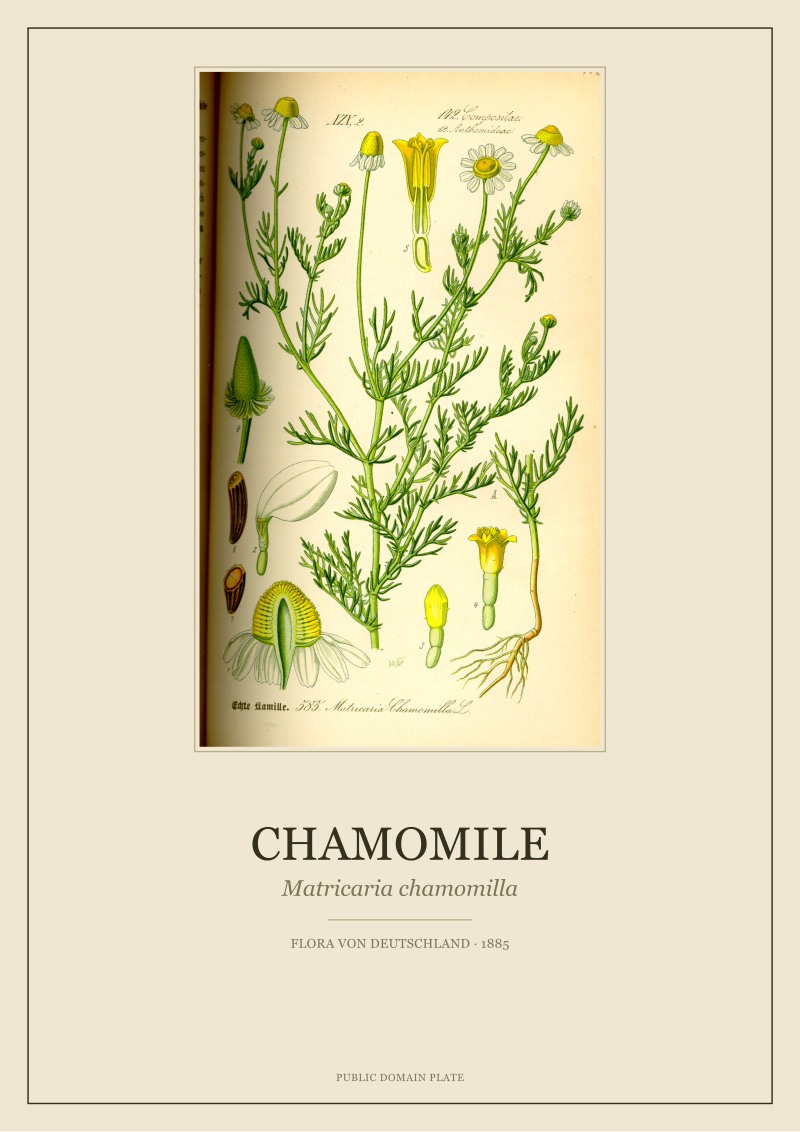
A plate, in botanical publishing, is a single sheet of illustration bound into a larger work — not a hand-painted original, and not a photograph. When we say we are restoring "the chamomile plate" from Thomé, we mean one specific printed leaf whose only job was to illustrate *Matricaria chamomilla* for a reader who had the accompanying text on a facing page.
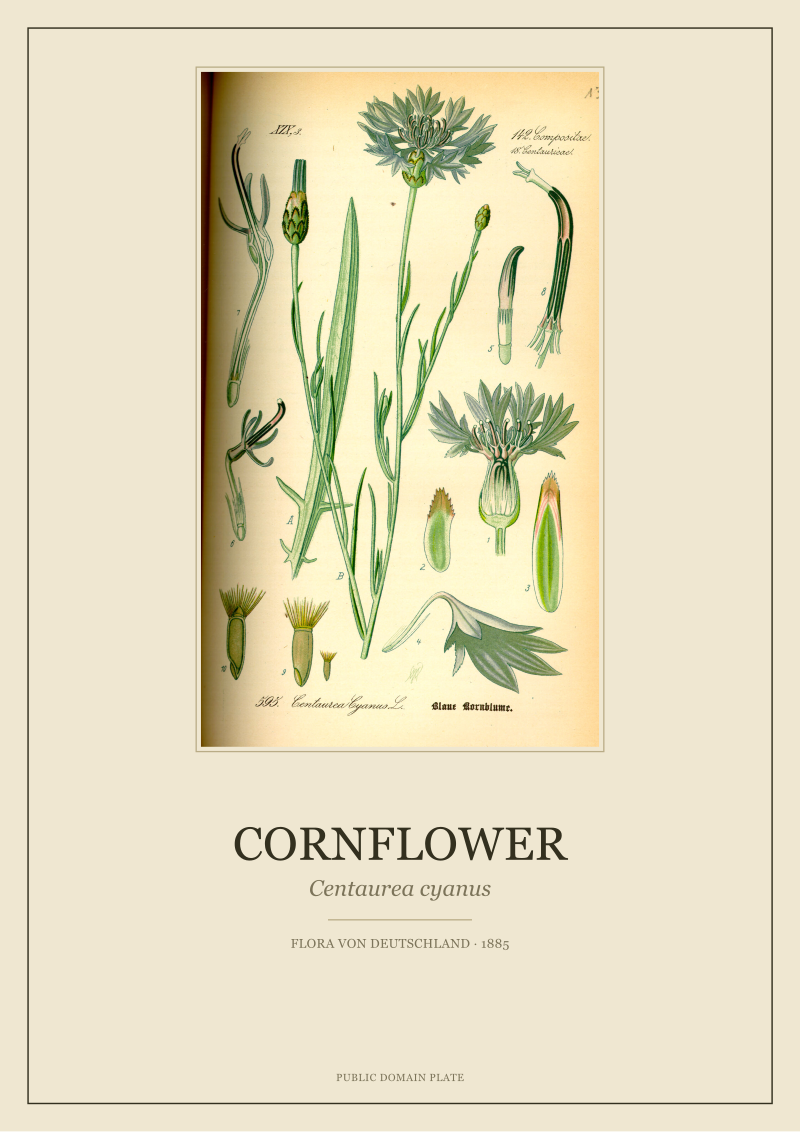
The word travels badly. People assume "plate" means a metal plate used to print the image; sometimes that is true, but for chromolithographic floras like Thomé's 1885 it referred to the finished illustration sheet as delivered to the binder. A plate is therefore both a physical object (a piece of coated paper, roughly book-page size) and an editorial unit (one species, one image, one number in a sequence). The cornflower — *Centaurea cyanus* — got its own plate in Thomé, not a corner of a shared one. That editorial decision is why we can lift it out today and hang it alone.
Public Domain
Public domain is a legal status, not a moral one, and this is the term that trips up almost everyone who has ever emailed us asking whether they are "allowed" to reprint a nineteenth-century flora. In most jurisdictions the copyright in an original illustration expires seventy years after the death of the author. Otto Wilhelm Thomé died in 1925, which places his work firmly in the public domain across the European Union and most of the world.
What that means in practice: no living heir can license the *Flora von Deutschland* plates, no publisher can revoke them, no museum can claim exclusive rights to the underlying image, and no restoration studio — including ours — can privatize a Thomé plate by cleaning it up. What a studio can own is the specific new file it produces: the labor of scanning, cleaning, colour-balancing and preparing for large-format print. The 1885 plate underneath remains everyone's. That distinction is the entire foundation of this trade.
 Chamomile
The print from this article · from €29.95
View the print →
Chamomile
The print from this article · from €29.95
View the print →
Flora
A flora, in the technical sense, is a book that inventories the plants of a defined region. Thomé's *Flora von Deutschland, Österreich und der Schweiz* — "Flora of Germany, Austria and Switzerland" — is exactly what the title claims: a survey of the vascular plants growing across the German-speaking lands, published beginning in 1885 as a teaching resource and reference work.
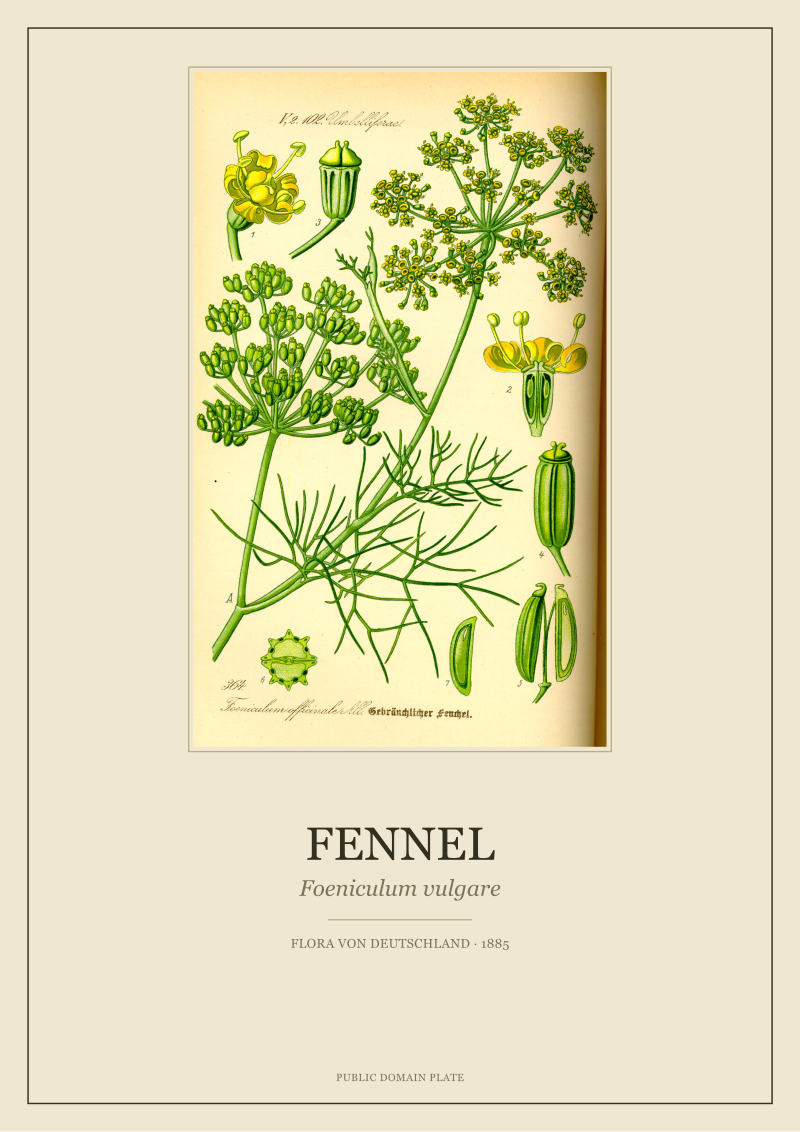
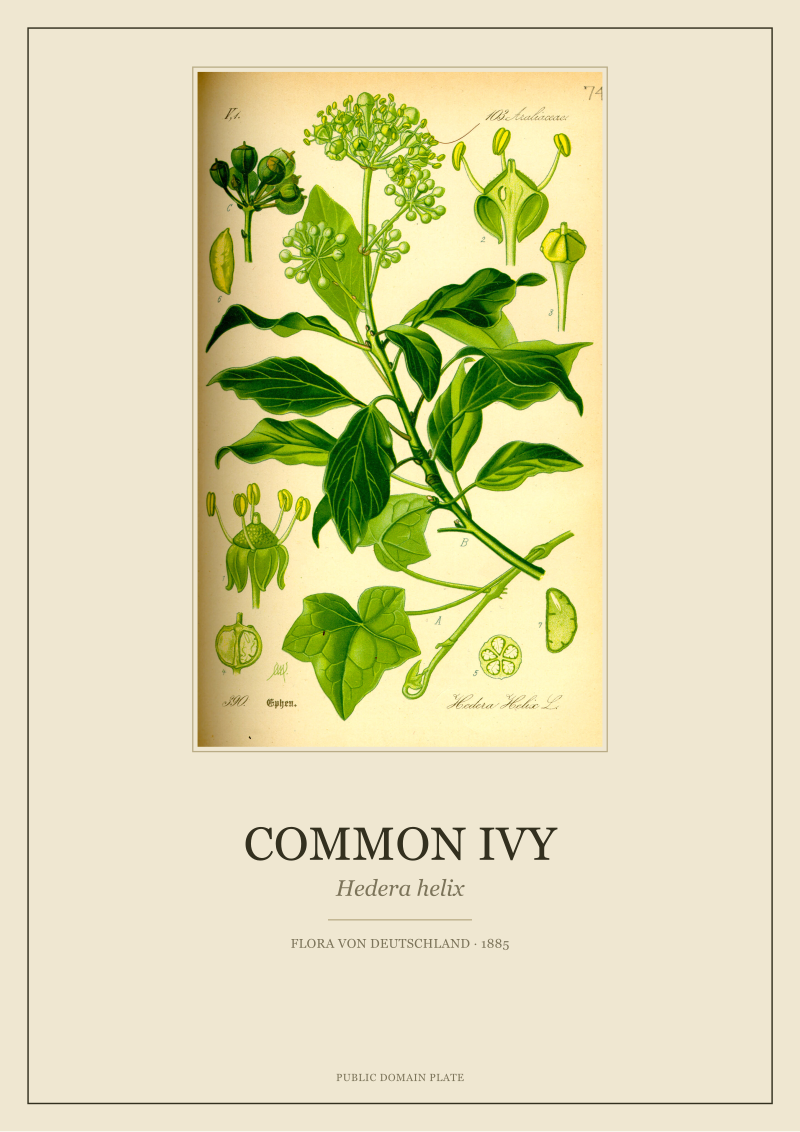
Why this matters for the public-domain question: the illustrations we call "vintage botanicals" almost never come from standalone art books. They come from floras — didactic publications with a scientific purpose, aimed at students, teachers and rural naturalists. That is where the plate of common ivy (*Hedera helix*) and the plate of fennel (*Foeniculum vulgare*) both lived: as reference material inside a multi-volume set intended to be opened flat on a schoolhouse desk. When we talk about the origin of most public-domain botanical art, we are really talking about the byproduct of nineteenth-century natural-science pedagogy, released back into circulation once its copyright ran out.
Chromolithograph
Chromolithography is the printing technique that gave nineteenth-century floras their colour, and it is the reason a plate from 1885 can still look startlingly saturated today. The process uses a separate limestone slab for each colour in the image; a skilled lithographer registers them in sequence so that the yellow, then the blue, then the red, then the darker outlines land on top of one another with (ideally) no gap and no overrun.
For Thomé's plates, this meant that the pale green of a chamomile leaf and the deeper green of an ivy leaf were not the same "green" pigment lightened — they were built up from different overlays. The visual density of a good chromolithograph, the way the ink sits *on* the paper rather than sinking into it, is a signature of the medium. Modern reproductions that flatten this into a single CMYK pass tend to lose the sensation of physical layers. Half of what a restoration studio worries about is preserving that stacked-ink quality across the digital step.
 Fennel
The print from this article · from €29.95
View the print →
Fennel
The print from this article · from €29.95
View the print →
Plate Number
Every plate in a formal flora carries a number, usually rendered as "Tafel" (the German for plate) followed by a numeral, printed discreetly in a corner. This is not decoration. It is the address of that illustration inside its parent work, and it is the piece of metadata that lets a librarian, a scholar or a restoration studio verify that a scan really comes from the edition it claims to come from.
When we receive a file purporting to be Thomé's cornflower, the plate number is one of the first things we cross-reference against surviving library copies. If the numbering does not match, either the source is not what it claims or the scan has been cropped past its own evidence. Plate numbers also anchor citations: a serious botanical reference to Thomé's fennel plate will name the volume and Tafel, not just "Thomé, 1885." That precision is why floras remained useful for a century after their science was superseded — you could always find the exact page again.
Latin Binomial
The Latin binomial is the two-word scientific name printed at the base of every plate — *Matricaria chamomilla*, *Hedera helix*, *Centaurea cyanus*, *Foeniculum vulgare* — and it is the single most important piece of text on the sheet, more important than the artist's signature and considerably more important than the common name. The first word is the genus, the second the species; together they identify the plant unambiguously across every language and every century.
For our purposes this matters because the common name drifts. "Chamomile" refers to at least three different plants in English-language usage; only *Matricaria chamomilla* is the one Thomé painted. When a client tells us they want "the chamomile print," we go back to the binomial to be sure we are shipping the same species the plate actually depicts. The binomial is also how a public-domain image survives translation: a plate labelled *Foeniculum vulgare* is still recognisable as fennel to a Portuguese botanist, an Italian herbalist or a Japanese archivist, regardless of what caption a later editor slaps on it.
Habitus
Habitus is the technical word for the whole-plant view — the illustration that shows the plant's overall form, including roots, stem, leaves, flowers and often the fruit or seed. Most Thomé plates are habitus illustrations with anatomical detail insets: the ivy plate shows the vine in its climbing form with a magnified inflorescence tucked to one side, the fennel plate shows the umbel structure alongside a section through a single flower.
This is a compositional choice with pedagogical logic. A student needed to recognise the plant in the field (which required seeing its overall shape) and also to identify it by reproductive structures (which required the enlarged details). For contemporary display, the habitus is doing quieter work: it is what makes a botanical plate feel like a portrait rather than a diagram. The subject stands upright on the page, unshaded, without background, in the same visual attitude as a formal photograph. That posture is why plates hang well as a series — the chamomile, the ivy, the cornflower and the fennel all face the viewer the same way.
Provenance
Provenance, borrowed from the art trade, is the documented chain of custody between the original object and the file in front of you. For a Thomé plate in 2026 that chain typically runs: original 1885 print run → institutional library copy → mid-twentieth-century preservation microfilm or later high-resolution scan → digitized upload to a public repository → download by a studio like ours → restoration workflow → final large-format file.
Every link in that chain matters. A plate scanned at 200 dpi from a re-bound library copy with foxing on the paper is not the same starting material as a plate scanned at 600 dpi from a first-edition volume kept in climate-controlled storage. Both are legitimately public domain. Neither can lie about what it is. When we describe a print in our own catalogue we try to say which library the scan traces back to and what shape the paper was in when it was captured. This is the museum-warmth version of a receipt. It is also the honest answer to the question "is this really from 1885" — the answer is not just "yes" but "yes, and here is how we know."
Restoration
Restoration, in the context of a public-domain plate, means the reversible digital work performed on a scan to bring it closer to how the original sheet looked when it left the printer in 1885 — not closer to how we imagine a nineteenth-century plate ought to look. Those are different targets. The first is bounded by the evidence in the file; the second is a fantasy that produces oversaturated, over-cleaned images that no library copy has ever supported.
Our restoration of Thomé's chamomile plate involves removing foxing artefacts introduced by paper ageing, correcting colour drift from the scanner's white balance, rebuilding torn margins where the binding cut into the image, and preserving — deliberately — the visible register lines of the original chromolithographic process. What we do not do is invent detail the plate never had, sharpen line-work past the ink's original weight, or shift the palette to match contemporary interior trends. If the ivy leaves in 1885 were a slightly desaturated green, they remain a slightly desaturated green in our file.
Scale of Reproduction
Scale of reproduction is the last term in the vocabulary and the one that changes everything about how a nineteenth-century plate reads. Thomé's original chamomile plate was printed at roughly book-page size — small enough to be held in one hand and studied at reading distance. A modern wall print of the same image at seventy centimetres tall is not the same object. The composition survives; the intimacy does not.
This matters when a plate crosses from library reference into interior context. Details that were pleasingly precise at book scale — the ridges on a fennel seed, the vein structure of an ivy leaf, the small floret cluster at the centre of a cornflower head — become architectural at wall scale. A pixel-thin printed line at 12 cm reads as a confident brushstroke at 70 cm; a scanner artefact invisible in a browser preview becomes a distraction the size of a fingernail. Working with public-domain botanicals seriously means knowing at what size the plate stops being a page and starts being a picture — and pricing the restoration to survive that transition. That threshold is what our own shop is organised around: plates prepared, at specific sizes, for the wall rather than the desk.
FAQ
Who was O.W. Thomé and why does his 1885 flora keep appearing in public-domain collections?
Otto Wilhelm Thomé was a German botanist and teacher whose *Flora von Deutschland, Österreich und der Schweiz* was published starting in 1885 as an illustrated reference for students and rural naturalists. The work went through several editions across the late nineteenth and early twentieth centuries, so many surviving copies exist across European libraries. Thomé died in 1925, placing his plates in the public domain in most jurisdictions well before contemporary digitization began, which is why they show up in almost every large public-domain botanical repository today.
Does "public domain" mean anyone can sell prints of these plates?
Legally, yes — in most jurisdictions no one can prevent anyone else from reproducing and selling images from Thomé's 1885 plates, because the underlying illustrations are out of copyright. What varies is the quality and provenance of the source file. A studio that has done its own high-resolution restoration owns the copyright in its restored file, not in the original plate. Two vendors can honestly sell "the same" Thomé chamomile print and offer materially different objects.
How can I tell if a "vintage botanical print" I'm buying is really from a nineteenth-century flora?
The strongest signals are metadata: the seller should be able to name the specific work (for example, Thomé's *Flora von Deutschland*), the year, the plate number and ideally the library source of the scan. The Latin binomial should match the species depicted. If the listing offers none of these — only vague language about "vintage botanical illustration" — the source may be a compilation of unrelated images or a modern pastiche in a nineteenth-century style.
What is the difference between a chromolithograph and a modern print of a chromolithograph?
A chromolithograph is a physical object produced in the nineteenth century by pressing paper against a succession of colour-loaded limestone slabs. A modern print of a chromolithograph is a digital reproduction of a scan of that object, output on contemporary paper with contemporary inks. The image is the same; the medium is entirely different. Serious sellers describe the second as "a print of a chromolithograph," not "a chromolithograph."
Why do Thomé's plates often look better than more recent botanical illustrations?
Chromolithography as a medium held colour in a way that modern four-colour offset printing struggles to match, because each pigment was laid down as its own layer of physical ink rather than dithered from a common process set. Combined with the didactic clarity of nineteenth-century botanical composition — a whole plant, upright, without background — the plates read cleanly at almost any scale. It is not nostalgia; it is a genuine artefact of an older printing technique.
Are plates from other nineteenth-century floras also in the public domain?
As a general rule, illustrations whose creators died more than seventy years ago are in the public domain in most jurisdictions. That covers most nineteenth-century floras, but the specific status depends on the country of publication and the country in which the image is being used. When in doubt, the safest reference points are the death date of the illustrator and the publication date of the flora — both should be well before the twentieth century for the plate to be uncontroversially free.
Why does the same plate look different across different online sources?
Because you are looking at different scans, made from different physical copies, on different scanners, with different colour profiles. One library's copy of Thomé may have yellowed more than another's; one scan may have been colour-corrected aggressively, another left raw. None of these versions is more "authentic" than another in a metaphysical sense — they are all valid witnesses to a plate whose original state we can only approach through the surviving prints.
From the collection
New plates from the archive and 10% off your first print.
One email now with your code. No noise after.