We started with a simple question: when did a British household first acquire a fern the way it acquired a print — deliberately, catalogued, framed as an object of taste? The paper trail runs backwards through nursery lists, natural-history quarterlies and the pulpit prose of one Charles Kingsley, who in 1855 named the whole business pteridomania. What we found was not a fashion. It was a five-decade collecting mania with a specific technology (the Wardian case), a naming manual (Newman's 1840 History of British Ferns), a coiner (Kingsley), and an ecological cost that the era's own botanists were already documenting by the 1860s. This article walks the timeline plate by plate.
1829: Nathaniel Bagshaw Ward Seals a Glass Box in East London
The mania needs a technology before it needs a name, and the technology is a physician's accident in Wellclose Square. Nathaniel Bagshaw Ward, a London doctor with a botanising habit, had for years been losing ferns to the sulphurous air of the East End — soot from the neighbouring foundries killed everything he tried to grow in an open garden. In 1829, according to his own later account in *On the Growth of Plants in Closely Glazed Cases* (1842), he sealed a hawkmoth chrysalis into a wide-mouthed glass jar with a little damp mould, meaning to watch the insect emerge. What emerged, weeks later and unannounced, was a seedling fern and a blade of grass, sprouted from spores already in the soil, thriving inside the closed jar for months.
The implication took him longer to work out than the observation. Ward realised the glass was doing three things at once: keeping the London air out, keeping the soil moisture cycling, and admitting light. The device the trade would come to call the Wardian case was, in effect, a portable microclimate. By the mid-1830s he was sending plants around the world in glazed boxes on the decks of merchant ships — the first shipments to survive months at sea. By the 1840s, cabinetmakers were producing parlour versions, and a middle-class family that could not keep a live fern in the kitchen window could now keep a dozen under glass in the drawing room. The mania has its enabling instrument on the table before it has its readership.
1840: Edward Newman Publishes the Manual That Made Every Frond Nameable
A craze cannot organise itself without a book to argue with. That book arrived in 1840, when the entomologist and printer Edward Newman brought out *A History of British Ferns*, the first popular volume to give every native British species a plain-English description, a habitat note, and — the crucial editorial move — a figure the reader could hold against a specimen. Newman ran through second and third editions in short order; the 1854 edition, revised and expanded, is the one most surviving Victorian fern presses were compiled against.
What Newman did that mattered was less scientific than social. He translated a Linnaean apparatus that had lived in Latin monographs and university herbaria into a nomenclature a curate, a schoolmaster, or a governess could use on a Sunday walk. Before Newman, an amateur returning from a Devon lane with an unfamiliar frond had no clean way to identify it without a correspondent at Kew. After Newman, the same amateur had a list, a key, and — implicitly — a target. Because the manual enumerated the British ferns as a finite set, it turned the countryside into a collectable series, the way a stamp catalogue turns a postal system into a game.
The publication also seeded the ancillary trades. Nurserymen began stocking named cultivars; printers issued fern albums with blank leaves for pressed specimens; instrument makers advertised trowels, vasculums and travelling presses in the back matter of natural-history quarterlies. By the late 1840s the market existed. It only lacked a slogan.
1855: Charles Kingsley Coins "Pteridomania" in Glaucus
The slogan arrived in a book meant to be about something else. In 1855, Charles Kingsley — Anglican priest, novelist, later Regius Professor of Modern History at Cambridge — published *Glaucus, or The Wonders of the Shore*, a slim volume urging readers of both sexes to take up the study of seaside natural history as a corrective to what he considered the moral idleness of resort life. Somewhere in that argument, in a passage that has been quoted almost as often as it has been misquoted, Kingsley named the parallel phenomenon he saw creeping across the drawing rooms of Torquay and Ilfracombe: pteridomania, from the Greek *pteris* for fern.
Kingsley did not invent the enthusiasm — the previous section shows it was already fifteen years mature. He named it, which is a different and more consequential act. Naming a thing gives the press a headline word, gives the moralists an object to scold and the promoters a shorthand to sell against. Within a decade, "pteridomania" was being used unironically in nursery catalogues and ironically in *Punch*. Kingsley's own tone was ambivalent: he approved of the natural-history impulse and worried at the collecting compulsion, particularly among what he called "young ladies" whose parlours were beginning to look like miniature Devonian ravines under glass.
The coinage matters editorially because it is the moment the mania becomes legible to historians. Before *Glaucus*, the archive shows scattered evidence of a widespread practice; after *Glaucus*, the archive shows a movement with a name, and every subsequent invoice, sermon, satirical print and prosecution can be tagged to it.
1860s: The Fern Rush Reaches the Hillsides — and the Prosecution Records
By the 1860s the mania had run past its parlour phase and out into the hillsides, with consequences the botanical press was already reporting in real time. The pattern is the one every collecting boom eventually produces: as named cultivars became scarce in nurseries, professional and semi-professional collectors began working the wild populations, particularly in Devon, Cornwall, the Lake District, Snowdonia and the wetter valleys of the west of Ireland. Contemporary reports in *The Gardeners' Chronicle* and in local newspapers describe entire cliffs stripped of their filmy ferns; ravines that had held the *Trichomanes* in living memory were, by the 1870s, being visited by disappointed naturalists who found only bare rock.
The prosecutions and the private laments run through the same decade. Landowners in the Lake District posted notices; a small trade in fern-lifting spades and packing crates was worked by men who supplied Manchester and Birmingham dealers by rail. Botanical societies began pressing for protection language in local bylaws; Ireland's *Trichomanes speciosum* — the Killarney fern — became the era's canonical extirpation story, its stations kept secret by the last botanists who knew them.
The interesting editorial fact about this decade is that the ecological argument against pteridomania was made by botanists loyal to the craze itself. They wanted the ferns to survive because they loved the ferns. What they did not have was a legal instrument; British wild plant protection would not arrive in any serious form until the twentieth century. So the decade's characteristic document is the pained journal note by a collector reporting that a station he first recorded in 1852 was, by 1868, empty. The mania had begun to eat its object.
1885: Thomé's Flora Prints the Ferns the Collectors Could Not Keep
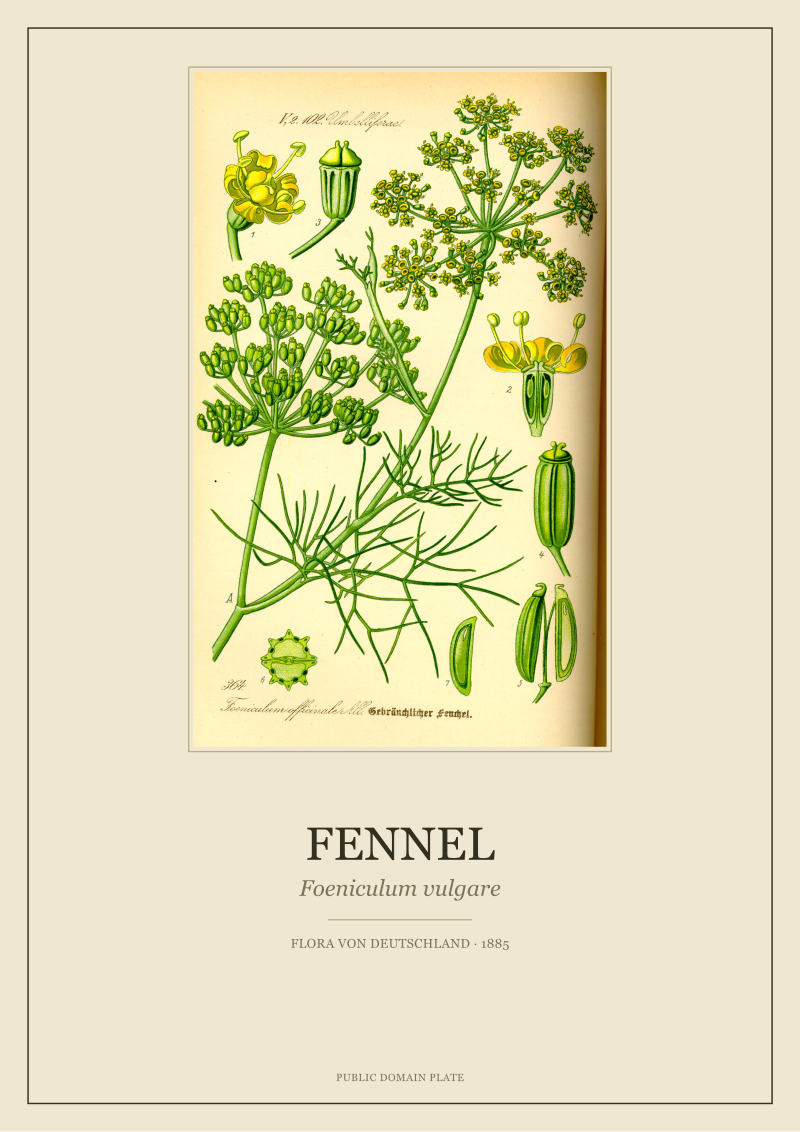
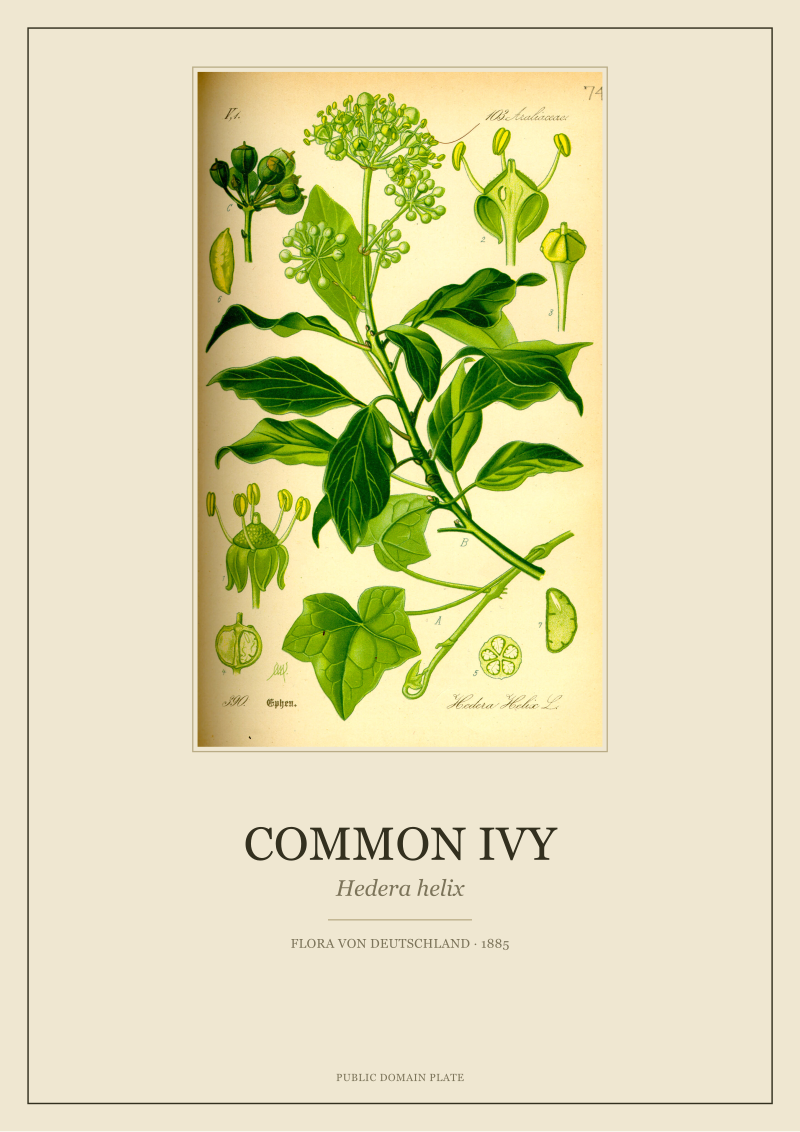
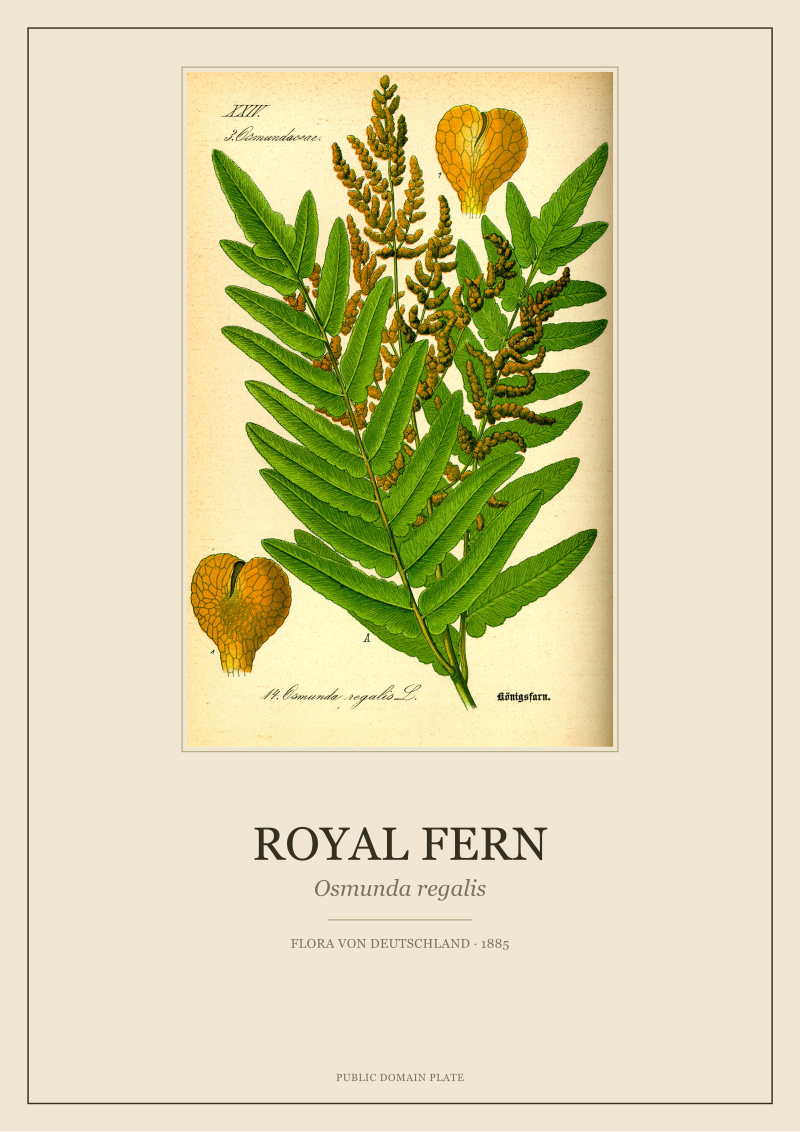
While the wild populations were thinning, a parallel and slower project on the Continent was doing what the hillsides could no longer do: fix the plants on paper. Otto Wilhelm Thomé's *Flora von Deutschland, Österreich und der Schweiz*, published in Gera from 1885 onward, set out to depict the entire vascular flora of German-speaking Europe in coloured plates of a consistent scientific standard — the habit at the centre of the sheet, a dissection of the reproductive parts at the margin, a plain caption identifying species and family. It is the tradition that our studio restores; the plates we hold from that work — Common Ivy (*Hedera helix*), Chamomile (*Matricaria chamomilla*), Cornflower (*Centaurea cyanus*), Fennel (*Foeniculum vulgare*) — are sister images to the fern sheets bound into the same set.
Thomé was, in the ordinary schoolmaster sense, not a Victorian at all; he was a German gymnasium director writing for a Central European scientific readership, not for the English-speaking mania. But the timing is precise. His flora appeared exactly as the wild British fern colonies were being reported as damaged or gone, and exactly as chromolithography — the multi-stone colour printing technology that made those plates possible at a subscription price — was reaching its technical peak. A middle-class household that in 1855 might have paid a collector to lift a *Osmunda* from a Welsh streambed could, thirty years later, subscribe to a scientific flora and receive an accurate, permanent, unkillable version of the same plant on rag paper.
That substitution — living specimen replaced by faithful plate — is the quiet argument Thomé's project makes to the collecting era it survives. The plates outlast both the mania and, in some cases, the wild colonies the mania emptied.
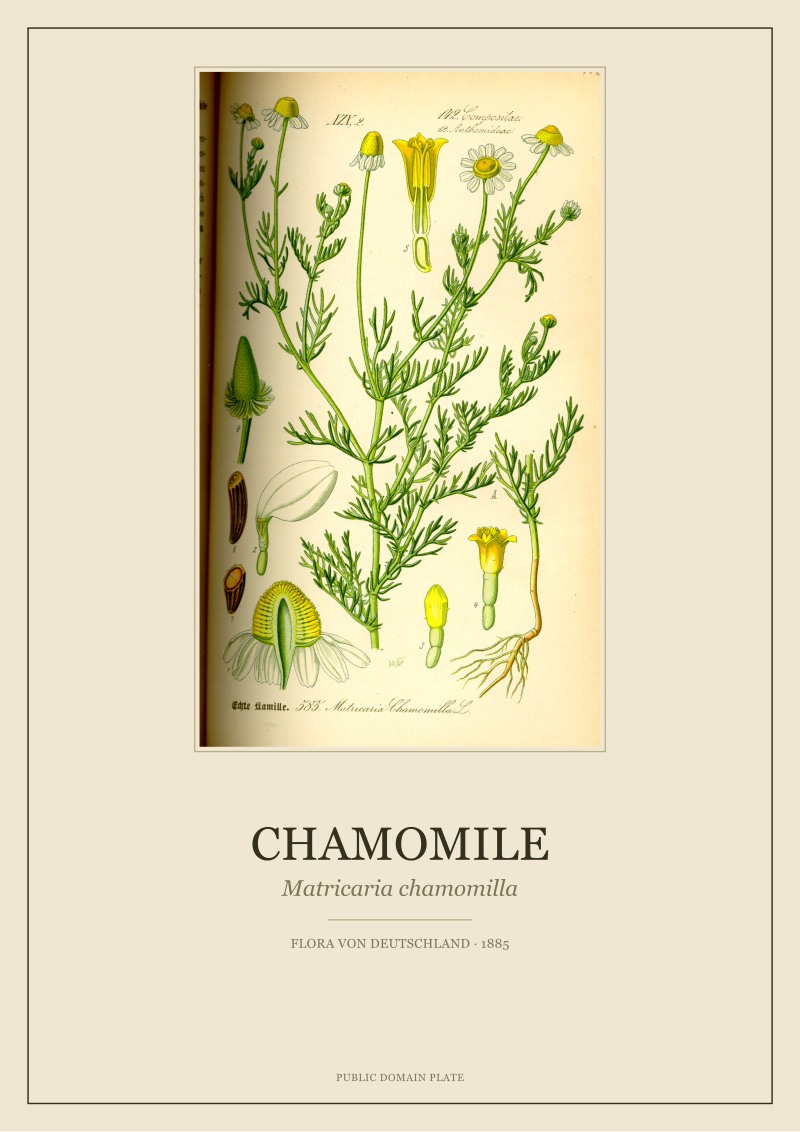 Chamomile
The print from this article · from €29.95
View the print →
Chamomile
The print from this article · from €29.95
View the print →
What It All Means: Why the Print Outlived the Craze
The five decades from Ward's sealed jar to Thomé's finished flora describe a full arc: a technology enables a hobby, a manual makes the hobby precise, a coiner gives it a name, an economy turns it destructive, a printing tradition preserves what the economy could not leave alone. Each step is dated and documented. None of it was inevitable, and the ecological damage of the middle decade was foreseen and mourned by people who thought of themselves as friends of ferns, which is a lesson that recurs in every collecting mania since — orchid, cactus, alpine, aroid.
The reason the print outlived the craze is not sentimental. It is material. A pressed fern in an album loses colour and structure within a generation; a Wardian case in a Victorian parlour survives only as long as somebody remembers to water it; a stripped hillside recovers, if at all, over a human lifetime. A chromolithographic plate on good paper, kept out of direct sun, will read at close to its original fidelity a hundred and forty years later. That is the accidental gift of the whole episode. The Victorian household that framed a fern print rather than pressing a live frond had chosen, without knowing it, the version of the plant that would still be legible in 2026.
The plates we restore sit in that lineage. We handle Ivy, Chamomile, Cornflower and Fennel from the 1885 flora because the tradition Thomé and his engravers built was catholic — it covered the wall-climbers, the meadow flowers, the kitchen herbs and, on facing pages of the same set, the ferns the pteridomaniacs had tried and failed to keep alive at home. When we work on those sheets today in the studio, at very high resolution and with a scanner rather than a spade, we are continuing the substitution the Victorians stumbled into: the print that survives the plant.
FAQ
What does the word "pteridomania" actually mean, and who first used it in print?
The word joins the Greek *pteris* (fern) with the Latin-derived *mania* (a compulsive enthusiasm), so it literally reads as "fern-madness." Charles Kingsley put it into print in 1855 in *Glaucus, or The Wonders of the Shore*, using it to describe the drawing-room fashion for collecting, growing and displaying ferns that was by then already well established in middle-class British households. Kingsley did not invent the practice; he named it, and the name stuck in the general press within roughly a decade.
Why were Wardian cases so central to the fern craze?
The Wardian case — the sealed glazed box Nathaniel Ward accidentally invented in 1829 — solved the specific problem that made most Victorian parlours hostile to ferns: coal-smoke air and dry indoor heat. Inside the glass the moisture cycled and the sulphurous atmosphere stayed out, so species that would die within days on an open windowsill could live for years. Without that device, the mania would have been confined to greenhouse owners; with it, ferns became furniture.
Did the Victorian fern craze really damage wild populations?
Yes, and the record for this is contemporary rather than retrospective. From the 1860s onward, articles in *The Gardeners' Chronicle* and local papers in Devon, the Lake District, Snowdonia and Ireland reported ravines and cliffs stripped by commercial fern-lifters supplying urban dealers. The Killarney fern, *Trichomanes speciosum*, became the emblematic case, its Irish stations reduced to a few kept-secret locations. British wild-plant protection law lagged the damage by many decades.
Is Thomé's *Flora von Deutschland* the same book as a Victorian English fern manual?
No, and the distinction matters. Otto Wilhelm Thomé's flora, first issued in 1885, is a Central European scientific work in German, aimed at a botanical readership across Germany, Austria and Switzerland. It is not part of the British popular-mania literature — Newman's 1840 *History of British Ferns* fills that role. What Thomé's flora provides is the plate tradition, executed to a high chromolithographic standard, that captured European species (ferns included) exactly as living populations elsewhere were being damaged by collecting.
How can I tell whether a fern print on the market is genuinely from the 1885 tradition?
The reliable diagnostics are the caption format, the plate composition and the paper. Thomé plates carry printed captions with species name, family and figure number; the plant is shown in habit with a dissection of reproductive parts at the margin, on rag paper of consistent weight. Reproductions on modern coated stock, or images stretched to fit a decorative frame ratio, are easy to spot once you have handled the originals. When in doubt, ask the seller to identify the source flora and edition.
Did the mania include men, or was it really only a "ladies' pastime" as *Punch* suggested?
The satirical press liked to code pteridomania as feminine, but the archive does not support that reading. The founding technologist (Ward), the coiner (Kingsley), the manual author (Newman), the major nurserymen and the most destructive commercial collectors were all men. Women collected, pressed, painted and catalogued ferns in large numbers, but the mania was a full-household phenomenon and, in its commercial and scientific expressions, dominated by men. The joke was cultural, not demographic.
Why does the print survive when the pressed fern and the potted specimen usually do not?
Pressed fronds lose their green within a generation and become brittle; live specimens in Wardian cases require continuous care and rarely outlast the family that keeps them; wild populations, once collected out, recover slowly or not at all. A chromolithograph printed in 1885 on rag paper, if kept out of direct sunlight and stored flat, still reads at close to its original colour and line 140 years later. The print is simply the most durable form the plant can take at domestic scale — which is the quiet reason our studio restores the plates at see the Chamomile print rather than trying to preserve anything else about the era.
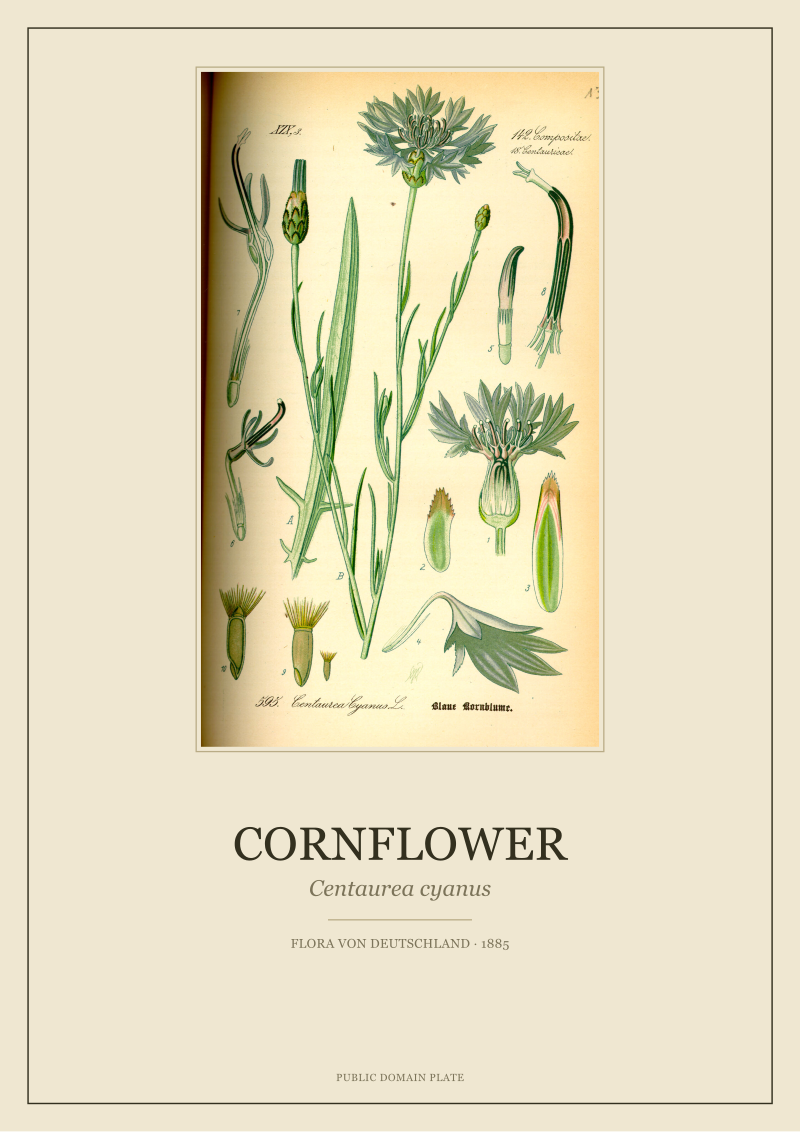 Cornflower
The print from this article · from €29.95
View the print →
Cornflower
The print from this article · from €29.95
View the print →
New plates from the archive and 10% off your first print.
One email now with your code. No noise after.