The email arrived at 11:14 on a Tuesday last September, the fourth one that month. A reader in Lyon had bought our restored Hedera helix plate, framed it above the dining table, and now wanted to know — since we evidently cared about leaves — how she might cast one in plaster herself. We do not cast. We restore 1885 lithographs from Thomé's Flora von Deutschland by hand and code. But the question keeps arriving, usually from people who have watched one of those glossy Instagram reels where a hand presses an ivy leaf into white powder and the leaf, impossibly, emerges whole. This piece is a flowchart in prose. Three questions, routed answers, one honest table at the end.
Question 1: Are You Casting for the Plant, or for the Shelf?
This is the fork that decides everything else, and almost no tutorial on the internet asks it. A plaster cast is either a document — an honest record of what a specific leaf looked like at a specific hour — or it is an object meant to live on a wall and look vaguely botanical from across the room. The two goals pull in opposite directions. The documentary cast respects the vein that is bent, the edge that is torn, the asymmetry Thomé drew into every Hedera helix leaflet in 1885 precisely because real ivy is never symmetrical. The decorative cast flattens, idealises, and gently lies.
The reel you watched probably optimised for the shelf. The leaf came out ghost-white and perfect because the maker chose a leaf that was already perfect, pressed it with a palm into fresh plaster, lifted cleanly, and cropped out everything that didn't photograph well. That is a legitimate craft. It is not the same craft as casting the chamomile sprig your grandmother grew.
If For the Plant
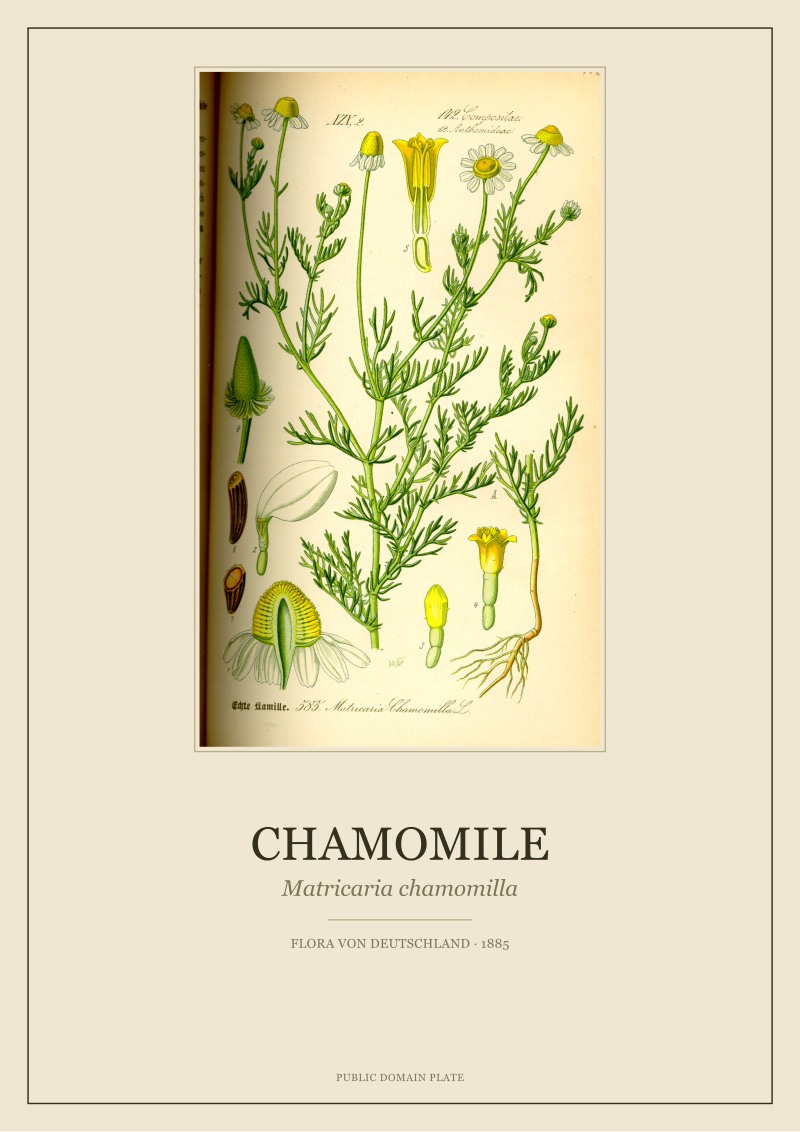
You are closer to what the 19th century called a natural-history impression than to decor. The constraints are different. You will want a plaster that captures the fine detail of a Matricaria chamomilla leaf's dissected pinnae without flooding the air pockets between them, which means a finer casting plaster (often sold as pottery or ceramic plaster rather than the hardware-store sort), a slower pour, and a release agent you choose with the plant in mind rather than whichever spray was on the shelf.
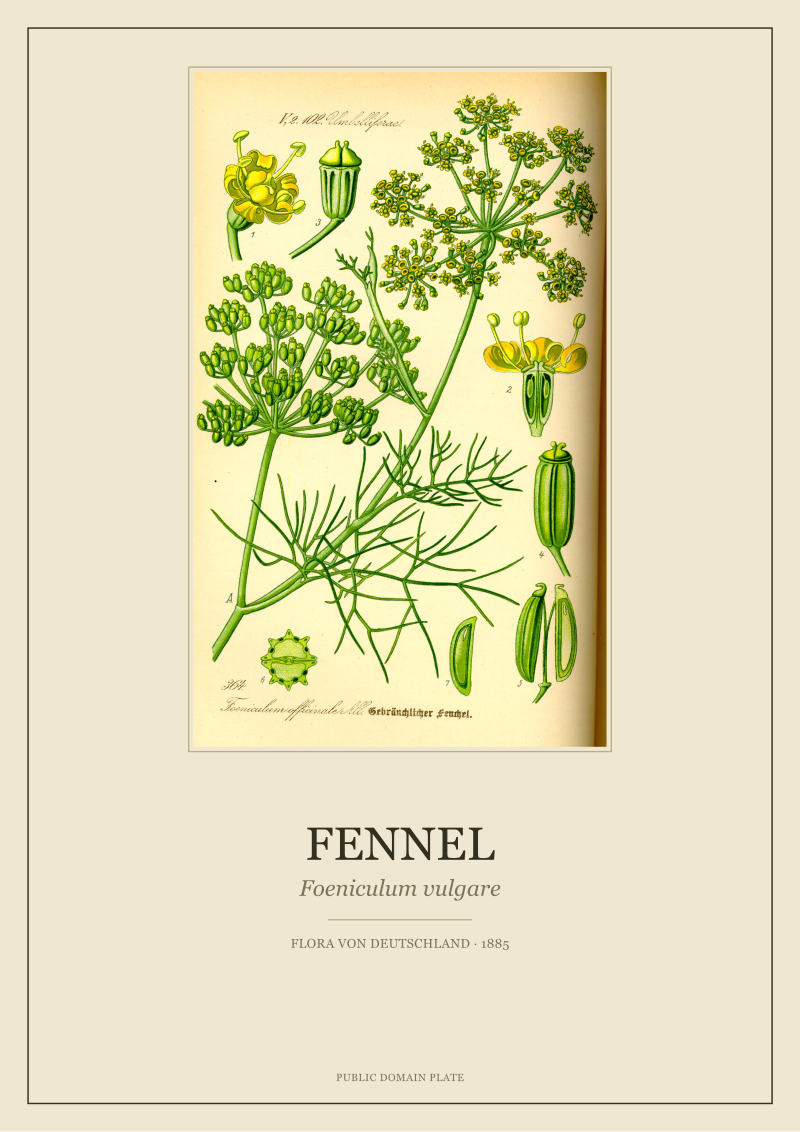
The documentary route also means you accept the result the plant gives you. A fennel umbel is three-dimensional in a way a flattened cast cannot honour. If you force it, you will produce a cast that lies about Foeniculum vulgare — the same lie Instagram makers tell about every herb with a complicated silhouette.
If For the Shelf
Pick a leaf that is already decorative — a mature Hedera helix with the classic five-lobed shape, waxy upper surface, visible but not fussy venation — and commit to the compromise. You are making a sculpture that references a leaf, not a leaf. The plaster can be coarser. The pour can be fast. The leaf you choose will almost certainly not be the leaf your plant actually offered you first; it will be the third or fourth one, the one that looks like what people think ivy looks like.
There is no shame in this, but we would ask you to be honest with yourself about what you are doing. You are not preserving the plant. You are producing an interior object inspired by it. If that is enough, the rest of this piece gets simpler for you.
Question 2: Is the Leaf Fresh, or Has It Been Pressed for a Week?
The second fork is a timing question, and it is where most reel tutorials quietly cheat. The hand that presses the ivy leaf into the plaster in the fifteen-second video did not pick that leaf fifteen seconds earlier. Fresh leaves fight back. They curl at the edges when they lose turgor, they bleed sap that reacts with gypsum, and they shed cuticle fragments into the mould that come out as pits in the finished cast. The maker in the reel almost certainly pressed that leaf under a book for several days first, and simply did not show you the book.
The question matters because it determines what the cast will look like three months after you make it, not three minutes. Fresh-cast plaster with trapped moisture crazes. Pressed-leaf plaster is more stable but reads flatter — the three-dimensionality of a living leaf has already been sacrificed before the plaster arrives.
If Fresh
You will need to accept moisture management as part of the process. The leaf should be picked within an hour of casting, blotted with a soft cloth to remove surface water (not sap), and used immediately. Fresh casts of chamomile foliage in particular are difficult because the leaves are so finely divided that each pinna acts as a tiny wick, pulling plaster into itself and refusing to release cleanly.
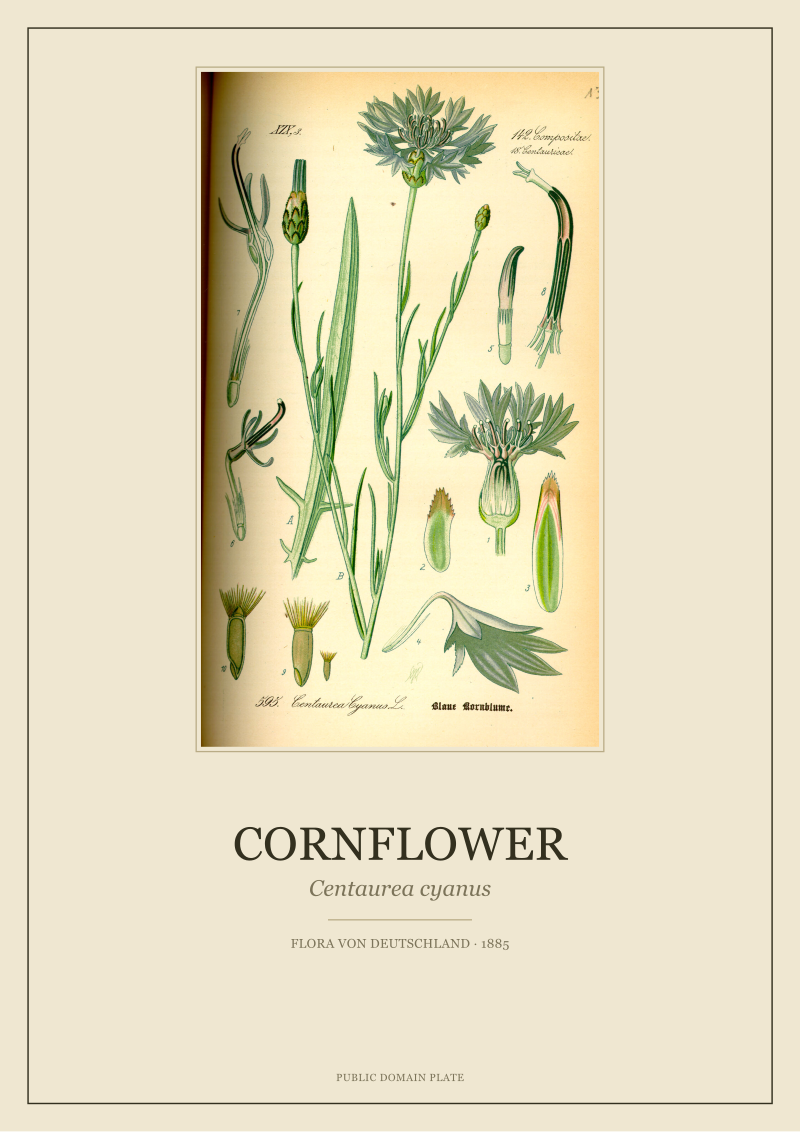
Honest answer: for fresh work, start with a thicker leaf. A single Hedera helix leaflet behaves. A cornflower bract — Centaurea cyanus has those small scaly involucres around the flower head — is a nightmare, and anyone selling you a tutorial that says otherwise has not actually tried it with cornflower.
If Pressed
The leaf has already surrendered its depth and its moisture. The casting will be more predictable, but you are now casting a two-dimensional object into what is essentially a shallow relief tile. Press the leaf between absorbent sheets under weight for five to seven days, and keep it between those sheets right up until the moment of pour. Air exposure after pressing causes slow curl which will register as warp in the final plaster.
A pressed-leaf cast is closer to a botanical plate than to a sculpture. That is not a bad thing. The 1885 lithographs we restore were themselves descended from pressed specimens — Thomé worked from herbarium sheets, not from live plants in his hand. If you accept this lineage, the pressed route stops feeling like a compromise.
 Chamomile
The print from this article · from €29.95
View the print →
Chamomile
The print from this article · from €29.95
View the print →
Question 3: Are You Willing to Destroy the Leaf to Keep Its Shape?
Most reel tutorials never raise this one either. The leaf you press into the plaster does not survive. It cannot. Either you remove it from the setting plaster while it is still soft, in which case you take fragments of the mould surface with it, or you leave it embedded, in which case it browns, decays and leaves a stain. The ghostly perfect cast you have been scrolling past is a cast where the leaf was removed and the resulting damage was retouched by hand before the photograph was taken.
So the honest question is whether you consent, in advance, to the destruction of the specimen for the sake of the record. For a leaf picked from your own garden Hedera, this is uncomplicated. For a leaf from a plant that mattered to someone — the chamomile from a departed grandmother, the fennel from a first allotment — the answer should be slower.
If Yes
Treat the leaf as the preparatory sketch, not the artwork. Pick several candidate leaves rather than a single one, and expect to lose some to tearing during release. Plan the cast with the leaf's removal in mind: shallow pours, generous release agent, the leaf lifted at the edge rather than the stem to avoid shearing the midrib across the mould face.
Accept that the finished plaster is a record of a leaf that no longer exists. This is not a sentimental sentence. It is the same bargain every natural-history draughtsman has made since the 16th century. The plate survives; the specimen does not. Thomé's chromolithographs of Matricaria chamomilla outlived every chamomile plant their draughtsman ever handled by at least a hundred and twenty years.
If No
You are in a different craft. What you want is not a cast but a photographed or scanned impression — the leaf laid on a flatbed, lit evenly, captured at high resolution, and preserved digitally without ever touching plaster. This is closer to the method we use for the plates in our shop at /shop/, where every surviving sheet of Thomé's 1885 Flora is captured and restored without being altered in substance.
The flatbed route gives you a document the leaf can walk away from. The plaster route gives you an object the leaf cannot. Choose with your eyes open.
If You Answered Everything: The Recap Table
Eight branches, one row each. The recommendation column is deliberately short — a sentence, not a procedure — because this piece is a routing document, not a workshop manual.
| Q1: Plant or Shelf? | Q2: Fresh or Pressed? | Q3: Destroy the Leaf? | Recommendation |
|---|---|---|---|
| Plant | Fresh | Yes | Fine casting plaster, pick a thick leaf, accept that this specimen ends here. |
| Plant | Fresh | No | Abandon casting; use a flatbed scan or a herbarium press instead. |
| Plant | Pressed | Yes | Honest relief tile; closest route to a Thomé-style botanical document. |
| Plant | Pressed | No | Press and scan the leaf; keep it in a sleeve, never pour plaster. |
| Shelf | Fresh | Yes | Decorative sculpture; pick a photogenic ivy leaf, don't pretend it's documentary. |
| Shelf | Fresh | No | You want a silicone mould workflow, not a direct plaster impression. |
| Shelf | Pressed | Yes | Flat decorative tile; cheap plaster is fine, lower your expectations of fidelity. |
| Shelf | Pressed | No | Buy or print a botanical plate; this question wasn't actually about casting. |
The last row is not sarcasm. Many of the readers who write to us about plaster casts discover, after a conversation of a few emails, that what they actually wanted was a wall object with botanical presence and were only reaching for plaster because the algorithm showed it to them first. A restored 1885 Hedera helix plate hanging above a dining table does the same decorative work and asks less of its maker and the plant.
Whichever row you landed on, the next question is no longer how. It is why — and whether the leaf in front of you is the one the project actually needs.
 Cornflower
The print from this article · from €29.95
View the print →
Cornflower
The print from this article · from €29.95
View the print →
FAQ
What kind of plaster do botanical casters actually use?
There are two broad families. Plaster of Paris — the hardware-store kind — is cheap, sets fast, and captures only coarse detail; it is adequate for decorative tiles. Fine casting plaster (sold variously as pottery plaster, ceramic plaster or alpha gypsum) sets slower, picks up finer venation, and is closer to what 19th-century naturalists used for impression work. Neither captures a leaf as faithfully as a flatbed scan. If the goal is documentary fidelity, scan first, cast second — or not at all.
Why do my casts come out with bubbles or pits in the leaf detail?
Three usual causes, roughly in order. First, the plaster was mixed too fast and trapped air; let it stand for a minute before pouring. Second, the leaf had surface moisture or sap that formed a boundary layer between gypsum and vein; blot before casting. Third, you poured onto a leaf that was already past its freshness window and had begun to shed cuticle. The pits are where cuticle flakes stuck to the plaster and lifted away with the leaf.
Can I reuse the plaster mould to make multiple identical casts?
Not with a direct leaf impression — the mould face is damaged when the leaf is removed, and the leaf itself cannot be reused. For editions, the standard workflow is to cast once into plaster, then take a silicone mould from that first plaster original, then cast subsequent copies from the silicone. This is a sculptor's workflow, not a botanist's, and it moves the piece firmly into the decorative-sculpture category rather than the documentary-record one.
Will a plaster-cast leaf preserve the actual plant for the long term?
No, and this is worth being clear about. Any organic matter left embedded in plaster will discolour, decay, and eventually stain the surrounding gypsum. The common Instagram image of a leaf still visible inside a white tile is either very fresh or very retouched. For long-term botanical preservation, the methods that actually work are herbarium pressing with acid-free sheets, high-resolution flatbed scanning, or professional specimen mounting. Plaster is not an archival medium for plant material.
Is casting a protected plant from the wild ever a problem?
Depending on your jurisdiction, yes — several European countries protect specific wild species from any form of collection, including the cutting of a single leaf. The commonest casting subjects in temperate Europe (garden Hedera helix, cultivated Matricaria chamomilla, Foeniculum vulgare from an allotment) are not usually restricted when taken from private cultivation. Wild Centaurea cyanus in agricultural settings is more complicated because the plant has become locally rare. Check your national flora before you cut.
How is this different from what your studio does with the 1885 plates?
We do not cast. We work exclusively with lithographs already printed in Thomé's Flora von Deutschland, Österreich und der Schweiz in 1885, all of which are public domain. Our process is restoration — removing foxing, correcting colour drift, repairing paper damage, preparing files for large-format print. The plant is not touched; the record of the plant is. A plaster cast is a sculpture of a leaf. A restored plate is a reprint of a drawing of a leaf. Different crafts entirely.
Can children or beginners realistically make a decent botanical cast at home?
For the decorative-shelf route, yes — flat ivy leaves, plaster of Paris, a shallow dish, no illusions about fidelity. The cast will not be museum-grade and should not be presented as such, but it will be a real object the child made. For the documentary route, no — fine casting plaster, moisture control, and release-agent choices are not beginner territory, and starting there usually produces frustration rather than a usable cast. Begin on the shelf side; graduate later if the craft holds.
Co-Authored-By: Claude Opus 4.7
New plates from the archive and 10% off your first print.
One email now with your code. No noise after.