How did a single word — "original" — come to mean six different things on the same auction listing? Pierre-Joseph Redouté published *Les Roses* in thirty folio parts between 1817 and 1824, in a print run most scholars place between 400 and 500 subscribers. Fewer complete sets survive intact today than there are dealers advertising "original Redouté roses" in any given month. The gap between those two numbers — a four-figure supply, a five-figure market — is where this article lives. We work on a different plate tradition entirely, O.W. Thomé's *Flora von Deutschland, Österreich und der Schweiz* (1885), and the comparison is the point.
1817–1824: Les Roses, the Folio Nobody Owned
The first thing to understand about *Les Roses* is that almost nobody who called themselves a rose lover in 1820 had seen one. The folio was issued in parts — livraisons — at roughly 30 francs each, over seven years. A complete set of thirty livraisons therefore ran around 900 francs, which was several months of wages for a Parisian artisan and a non-trivial sum even for a provincial doctor or notary. Subscribers were aristocrats, state libraries, botanical gardens, and a thin band of wealthy amateurs, mostly in France, with a scattering in London, Vienna and Saint Petersburg.
The plates themselves were produced using stipple engraving printed in colored inks, then finished by hand with watercolor. This is the technique most responsible for Redouté's reputation and most responsible for later confusion: stipple printing in colored inks is already a kind of "color printing", but the final luminosity came from a human colorist with a brush. Each livraison contained five or six plates. The plant portraits were drawn by Redouté from living specimens, many of them cut from Empress Joséphine's garden at Malmaison before her death in 1814, which is where he had developed the working style the folio depended on.
Three features of this production shape everything downstream. First, the editions were small by design — the technique could not support mass printing. Second, the hand-finishing meant that any two "original" plates from the same engraving are, strictly speaking, not identical. Third, the folio was sold in parts, which is how it began to come apart.
1824–1900: Reprints, Reductions, and the First Confusion
By the late 1820s a second edition in octavo — a much smaller page size than the folio — was already circulating. The text was rewritten for a broader readership and the images were reduced and re-engraved. These were commercial decisions made by Parisian publishers who had watched the folio sell out and wanted to sell it again, smaller and cheaper. For the purposes of auction cataloguing in 1890, a plate from the octavo was still referred to, by some dealers, as an "original Redouté". It was in fact an original early-nineteenth-century print, just not from the folio Redouté had overseen.
A second current of reprinting ran through the second half of the century. Chromolithography, the color-stone printing technique that would dominate book illustration from roughly 1860 onward, made it economically feasible to reissue botanical plates at scale for the first time. Several publishing houses in Paris and Leipzig issued Redouté rose series in chromolithograph, often bound into gift books aimed at middle-class parlors. These books carried the artist's name on the title page and reproduced the plant portraits reasonably well. They were not, by any technical definition, the same object as the 1817 folio.
Simultaneously, the folio itself was being broken. Dealers discovered early that a bound volume of *Les Roses* was worth more taken apart than kept whole: one hundred and seventy loose plates sold individually generated more revenue than one intact album sold once. This is why complete sets became rare long before they became old. By 1900 the word "original" had three plausible meanings in the rose trade — folio plate, octavo plate, late-century chromolithograph — and auction houses were already quietly disagreeing about which was which.
1885: Thomé's Flora and a Different Idea of Botanical Accuracy
In the same decade that French dealers were pulling folios apart, a German schoolmaster named Otto Wilhelm Thomé published the first volumes of *Flora von Deutschland, Österreich und der Schweiz*. The 1885 edition was aimed at a completely different audience: schools, universities, provincial libraries, apothecaries, and the growing class of German amateur naturalists. The plates were chromolithographs, printed in multiple color stones, bound into reference volumes rather than sold as livraisons.
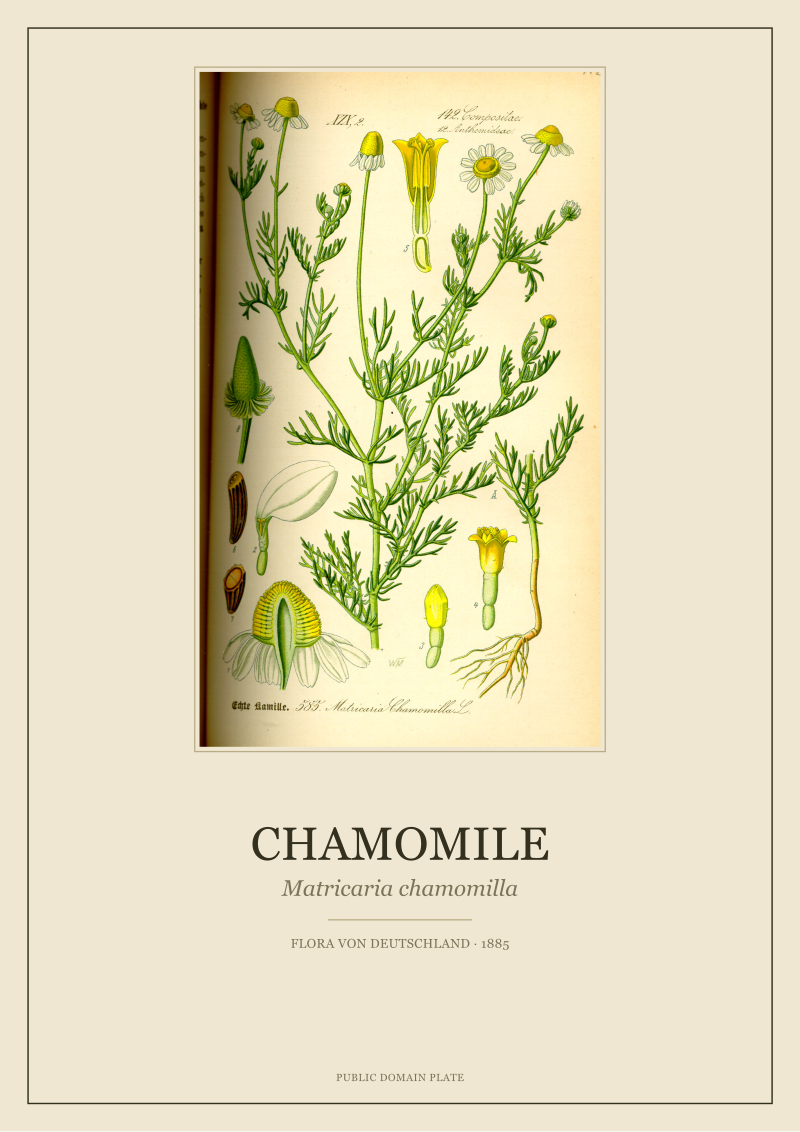
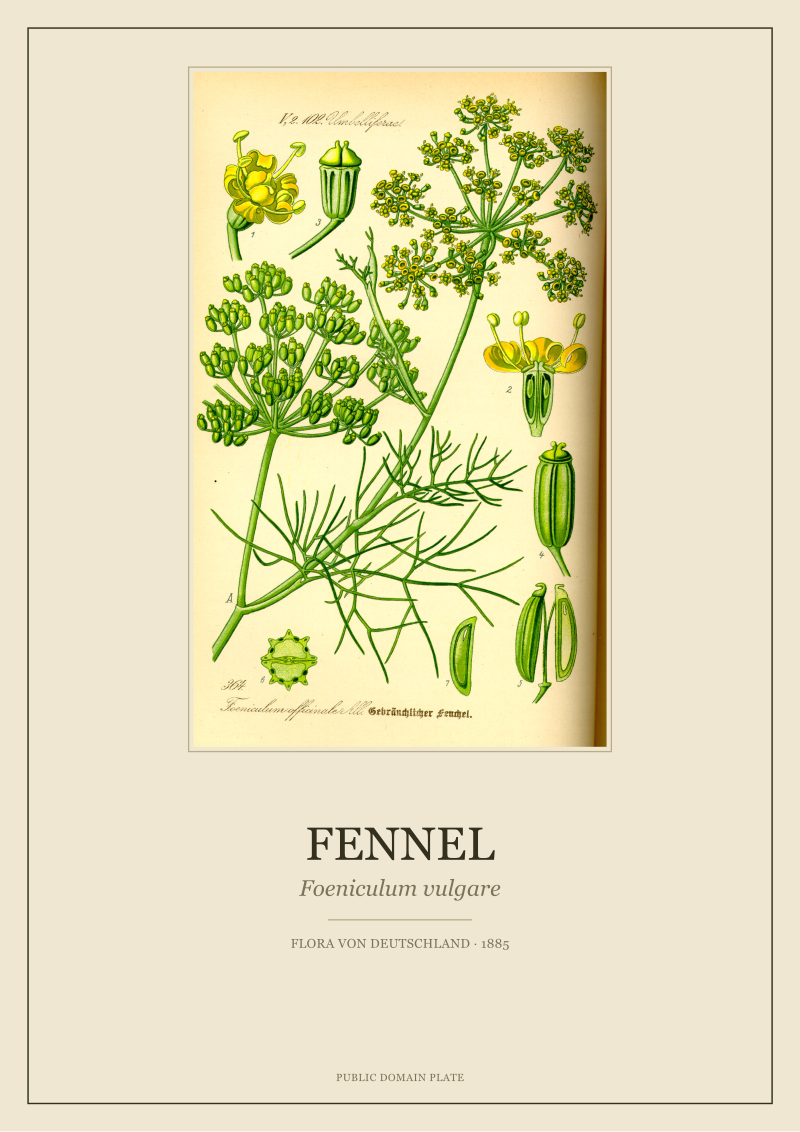
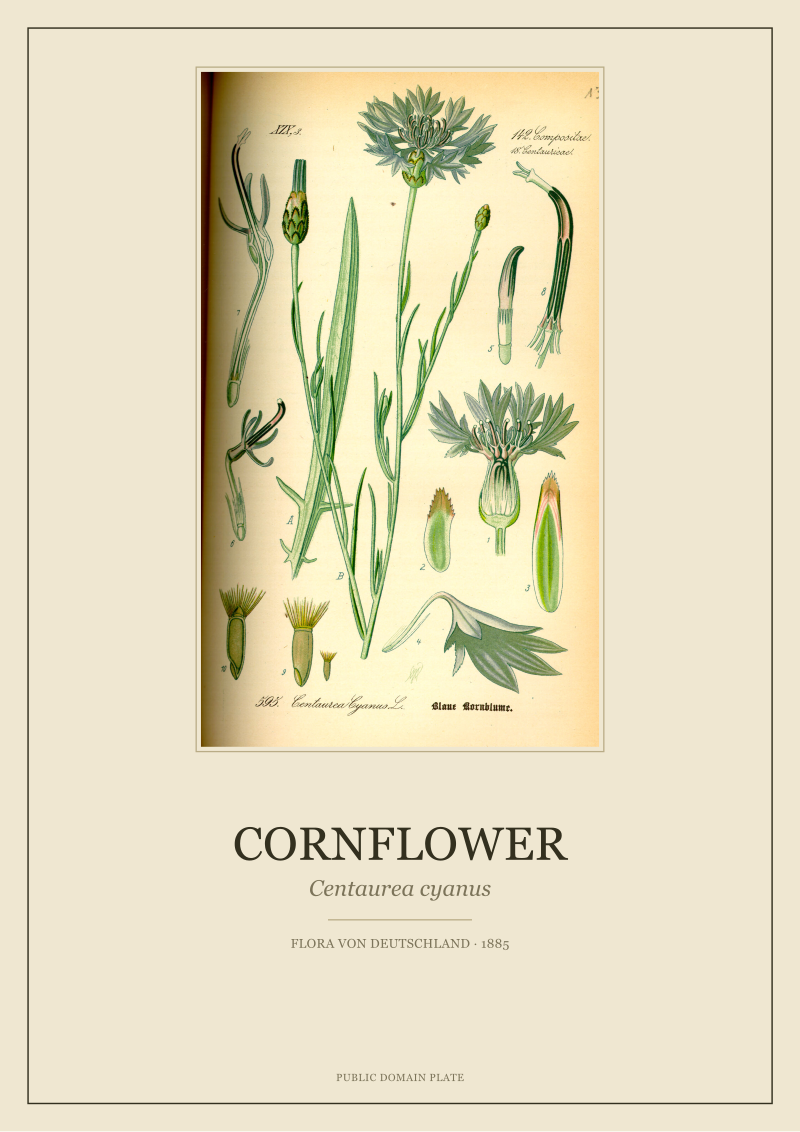
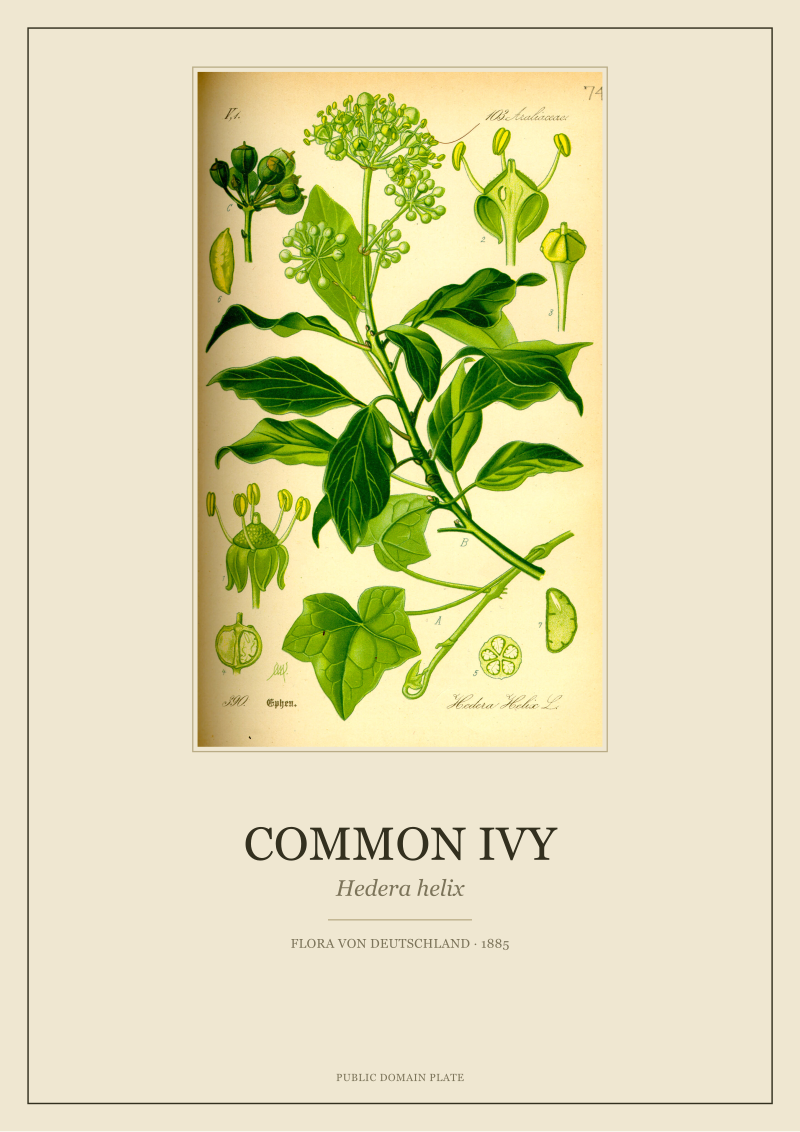
The ambition of Thomé's project was different from Redouté's in a way that matters for how a plate looks on a wall today. Redouté's roses are, first, portraits of individual specimens, often cultivars, often specific plants grown for the artist. Thomé's plates are species diagrams. A single plate shows the Chamomile (*Matricaria chamomilla*) with its root system, its leaf detail, the floral section cut away, the achene. A plate of Common Ivy (*Hedera helix*) shows juvenile and mature leaf forms, the flower in umbel, the drupe. The Cornflower (*Centaurea cyanus*) plate carries the involucral bracts in close dissection. Fennel (*Foeniculum vulgare*) appears with its umbel of umbels and its fruit diagrammed to the embryo.
This difference — portrait versus diagram, individual plant versus species — is why the two traditions age into wall art differently. A Redouté rose is luminous and intimate. A Thomé plate is cold, taxonomic, and reads more like an architectural drawing than a still life. Both are botanical illustration. Only one of them was meant to be looked at for pleasure. That the other has become wall-art material in the last twenty years is a separate story.
 Chamomile
The print from this article · from €29.95
View the print →
1960–2010: Coffee-Table Reproductions and the Word "Original" Breaks
Between roughly 1960 and the early 2000s, Western publishing produced a long wave of oversized art books reproducing nineteenth-century botanical plates. Taschen, Dover, Thames & Hudson, Phaidon and dozens of smaller houses issued Redouté compilations, often in quarto, with varying degrees of fidelity. These books were printed offset, on coated paper, in four-color CMYK process. They were not fakes and did not claim to be; most carried clear copyright and publication dates on the colophon page.
What happened next was predictable. The art books went out of print. Secondhand copies filtered down to estate sales. People cut the plates out. Framed, matted, hung on walls, and eventually sold on, these mid-twentieth-century offset reproductions — now yellowed, now with slightly foxed margins, now looking convincingly old — began to appear in antique shops and online marketplaces described as "original" prints. The seller sometimes believed this. Often the seller simply did not know the difference between a nineteenth-century stipple engraving and a 1972 offset lithograph on coated stock.
The economics are straightforward. A genuine folio plate from *Les Roses*, when it surfaces at a major auction house with provenance, trades in the four- to five-figure range per plate depending on species and condition. A 1970s offset reproduction trades at retail for perhaps 40 to 80 units of local currency. The spread is wide enough that the word "original" has strong incentive to drift, and drift it did. By 2010, the phrase "original Redouté rose print" on a secondary-market listing could, with a straight face, refer to any of five distinct objects: folio plate, octavo plate, chromolithograph gift book plate, mid-century offset reproduction, or late offset reproduction printed as recently as the Clinton administration.
2008–2026: The Public-Domain Scan Era and the Studio Restoration
The sixth meaning — and the one that matters for anyone framing a plant portrait today — arrived with the digitization of institutional libraries. Between roughly 2008 and 2020, the Biodiversity Heritage Library, the Smithsonian, the Bibliothèque nationale de France, the Missouri Botanical Garden and dozens of national and university libraries scanned their holdings of nineteenth-century botanical works, including *Les Roses* and multiple editions of Thomé's *Flora*, at high resolution and released them into the public domain.
This was a civilizational act and we should not pretend otherwise. It also broke the "original" market in a different direction. Within a few years, print-on-demand sellers were offering Redouté roses and Thomé plates at every price point from a two-dollar digital download to a hundred-dollar framed giclée. Most of these files are the library scans themselves, lightly edited: the raw scan includes the original book's paper tone, its age foxing, its binding shadow, its scan noise, and often a library stamp. Printed straight from the scan, the result looks less like the plate and more like a photograph of the plate.
A studio restoration is a different object. Working from the same public-domain source, a restorer separates the plant from the paper substrate, removes the foxing and the scan artifacts without erasing the printed line, rebuilds the color registration where the original chromolithograph has drifted, and outputs a print whose relationship to the 1885 plate is closer to a careful translation than to a photograph. Our work is on Thomé specifically — the Chamomile, the Ivy, the Cornflower, the Fennel and the rest of the *Flora* — because the taxonomic plate structure responds to restoration in a way the portrait plate does not. The relevant plates sit in our shop at /shop/. We do not restore Redouté roses; the portrait tradition belongs to specialists who have spent careers with that specific paper, and we have not.
 Fennel
The print from this article · from €29.95
View the print →
What It All Means
Six definitions of "original" are now in simultaneous circulation for the same artist: the 1817 folio plate, the 1820s octavo, the late-century chromolithograph, the twentieth-century offset reproduction in all its vintages, the raw public-domain scan, and the restored print worked up from that scan. A dealer using the word without qualifier is not necessarily lying — the word has simply lost its boundary.
The lesson is less about Redouté than about how any nineteenth-century image survives into the present. A folio plate is a physical object with a serial production history. A chromolithograph is a printing technology with its own economics. An offset reproduction is a mid-century publishing decision. A scan is an institutional act of digitization. A restoration is a studio decision about what to keep and what to remove. These are five different disciplines and five different price structures. Calling them all "original" collapses something worth preserving.
Our only claim about our own work is a modest one. We restore 1885 Thomé plates — public-domain source, studio-separated line, rebuilt color, printed on archival stock. We are honest about the chain of custody because the chain of custody is what the word "original" was supposed to describe in the first place. None of this tells you whether to spend four figures on a folio plate or forty on a studio restoration. That calculation depends on what the plate is for — a collection, a wall, a room — and that question is where the real work starts.
FAQ
How many complete sets of Redouté's *Les Roses* folio still exist?
No exact census exists. Scholarship places the original subscription run between 400 and 500 copies, and most specialists working the auction record estimate that complete, intact sets in good condition number in the low dozens today. The majority of surviving plates circulate as single sheets, having been broken out of albums during the dealer-driven dismembering waves of the late nineteenth and twentieth centuries. "Rare" understates it; genuinely intact folios are closer to institutional holdings than private ones.
Is a chromolithographic Redouté rose from a 1890s gift book an "original"?
By strict print-history standards, it is an original nineteenth-century chromolithograph, not an original folio plate. The distinction matters. A chromolithograph was printed from color stones, not stippled and hand-finished, and belongs to a cheaper, later, mass-market publishing tradition. It is an antique object. It is not the same object as an 1820 livraison plate. Dealers who conflate the two are, at best, using "original" to mean "nineteenth century", which is a different claim.
What makes Thomé's *Flora* different from Redouté's roses visually?
Redouté drew portraits of specific plants, often cultivars, with luminous color and intimate composition. Thomé drew species diagrams — the plant plus its taxonomic apparatus: leaf details, floral sections, seed structures. A Thomé plate of Chamomile or Fennel reads closer to an architectural drawing than a still life. Both are botanical illustration of the first rank; they belong to different genres within that tradition. The diagrammatic style ages into interiors with a cooler, more structural quality.
How can I tell if a framed "Redouté" print is a twentieth-century reproduction?
Several tells, usually in combination. Offset reproductions printed from 1960 onward typically sit on coated or semi-coated paper that feels distinctly different from a stipple-printed sheet from 1820. Under magnification, the dot pattern of four-color process printing becomes visible, where the original would show stipple texture and a hand-watercolored edge. Paper tone that is uniformly cream across the whole sheet, including inside the image field, is another signal; genuine folio plates show tonal variation.
Does restoring a scanned plate change its public-domain status?
The underlying 1885 Thomé plate is public domain and remains so. A studio restoration is a derivative work: the restored file reflects editorial decisions about color, cleaning, and reconstruction that are themselves expressive. The source plate is free for anyone to use. A particular restoration is specific to the studio that produced it. This is the standard public-domain-plus-restoration distinction used across the museum-reproduction trade and is not unique to botanical plates.
Why do you work on Thomé rather than Redouté?
The 1885 taxonomic plate structure is what our restoration process is built for. Clean line separation, reconstructable color registration, and diagrammatic composition all respond well to studio treatment. Redouté's portrait tradition — stipple printing, hand-applied watercolor, luminous color transitions — is a different craft entirely, one best handled by specialists in early-nineteenth-century French printmaking. We prefer honest limits over expanded catalogue; the Chamomile, Ivy, Cornflower and Fennel are where our hands are trained.
Is there a price point at which buying an offset reproduction makes sense?
For most wall-art purposes, yes. A genuine folio plate is a collector's object with insurance and conservation costs attached. A well-executed modern restoration from a public-domain source gives most of the visual presence at a fraction of the cost, with none of the handling anxiety. The offset reproductions from the 1970s coffee-table era occupy an awkward middle: they are neither antique in any meaningful sense nor restored with current scanning technology. We would skip that middle layer.
What should I actually look for on a listing that says "original"?
Three things. First, the printing technique explicitly named — stipple engraving with hand color, chromolithograph, offset reproduction, giclée. Second, the publication source, with date and publisher. Third, provenance for anything claiming folio-era production. A listing that answers those three questions clearly is operating in good faith, whatever the price. A listing that answers none of them is using "original" as a mood, not a fact.
From the collection
New plates from the archive and 10% off your first print.
One email now with your code. No noise after.