We have read, at this desk, more articles about lemon balm than any studio should reasonably admit to. Most of them arrive at Melissa officinalis through the same narrow door and leave through the same one, and we have watched the plant flatten a little each time. The plate we keep returning to — O.W. Thomé's, from the 1885 edition of Flora von Deutschland, Österreich und der Schweiz — is not written about at all in that literature. It sits in the public domain, quietly correct, while the internet writes around it. This piece is about that gap: what the coverage of lemon balm and its bees repeatedly misses, and what a nineteenth-century plate can still say if anyone bothers to look.
The habit is stubborn enough that it survives translation. English, German, Spanish, Portuguese: the paragraph order is nearly identical. We are not going to name publications, because it is not a publication problem. It is a genre problem, and the genre has been photocopying itself for the better part of two decades.
What They All Get Wrong
The shared error is a category error. Lemon balm is written about as a wellness product with a leaf attached, rather than as a plant that happens to have accumulated centuries of human handling. Almost every article on Melissa officinalis opens by promising that the reader is about to learn what the plant does — for sleep, for nerves, for "calm" — and then organizes everything else around that promise. The bee reference, when it appears, is a decorative footnote on the way to the tea recipe. The plant itself, the actual green thing with a square stem and paired leaves, is barely present.
We have watched this pattern do specific damage. The name Melissa is Greek for honeybee, and that fact gets one sentence, usually near the top, phrased as trivia. It is not trivia. It is the etymological hinge of the whole plant, and it explains something that the rest of the article then fails to explain: why bees are on this plant in the first place. The answer is not folklore. It is floral architecture. Lemon balm belongs to Lamiaceae, the mint family, and its flowers are labiate — two-lipped, small, pale, arranged in whorls at the leaf axils. That shape is a landing platform, evolved for insect pollinators with a specific tongue length. The bee in the name is not a metaphor. It is a description of the plant's design brief.
The second error is visual. The illustrations that accompany these articles are, almost without exception, cropped stock photography of a healthy leaf in a ceramic mug. Sometimes there is a wooden spoon. The flowering top of the plant, which is where the whole bee argument actually happens, is not shown. This has consequences beyond aesthetics. A reader who has only seen the leaf-in-mug image cannot recognise Melissa officinalis in a garden, cannot distinguish it from any of the several other soft, ovate, crenate-leaved plants it superficially resembles, and cannot see what the bee is landing on. The photograph has been optimised for the sale, and the plant has been edited out of it.
The third error is temporal. Historical use — the fact that this plant was grown in monastery gardens, distilled into cordials, listed in early modern pharmacopoeias — is repeatedly presented as evidence of present-day efficacy, rather than as evidence of long human interest. The distinction matters. Something can have been used for centuries and still not do the specific modern thing an article claims it does. Coverage that collapses that gap is not writing about lemon balm. It is writing a marketing brochure with a Latin name at the top.
What Is Almost Always Missing
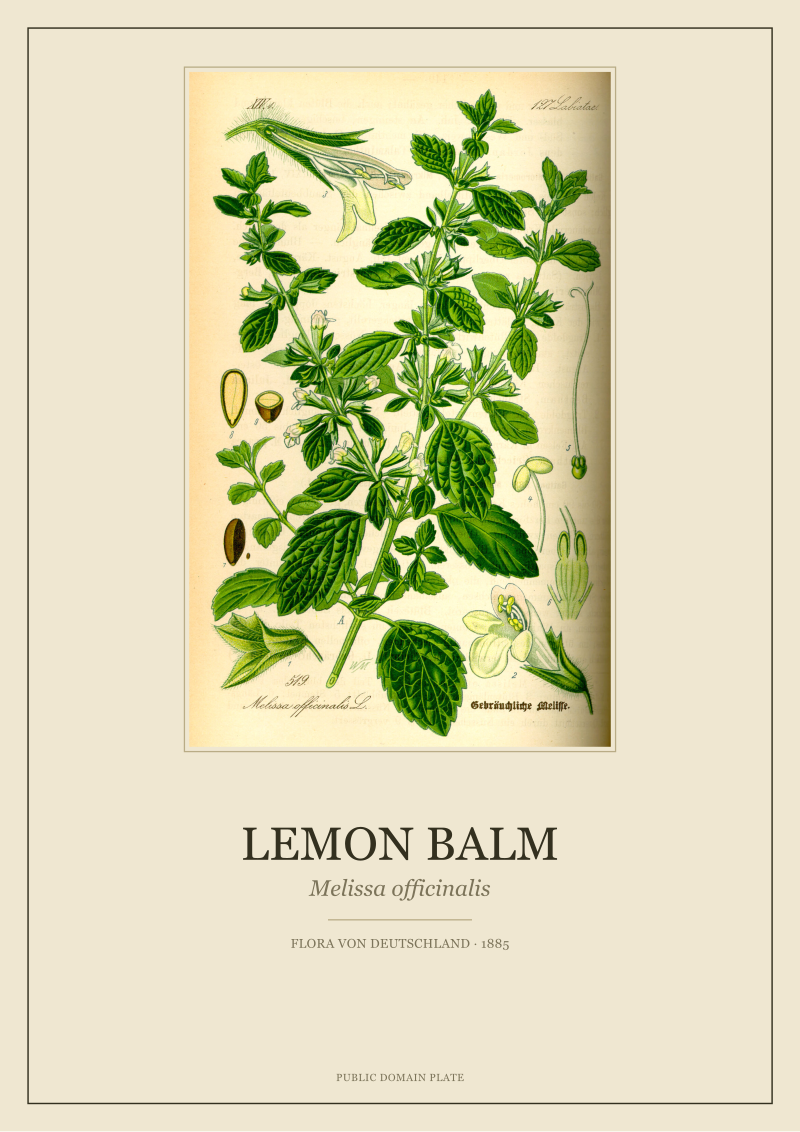
What is missing, most obviously, is the plate. Not this plate specifically — any plate. The nineteenth-century botanical tradition produced a rigorous, verifiable visual record of Melissa officinalis, and Thomé's 1885 illustration for Flora von Deutschland, Österreich und der Schweiz is one of the clearer entries in it. It shows the habit of the plant, the leaf shape, the whorled inflorescence, and the labiate flower structure that the text-only articles keep gesturing at without ever showing. That an entire genre of writing about a plant proceeds without reference to the discipline of drawing that plant is, to our eye, remarkable. It is also easy to fix, because the plate is in the public domain and has been for a very long time.
What is missing next is the reading of the name. Officinalis is a species epithet that appears on hundreds of European medicinal plants — rosemary, sage, dandelion, valerian. It comes from officina, the Latin word for a workshop, later the storeroom of a monastery where prepared remedies were kept. Officinalis on a label is not a claim of efficacy. It is an archival tag: this plant was in the storeroom. Articles that translate officinalis as "medicinal" and then treat that translation as endorsement are, quietly, misreading a filing system as a prescription.
What is missing after that is the specificity of the bee. Melissa is not "bees" in the generic sense. In the classical sources the word attaches to honeybees and, by extension, to priestesses and nymphs associated with them; the bee-nymph Melissa is a recurring figure in Greek myth, and the plant name carries that whole cultural pile with it. A paragraph that says "the Greeks called it bee-plant" and moves on has skipped the interesting part, which is that a plant, a pollinator, a mythological figure, and a Latin storeroom label are all sitting inside one binomial. That density is exactly the sort of thing a botanical print earns its place on a wall by carrying.
What is missing last is craft. Almost nothing gets written about how the plate itself was made — the lithographic technique, the hand-colouring conventions of the period, the fact that Thomé's plates were prepared to teach a particular audience and reflect the botanical vocabulary of the moment. A reader interested in lemon balm because it is beautiful, rather than because it is a supplement, is being served nothing. That reader, in our experience, is not rare. They are the reader the current coverage does not know exists.
 Lemon Balm
The print from this article · from €29.95
View the print →
Lemon Balm
The print from this article · from €29.95
View the print →
What I Would Say Instead
We would start with the plate. Thomé's 1885 illustration is a small argument in favour of looking. It shows the plant with the discipline the plant deserves: opposite leaves, ovate with a crenate margin and a slightly puckered surface; a square stem, which is the Lamiaceae family signature you can feel with a thumb; whorls of small, pale, two-lipped flowers gathered at the leaf axils on the upper stem. That is Melissa officinalis. Everything a person needs to identify it in a garden, or to understand why a bee is interested, is on the sheet. Any article about lemon balm that does not begin here is beginning somewhere else on purpose.
We would then read the name as a nested joke. Melissa is a bee. Officinalis is a storeroom. Together, the binomial reads, roughly, "the storeroom's bee-plant" — a piece of botanical shorthand that tells you two things about the plant's human history without telling you anything about what it does. Bees care about it because it is Lamiaceae and because its labiate flowers reward foragers with a landing platform and nectar; humans cared about it enough to keep it in the officina because it smelled of lemon and was easy to grow near a kitchen door. Those are historical and structural facts, and they are enough. The article does not need to close the loop into a health claim to be interesting. It becomes less interesting when it does.
We would treat the bee story as a piece of design writing, not folklore. The whorls of pale flowers, the two-lipped corolla, the position on the stem, the square profile — these are not random. They are the plant's answer to the problem of getting pollinated, and the bee in the name is a witness. Read this way, the plate stops being decoration and starts being an argument diagram. Thomé drew every element you would need to explain why the bee is there, in the order you would need to explain it in. That is what a good botanical illustrator does. That is what the tradition was for.
We would let the historical apothecary layer stay historical. Monastery gardens grew Melissa. Cordials, waters and infusions were made from it, and it is recorded in early modern pharmacopoeias. Those are facts about the past. They belong in the article as history, in the same register as the mythology and the etymology, and they do not need to be reheated into present-tense advice. A reader can hold "this plant has been in the human record for a very long time" without needing that sentence to double as a recommendation. Most readers, in our experience, prefer it that way.
Finally, we would put the plate on a wall. When we restore Thomé's Melissa officinalis for our own catalogue at /shop/, the work is small and specific: cleaning the scan, correcting the paper cast, protecting the line, holding the pale colour of the flowers where a lazier pass would push it grey. What comes out is not a wellness graphic. It is a plant, drawn accurately in 1885, with a bee written into its name and a family visible in the shape of its flowers. That is the article we would like to read about lemon balm, and until it becomes more common we will keep making the object it should have been about.
 Rosemary
The print from this article · from €29.95
View the print →
Rosemary
The print from this article · from €29.95
View the print →
New plates from the archive and 10% off your first print.
One email now with your code. No noise after.