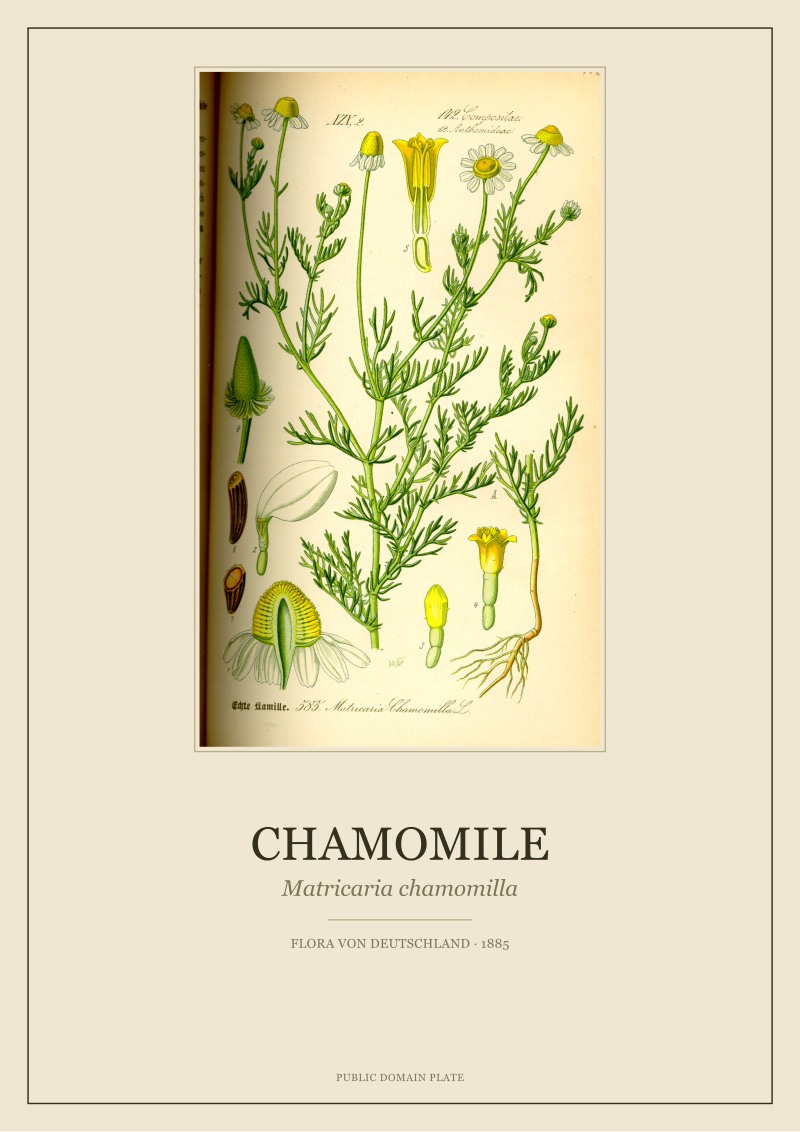
Every plant on earth has a two-word Latin name, and the second word is the one that does the real work. The chamomile on our 1885 Thomé plate is not labelled Matricaria — it is Matricaria chamomilla, and without that second word the label would be pointing at roughly a dozen other species in the same genus. The binomial system, formalised by Linnaeus in the middle of the eighteenth century, is the closest thing botany has to a passport. It is also, once read properly, the most honest label on any wall.
Most articles about botanical Latin treat the topic as a party trick. Learn a bit of Latin, impress your dinner guests, sound like a person who has read a book. That is not what the system is for and it is not why the label on a nineteenth-century plate is worth learning to read. Binomial nomenclature is an argument about what counts as a distinct thing, made in a dead language for the practical reason that the living ones kept renaming everything.
We restore these plates for a living, which means we read hundreds of labels a year. What follows is what the two words actually say, in the order they were written, and why the label on a Thomé plate from 1885 is arguably the format at its most honest moment.
The First Word Is a Family Reunion, the Second Is the Name Tag
The first word — the capitalised one, the genus — is the family reunion. It says: this plant belongs with a group of others that share enough anatomical structure to be considered close relations. Matricaria is a small genus of mayweeds and chamomiles. Hedera is the ivy genus. Centaurea holds the knapweeds and cornflowers. Foeniculum, awkwardly, holds essentially one economically important plant and a couple of close relatives. The genus is the shelf. It is not the book.
The second word — lowercase, and this matters — is the specific epithet. It is not, strictly speaking, "the species name"; the species name is the whole binomial. But the epithet is the part that does the pointing. Chamomilla, helix, cyanus, vulgare. Say those four words to a botanist without their genus attached and you have said almost nothing, because helix could be a snail and cyanus could be a bird and vulgare is Latin for common and appears in hundreds of names. The epithet is a name tag pinned to a reunion. It only functions in the room.
This is the part that most casual writing about Latin names misses. Matricaria chamomilla is not one Latin word plus a descriptor. It is a coordinate pair. Change the first word and the second becomes ambiguous; change the second word and the first becomes a shelf you cannot find the book on. When our plate for Matricaria chamomilla lists that binomial in full, it is not being pedantic — it is being minimally sufficient. Anything shorter would be a lie of omission.
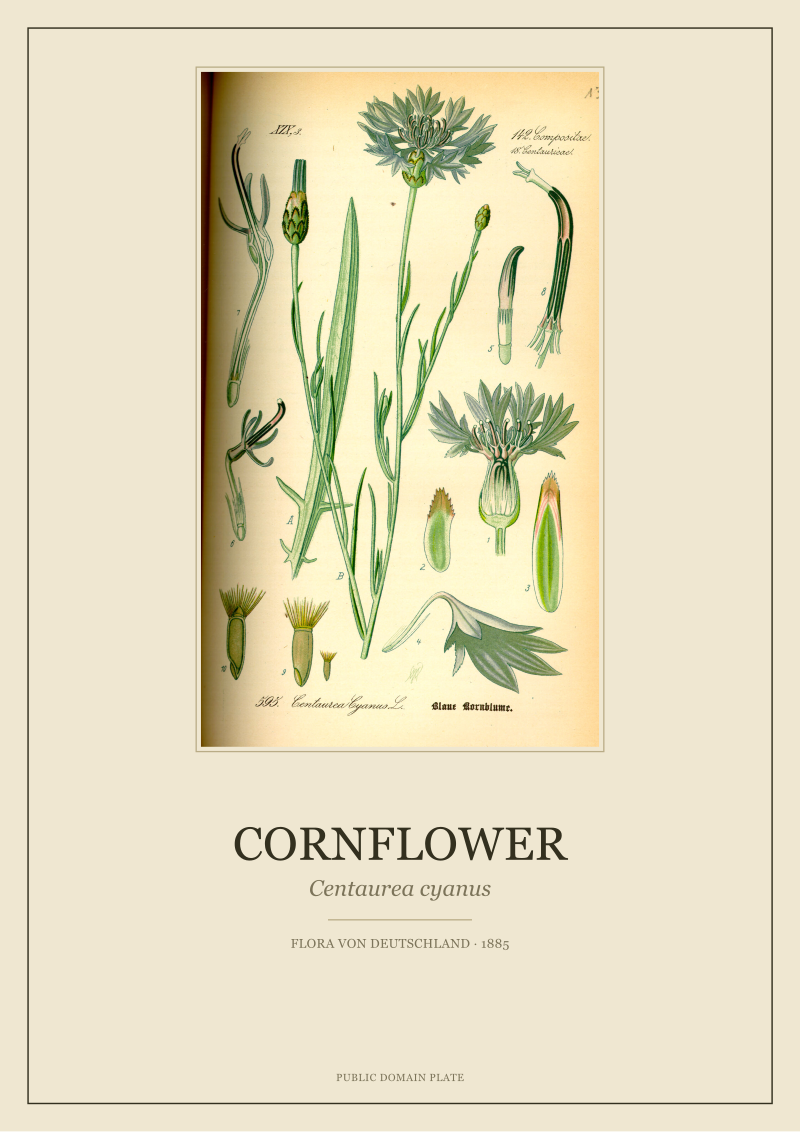
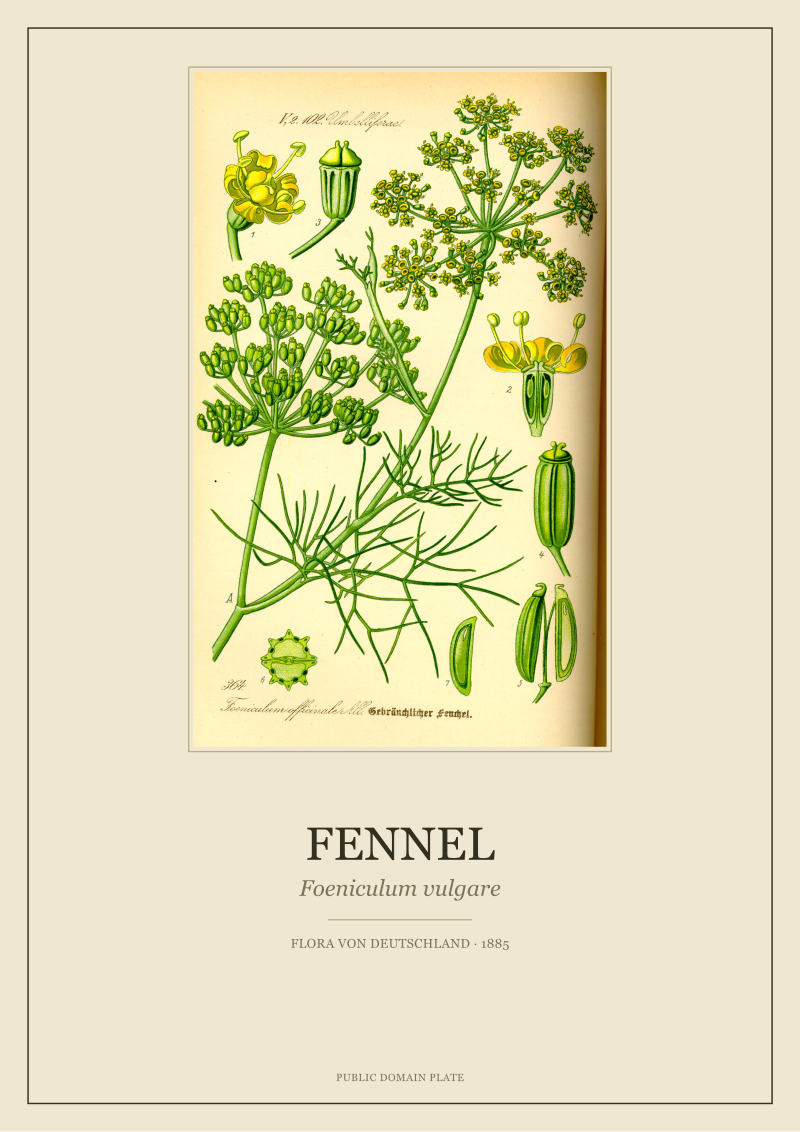
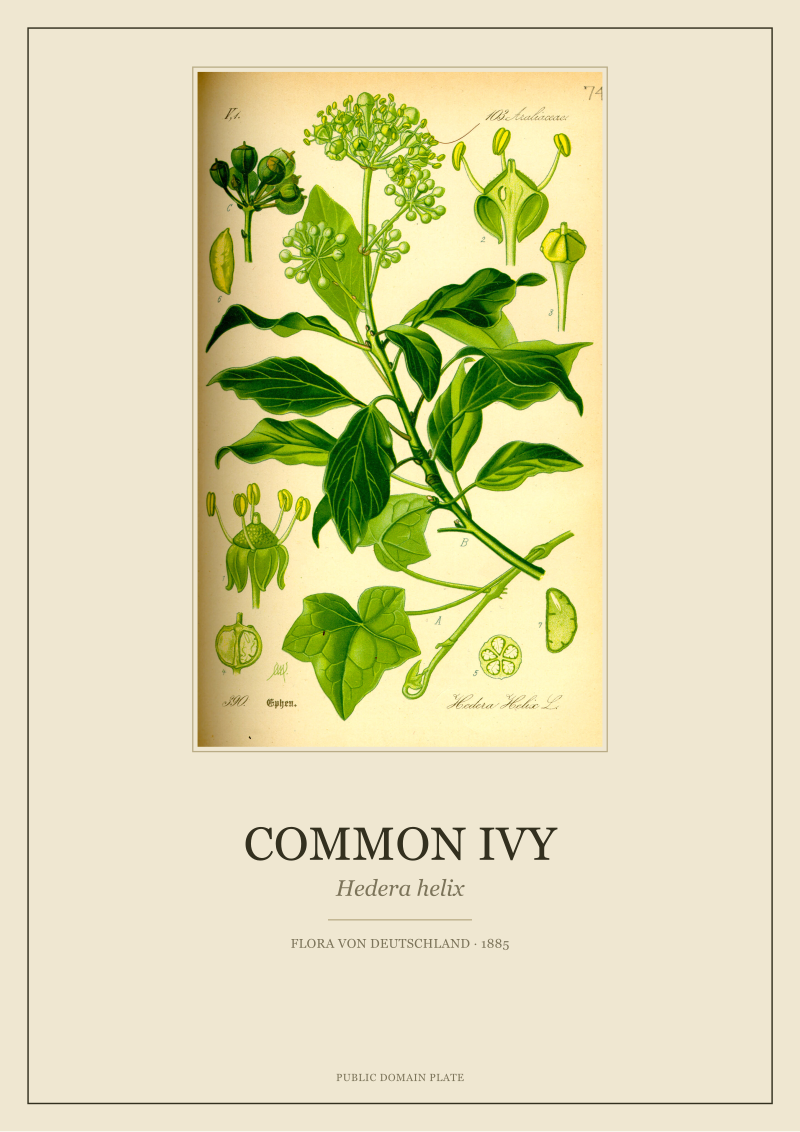
The epithets themselves are often more transparent than people expect once you know they are meant to be read. Helix, the epithet of common ivy on our Hedera helix plate, is Greek for twist or spiral, and Hedera helix is exactly the species that twists up trees and walls; the second word is describing the first word's behaviour. Cyanus, the epithet for the cornflower, is the Greek-derived word for a specific deep blue — the same root that gives us cyan — and Centaurea cyanus is the deep-blue one in a genus otherwise full of purples and pinks. Vulgare, in Foeniculum vulgare, is Latin for common or ordinary, marking this fennel as the everyday version of the genus rather than a rarer relative. None of this is ornament. Each epithet is doing forensic work.
Linnaeus Did Not Invent Latin Names, He Enforced the Format
The most common misconception about Carl Linnaeus is that he gave plants their Latin names. He did not. Plants had Latin names for well over a millennium before he was born, because Latin was the working language of European scholarship and every serious herbal from the medieval period onward wrote plant descriptions in it. What Linnaeus did in 1753, with Species Plantarum, was enforce a format.
Before Linnaeus, a plant's Latin name was typically a short descriptive phrase — sometimes five or six words long — that tried to distinguish it from its neighbours by piling up adjectives. A single species might be referred to by three or four different phrase-names depending on which author was writing. Cross-referencing was a nightmare, and the herbal tradition was drowning in synonyms. Species Plantarum offered a deal: use one genus name and one epithet, and everyone will know what you mean. Linnaeus's contribution was less like inventing a language and more like inventing a spreadsheet. He made the names sortable.
This matters because it explains why the system feels arbitrary in places. Linnaeus was standardising a mess, not designing from scratch. Many of the genus names he settled on were pulled from classical Roman and Greek sources — Foeniculum is essentially the Latin word Pliny used, Hedera is straight classical Latin for ivy, Centaurea is named after the mythological centaur Chiron via a chain of ancient herbal tradition. Others were coined or repurposed. Matricaria's etymology has more than one candidate story and both are old enough that a definitive answer is not really available. The system is not internally elegant. It is internally consistent, which is a much rarer and more useful property.
What Linnaeus also did, and this is where the wryness starts, was insist that botany was a formal science with an author trail. This is why you will sometimes see a binomial followed by an author abbreviation — Matricaria chamomilla L., for instance, where the L. is Linnaeus signing his own naming decision. The author citation is a receipt. It says: this name was proposed here, by this person, and if you disagree with it you know where to file your complaint. Very few working professions built themselves a permanent, personally attributed audit trail in the eighteenth century. Botany did, and it did it in Latin so that the receipt would survive translation.
The uncomfortable part of the Linnaean legacy is that his sexual system of classification — the framework he used to sort plants into groups — turned out to be scientifically wrong within about a century of his death. The binomial format survived. The classifications underneath it were revised, and are still being revised. This is a feature of the system, not a bug. The two-word format is durable precisely because it does not depend on any particular theory of why plants are related; it just insists that each species get exactly two words and that everyone use the same two.
 Chamomile
The print from this article · from €29.95
View the print →
Chamomile
The print from this article · from €29.95
View the print →
Reading a Thomé 1885 Label Is Reading the System at Its Peak
By 1885, when Otto Wilhelm Thomé finished the plates for Flora von Deutschland, Österreich und der Schweiz, the binomial system had been the working standard for more than 130 years. That length of runway matters. The names on Thomé's plates are not tentative or transitional. They are the settled, cross-referenced, argued-over consensus names of nineteenth-century Central European botany, produced at a moment when the taxonomy was mature and the printing technology — chromolithography — was finally good enough to reproduce plant colour faithfully at scale.
A Thomé label typically gives you, at minimum, the German common name and the binomial. Sometimes the family is listed. Sometimes an author citation. Sometimes the plate carries small letter-keyed detail illustrations of the flower dissected — anther, ovary, cross-section of the seed — and the label extends into a small legend at the bottom. The point of the layout is that a working botanist or a serious amateur could pick up any plate in the set and, without external reference, know exactly which species was being depicted, at what magnification, and with which parts labelled.
This is what we mean when we say the label is the most honest thing on the wall. A watercolour of a chamomile could be almost anything. A photograph of a chamomile depends on lighting and season. A Thomé plate of Matricaria chamomilla, with its binomial printed underneath and its floret cross-sections annotated in the margin, is making a specific claim about a specific species and inviting you to check the work. If the drawing is wrong, the label makes it falsifiable. That is a different relationship to accuracy than most botanical imagery has, before or since.
There is a small pleasure, once you can read the label, in noticing what the format quietly reveals. Foeniculum vulgare tells you fennel is the common one of a small genus. Hedera helix tells you the ivy's climbing habit is right there in the name. Centaurea cyanus tells you the cornflower earned its epithet from its colour, which is why our Centaurea cyanus plate is one of the few in the Thomé set where the pigment itself is doing the taxonomic work — the blue is not decoration, it is the specific epithet made visible. When you frame one of these plates properly — and this is the only place in this piece we will mention it, our restored editions live in the shop — the label is part of what you are hanging. It is not a caption. It is the species' name, in the format the plant carries wherever it goes.
This started as a piece about how to pronounce Latin plant names and turned, somewhere in the second draft, into a piece about why the two-word format is a piece of eighteenth-century engineering that survived being wrong about almost everything except its own shape. We are more interested in the second essay. Naming things well is a rarer accomplishment than naming them correctly, and Linnaeus, for all his flawed classifications, did the harder of the two jobs.
FAQ
Why is the genus always capitalised and the species epithet always lowercase?
It is the convention established by botanical publication rules and preserved for two and a half centuries because it makes the two parts of the name instantly distinguishable in running text. A capital initial signals: this is the shelf, the group name, the noun. A lowercase word after it signals: this is the epithet, the pointer. In a dense scientific paragraph the eye can pick the binomial out at a glance, which was much of the original point.
What does the "L." after a botanical name mean?
It is the author abbreviation for Carl Linnaeus, and it means Linnaeus was the person who formally published that binomial. Botanical names carry authorship because names can be disputed and revised, and knowing who proposed a name lets later botanists trace the reasoning. Other authors have their own abbreviations. A binomial with no author is not wrong, just less complete — it is the name without its receipt attached.
Are common names ever more accurate than Latin ones?
No, and this is the whole reason the binomial system exists. A common name like "chamomile" refers to at least two commercially important species and a handful of relatives, depending on the country and the century. Matricaria chamomilla is one specific plant. Common names are affectionate and useful; they are not diagnostic. The Latin name is the one that survives translation and the passage of time.
Why is so much botanical Latin actually Greek?
Because classical scholarship inherited from both languages and because many of the plant names Linnaeus preserved were already Greek-derived when he adopted them. Helix, cyanus and dozens of common epithets are Greek roots latinised into the standard format. The system's name is "botanical Latin" as a matter of convention, not linguistic purity — it functions as a specialised, half-Latin half-Greek technical vocabulary.
Do the names on old botanical plates still match the ones used today?
Often, but not always. Modern taxonomy has moved species between genera when new evidence — anatomical, chemical, more recently genetic — has revealed relationships the nineteenth century could not see. The four species on our featured Thomé plates all retain the same binomials they carried in 1885, which is more common with well-established, widely used plants than with obscure ones. For rarer species, the historical name and the current name sometimes diverge.
Why is 1885 considered a good year for botanical illustration?
Two forces met. Taxonomic naming had matured after more than a century of the Linnaean system, so the labels on new plates were stable and cross-referenced. And chromolithography — colour printing from limestone plates — had reached a technical peak, allowing subtle colour and fine botanical detail to be reproduced at scale for the first time. Thomé's Flora von Deutschland is one of the clearest documents of that convergence.
Can I trust the anatomical detail on a nineteenth-century plate?
For most established European species, yes, to a degree that would surprise people who assume older means less accurate. Plates in scientific floras were drawn by trained illustrators working from herbarium specimens and often reviewed by the botanist author. The detail vignettes — cross-sections, isolated florets, seed structures — were produced to be used, not to be decorative. They were teaching tools that had to survive scrutiny by other working botanists.
Is there a shorter way to write a binomial once it has been introduced?
Yes. After the full name has been given once, later mentions in the same text can abbreviate the genus to its initial — Matricaria chamomilla becomes M. chamomilla. This is standard in scientific writing and permitted in most style guides. What is never done is dropping the epithet and using only the genus, because that would collapse the coordinate pair back into ambiguity. The epithet is the part that cannot be shortened away.
 Cornflower
The print from this article · from €29.95
View the print →
Cornflower
The print from this article · from €29.95
View the print →
New plates from the archive and 10% off your first print.
One email now with your code. No noise after.