At 10:14 on a Tuesday in October, a reader wrote to the studio asking how many ferns she needed for the wall behind her reading chair. The wall was 164 cm wide. She had seen a magazine spread with, she estimated, "about twelve" framed botanicals and wanted to know if that was right, or ruinous, or both. We did the math on a notepad before answering. This article is that notepad, formalised. We will ask three questions in sequence, each with a Yes branch and a No branch, and at the end we will tabulate every combination. The arithmetic is unglamorous and, we think, the point.
Question 1: Is Your Wall Longer Than 180 cm?
This is the first fork because it decides whether the composition behaves as a strip or as a grid. Below roughly 180 cm, a single horizontal row of standard A3-ish botanicals runs out of wall before it runs out of visual rhythm; the arrangement wants to stack. Above 180 cm, a strip reads as a strip and does not beg for a second row. 180 is not sacred — it is simply the number at which four frames of 30 cm width, separated by three 8 cm gaps, fit with 36 cm of breathing room on the ends: 4 × 30 + 3 × 8 + 2 × 18 = 180. Change the frame width or the gap and the threshold moves. We use 180 because our most-ordered frame is 30 × 40 cm and our standard inter-frame gap is 8 cm.
If Yes
A horizontal strip is honest. Pick four to six plates, align the horizontal centerline across the row, and let the vertical mass of the wall carry the rest. The arithmetic is: wall length minus 2 × (end margin) divided by (frame width + gap), with gap counted one fewer time than the frame count. On a 220 cm wall with 20 cm margins at each end: 220 − 40 = 180 cm of working width. Six 30 cm frames = 180 cm of frames. That leaves 180 − 180 = 0 cm for gaps across five intervals, which is unworkable. Drop to five frames: 150 cm of frames across four gaps = 30 cm of gap total = 7.5 cm each. Acceptable. Five it is.
If No
Shorter walls want a grid, and the grid wants an even count. The reader's wall at 164 cm sits here. The strip logic breaks: 164 − 40 (margins) = 124 cm; (124 − 3 × 8) ÷ 4 = 25 cm per frame, which is smaller than our smallest standard. Reduce to three frames across: (124 − 2 × 8) ÷ 3 = 36 cm, acceptable but still begging for a second row. The grid resolves it. A 3 × 2 arrangement — three columns, two rows — fits a reading-chair wall between roughly 75 cm and 110 cm of visible vertical range. We will carry this answer forward.
Question 2: Do You Want Botanical Accuracy, or Just Green Shapes?
This question matters because "fern wall" is often shorthand for "wall of fine, feathery, articulated green shapes" rather than a species-accurate hang of Pteridophyta. The two routes diverge in catalog, pricing, and visual effect. Accuracy means every plate is actually a fern — a single clade, limited palette range, strong family resemblance across the wall. Shapes means you are shopping for a graphic quality — threadlike leaflets, umbels, trailing habit — and the strongest shape-matches in our catalog are not themselves ferns. The reader rarely cares which it is until asked. Asking changes the arrangement.
If Yes
Species accuracy narrows the catalog sharply. You are now shopping within a single plant group, and the visual range inside that group is a function of leaf architecture (pinnate, bipinnate, tripinnate) and plate size. Three to five accurate fern plates read as a coherent small library; above six, the eye begins to pattern-match and the wall tips toward a specimen cabinet aesthetic. That is a legitimate choice — nineteenth-century natural history interiors did exactly this — but it is not what most readers imagine when they say "fern wall." Price the arrangement at single-species-group rates. Expect to wait longer for restoration of plates in good condition; fern plates in the 1885 corpus survived unevenly because the paper weight was often lighter than for showier flowering plants.
If No
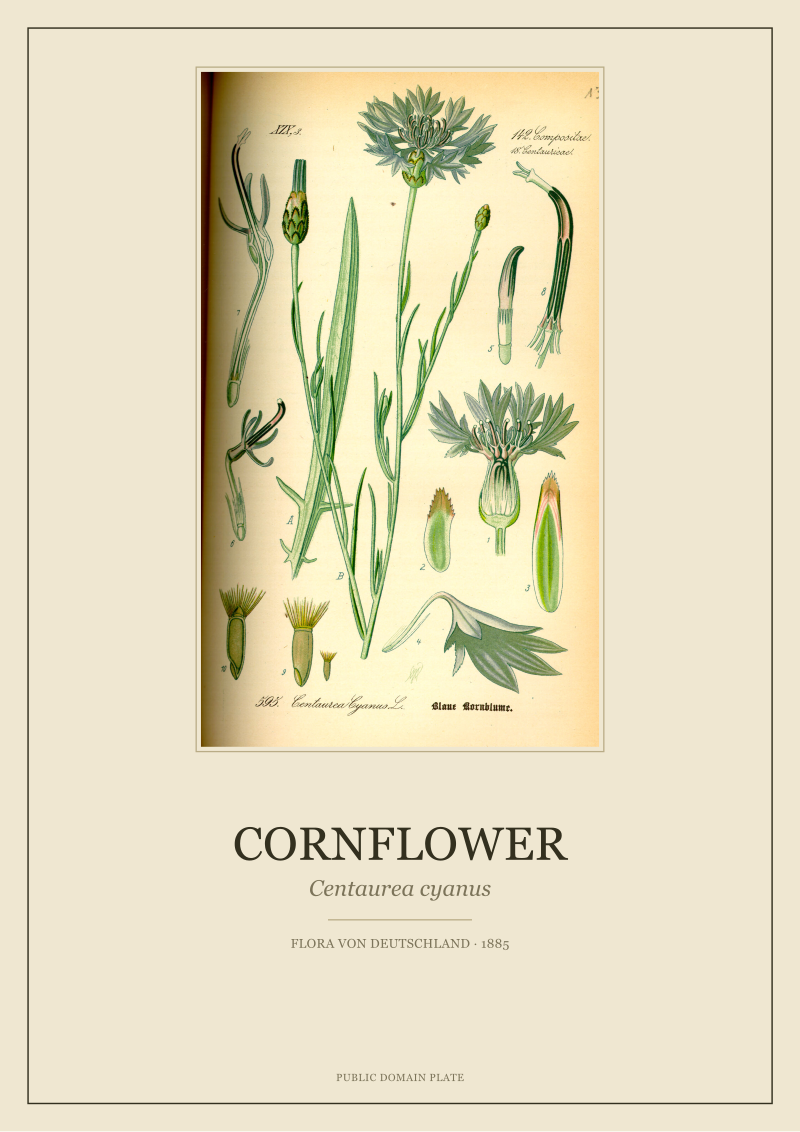
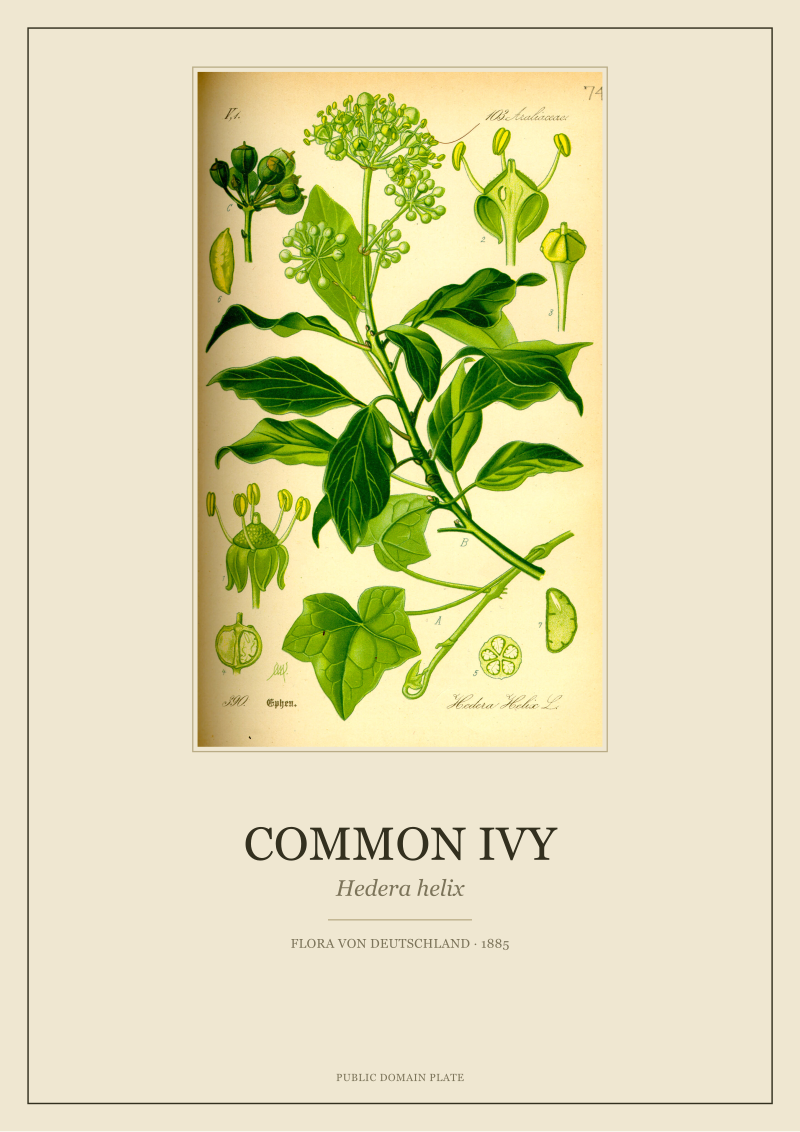
Green shapes opens the catalog to adjacent fine-foliage plates, which is where our 1885 inventory earns its keep. *Foeniculum vulgare* — fennel — in O.W. Thomé's plate from *Flora von Deutschland, Österreich und der Schweiz* (1885) has threadlike leaflets and an umbel structure that, at wall distance, reads as fern-adjacent. *Hedera helix* — common ivy — from the same series contributes a trailing-foliage mass that anchors a grid corner. *Matricaria chamomilla* and *Centaurea cyanus* bring smaller, more detailed leaf articulation that works as internal rhythm between larger pieces. A grid of six, mixing two true ferns with one each of fennel, ivy, chamomile, and cornflower, reads as "fern wall" to every eye that walks past and as "mixed herbarium" to a botanist standing one meter away. Both reads are correct. The second one costs less because the catalog is wider.
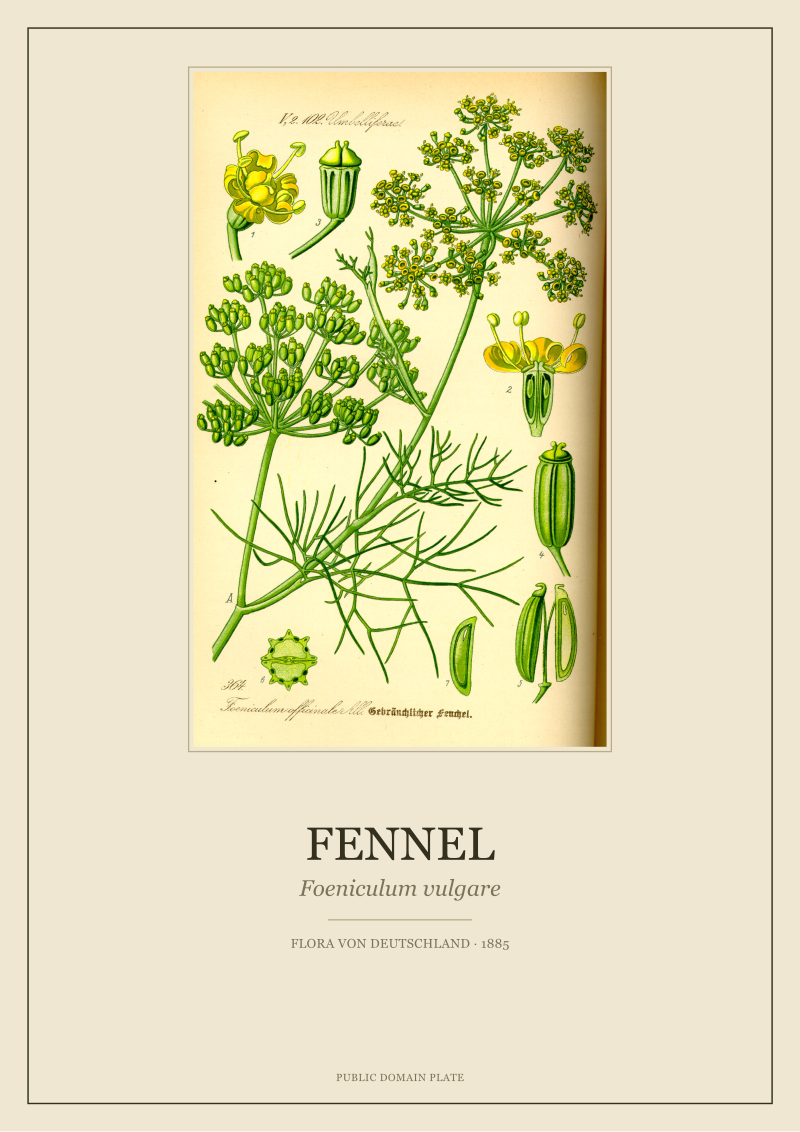 Fennel
The print from this article · from €29.95
View the print →
Question 3: Are You Framing, or Pinning Straight to the Wall?
This is where the math changes hardest. A 30 × 40 cm plate framed with a standard 6 cm mat and 1.5 cm moulding occupies 45 × 55 cm of wall. An unframed plate occupies 30 × 40 cm. The difference across six plates is substantial, both in used wall area and in sightline weight. Framing also adds roughly 180–240 g of hanging mass per plate once glass is included, which matters for plaster walls on heritage interiors; pinning adds effectively nothing. The question is not aesthetic, it is dimensional and structural. Resolve it before choosing frame count.
If Yes
Framing recalculates the whole arrangement. On the reader's 164 cm wall with 20 cm end margins, the working width is 124 cm. Framed plates at 45 cm width across three columns: 3 × 45 = 135 cm, which exceeds 124 cm and does not fit. Reduce to two columns: 2 × 45 = 90 cm, plus one 8 cm gap = 98 cm, leaving 26 cm total end margin — 13 cm each side, tight but legal. The 3 × 2 grid becomes a 2 × 3 grid: two columns, three rows. Total plates: six, same count as the unframed version, but the geometry is portrait-oriented rather than landscape. The visual effect is a vertical panel rather than a mural strip. Not the same wall.
If No
Pinning or clip-mounting removes the frame penalty. The 3 × 2 grid holds: three 30 cm columns across 124 cm of working width leaves (124 − 90) ÷ 2 = 17 cm of gap between the three plates, which is wide. Narrow the end margins to 12 cm each and the gap drops to a cleaner 10 cm. The arrangement reads looser, more herbarium-sheet than gallery, and the paper itself becomes part of the material story. We mention this because our restored plates ship with a 2 cm archival margin that is designed to receive a bulldog clip or magnetic hanger without touching the printed field. Pinning is not a compromise, it is a different grammar.
If You Answered Everything: The Decision Table
Eight combinations, one recommendation each. Each row assumes the reader has already resolved end-margin discipline and vertical sightline height; those are constants, not forks.
| Q1 (Wall > 180 cm) | Q2 (Accuracy) | Q3 (Framing) | Recommendation |
|---|---|---|---|
| Yes | Yes | Yes | Horizontal strip of 4–5 framed fern plates, single species group, 8 cm gaps. |
| Yes | Yes | No | Horizontal strip of 5–6 pinned fern plates, generous 10–12 cm gaps for air. |
| Yes | No | Yes | Framed strip of 5, mixing two ferns with fennel, ivy, and one accent plate. |
| Yes | No | No | Pinned strip of 6, loose herbarium feel, mix ferns with fennel and ivy. |
| No | Yes | Yes | Two-column, three-row grid of six framed fern plates; portrait orientation. |
| No | Yes | No | Three-column, two-row grid of six pinned fern plates; landscape orientation. |
| No | No | Yes | 2 × 3 framed grid: two ferns, fennel, ivy, chamomile, cornflower. |
| No | No | No | 3 × 2 pinned grid: two ferns and four fine-foliage neighbors from 1885. |
Notice what the table does not do. It does not recommend twelve plates in any cell. Twelve plates on a 164 cm wall framed at 45 cm per unit requires either a four-row grid (impossible without wrapping onto a ceiling) or two-column stacking of six rows at ~22 cm vertical pitch, which crushes each plate into illegibility. Twelve is a magazine number, chosen for a double-page spread photograph taken from four meters away. In a reading-chair interior, twelve is not twelve; twelve is noise.
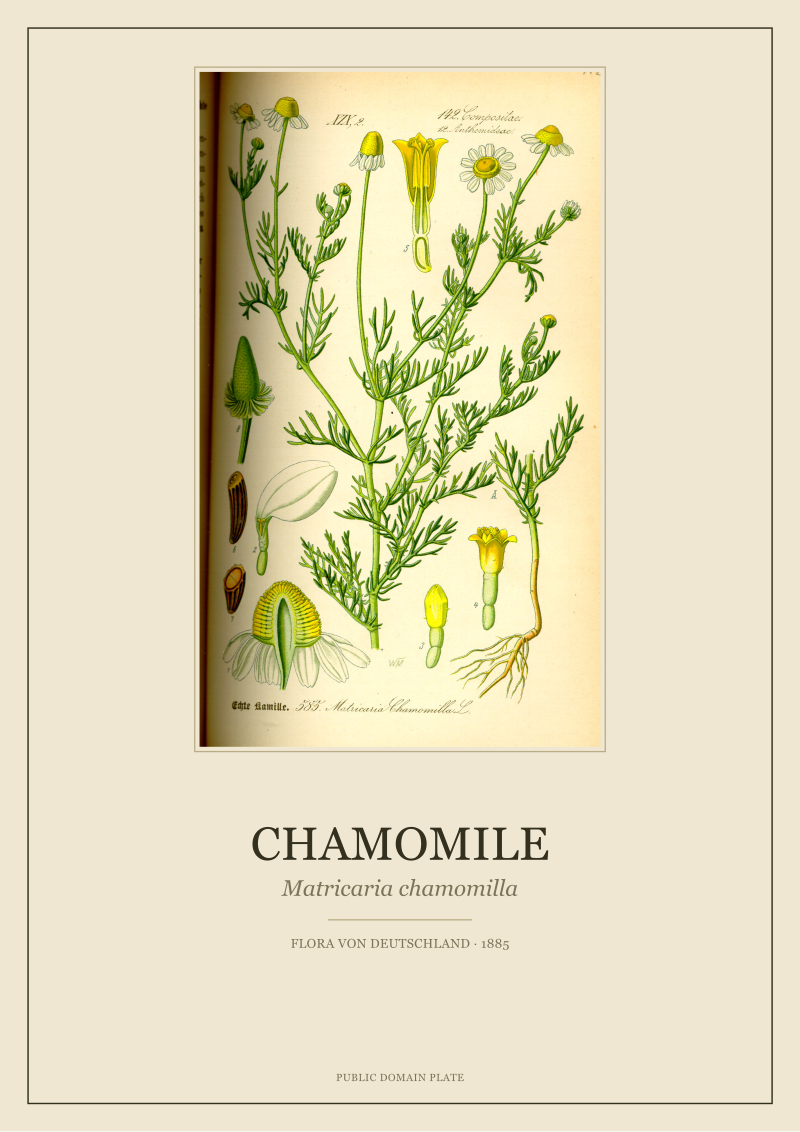 Chamomile
The print from this article · from €29.95
View the print →
The Arithmetic Nobody Writes Down
The reader's answers, reconstructed from her message: her wall is 164 cm, so No to Question 1. She was imagining a feel more than a species list, so No to Question 2. She used the phrase "framed botanicals," so Yes to Question 3. That routes her to row seven: a 2 × 3 framed grid, six plates, mixing two ferns with one each of fennel, ivy, chamomile, and cornflower. The arithmetic that produced the number six, in full: wall width 164 cm, end margins 2 × 12 cm = 24 cm, working width 140 cm, framed plate width 45 cm, two columns = 90 cm, one gap of 8 cm = 98 cm, remaining breathing room (140 − 98) ÷ 2 = 21 cm distributed into slightly looser end margins at 22.5 cm each. Vertical: three rows at 55 cm per framed plate plus two 8 cm gaps = 181 cm of vertical panel, which on a standard 240 cm ceiling with 90 cm chair-rail datum leaves roughly 60 cm of ceiling clearance. Legal. Elegant. Six plates. Not twelve.
The honest total cost, if every plate were sourced from our restored 1885 catalog at current studio pricing, is roughly a third of what the magazine spread implied, because the magazine spread was photographed from a room with a six-meter wall. Scale distorts budget. The arithmetic is the only thing that does not. For readers who want to see the plates discussed above as individual portraits before committing to the grid, we keep them in the shop at /shop/ with the full restoration provenance on each listing.
None of this tells you which two ferns, among the plates we restore, carry the right line weight to anchor a 2 × 3 grid against the fennel's umbel and the ivy's trail. That is a different arithmetic — about leaf cadence and ink density rather than wall centimeters — and it is where the next notepad begins.
FAQ
How many botanical plates do I actually need for a wall behind a reading chair?
On a wall between 150 and 180 cm wide with a standard 30 × 40 cm plate size and 8 cm gaps, six plates arranged in a 3 × 2 or 2 × 3 grid is the mathematical sweet spot. Twelve, which magazine spreads often suggest, is a number scaled for photography from four meters away and will overcrowd an intimate interior. Run the arithmetic from your wall dimensions outward rather than from a reference image inward.
Are the plates discussed here actually ferns, or just fern-shaped?
The 1885 Thomé plates we referenced by name — fennel, ivy, chamomile, cornflower — are not ferns. They are fine-foliage neighbors that read as fern-adjacent in a mixed grid. True fern plates exist in the same 1885 corpus and in several contemporary floras, and the studio restores them separately. Whether you want species-accurate ferns or green-shape ferns is a question the article asks explicitly, because the two routes change the catalog you shop from.
What is the actual frame width I should budget for?
A standard 30 × 40 cm plate with a 6 cm archival mat and 1.5 cm moulding occupies 45 × 55 cm of wall. That is the number you plug into the grid calculation, not the paper size. A common error is to compute a grid using plate dimensions and then discover, after framing, that the arrangement no longer fits the wall by 20 to 40 cm. Measure framed, not raw.
Can I pin a restored 1885 plate directly to the wall without damaging it?
Our restored plates ship with a 2 cm archival margin designed to receive a bulldog clip or magnetic hanger without the fixture touching the printed field. Pinning is a legitimate hang style, not a compromise, and it changes the visual grammar of the wall toward a herbarium-sheet looseness. It also removes the frame penalty from the grid calculation, which widens the arrangement options on shorter walls.
Why does the article say "no" to twelve plates when magazines show twelve?
Magazine spreads are photographed from distances of three to six meters, which compresses visual density and makes twelve plates read as a cohesive field. A reading-chair interior is viewed from one to two meters, and at that distance twelve plates on a 164 cm wall compress each plate below the legibility threshold for its illustrated detail. The math is a function of viewing distance, not of taste.
Does the studio sell true fern plates, and where?
We restore true fern plates alongside the broader 1885 flora corpus. Current restored inventory, with full provenance for each plate, is listed in the shop at /shop/ — the only commercial destination we link to from editorial pages. We do not list individual Latin binomials in this article because the grounding we cite here covers the fine-foliage neighbors, not the fern plates themselves; the shop listing is the authoritative source for which fern species are currently available in restored form.
What is the right vertical height for a reading-chair wall grid?
A 2 × 3 framed grid of 30 × 40 cm plates at 8 cm vertical gaps produces 181 cm of total panel height. On a standard 240 cm ceiling with a chair-rail or seat-datum at roughly 90 cm, that leaves about 60 cm of clearance above the top row — enough for the composition to breathe without feeling marooned. Shorter ceilings require either a 2 × 2 grid or a horizontal strip; grid height, not grid width, is usually what fails first.
From the collection
New plates from the archive and 10% off your first print.
One email now with your code. No noise after.