Most writing on Mediterranean fennel starts with the kitchen. We are going to start with a plate. Specifically, the Foeniculum vulgare plate from O.W. Thomé's Flora von Deutschland, Österreich und der Schweiz, dated 1885 — a German school-flora that catalogued a plant whose centre of gravity had always been further south. That single fact — a Mediterranean umbellifer, rendered by a Central European hand, printed for a Central European reader, in the last decade before colour photography would make botanical illustration commercially redundant — is the fork this article walks through. Three questions, three branches, one table at the end.
Question 1: Are You Reading the Plate, or the Plant?
A plate is not a plant. This is the first fork, and skipping it produces the tourist article that says fennel "originated" in the Mediterranean and then lists recipes. The plate is a printed object. It has a date, an author, a technique, a print run, a purchase price, a library shelf, a scan history. The plant has a genome, a range, a phenology, a chemistry, a pollinator list. These are two different research programmes. Confusing them is the reason the internet has ten thousand fennel articles and roughly none that describe what Thomé's line actually does with the umbel.
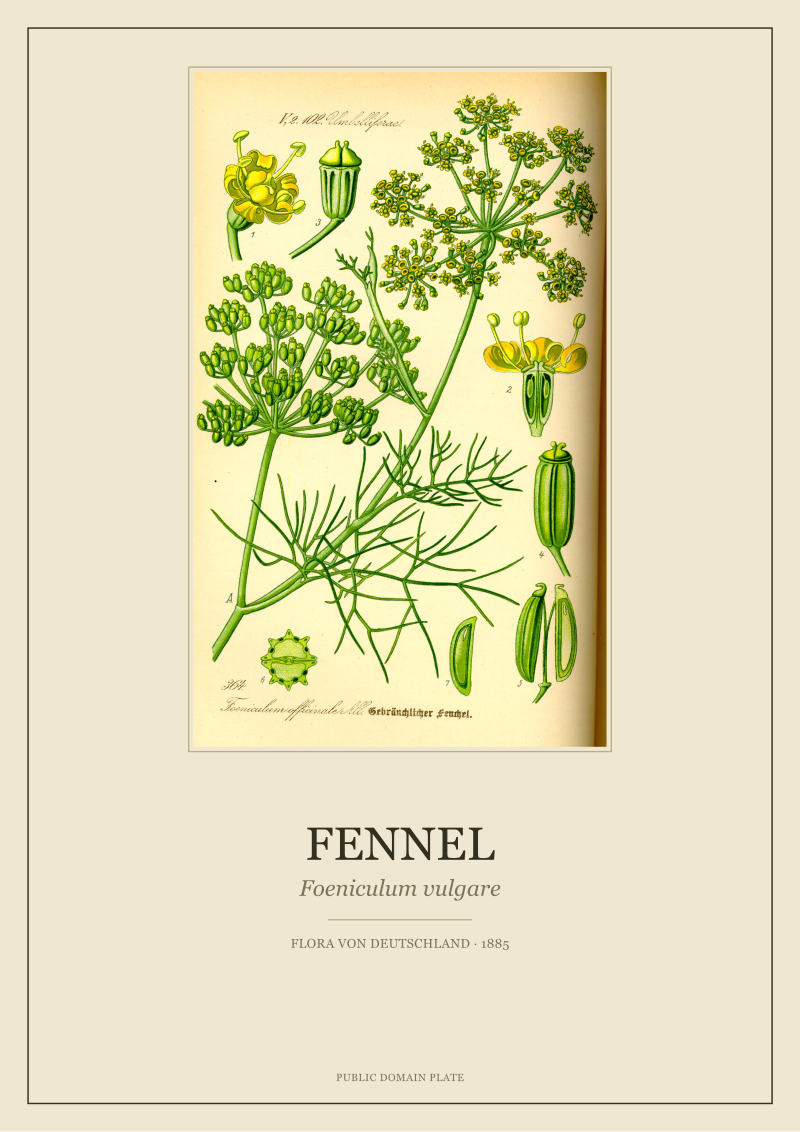
The Thomé plate — plate for *Foeniculum vulgare*, in the *Flora von Deutschland, Österreich und der Schweiz*, 1885 — is chromolithography. Stone by stone, colour by colour, key line by key line. The umbel is rendered in flat green with the ribbing carried by the outline. The stem is unshaded. The dissection details — the small isolated florets, the fruit halves — sit outside the main portrait, in the arrangement any 19th century flora reader would recognise as the diagnostic register. Nothing on the sheet is accidental. Every element served identification, and the choices survive as an argument about what mattered to a Central European botanist in 1885.
If Yes
If you are here for the plate, your first move is to stop treating the illustration as a picture of a real specimen and start treating it as a compiled diagram. Thomé's plates were not painted from a single fresh cutting. They composited what a well-formed fennel is *supposed to look like* according to the taxonomic consensus of 1885 — an idealised umbel above a dissection panel, colour keyed to a limited chromolithographic palette that skewed the greens cooler than living fennel actually is. This matters because when we restore the plate at our studio, the target is not "the fennel plant." The target is the printed object that appeared in a Central European classroom the year Karl Benz filed the Motorwagen patent. Any restoration that "corrects" the green toward field truth is quietly lying about what 1885 saw.
If No
If you are here for the plant, the plate is still your entry point — but you owe it a different question. Ask what Thomé chose to include. The full flowering umbel, the stalked leaves reduced to feathered outline, the fruit rendered twice (whole and split). Ask what he left out. No root system. No first-year rosette. No portrait of the wild coastal populations that never made it into a German school-flora because a German school-flora is, by design, an inventory of what a German-speaking schoolchild might reasonably meet in a Central European field. The Mediterranean fennel is in the book. It is not in the book *as* Mediterranean. That silent transposition is the entire subject of the second question.
Question 2: Is Your Mediterranean the Basin, or the Idea?
Fennel is documented across the Mediterranean basin — the coastal margins of Iberia, Italy, Greece, the Levant, North Africa, the Atlantic islands off the basin's western threshold. That is the geographical Mediterranean. It is also, separately, an idea: a climatic zone, a cuisine, a set of associations, a mood in a room. When somebody types "fennel botanical history mediterranean" into a search bar, they may mean either. The article that refuses to pick is the article that ends up describing neither.
The Thomé plate forces the question because Thomé did not draw a Mediterranean plant in a Mediterranean setting. He drew a naturalised, cultivated, and locally established fennel — a plant that had spread far enough north and been grown consistently enough in Central Europe to warrant a place in a flora of Germany, Austria and Switzerland. That is a fennel of the *idea* more than the *basin*. The specimen tradition Thomé worked in had been decoupling Mediterranean plants from Mediterranean latitude for at least three centuries at that point. What the plate documents is the successful editorial migration of a southern umbellifer into a northern reference book.
If Yes
If your Mediterranean is the basin — geography first — the Thomé plate is a secondary source. Primary would be the Italian, Iberian and Ottoman herbaria that catalogued fennel on its home ground. The plate is still useful, but as a reception document: how a Central European scientific culture absorbed and standardised a plant it had not evolved alongside. That reading places the 1885 illustration inside a longer story of botanical transplant literature, where "Mediterranean" species are re-drawn by hands that have never seen the plant in situ, and the drawing itself becomes the northern reader's Mediterranean. You are studying a filter, not a landscape.
If No
If your Mediterranean is the idea — the associative field, the cuisine, the aesthetic — the Thomé plate is oddly the *primary* source, precisely because it is not a photograph. A photograph of fennel in Puglia gives you a specific plant on a specific afternoon. A chromolithograph gives you the *type-image* — the version of fennel that a 19th century Central European learned to picture when the word was spoken, and that a great deal of subsequent European decorative use inherited without ever meeting the basin. The Thomé plate is one of the objects through which the fennel-as-idea entered northern European visual literacy. That is a real and traceable art-historical function, and it has nothing to do with cuisine.
 Fennel
The print from this article · from €29.95
View the print →
Fennel
The print from this article · from €29.95
View the print →
Question 3: Do You Want the Fennel of 1885, or the Fennel of Now?
This last fork is the one everyone skips, and skipping it is why most botanical writing collapses into either antiquarian nostalgia or presentist over-correction. The fennel of 1885 is the fennel of Thomé's plate: a plant known through a chromolithographic idiom, published for a schoolroom, priced for a middle-class household, printed on paper stocks that have since browned unevenly. The fennel of now is the fennel of high-resolution field photography, of DNA barcoding, of updated Apiaceae phylogenies, of a Mediterranean climate that has shifted measurably since the plate went to press. These are not competing truths. They are different registers.
The restoration decision at our studio depends entirely on which register the finished print serves. Restoring the plate as an 1885 object means preserving the paper tone the pigment sat inside, holding the chromolithographic colour envelope, and refusing to import contemporary botanical corrections. Restoring the plate as a contemporary botanical reference means the opposite: neutralising the paper, saturating the greens toward field truth, and effectively producing a modern illustration wearing 1885 clothes. Both are defensible. Only one is honest about which it is.
If Yes
If you want the fennel of 1885, the plate is the destination. You are looking at, and framing, a specific object printed in a specific year for a specific readership. The value proposition is temporal — you are hanging a slice of 19th century Central European scientific culture on a wall. Our studio's restoration in this mode is conservative: unify the paper tone across a scanned original, correct only the damage that photography would have suppressed anyway (fold shadows, bleed-through, foxing), leave the chromolithographic colour untouched. The finished print reads as what it is. A Mediterranean plant in a German book, still in the visual language of the German book. You can see one of these restored fennel plates in the studio's shop.
If No
If you want the fennel of now, the plate is a starting point and you are asking it to do something it was never built to do — represent living Mediterranean fennel to a 21st century eye. That project is legitimate, but it belongs to contemporary botanical illustrators working from field photography and modern taxonomic keys, not to restoration. When we are asked for the fennel of now, we redirect. Our practice is 1885 forward, not 2026 backward. This is not modesty. It is a working definition of restoration that refuses to smuggle contemporary aesthetics into a public-domain artefact and then pretend the artefact endorsed them.
If You Answered Everything: The Route Table
Eight answer combinations, eight one-sentence recommendations. Read your row. The context paragraph after the table explains what the pattern says about the field as a whole.
| Q1: Plate or Plant | Q2: Basin or Idea | Q3: 1885 or Now | Recommendation |
|---|---|---|---|
| Plate | Basin | 1885 | Read Thomé as a reception document; frame the print as a 19th century Central European artefact about a southern plant. |
| Plate | Basin | Now | Wrong fit — study modern Mediterranean herbaria instead; the 1885 plate is not the right primary source. |
| Plate | Idea | 1885 | Ideal case for a conservative restoration; the plate *is* the fennel-as-idea in northern European visual memory. |
| Plate | Idea | Now | Use the plate as a design reference only; commission a contemporary illustration for accuracy. |
| Plant | Basin | 1885 | Cross-reference Thomé with Italian and Iberian floras of the same decade; the plate is one voice among several. |
| Plant | Basin | Now | Skip the plate; go to current field botany, DNA-level phylogenies, and photographs from the basin itself. |
| Plant | Idea | 1885 | Read the plate as evidence of how the plant-as-idea was standardised in print, not as evidence of the plant itself. |
| Plant | Idea | Now | Recognise that "Mediterranean fennel" is largely a cultural construction; the plate contributed to building it. |
The pattern the table exposes is that only two of the eight combinations put the Thomé plate at the centre — Plate/Idea/1885 and Plate/Basin/1885. Every other combination pushes the reader toward a different primary source. This is the honest map. Most articles about "Mediterranean fennel botanical history" quietly claim to serve all eight cells, which is why they end up serving none. A public-domain plate from 1885 is a specific object with specific competences. Naming them is more useful than expanding them.
The next question, the one this piece deliberately does not answer, is how the *Foeniculum vulgare* type-image built by plates like Thomé's shaped the 20th century commercial iconography of Mediterranean cuisine — the packet fronts, the recipe-book borders, the tourist-board posters. That is a reception-history question about food branding, not a botanical illustration question, and it is where the real work on fennel-as-idea starts.
FAQ
Who was O.W. Thomé and why did his flora include a Mediterranean plant?
Otto Wilhelm Thomé was a German botanist whose *Flora von Deutschland, Österreich und der Schweiz* (published from 1885) became one of the most widely reproduced illustrated floras in Central Europe. It included fennel because fennel was well established in Central European cultivation and had naturalised widely enough to warrant a plate — a flora of a region documents plants the reader might actually encounter there, not only plants native to the region.
What is the plate technique used for the Thomé fennel illustration?
Chromolithography — colour lithographic printing built from multiple stones, one per colour, aligned so that the flat colour fields register cleanly against the printed key line. Fennel's chromolithographic rendering shows the signature of the technique clearly: unmodulated greens, outline-driven volume in the umbel, and the diagnostic dissection details placed in the flat register a botanical reader was trained to scan.
Is the Thomé fennel plate really in the public domain?
Yes. The *Flora von Deutschland, Österreich und der Schweiz* dates to 1885, which places the plates well outside any copyright term in every jurisdiction that recognises life-plus-70 or shorter. Public-domain status covers the original printed sheets. Individual modern scans and restorations may carry the labour claim of the institution or studio that produced them, but the underlying plate itself is free.
Why say "Mediterranean" fennel if the plate was printed in Germany?
Because the plant's centre of botanical gravity — its documented distribution, its long-standing cultural association, its likely origin story in the older European sources — is Mediterranean, not Central European. The Thomé plate documents fennel as it existed in the Central European scientific record in 1885, which is one waypoint in a much longer geographical journey. Calling the plant Mediterranean names the plant. Naming the plate as 1885 German names the object.
Does restoring an 1885 botanical plate change what it says about the plant?
It can. A restoration that neutralises the paper tone and pushes the greens toward field accuracy produces a modern-looking image dressed as 1885 — that is a stylistic decision, not a neutral one. A restoration that preserves the paper tone and holds the chromolithographic palette keeps the plate honest to its date, at the cost of visual "correctness" by contemporary eyes. Neither is wrong. The mistake is not stating which register the finished print serves.
Why don't botanical restorers just use modern photographs of fennel instead?
Because a modern photograph is a different object with a different job. It represents a specific plant on a specific day in a specific light. A 19th century chromolithograph represents a compiled type-image built to teach identification and to travel through classroom, library and household as a stable reference. The two documents answer different questions. Restoration protects the second; field photography produces the first.
Where does fennel appear in botanical illustration outside Thomé?
Fennel — *Foeniculum vulgare* — appears widely across the 18th and 19th century European illustrated floras and herbals, in both Central European and Mediterranean traditions. It is one of the recurring umbellifers in the printed record, alongside carrot, parsley and dill relatives. The Thomé plate is one entry in a long series. Its distinctiveness is the chromolithographic idiom and the schoolroom-flora context, not the choice of subject.
Is this plate suitable for a wall in a contemporary interior?
The 1885 Thomé fennel plate carries the visual traits that read well at wall scale — a clean umbel silhouette, a limited colour palette, a diagnostic layout that reads as composition rather than diagram. It sits comfortably alongside other umbellifers from the same era. What matters more than the plant is the restoration decision behind the print: a conservative 1885-forward restoration will hold its own against contemporary interiors precisely because it is not pretending to be contemporary.
New plates from the archive and 10% off your first print.
One email now with your code. No noise after.