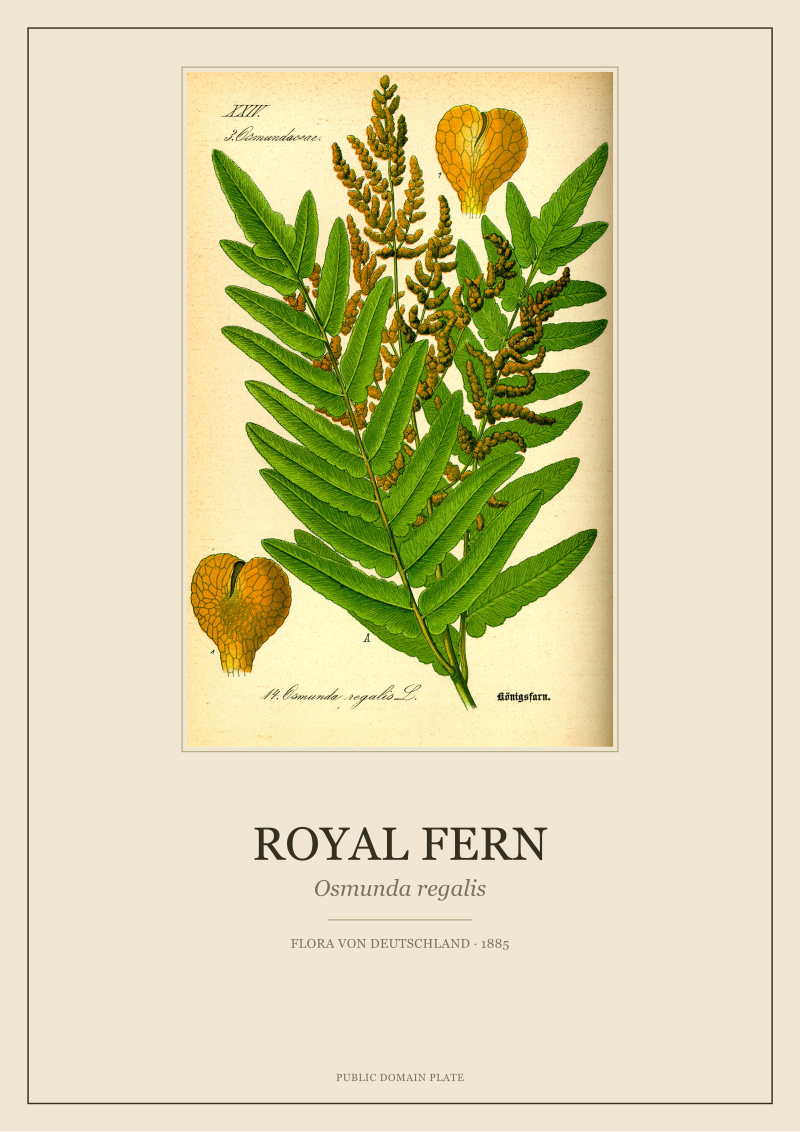
In 1885, Otto Wilhelm Thomé closed the last quires of Flora von Deutschland, Österreich und der Schweiz — the chamomile plate, the common ivy, the cornflower, the fennel among them — and shipped a schoolbook that would outlive its classroom. Pierre-Joseph Redouté had been dead forty-five years by then, and his roses were already the shorthand for botanical art in the popular mind. This piece is about the illustrators the shorthand skips: the ones whose line, colour and scientific patience shaped how we still look at plants. We restore Thomé's plates by hand and code, so we start from there and read outward.
How We Read a Century of Botanical Illustration
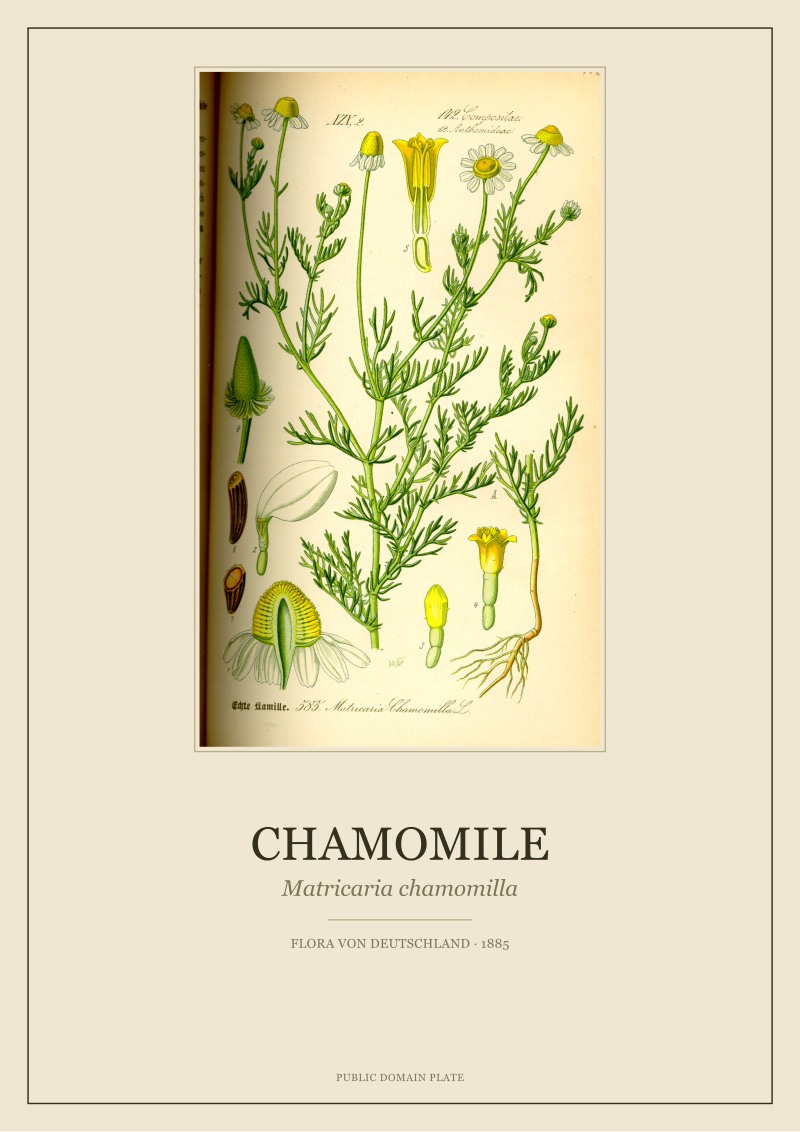
The desk method is unromantic. We start with a plate we have already restored — Matricaria chamomilla under Thomé's signature, say — and we ask what the drawing is actually doing. Is the ray floret sitting flat to the paper or lifting toward the eye? Is the dissection tucked beside the habit view or floating in white space? Is the root drawn as evidence or as decoration? Those choices are decisions with a lineage, and the lineage is the story of the artists this piece is about.
From there we widen. For each illustrator we look at three things and only three: the pictorial habit (how the plant sits on the page), the analytical habit (what the artist chose to dissect and label), and the print habit (whether the image was engraved, lithographed, or later chromolithographed, because the technique bends the image before it reaches the reader). We do not rank on beauty. We rank on how much of the plant a working botanist can still recover from the plate a hundred and fifty years later.
The limitation is honest. Our reading is biased toward European floras, because that is where our own plates sit — Thomé is a Central European book. Chinese, Persian, Mughal and Indigenous American botanical drawing traditions deserve their own desk, and this is not it. Where we say "the century of botanical illustration" we mean, loosely, the long window from Merian's late 17th century through Fitch's late 19th — the window Thomé's own plates close.
Finding #1: Maria Sibylla Merian, Where Entomology Enters the Frame
Merian arrived in Suriname in 1699, in her early fifties, with her daughter and no institutional backing, and came home with the drawings that would become Metamorphosis Insectorum Surinamensium in 1705. That plate book is the first thing to say about her, and the second thing is what it did to botanical illustration: it put the insect and its host plant on the same sheet, at every stage of the insect's life, and refused to separate them.
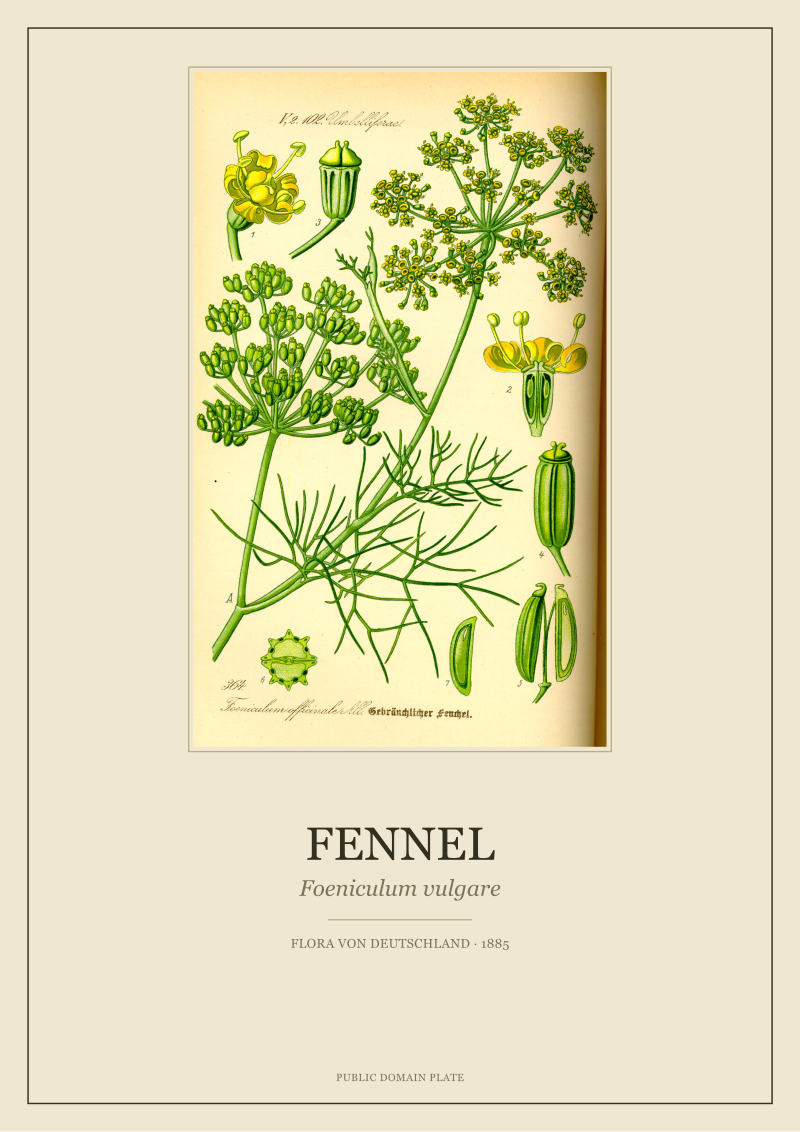
Before Merian, the plant plate and the insect plate were different genres, made by different artists, bound in different books. She insisted they were the same subject. Read Thomé's fennel — Foeniculum vulgare, 1885 — and notice how the umbel is drawn in isolation; the swallowtail caterpillar that lives on it is not there. That is a genre convention Merian argued with, and lost, and won again in the 20th century when field guides finally adopted her logic.
The technical marks of her hand: watercolour on vellum, prepared with a ground so the pigment sits without sinking; compositions built in curves that lead the eye from egg to larva to pupa to imago, with the plant as stage; a colour range that reads bright even now, because she painted from living specimens rather than dried. The Suriname work also carries an ethical weight she does not always get credited for — she recorded the names and uses of plants told to her by enslaved and Indigenous women, and she named them as her sources at a time when European natural history usually did not. That is a piece of the record worth keeping visible.
 Chamomile
The print from this article · from €29.95
View the print →
Chamomile
The print from this article · from €29.95
View the print →
Finding #2: Georg Dionysius Ehret and the Linnaean Line
If Merian's argument was between kingdoms, Ehret's was within one. Born in Heidelberg in 1708, he came into his own in the 1730s and 1740s alongside Carl Linnaeus, and the collaboration produced the visual grammar of the sexual system of plants — the diagram that lets you look at a flower and count stamens and pistils and sort the plant into class and order.
Ehret drew that diagram. The 1736 plate showing the classes of Linnaeus's system, with its neat rows of floral organs cut away and numbered, is the piece of botanical illustration that made Linnaean taxonomy legible to anyone with eyes. It is also the reason later plates — Thomé's included — carry a dissection panel beside the habit view. That convention is Ehret's, and once you notice it, you see it everywhere in the 19th century.
His single-plant plates carry the same discipline. A magnolia or a passiflora by Ehret is a habit view with the diagnostic parts pulled out and enlarged in the margins — a stamen shown at three angles, a seed opened, a leaf sectioned. He drew for engraving, which meant thinking in line before colour, and he understood that a plate had to survive being printed in black ink and then hand-coloured by a different worker without losing its evidence. That discipline is what separates a botanical illustration from a flower painting, and Ehret is the one who codified it for the century that followed.
Finding #3: Franz and Ferdinand Bauer, the Draftsmen Behind the Botanists
The Bauer brothers, born in Feldsberg in the late 1750s, are the illustrators most working botanists will name first when asked who the best ever was. Franz stayed put — he was resident botanical artist at Kew from 1790 until his death in 1840, and he drew what came through the glasshouses. Ferdinand travelled. He went to the Levant with John Sibthorp for the Flora Graeca in the late 1780s, then to Australia with Matthew Flinders on the Investigator in 1801, and he brought back drawings that took decades to publish.
Their working method is the thing to steal. In the field Ferdinand made pencil sketches keyed to a numbered colour chart — he wrote a number, not a colour name, beside every part of the plant. Back in London or Vienna, months or years later, he mixed pigment to match the number and painted. The results are watercolours that read as if painted from a living specimen when they were painted from memory and code. It is one of the earliest working systems for what we would now call colour reproduction across time and distance, and it worked.
Franz's Kew plates are quieter and more forensic. He was interested in the microscope, and some of his best sheets are cross-sections and cellular studies made from specimens that had never before been drawn at that magnification. He was also patient in a way that is hard to imagine now: some of his plates for the Delineations of Exotick Plants took him five years each. The Bauers are the argument for treating botanical illustration as a discipline that rewards obsession.
 Fennel
The print from this article · from €29.95
View the print →
Fennel
The print from this article · from €29.95
View the print →
Finding #4: Walter Hood Fitch and the Century of Kew
Fitch is the volume answer. Scottish, born in Glasgow in 1817, he was hired by William Hooker as a teenage assistant and became the principal artist for Curtis's Botanical Magazine — the longest-running botanical periodical in the world — for something like forty years. The number usually cited for his output across all publications is around ten thousand drawings. Whatever the exact figure, no single hand shaped what Victorian readers thought a botanical plate looked like more than his.
His plates are the maturation of the lithographic era. Where Ehret drew for the engraver and Merian painted for the copper plate, Fitch drew directly onto stone, which cut a step out of the reproduction chain and let his line survive to the reader without an intermediary. That directness is why his plates feel confident even when the subject is difficult — a rhododendron in three-quarter view, a cycad cone half-open, a fern frond rendered as a single unbroken gesture across the sheet.
The craft carries into Thomé's generation. By 1885, chromolithography had industrialised what Fitch had done by hand, and the Flora von Deutschland plates come out of that industrialised tradition — colour laid down in registered stones, one for each pigment, the illustrator now working through a technical chain rather than at the stone itself. When we restore a Thomé chamomile, we are undoing damage from that chain as much as from time. Fitch is the last figure in the century where the artist's hand and the printed plate were still nearly the same thing.
The Illustrators at a Glance
| Illustrator | Working window | Signature contribution | Print technique | Where to look first |
|---|---|---|---|---|
| Maria Sibylla Merian | Late 17th–early 18th c. | Plant and insect on the same plate, life stages together | Copper engraving, hand-coloured | Metamorphosis Insectorum Surinamensium (1705) |
| Georg Dionysius Ehret | Early–mid 18th c. | Codified the dissection panel and Linnaean diagram | Copper engraving, hand-coloured | Plantae Selectae; Linnaean plates from the 1730s |
| Ferdinand Bauer | Late 18th–early 19th c. | Numbered colour-code field system; expedition plates | Copper engraving, hand-coloured | Flora Graeca; Illustrationes Florae Novae Hollandiae |
| Franz Bauer | Late 18th–mid 19th c. | Microscope-grade cellular and cross-section work | Copper engraving, hand-coloured | Delineations of Exotick Plants (Kew) |
| Walter Hood Fitch | Mid–late 19th c. | Direct drawing onto stone; ten thousand plates | Lithography, later hand-coloured | Curtis's Botanical Magazine |
| Otto Wilhelm Thomé | Late 19th c. | Schoolbook flora that became wall art | Chromolithography | Flora von Deutschland (1885) — some plates restored at Botanic Walls |
What This Piece Does Not Do
This is a European reading, and the frame shows. It leaves out the great Chinese materia medica tradition, the Mughal and Persian court florilegia, the Codex Cruz-Badianus and other Indigenous American plant books, and the Japanese honzōgaku painters — each of which is a separate desk we are not qualified to run. It also leaves out the 20th century almost entirely, which means no Margaret Mee on Amazonian bromeliads, no Rory McEwen on tulips, no Anne Ophelia Dowden on North American wildflowers, and no living illustrators. Those absences are choices, not judgments.
We have also stayed narrow inside the artists we did cover. Merian's Nuremberg years, Ehret's late London workshop, the full posthumous publication history of the Bauer Australian material, and Fitch's disputes with the Hookers over pay and credit are all real and interesting, and none of them are here. If any of these threads matters for what you are trying to make or hang or know, treat this piece as an index card, not a bibliography.
The Takeaway
The illustrators worth knowing after Redouté are the ones who taught the plate to think — Merian across kingdoms, Ehret through the diagram, the Bauers through the field, Fitch through volume. Their choices are still on the wall.
FAQ
Why is Redouté so much more famous than the illustrators in this piece?
Redouté had a court, a subject and a technique in perfect alignment: French empresses, roses and lilies, and stipple engraving that reproduces cleanly at any scale. The result was a body of work built for reproduction and gift-giving. The illustrators covered here worked mostly inside scientific publishing, so their images travelled through botany books and periodicals rather than as standalone prints — which meant fewer poster shops and calendars carried their names into the 20th century.
Was Maria Sibylla Merian actually a scientist, or an artist who painted nature?
Both, and the distinction is largely a later invention. The Metamorphosis Insectorum Surinamensium is a work of observational entomology as well as illustration — she recorded life cycles that European science had not documented and named host plants correctly. Modern historians of science treat her as a working naturalist whose primary output happened to be pictorial. The 17th century did not force the choice.
Which illustrator's plates are still the reference standard for botanists today?
Ferdinand Bauer's Flora Graeca watercolours and Franz Bauer's Kew studies are still consulted for identification, particularly for taxa where the type specimen is damaged or lost. Fitch's Curtis's Botanical Magazine plates remain in active citation because the magazine is still being published. Ehret's plates are more historical reference than working tool, though his Linnaean diagrams are still reproduced in taxonomy textbooks.
Why did chromolithography make botanical illustration decline artistically?
It did not make it decline, but it did change the labour. Chromolithography let publishers issue colour plates at industrial scale, which meant the artist increasingly handed off drawings to a chain of specialist lithographers who separated the colours onto multiple stones. The plate you received was a translation of a translation. Some late 19th-century floras — Thomé's included — are magnificent within that constraint; others are visibly weaker than the hand-coloured engravings that preceded them.
Are original prints by these illustrators still affordable to buy?
It varies enormously. A single loose plate from Curtis's Botanical Magazine in Fitch's era is often obtainable in the low hundreds of euros in average condition. Merian original plates from the 1705 Suriname book are museum-tier and priced accordingly when they come up at all. Ehret and Bauer originals sit between those poles depending on subject and provenance. Restored high-resolution reproductions from the same public-domain source material are a separate market and much more accessible.
Do these illustrators' works still influence how field guides are drawn today?
Directly. The convention of habit view plus enlarged diagnostic parts on the same page is Ehret's. The convention of showing plant and associated insect together is Merian's. The convention of a field-portable colour-key system is the Bauers'. The convention of the working illustrator embedded in a scientific institution and producing thousands of consistent plates over decades is Fitch's. Modern field guides inherit all four, usually without naming the source.
Where does Thomé fit in this lineage?
Thomé is the schoolbook end of the tradition. Flora von Deutschland, Österreich und der Schweiz was written and illustrated to teach German-speaking students their national flora, not to advance botanical science. But the plates inherit Ehret's dissection discipline, Fitch's lithographic confidence and the general 19th-century assumption that a plant deserves both a habit view and analytical detail. That is why Thomé's 1885 plates still hold up as wall art — they were made inside a mature tradition, at the point where it had learned everything the earlier illustrators had to teach.
From the collection
New plates from the archive and 10% off your first print.
One email now with your code. No noise after.